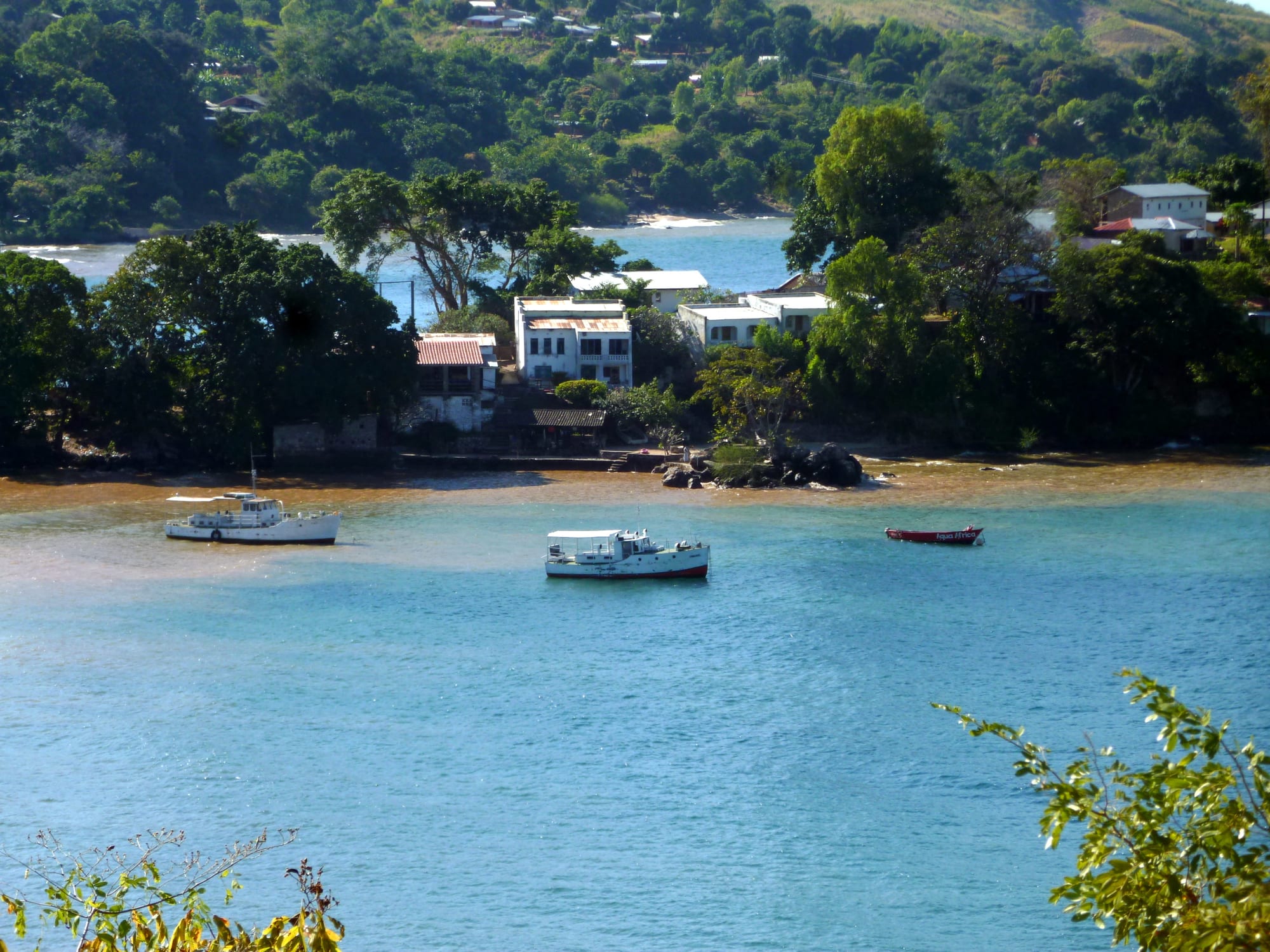
A sheltered blue bay with three small boats at anchor, houses and trees on the wooded headland behind

Mzuzu & the Northern Region, Malawi

Nkhata Bay

The sheltered bay at Nkhata Bay on the north-western shore of Lake Malawi. (Avi Alpert / Wikimedia Commons · CC BY-SA 2.0)

A lakeside town on the north-western shore of Lake Malawi, built around a deep, wooded bay where steep green hills drop straight into clear water. It is the headquarters of Nkhata Bay District, a Tonga fishing and cassava-growing area, a call on the lake ferry route, and the northern shore's main base for snorkelling among the lake's cichlids.

Neighbourhoods

  • The harbour and town centre
    • First-time visitors
    • Markets
    • Close to transport

    The working heart of the town, where the road down from the escarpment reaches the water. The market, shops, bus stage, fish landing and the pier used by the lake ferry are all within a few minutes' walk of each other, and the streets are busiest in the early morning and at dusk.

    Open in Maps
  • The southern shore
    • Beaches
    • Swimming
    • Quiet

    The stretch of sand and rock south of the bay, reached by a short walk or minibus ride from the centre. This is where most of the town's swimming happens, on a shallow beach backed by trees, with rocky points at either end that are good for snorkelling.

    Open in Maps
  • The bay's northern headlands
    • Views
    • Quiet and residential
    • Snorkelling

    Steep, wooded slopes north of the harbour, where paths run between houses and small coves. Most of the town's lakeside lodges sit along here on rocky ground above the water, and the views back across the bay are the best in town.

    Open in Maps

Things to do

The lake and the beaches

  • The beaches south of the baybeach

    The town's main swimming beaches, a short way south of the harbour, with shallow water, shade trees and rocky headlands at each end.

    Open in Maps
  • The rocky coves of the bayattraction

    Granite points and boulder shores around the bay hold dense populations of small, brightly coloured cichlids, and are the reason snorkellers and diving schools come here.

    Open in Maps
  • Boat trips on the lakeattraction

    Local operators run kayaks, snorkelling boats and sunset trips from the beaches, and fishermen's plank boats cross to villages along the shore that no road reaches.

    Open in Maps

The town

  • Nkhata Bay marketmarket

    A street market above the water selling dried and fresh lake fish, cassava, tomatoes and second-hand clothes, at its fullest in the late afternoon.

    Open in Maps
  • The ferry pier and fish landingtransit hub

    The concrete pier where the lake steamer ties up and cargo is loaded by hand, beside the beach where fishing boats land usipa and chambo each morning.

    Open in Maps

Short trips from the town

  • Chinthechebeach

    A lakeshore settlement of long sandy beaches and fishing villages, calmer and flatter than the rocky bay to the north, where the Lake of Stars music festival was held from 2004 to 2007.

    Open in Maps
  • Mzuzuattraction

    The Northern Region's capital and Malawi's third largest city, up on the plateau, with Mzuzu University and the coffee trade.

    Open in Maps

Seasonal events

  • Independence DayJuly

    Malawi's national day on 6 July, marked with school parades, football matches and music in the town.

Eat and drink

Long-standing places and food districts in Nkhata Bay. Hours, ratings and directions come from your maps app, always current.

Nkhata Bay classics

  • Grilled chambo and usiparestaurant

    The lake's tilapia, grilled whole over charcoal, and the tiny sardine-like usipa fried crisp, served with nsima or chips at simple eateries near the harbour.

    Open in Maps
  • Kondowolerestaurant

    The stiff, stretchy cassava-flour staple of this cassava-growing district, eaten with fish and a leaf relish, and much more common here than maize nsima.

    Open in Maps

Markets and food streets

  • The market and roadside stallsmarket

    Dried fish, cassava, groundnuts, bananas and mangoes sold from stalls and mats, with women frying dough and roasting maize along the road down to the water.

    Open in Maps
  • The lakeside lodge kitchensneighborhood

    The cluster of lodges on the headlands north of the bay cook fish, curries and Malawian dishes for guests and passers-by, usually on terraces above the water.

    Open in Maps

Experience Nkhata Bay

History

The bay's shelter and deep water made it a landing place long before it was a town. The Tonga, who farm and fish along this stretch of shore, were raided in the nineteenth century from the north and west, and the arrival of the Free Church of Scotland mission on the escarpment at Livingstonia in 1894, and of British administration after the Nyasaland protectorate was declared in 1891, brought schools, a boma and a port to the lakeside villages below.

Nkhata Bay became the northern shore's harbour. Lake steamers called at the pier with cargo and passengers when there was no useful road, rubber, timber and other produce from the district went out by water, and the town grew as the district's administrative centre. In March 1959, during the state of emergency declared across Nyasaland on 3 March after opposition to the Central African Federation, colonial forces opened fire on a crowd at Nkhata Bay and a number of people were killed; 51 people died across the protectorate during the emergency and the weeks around it, and the Nkhata Bay killings are long remembered in northern Malawi.

After independence in 1964 the town remained a district headquarters and a ferry stop, and from the 1980s it acquired a second life as a travellers' halt: the rocky coves proved to be an unusually cheap and easy place to snorkel and dive among the lake's cichlids, and a line of small lodges grew along the headlands. Its fortunes since have followed the road to Mzuzu, the fishing and the ferry, and the wider ups and downs of Malawi's economy.

Culture & Customs

Nkhata Bay is the centre of Tonga country, a lakeshore people counted as part of the wider Tumbuka group and speaking Chitonga, a dialect of Chitumbuka, with a long tradition of fishing, cassava farming and labour migration. Families here have sent workers to the mines and cities of southern Africa for generations, and money and ideas returning from abroad have shaped the town as much as the lake has.

Church life is strong, as it is across the north, with Presbyterian congregations tracing back to the Livingstonia mission alongside Catholic, Anglican and Pentecostal churches; Sunday singing carries across the water. Funerals and chiefs' ceremonies draw whole villages, and drumming and dance — including the Tumbuka vimbuza tradition of the wider region — mark the big occasions.

The town also has an easy, mixed social life that comes from decades of visitors. Reggae and Malawian pop play from bars on the hill, wood carvers and painters sell from stalls along the road, and lodge staff, boat crews and dive guides are often young people from the district itself. Manners are unhurried: greetings come before business, elders are addressed first, and bargaining in the market is polite and good-humoured rather than sharp.

Daily Life

About 14,000 people lived in the town at the 2018 census, and it serves a district of about 165,000 spread along the shore and up into the hills. The day begins on the water, with boats landing usipa and chambo at first light and women carrying fish up to the drying racks and the market. Cassava is the staple crop on the thin lakeside soils, along with bananas, mangoes and maize where the land allows, and rubber, macadamia, sugar and rice are grown on plantations around the town.

The other economies are the harbour and the visitors. The pier handles cargo and ferry passengers, and the lodges, dive schools, boat crews and craft stalls give steady work to a town with few other employers. Government offices, the district hospital and schools fill out the formal jobs; most people work for themselves, trading, fishing, farming or carrying.

Life is shaped by things beyond the town's control: fuel and foreign-exchange shortages that make transport dear and erratic, a kwacha that has lost value repeatedly, and the condition of the escarpment road to Mzuzu, which everything depends on. Electricity and water supplies are intermittent, bicycle taxis do the work buses would do elsewhere, and many young people leave for Mzuzu, Lilongwe or South Africa, sending money home.

Food

Fish and cassava define eating here more than anywhere else in Malawi. Usipa, the lake's small sardine-like fish, is fried fresh the morning it is landed or sun-dried on racks along the shore and sold by the cupful; chambo, the prized tilapia, is grilled whole over charcoal; and larger catches such as kampango, the big lake catfish, appear in season.

The staple that goes with them is kondowole, a stiff, stretchy porridge made from cassava flour rather than the maize nsima eaten in most of the country — a northern lakeshore dish that surprises Malawians from elsewhere. It is torn by hand and dipped into fish or a relish, or ndiwo, of beans, pumpkin leaves or greens in groundnut sauce. Cassava itself is also boiled, roasted at the roadside or pounded, and bananas, mangoes and sugar cane grow in the gardens above the bay.

Street food is simple and cheap: mandasi, small fried dough buns, sold warm in the morning; roasted maize; chips with fried fish; and samosas near the bus stage. Lodge kitchens on the headlands add curries, pizzas and banana bread for travellers. To drink there is thobwa, a lightly fermented maize or millet drink, strong sweet tea, chibuku sorghum beer in the bars, and Malawian lager and gin; coffee, when it appears, usually comes from the smallholders' cooperative around Mzuzu.

Planning tools

Budget

One of the cheapest places to stay on Lake Malawi. Beds in lakeside backpacker lodges, fish and nsima in the town, and minibuses to Mzuzu cost very little; snorkelling and diving courses, chartered boats and a ferry cabin are the main extras. Almost everything is paid for in cash, and the ATMs in town cannot always be relied on.

Daily Budget Midrange
USD 70–180 (a lakeside chalet, restaurant meals, a boat or diving trip, transfers)
Daily Budget Shoestring
USD 20–40 (backpacker lodge bed or camping, local food, minibuses)

Bring enough kwacha from Mzuzu for the whole stay, and carry some US dollars in cash as a reserve.

Best Time to Visit

May to October, the dry season, when the roads are firm, the water is clear and boats run reliably. October and November are very hot on the lakeshore. The rains from December to March bring green hills, heavy downpours and cloudier water near the river mouths, but the lake stays warm enough to swim in all year.

Suggested Number of Days

Two or three days suit most visits, which is enough for the beaches, the water and the market at an unhurried pace. Allow four or five with trips along the lakeshore or a crossing to the islands. Divers taking a course and travellers waiting on the ferry need longer.

First Visit
2–3 days
With Surroundings
4–5 days

Transportation

The town is small enough to cross on foot, and bicycle taxis carry people and luggage up its steep hills for a few coins. Minibuses and shared pickups leave from the bus stage for Mzuzu and along the lakeshore road, filling up before they go rather than running to a timetable. Boats are the other way to move: the lake ferry links the lakeshore towns and the islands, and small local boats serve shore villages with no road.

Ask at the pier about the ferry's current running before building plans around it, and agree a price with a bicycle taxi or boatman first.

Airport & Station Connections

Most arrivals are by road from Mzuzu, about 40 km away over the escarpment, an hour or so by minibus; Mzuzu is several hours north of Lilongwe on the M1. The lakeshore road continues south past Chintheche towards Nkhotakota and the Central Region. The other route is the lake ferry, which calls at the town's pier on its way between the southern lakeshore, Likoma Island and Chilumba in the north.

Walkability

The centre is compact and walkable, though the ground is steep: the road drops sharply from the escarpment to the bay and the lodges sit above the water on rocky paths and stairs. The beaches south of the bay are a walk of twenty minutes or so from the market. There are few pavements and little street lighting, so walks after dark are usually made by bicycle taxi.

Safety

The town is relaxed and crime against visitors is mostly opportunistic — theft from beach chalets, unattended bags and parked vehicles. The greater risks are in the water and on the road: sudden squalls blow up on the lake, the shoreline shelves steeply, malaria is present at lake level, and the lakeshore and escarpment roads are poor and best not driven at night.

Use guides on remote walks, don't walk after dark, lock valuables away, take malaria prophylaxis, and treat bilharzia and sudden lake squalls as real risks. Check current official travel advice before travelling.

Climate

Hot and humid at lake level, with a single rainy season. Temperatures vary less than the rainfall does, and the lake keeps nights milder than on the plateau above. Being in the southern hemisphere, the warmest months are from November to March.

Summer
hot and wet, November–March; days often above 30°C, high humidity, heavy afternoon and night rain, and warm lake water
Winter
dry and clear, May–August; warm days around 25°C, cooler nights, light winds and the clearest water of the year

Local Customs

This is Tonga country, and Chitonga is heard alongside Chitumbuka, Chichewa and English. Greetings matter: a handshake and a few words before any request are expected, and elders are greeted first. Churches are full on Sundays and the town is quiet in the morning. Modest dress away from the beach is appreciated, and swimwear stays on the beach rather than in the market.

Ask before photographing people, fishermen or the market; tipping is not obligatory but small amounts are welcome for guides, boatmen and lodge staff.

Common Payment Methods

The currency is the Malawian kwacha, and cash runs the town: the market, minibuses, bicycle taxis and boatmen take nothing else. A bank and ATMs are in the centre but can be out of cash or offline, so most travellers draw money in Mzuzu. Lodges and dive schools may accept cards or US dollars, but this should not be assumed.