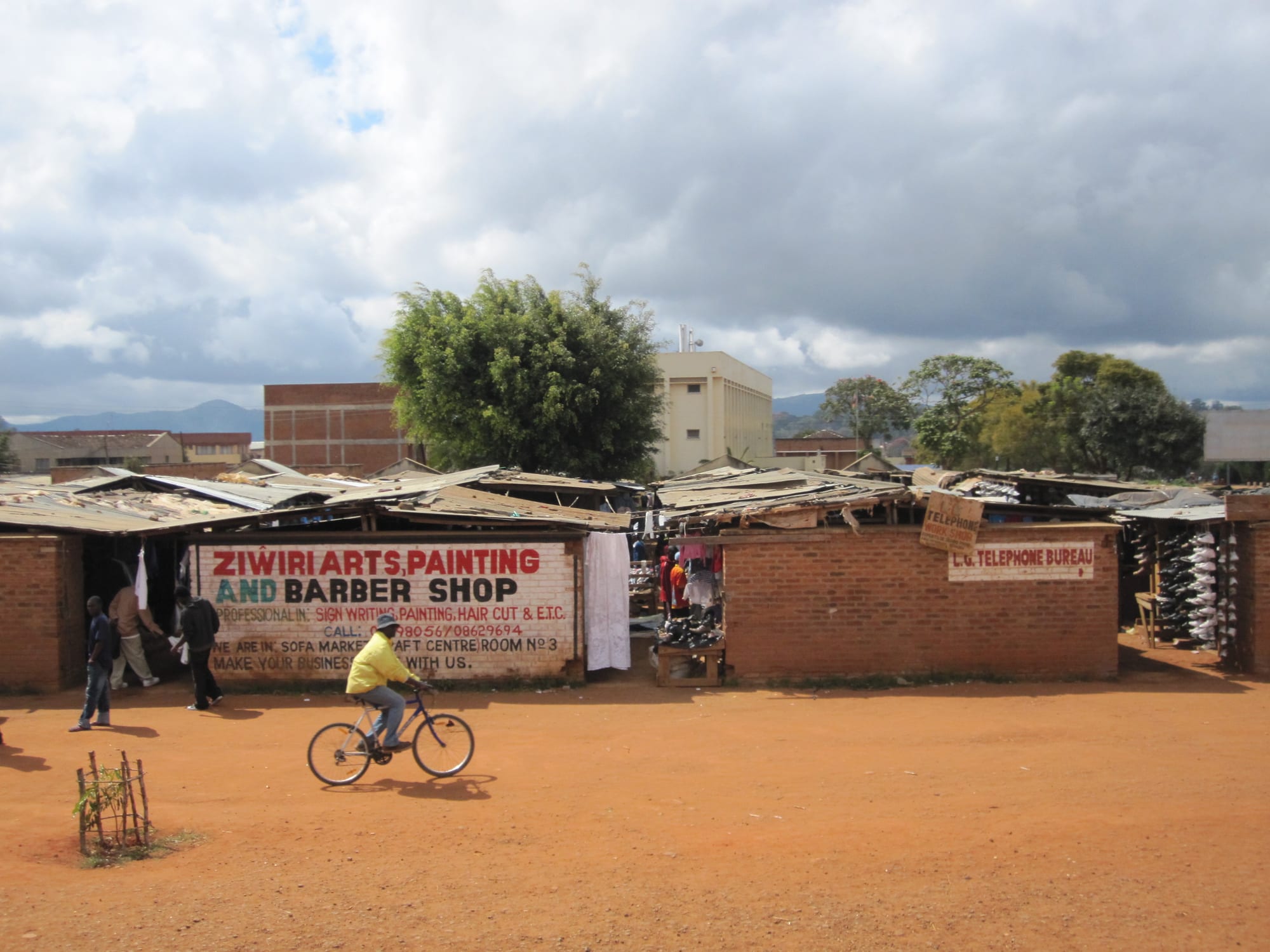
A row of brick market stalls with corrugated roofs on red earth, a cyclist passing and hills behind

Mzuzu & the Northern Region, Malawi

Mzuzu

Shops and workshops on the red earth of Mzuzu. (Le Grand Portage / Wikimedia Commons · CC BY 2.0)

The capital of Malawi's Northern Region and the largest city in the north, standing at about 1,250 metres on the highlands above Lake Malawi. A late creation that grew from a small colonial settlement into a junction of the roads north, south and east, it is the region's market, university and coffee town and the place travellers pass through on the way to the lake, Nyika and the escarpment.

Neighbourhoods

  • The city centre
    • First-time visitors
    • Markets
    • Close to transport

    A compact grid of shops, banks, offices and hotels around the main roundabout, with the market and the bus depot a short walk away. Everything practical in the north — banks, supermarkets, mobile-money agents, buses — is found here, and it is busiest in the morning.

    Open in Maps
  • Katoto and the northern suburbs
    • Quiet and residential
    • Long stays

    Leafy, low-rise residential streets on the edge of the centre, laid out with gardens and jacarandas around schools, churches and guesthouses. Government houses and aid-agency offices are concentrated here, and it is quieter and cooler than the market end of town.

    Open in Maps
  • Luwinga and the university side
    • Students and nightlife
    • Local life

    The district towards Mzuzu University, with student housing, small bars and restaurants, hardware shops and roadside stalls. Life here follows the academic year, and the road out of it climbs towards the Viphya highlands.

    Open in Maps
  • Chibavi and the eastern townships
    • Local life
    • Markets

    Dense residential neighbourhoods of brick houses, churches, football grounds and small shops where most of the city's population lives. Trading happens on street corners and at local markets rather than in the centre, and minibuses run in from early morning.

    Open in Maps

Things to do

In the city

  • Mzuzu Museummuseum

    A small regional museum, opened in 1986, with objects and displays from the cultures of northern Malawi.

    Open in Maps
  • Mzuzu marketmarket

    The city's main market, a sprawl of stalls selling vegetables, dried fish, cassava, second-hand clothes, tinware and carvings, and the busiest trading place in town.

    Open in Maps
  • The city's coffee tradeattraction

    Mzuzu is the centre of Malawi's coffee trade, and the smallholder growers' cooperative based in the city hulls, processes and exports beans from the northern hills, and they are sold and drunk in cafés around the centre.

    Open in Maps

Campuses and institutions

  • Mzuzu Universityattraction

    A public university founded in 1997, which took its first students two years later, on the edge of the city; its campus, library and students give Mzuzu much of its character.

    Open in Maps

Short trips from the city

  • Nkhata Bayattraction

    The lakeside town on its wooded bay, the northern shore's base for swimming, snorkelling among cichlids and the lake ferry.

    Open in Maps
  • Vwaza Marsh Wildlife Reservepark

    Woodland and wetland around Lake Kazuni, where hippos and elephants come to the water and the birdlife is rich.

    Open in Maps
  • Nyika National Parkpark

    A high rolling grassland plateau above 2,000 metres with roan antelope, eland, zebra and wildflowers in the rains.

    Open in Maps

Seasonal events

  • Independence DayJuly

    Malawi's national day on 6 July, marked with parades, school displays and football at the city stadium.

  • Mzuzu University graduationusually the dry season

    The university's graduation fills the city with families from across the north, and hotels and restaurants are at their busiest.

  • Christmas and New YearDecember and January

    The period when northerners working in Lilongwe, Blantyre and South Africa come home, filling churches, bars and the bus depot.

Eat and drink

Long-standing places and food districts in Mzuzu. Hours, ratings and directions come from your maps app, always current.

Mzuzu classics

  • Nsima with ndiworestaurant

    The maize staple with a relish of beans, pumpkin leaves, greens in groundnut sauce or stewed meat, served at canteens around the centre and the market.

    Open in Maps
  • Grilled chambo and usiparestaurant

    Lake fish brought up from Nkhata Bay — tilapia grilled whole, and the tiny dried usipa fried crisp — eaten with nsima or chips.

    Open in Maps
  • Mzuzu coffeecafe

    Coffee grown by smallholders in the hills around the city, roasted locally and served in cafés in the centre; the north is Malawi's coffee country.

    Open in Maps

Markets and food streets

  • Mzuzu marketmarket

    Vegetables, dried fish, cassava, groundnuts, bananas and sacks of maize, with women frying mandasi and roasting maize along its edges.

    Open in Maps
  • The bus depot food stallsneighborhood

    Rice and beans, chips, samosas, boiled eggs and roasted maize sold to travellers waiting for minibuses to the lake, Rumphi and Lilongwe.

    Open in Maps

Experience Mzuzu

History

Mzuzu is a young city on old ground. The plateau above the lake was Tumbuka country long before the town existed, and the Ngoni settled the Mzimba highlands to the south-west in the nineteenth century. The mission at Livingstonia and its schools shaped the whole region's education, but the site of Mzuzu itself carried nothing more than scattered villages until the colonial period.

The town grew up around a road junction, where the routes to the lake, to Karonga and to Lilongwe met, and the settlement that formed there acquired workshops, offices and a market. That junction made it. As the Northern Region's administration was built up, Mzuzu became the natural place for it, and after independence in 1964 it grew quickly as the region's headquarters, market and staging post.

Mzuzu is now the third largest city in Malawi by population, after Lilongwe and Blantyre, and has grown quickly, drawing people from Mzimba, Rumphi, Nkhata Bay and Karonga. The founding of Mzuzu University in 1997, which admitted its first students two years later, gave it a second role as the north's centre of higher education. Its modern history has been one of steady expansion under difficult conditions: tarmac stops at the city's edge in places, and its fortunes track the state of the M1, the coffee price and the national economy.

Culture & Customs

Mzuzu is the cultural capital of the north in the plain sense that everyone from the north passes through it. Chitumbuka is heard everywhere and is a point of pride: it was removed from schools and broadcasting under Hastings Banda's one-language policy and returned with multiparty politics in 1994, and the city's radio, churches and market talk in it daily. Ngoni from Mzimba, Tonga from the lakeshore and Ngonde from Karonga all have communities here.

Church life is strong and publicly visible, with the Presbyterian tradition of Livingstonia alongside Catholic, Anglican and Pentecostal congregations; choirs practise in the evenings and Sunday clothes are worn with care. Vimbuza, the Tumbuka healing dance recognised by UNESCO, belongs to the surrounding villages rather than the city centre, but drumming and dance mark weddings, funerals and chiefs' ceremonies here too.

The university gives the city a student culture of debate, music and football that few other Malawian towns have outside the capital. Northerners have a long reputation in Malawi for schooling and for working away from home, and Mzuzu families are used to relatives in Lilongwe, Blantyre and South Africa. Manners are formal and unhurried: greetings first, titles used, and business conducted politely and at length.

Daily Life

About 220,000 people lived in Mzuzu at the 2018 census, making it Malawi's third largest city and by far the largest place in the north. Most live in dense residential townships on the city's edges and walk or take minibuses to the centre and the market. The day starts early, with produce arriving from Mzimba and the lakeshore before dawn, and slows sharply after dark.

The economy is trade, services and government: the market and shops, banks, the regional hospital, schools, the university, aid and church organisations, and the transport business built on the bus depot. Coffee from the surrounding hills is bought, processed and exported through the city, tobacco and timber from the Viphya plantations pass through, and small workshops make furniture, tinware and building materials.

Daily life is shaped by shortages that are national rather than local: fuel queues, foreign-exchange scarcity that empties shop shelves of imports, power cuts that send small businesses onto generators, and a kwacha that keeps losing value. Water and electricity supplies are uneven in the townships. Many young people leave to study or work elsewhere, and the money they send back is a visible part of the city's income.

Food

Mzuzu eats the food of the northern highlands. Nsima, the stiff maize porridge, is the staple, eaten by hand with ndiwo, a relish of beans, pumpkin or cassava leaves, greens in groundnut sauce, or a little meat. Cassava comes up from the lakeshore districts, and kondowole, the stretchy cassava-flour version of nsima eaten with fish, appears in households with roots at Nkhata Bay.

Fish is the treat: chambo tilapia and the small dried usipa are carried up the escarpment from the lake each day and sold in the market and cooked at canteens around town. Rice from the Karonga plain, beans, sweet potatoes, pumpkins and Irish potatoes from the cool highlands fill out meals, and roadside sellers offer roasted maize, boiled cassava, mandasi dough buns, samosas and chips throughout the day.

The city's own product is coffee. Smallholders in the hills around Mzuzu and in the Misuku hills further north grow coffee that is processed and marketed through the city, and it appears in cafés in the centre alongside strong sweet tea, which remains the everyday drink. Thobwa, the lightly fermented maize or millet drink, is sold in the market; chibuku sorghum beer is drunk in the townships; and bottled lager, Malawian gin and imported soft drinks fill the bars around the centre.

Planning tools

Budget

Mzuzu is inexpensive and is the north's best place to spend money usefully: guesthouses, canteens and minibuses cost little, and it is the last reliable place to draw cash, buy supplies and fill a fuel tank before Nyika, Livingstonia or Karonga. Hiring a 4x4 with a driver for the reserves is the one large expense.

Daily Budget Midrange
USD 70–180 (a hotel room, restaurant meals, a hired 4x4 for Nyika and Vwaza, park fees)
Daily Budget Shoestring
USD 20–40 (guesthouse or backpacker room, canteen meals, minibuses)

Draw kwacha and buy fuel here rather than further north, and keep some US dollars in cash in reserve.

Best Time to Visit

May to October, the dry season, when roads into Nyika, Vwaza and up the escarpment are passable and the plateau air is clear and cool. September and October are hot and hazy. The rains from December to March bring heavy afternoon storms, green hills and muddy dirt roads, and cold, misty mornings are common at this altitude.

Suggested Number of Days

A day or two covers the city itself, which is a working town rather than a sightseeing one. Four to six days make sense when it is used as a base, since the reserves, the lake and the escarpment are each a long drive away and road conditions decide the pace.

First Visit
1–2 days
With Surroundings
4–6 days

Transportation

The city is small and most people walk, take a bicycle taxi or use the minibuses that run along the main roads. The bus depot is the transport hub of the whole region, with minibuses and shared pickups to Nkhata Bay, Rumphi, Mzimba, Karonga and Chitipa, and coaches south to Lilongwe and Blantyre. Reaching Nyika, Vwaza or Livingstonia needs a hired 4x4 or an organised trip.

Minibuses leave when full rather than to a timetable, so early departures are the reliable ones; agree fares and bicycle-taxi prices before setting off.

Airport & Station Connections

Mzuzu sits on the M1, about five to six hours north of Lilongwe by road through the Viphya highlands, and the same road continues north to Karonga and the Tanzanian border. Nkhata Bay and the lake are about 40 km east down the escarpment. The city has a small airport; flights are limited and most arrivals come by road.

Walkability

The centre is easily walked end to end in twenty minutes or so, and the market, banks, shops and bus depot are all within that circle. Beyond it the city spreads into low-density suburbs and townships where distances grow and pavements give out. Street lighting is patchy, so people take bicycle taxis or minibuses after dark, and red dust in the dry season turns to mud in the rains.

Safety

Mzuzu is calm by the standards of African cities, and violent crime against visitors is uncommon. The practical risks are bag snatching and pickpocketing around the bus depot and market, theft from parked vehicles and rooms, poorly lit streets at night, and road accidents on the M1 and the escarpment road.

Use guides on remote walks, don't walk after dark, lock valuables away, take malaria prophylaxis, and treat bilharzia and sudden lake squalls as real risks. Check current official travel advice before travelling.

Climate

Altitude makes Mzuzu cooler and wetter than the lakeshore below it, with a single rainy season and a long dry season. Mornings can be misty and nights genuinely cold in the middle of the year. Being in the southern hemisphere, the warm months run from November to March.

Summer
warm and wet, November–March; days in the mid-20s °C, heavy afternoon storms, green hills and muddy side roads
Winter
dry and cool, May–August; days around 20–24°C, cold nights that can approach 10°C, clear skies and dust

Local Customs

This is Tumbuka country, and Chitumbuka is the language of the street, with Chichewa and English used in offices and schools. Greetings come before business, and elders are greeted first, often with both hands on a handshake. Churches are central to social life and full on Sundays, and dress in town is neat and fairly conservative.

Ask before photographing people, the market or official buildings; tipping is not customary but is appreciated by guides and drivers.

Common Payment Methods

The currency is the Malawian kwacha. Mzuzu has the north's banks, cash machines and mobile-money agents, and hotels and supermarkets may take cards, but cash runs the market, the minibuses and everything beyond the city. Machines can be empty or offline, especially at weekends, so most travellers draw money early and carry US dollars as a reserve.