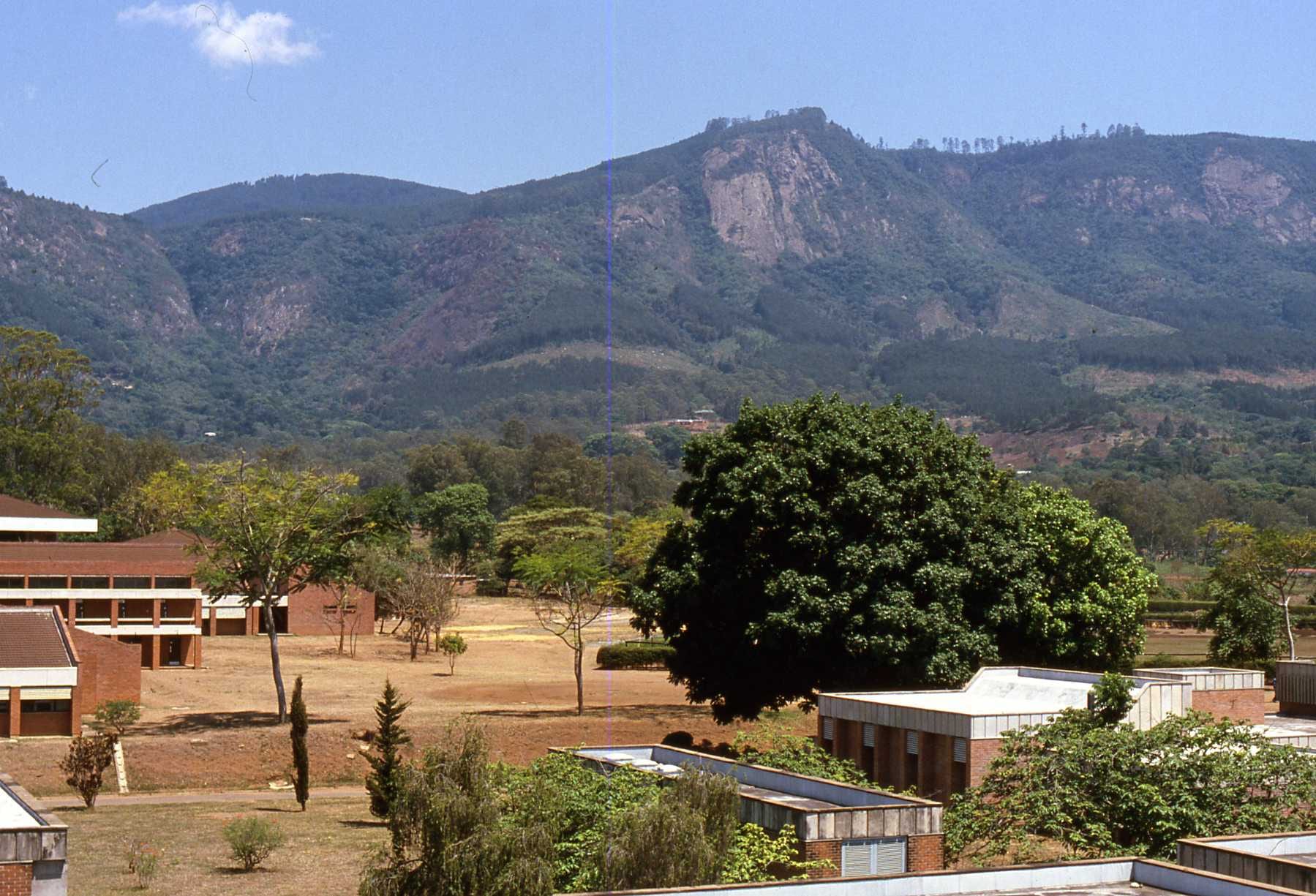
Low brick university buildings and trees on dry ground below a long forested mountain wall with bare rock faces

Blantyre & the Southern Region, Malawi

Zomba

The Zomba Plateau rising behind the Chancellor College campus on the edge of Zomba. (Kevin.Souza / Wikimedia Commons · CC BY-SA 4.0)

Malawi's colonial capital until 1975, spread at about 950 metres along the foot of the Zomba Plateau in the Shire Highlands. Brick administrative buildings, a botanic garden and jacaranda-lined avenues survive from the protectorate era, beside a large market and the university campus that make the town a busy regional centre today.

Neighbourhoods

  • The colonial quarter
    • Historic district
    • Architecture
    • Quiet walks

    The upper part of town on the slope below the plateau, where the protectorate administration was built: brick and stone offices, the old Parliament building, official residences behind hedges and mature trees, and the Gymkhana Club. Streets are wide, shaded and unusually quiet for a Malawian town.

    Open in Maps
  • The town centre and market
    • Local life
    • Markets
    • Transport

    The commercial strip along the main road, with shops, banks, minibus and bus stages and one of the largest markets in southern Malawi, where produce from the plateau and the plains around Lake Chilwa is traded. Busy, crowded and the practical centre of daily business.

    Open in Maps
  • Chirunga and the university
    • Students and cafés
    • Quiet and residential
    • Green surroundings

    The campus area at the town's northern edge, built around Chancellor College of the University of Malawi, with staff housing, bookshops and student eating places. The plateau road begins nearby, so the district makes a convenient base for walks on the mountain.

    Open in Maps
  • The plateau road and slopes
    • Views
    • Walks
    • Cool air

    The forested slope above the town, climbed by a road that winds up through pine and cedar plantations to the dam, the streams and the viewpoints. Temperatures fall noticeably with the height, and mist often sits on the top while the town below stays clear.

    Open in Maps

Things to do

The plateau

  • Zomba Plateaupark

    The forested massif rising to 2,087 metres directly above the town, laced with tracks through pine plantation and remnant evergreen forest, and reached by a road from the town centre.

    Open in Maps
  • Mulunguzi Damattraction

    The reservoir on the plateau that supplies the town with water, ringed by a walking track through the plantations.

    Open in Maps
  • Plateau waterfalls and viewpointsviewpoint

    Streams, waterfalls and still pools cross the top of the plateau, and its edges look out over the Shire Highlands to Lake Chilwa in the east, Mount Mulanje to the south-east and the Shire River to the west.

    Open in Maps
  • Williams Fallsattraction

    The plateau waterfall most often singled out for a visit, one of several on the streams that cross the top; swimming beneath the plateau's falls is part of the draw.

    Open in Maps
  • Queen's View and Emperor's Viewviewpoint

    Two named lookouts on the plateau's edge, with wide views across the plains and hills of southern Malawi.

    Open in Maps
  • Chingwe's Holeattraction

    A deep shaft on the plateau, long attached to local legend and to the poetry written in the town.

    Open in Maps

The old capital

  • The old Parliament buildinglandmark

    The brick chamber that housed Malawi's legislature until it moved to Lilongwe in 1994, standing among the administrative buildings of the colonial quarter.

    Open in Maps
  • Zomba Botanic Gardenpark

    A shaded garden of mature trees and streams laid out below the plateau in the protectorate period, on the edge of the old administrative area.

    Open in Maps
  • Zomba War Memoriallandmark

    A memorial to the soldiers of the King's African Rifles, beside the main road at the southern entrance to the town.

    Open in Maps
  • Chancellor Collegeattraction

    The main teaching campus of the University of Malawi, long the country's centre of academic and literary life, on the northern edge of the town.

    Open in Maps
  • Zomba marketmarket

    A large daily market of produce, dried fish, secondhand clothes and household goods, drawing farmers from the plateau villages and the Lake Chilwa plain.

    Open in Maps

Short trips from the town

  • Lake Chilwaattraction

    A shallow, reed-fringed lake about 40 kilometres east with no outlet, important for fishing and for enormous numbers of waterbirds, with Chisi Island in the middle.

    Open in Maps
  • Blantyreattraction

    The country's business capital, founded as a Scottish mission, with the brick Church of St Michael and All Angels and Mandala House.

    Open in Maps

Eat and drink

Long-standing places and food districts in Zomba. Hours, ratings and directions come from your maps app, always current.

Zomba classics

  • Nsima and chambo kitchensrestaurant

    Small eating houses around the town centre serving nsima with beans, greens, goat or fried lake fish, the standard midday meal.

    Open in Maps
  • Plateau trout and strawberriesrestaurant

    The cold streams of the plateau support a trout farm, and the slopes are known for strawberries and other berries grown for sale in the town.

    Open in Maps

Markets and street food

  • Zomba marketmarket

    Maize flour, tomatoes, groundnuts, bananas, dried usipa from the lakes and piles of vegetables from the plateau villages, with mandasi and roasted maize sold at the edges.

    Open in Maps
  • The town centre food stallsneighborhood

    Roadside grills and stalls along the main road doing chips, roasted maize, fried dough and grilled meat for the minibus trade.

    Open in Maps

Experience Zomba

History

Zomba grew from a mission and trading station at the foot of the mountain into the seat of British power in Nyasaland. The Church of Scotland's Blantyre mission had established itself to the south, and the consul Harry Johnston, who reached the country in 1889, made Zomba his base; when the protectorate was declared in 1891 the town became its capital, chosen for the cool air of the highlands, the water running off the plateau and the defensive position below it.

The administration built in brick and stone along the slope: offices, a residency, barracks for the King's African Rifles and the club and gardens that went with a colonial capital. Indian and Malawian traders settled around the market, and the town stayed small, formal and green — an administrative place rather than a commercial one, with Blantyre taking the business. In 1915 the authorities in Zomba directed the response to John Chilembwe's rising in the estates to the south.

Zomba remained the capital of Nyasaland and then of independent Malawi until 1975, when Hastings Banda moved the seat of government to Lilongwe; Parliament stayed on in the old chamber here until 1994. The loss of the ministries left the town quieter, and its later identity has been academic: Chancellor College of the University of Malawi, founded in 1965 and brought together at Zomba in 1973, made it the country's intellectual centre, a place of writers, poets and teachers, including during the years when censorship was heaviest.

Culture & Customs

Zomba is known in Malawi as a town of books and argument. Chancellor College produced much of the country's modern writing in English and Chichewa, and the writers associated with it — poets and novelists who worked under a censorship board and, in some cases, in detention or exile — gave the town a reputation for intellectual independence that survives in its bookshops, debates and student politics.

The population is mixed. The Yao are strongly represented, and Islam is a visible part of town life, with mosques in the centre and Friday prayers well attended; Lomwe families from the estates to the south and Chewa speakers from across the country make up much of the rest, and the Presbyterian, Catholic and Pentecostal churches are full on Sundays. Chichewa is the everyday language, with Chiyao widely used and English common on campus and in offices.

Manners are formal by Malawian standards: greetings are taken seriously, elders are addressed first, and the two-handed handshake is standard. The plateau is part of local identity rather than just a view — it supplies the town's water, firewood and timber, and the forest has its own stories, most of them attached to Chingwe's Hole. Football, church choirs and the market are the town's shared social life.

Daily Life

Zomba is one of Malawi's four main urban centres and by far the smallest and quietest of them. The town stretches along the road below the mountain, from the market and bus stage up through the old administrative streets to the campus and the forestry boundary.

The economy rests on the university, the remaining government offices and institutions, the military and police establishments, the market and trade with the farming country around. Smallholders on the plateau's lower slopes grow maize, vegetables, strawberries and timber, and fishing families from Lake Chilwa supply dried fish to the market. There is little industry.

Days start early, with minibuses filling at the stage and traders setting up before dawn, and the market is at its busiest in the morning. Power cuts are routine, and the fuel and foreign-currency shortages of recent years have pushed up transport and food prices sharply, as they have across Malawi. Pressure on the plateau forest from firewood cutting and charcoal burning, and the state of the older public buildings, are the town's long-running concerns.

Food

Zomba eats what the Shire Highlands grow. Nsima, the stiff maize porridge, comes with ndiwo — a relish of beans, pumpkin or cassava leaves, rape, cabbage or okra, often thickened with groundnut flour — and with goat, chicken or fish when budgets allow. Chambo tilapia and dried usipa reach the market from Lake Malawi and Lake Chilwa, and matemba, small dried fish, are a staple relish.

The plateau adds things unusual for Malawi. Cold streams feed a trout farm, and trout appears on lodge menus in a country where freshwater fish otherwise means lake species; the slopes produce strawberries, blackberries and other soft fruit sold by the roadside and in the town, along with potatoes, carrots and other temperate vegetables grown at height.

Street food is the national repertoire: mandasi, small fried dough cakes eaten with tea, roasted or boiled maize, chips cooked at the roadside, sugar cane and grilled meat at the bus stage. Thobwa, the lightly fermented maize drink, is sold from buckets in the market; chibuku, the commercial sorghum beer, is drunk in the bars; Carlsberg and Kuche Kuche lagers come from Blantyre; and the tea is grown on the estates to the south.

Planning tools

Budget

Zomba is inexpensive even by Malawian standards, with guesthouses in town and a handful of lodges on the plateau. The main costs are a room, a guide or a vehicle for the mountain, and transport in from Blantyre. Food from the market and the town's eating houses costs very little.

Daily Budget Midrange
USD 80–200 (lodge or hotel room, meals out, a guide on the plateau, a hired car)
Daily Budget Shoestring
USD 20–40 (guesthouse or campsite, market and local food, minibuses)

Carry kwacha in cash for the plateau; the cash machines and banks are all in the town centre below.

Best Time to Visit

May to October is the dry season, with clear air, firm paths on the plateau and cool nights. September and October are hot in the town. The rains from November to April bring mist and cloud to the mountain, slippery tracks and green, dense forest; the jacarandas flower around October and November.

Suggested Number of Days

A day or two covers the town and a first look at the plateau. Three or four suit anyone walking the mountain properly or combining the town with the lakes and roads nearby. Weather on the plateau is the main reason to allow extra time.

First Visit
1–2 days
With Surroundings
3–4 days

Transportation

Minibuses and shared taxis run along the main road and between the town centre, the market and the university, and buses and minibuses leave through the day for Blantyre, Liwonde and Lilongwe. The plateau is reached by a steep road that needs a hired vehicle, a taxi or a long walk; cyclists and pedestrians use the same road.

Agree a taxi fare before setting off, and arrange a pick-up time if driving or being dropped on the plateau, where there is no transport waiting.

Airport & Station Connections

Zomba lies about 65 kilometres north-east of Blantyre on a good tarred road, roughly an hour by car and a little longer by minibus. The nearest airport is Chileka at Blantyre; Lilongwe is around four to five hours away by road. Most visitors arrive by road from Blantyre or on the way between Blantyre and Liwonde.

Walkability

The town is easy to walk, and the colonial quarter in particular is best seen on foot, though the ground rises steadily and the upper streets are a stiff climb from the market. The plateau is a different matter: the road up is long and steep, and paths on the mountain are best walked with a guide. Streets are unlit after dark.

Safety

Zomba is a calm town, with the ordinary risks of petty theft and pickpocketing around the market, the bus stage and crowded streets. The known problem is on the plateau, where there have been muggings of walkers on isolated paths; local guides and forestry staff know which routes are used and which are not.

Use guides on remote walks, don't walk after dark, lock valuables away, take malaria prophylaxis, and treat bilharzia and sudden lake squalls as real risks. Check current official travel advice before travelling.

Climate

Mild for Malawi, thanks to an altitude of about 950 metres, with a single rainy season. The plateau above is several degrees cooler again and often wrapped in cloud when the town is clear.

Summer
warm and wet, December–February — days around 27°C in the town, with heavy afternoon rain and storms
Winter
dry and mild, June–August — days in the low 20s °C and cool nights, cold on the plateau

Local Customs

Zomba is a university and civil-service town, and dress is conservative: knees covered away from lodges, and shoulders covered in the market and around churches and mosques. Greetings come before business, and a handshake with the left hand touching the right forearm is the respectful form. Photographing government buildings, the police and soldiers is not welcome.

Tipping is not obligatory but is usual for guides and porters on the plateau. Alcohol is sold openly but drinking in the street is frowned on.

Common Payment Methods

The currency is the Malawian kwacha. Banks and cash machines are on the main road in the town centre, and cards work at a few hotels and supermarkets but nowhere else; markets, minibuses, guides and small guesthouses are cash only. US dollars in cash are useful for larger lodge bills.