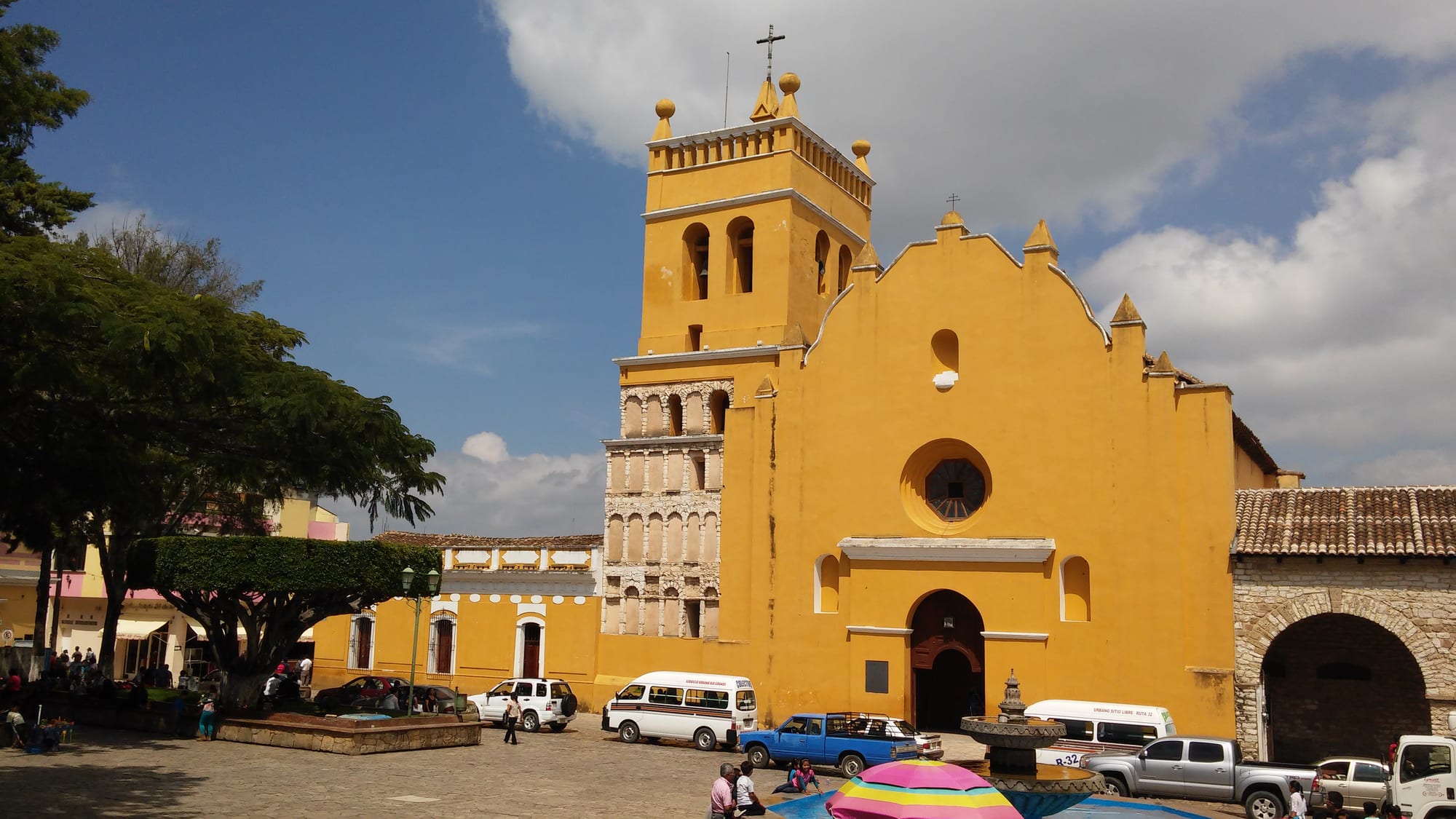
The ochre façade and tower of the church of Santo Domingo in Comitán, with a fountain, trees and parked vans on the square

Chiapas, Mexico

Comitán

The parish church of Santo Domingo de Guzmán on the main square of Comitán. (Joalagdi / Wikimedia Commons · CC BY-SA 4.0)

A highland town in eastern Chiapas near the Guatemalan border, founded as a Tzeltal settlement called Balún Canán and refounded by Dominican friars in the 16th century. Chiapas's independence began here in 1821; the town gave Mexico the politician Belisario Domínguez and the writer Rosario Castellanos, and is now a market and service centre and the gateway to the Montebello lakes.

Neighbourhoods

  • Centro
    • First-time visitors
    • Historic district
    • Museums

    The colonial core around the Parque Central Benito Juárez, with its topiary, shade trees and busts of the town's famous figures, the church of Santo Domingo, and most of the museums within a few blocks. Narrow streets of Baroque, Neoclassical and Neo-Gothic buildings run out from the square.

    Open in Maps
  • La Pila
    • Local life
    • Churches

    A traditional barrio of the town, home to the orange-and-red church of San Caralampio, the focus of the town's most fervent festival each February.

    Open in Maps
  • Barrio de Guadalupe
    • Local life
    • Festivals

    The neighbourhood of the Guadalupe church, which fills each December with one of the largest pilgrimages in the region, with a fair alongside.

    Open in Maps

Things to do

The town

  • Parque Central Benito Juárezpark

    The main square, with clipped hedges, flower beds and benches, live music on some evenings and statues of figures such as Rosario Castellanos.

    Open in Maps
  • Templo de Santo Domingo de Guzmánlandmark

    The Dominican parish church on the main square, the heart of the town since the friars gave it the name Santo Domingo de Comitán in the 17th century.

    Open in Maps
  • Templo de San Caralampiolandmark

    A church in the barrio of La Pila with a bright orange and red façade and a white interior, dedicated to the martyr said to have saved the town from an epidemic.

    Open in Maps
  • Casa Museo Doctor Belisario Domínguezmuseum

    The family house of the physician and senator Belisario Domínguez, killed after a speech against the dictator Victoriano Huerta, with a 19th-century pharmacy.

    Open in Maps
  • Museo de Arte Hermila Domínguez de Castellanosmuseum

    An art museum with works by Rufino Tamayo, Francisco Toledo, José Luis Cuevas and José Guadalupe Posada, alongside exhibitions of local artists.

    Open in Maps
  • Museo Arqueológico de Comitánmuseum

    A museum of the pre-Hispanic cultures of the Chiapas highlands and the Maya trade routes, with finds from sites around the town.

    Open in Maps

Short trips from the town

  • Tenam Puentelandmark

    A Maya archaeological site in the Balún Canán valley about 12 kilometres south of Comitán, less visited than the big sites, with pyramids, ball courts and views over fields and forest.

    Open in Maps
  • Lagunas de Montebello National Parkpark

    Chiapas's first national park, created in 1959 near the Guatemalan border, with dozens of lakes of different colours in a pine forest; UNESCO named it a biosphere reserve in 2009.

    Open in Maps
  • Chinkulticlandmark

    A Classic Maya city inside the Montebello park, with step pyramids, some 200 smaller buildings, carved stelae of its rulers and hieroglyphic inscriptions dated from 591 to 897.

    Open in Maps
  • El Chiflón waterfallspark

    A series of waterfalls and turquoise pools in the municipality of Tzimol, best known for the cascade called the Velo de Novia, the bride's veil.

    Open in Maps

Seasonal events

  • Fiesta de San CaralampioFebruary

    The town's most fervent celebration, in honour of the martyr who, according to legend, saved Comitán from an epidemic, centred on his church in La Pila.

  • Feria de Santo Domingo and Expoferiaearly August

    The feast of the town's Dominican patron, with a trade and agricultural fair.

  • Virgin of Guadalupe pilgrimageDecember

    A great pilgrimage to the Barrio de Guadalupe, drawing pilgrims from across the state and beyond, accompanied by a fair.

Eat and drink

Long-standing places and food districts in Comitán. Hours, ratings and directions come from your maps app, always current.

Comitán classics

  • Mercado Primero de Mayomarket

    The central market, selling fresh produce, cheese and meat alongside many homemade regional dishes.

    Open in Maps
  • Central de Abasto 28 de Agostomarket

    A busy market of fresh fruit, vegetables, cheeses and meats, and a place to see everyday local life.

    Open in Maps

Evenings

  • Mercado San Josémarket

    A market given over to eating, with several kitchens around a shared dining area.

    Open in Maps
  • Parque Centralneighborhood

    The cafés, restaurants and shops around the main square.

    Open in Maps

Experience Comitán

History

The first town was founded in a swamp by Tzeltal people, who called it Balún Canán, usually translated as "nine stars". The Spanish began their conquest of the region in 1528, and the Dominican friars formally established the colonial town in 1556; it became a vicarage in 1625 and took the name Santo Domingo de Comitán. Like the rest of Chiapas it was governed from Guatemala through the colonial period, and it was also known as Comitán de las Flores.

On 28 August 1821 the town declared itself free and independent of both Spain and the Captaincy General of Guatemala, the first step towards the independence of Chiapas, which is why Comitán calls itself the cradle of Chiapas independence. Chiapas joined Mexico in 1824.

In 1915 the town was renamed Comitán de Domínguez in honour of Belisario Domínguez, a physician born here who, as a senator, made a speech in Congress against the dictator Victoriano Huerta and was murdered for it in 1913. The writer Rosario Castellanos spent her childhood in Comitán and set her novel Balún Canán here, taking the town's old Maya name as its title. On 9 October 2012 Comitán joined the federal Pueblos Mágicos programme, recognised for its culture, architecture, history and food, including its sweets.

Culture & Customs

Comitán is a town of writers and of memory. She is among the figures honoured with busts and statues in the main square, the cultural centre and the regional library carry her name, and an international festival in her honour has been held for more than a decade. The poet Óscar Bonifaz collected the town's archaisms and regional expressions in a book, and the local speech, in which some older people still use vos, is a point of pride.

The religious year is crowded. The main feasts are San Sebastián in January, the Virgen de la Candelaria and San Caralampio in February, San José in March, Santo Domingo with its Expoferia in August, the Virgen del Rosario and San Judas Tadeo in October, and the Virgin of Guadalupe in December. San Caralampio stirs the greatest devotion, although he is not the official patron: legend says the martyr saved the town from an epidemic.

The town's museums reflect the same mix of local and national culture: the house of Belisario Domínguez with its old pharmacy, the art museum named after Hermila Domínguez de Castellanos with works by Tamayo, Toledo and Cuevas, an archaeological museum, a city museum and a museum of Rosario Castellanos. The architecture runs from Baroque churches to Neoclassical and Neo-Gothic houses.

Daily Life

About 113,000 people lived in the city at the 2020 census, up from about 98,000 in 2010, an average growth of 1.6 per cent a year. The city covers about 34 square kilometres. It is the commercial centre for at least eight surrounding municipalities, and its population is largely ladino with Tojolabal and Tzeltal people.

The economy rests on commerce and services. A shopping centre, Plaza las Flores, has national chains, supermarkets and a cinema, while the central markets and small shops of the old town carry on alongside them. Comitán is also a popular holiday town for Mexicans, who come for the colonial centre, the food and the lakes.

Most adults can read and write, and the town has campuses of several colleges and universities, including one named after Rosario Castellanos. Daily life centres on the lively Parque Central and on the feasts of the barrio churches, which punctuate the year with processions, fireworks and fairs.

Food

Comitán is known across Chiapas for its food. Typical dishes include butifarras, a boiled local sausage, along with chorizo and longaniza made in the town's own style; hueso asado; chilevinagre; picles; chicharrón; and pellizcadas, tortillas with asiento. Bocadillos de patashete are another local snack.

The drinks are distinctive. Comiteco is a local spirit that used to be made from agave; mistela is a fruit liqueur; and the warm and cold drinks include jocoatol, atole de granillo, temperante and pozol made with peanuts.

Above all, the town is famous for its sweets, many made by traditional methods: chimbo, africanos, peanut sweets, dulce de coyol, nuegados, melcocha, quiebramuelas and trompadas. They are sold in shops and at stalls around the centre and in the markets, where Mercado Primero de Mayo also serves homemade regional dishes. The town's food is one of the reasons given for its Pueblo Mágico listing; the sweets are made from regional ingredients, some by methods dating from before the conquest.

Planning tools

Budget

Comitán is inexpensive, and most of its visitors are Mexican. Market food and the town's sweets cost little. The main expense is getting to the lakes and falls, by colectivo, taxi or organised tour, plus the small entry charges at each site.

Daily Budget Midrange
USD 75–140 (colonial-style hotel, restaurants, a tour or taxi to the lakes)
Daily Budget Shoestring
USD 30–50 (budget hotel, market food, colectivos)

Carry cash in small notes for colectivos, park and waterfall entry charges and community fees on rural roads.

Best Time to Visit

The weeks after the rains end in October bring the coolest and most pleasant weather of the year. The dry season warms up from March to May, and the rainy season lasts from May to October. San Caralampio's feast in February and the Guadalupe pilgrimage in December are the busiest times.

Suggested Number of Days

One or two days are enough for the town itself. The lakes and waterfalls around it are a day each, so most people who come for them stay three or four days in all.

First Visit
1–2 days
With Surroundings
3–4 days

Transportation

The centre is small enough to walk. Colectivo vans run around town and to the surrounding villages, and many pass the Central de Abasto. Taxis are available, and colectivos, taxis and tours run to the lakes, the falls and Tenam Puente.

Travel to the lakes and falls by day, and check locally about road conditions near the Guatemalan border.

Airport & Station Connections

The nearest airport is Tuxtla Gutiérrez International Airport, which serves Comitán. First-class buses use the OCC terminal on Highway 190, with services from San Cristóbal, about two hours away, Tuxtla, about three, and Tapachula; colectivo vans also run from San Cristóbal and Tuxtla.

Walkability

The historic centre is compact and walkable, with narrow streets and clean pavements, and the main museums lie within a few blocks of the Parque Central.

Safety

Safety varies enormously by state and even neighbourhood. San Cristóbal, Palenque and the main tourist routes are visited without trouble by most travellers, but Chiapas has serious problems away from them: since around 2021 rival organised-crime groups have fought for territory near the Guatemalan border and in parts of the highlands, forcing residents from their homes, and road blockades, land disputes and robbery on rural roads are common.

Stick to main routes and daytime travel, avoid the border areas, and take local advice before driving rural roads. Check current official travel advice before travelling.

Climate

A mild highland climate. Afternoons are warm and fairly humid for much of the year, mornings are cool in the dry season, and it can get quite chilly from October to March. The rains last from May to October.

Summer
the rainy season, May to October, with mild mornings and warm, humid afternoons; the town's annual mean temperature is about 19°C
Winter
dry and cool, chilly from October to March; the region's figures give cold highland nights near 0°C

Local Customs

Comitecos are proud of their town's part in Chiapas independence and of its writers, and its Spanish has its own regional words; some older people still use vos instead of tú. Religious feasts for San Caralampio, Santo Domingo and the Virgin of Guadalupe are major events, and the town's population includes Tojolabal and Tzeltal people.

Ask before photographing people at the markets and in the villages.

Common Payment Methods

The currency is the Mexican peso. There are ATMs in the centre and in the shopping centre, and cards are accepted in larger shops and hotels, but markets, colectivos and the entry charges at the lakes and falls are paid in cash.