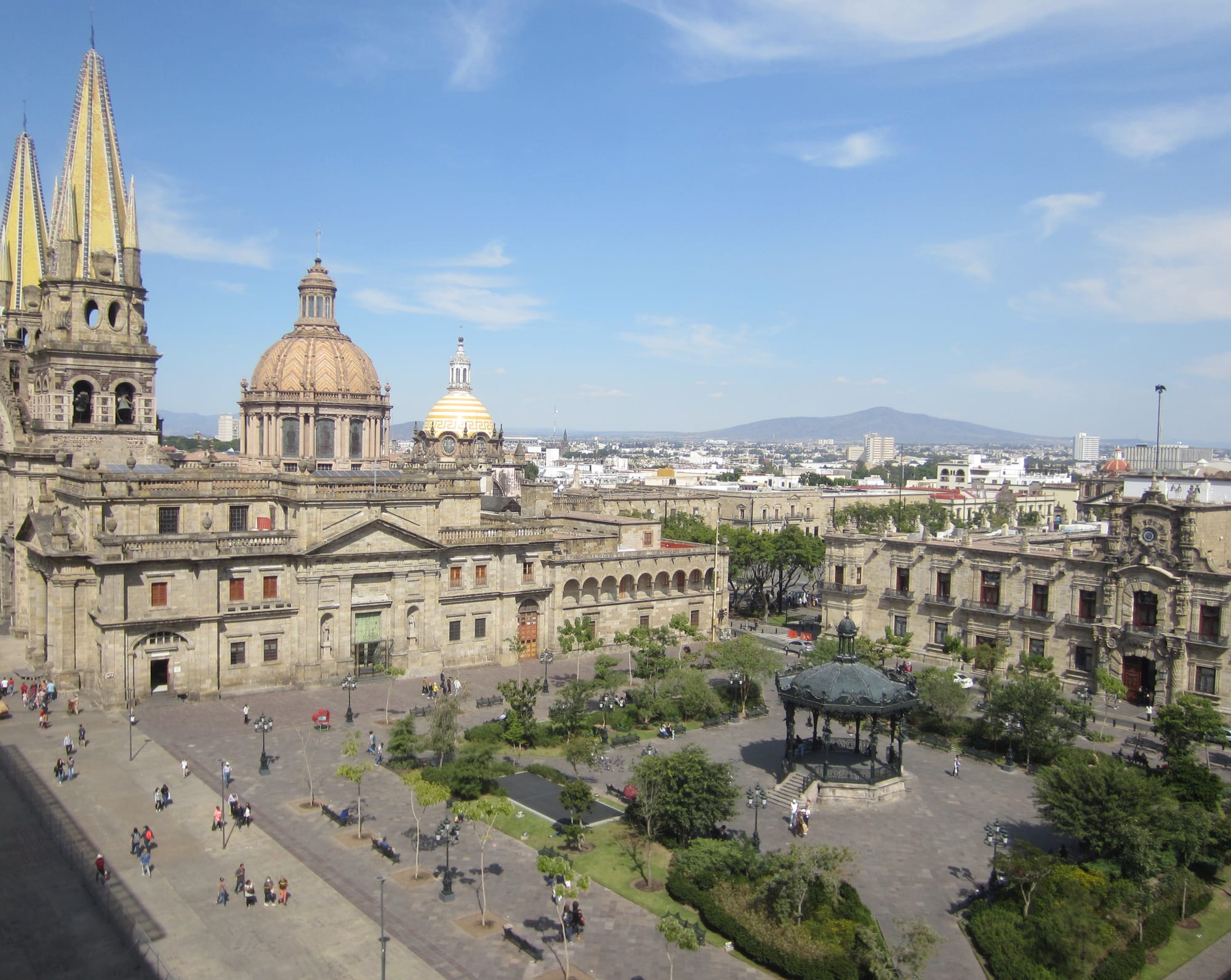
The spired towers and tiled domes of Guadalajara Cathedral beside a stone palace and a tree-lined square with a bandstand

Guadalajara & the Pacific Centre, Mexico

Guadalajara

Guadalajara Cathedral and the Plaza de Armas, with the Jalisco Government Palace on the right. (Another Believer / Wikimedia Commons · CC BY-SA 4.0)

The capital of Jalisco, set in the Atemajac Valley in western Mexico and the heart of the country's third-largest metropolitan area. Founded on its present site in 1542 as the capital of Nueva Galicia, it grew into Mexico's second city; today it is a centre of commerce, electronics and universities, and the home of mariachi, birria and the torta ahogada.

Neighbourhoods

  • Centro Histórico
    • First-time visitors
    • Historic district
    • Close to public transport

    The oldest part of the city, laid out along an east–west axis of squares from the Plaza de Armas and the cathedral to the Plaza Tapatía, the Hospicio Cabañas and the Plaza de los Mariachis. Most of the major sights and the great market are here, served by the light rail.

    Open in Maps
  • Colonia Americana and Lafayette
    • Nightlife
    • Best for food
    • Architecture

    Districts west of the centre where wealthy families built French-inspired houses in the early 20th century, many now converted into shops, cafés and restaurants. Avenida Chapultepec, about 2 km west of the centre, is the city's busiest bar street.

    Open in Maps
  • Tlaquepaque
    • Crafts and shopping
    • Best for food

    A separate municipality south-east of the centre whose old town keeps the feel of a small colonial town, with pottery and blown-glass workshops, galleries, restaurants and a regional ceramics museum around its main garden square.

    Open in Maps
  • Zapopan
    • Pilgrimage church
    • Quiet and residential
    • Football

    The large municipality to the west and north-west, home to the Basilica of Our Lady of Zapopan, wealthy suburbs and the Chivas stadium.

    Open in Maps
  • Tonalá
    • Crafts and markets
    • Local life

    A pottery town on the eastern edge of the metropolitan area, now a city of its own, with handicraft shops and a street market of crafts held in front of the main church on Thursdays and Sundays.

    Open in Maps

Things to do

Famous landmarks

  • Guadalajara Cathedrallandmark

    The Cathedral of the Assumption, completed in 1618; earthquakes in 1818 and 1849 brought down its towers, and their replacements, covered in yellow and blue tiles, are a symbol of the city.

    Open in Maps
  • Teatro Degolladolandmark

    A neoclassical theatre of the mid-19th century on the city's central plaza, with a mosaic of Apollo and the nine Muses on its pediment and a ceiling mural from Dante's Divine Comedy.

    Open in Maps
  • Palacio de Gobiernolandmark

    The state government palace beside the cathedral, which holds José Clemente Orozco's mural of Miguel Hidalgo, his arm raised in anger.

    Open in Maps
  • Templo Expiatoriolandmark

    A Gothic Revival church built over several decades from the late 19th century, known for its stained glass and a tower clock with a procession of the apostles.

    Open in Maps
  • Plaza de los Mariachislandmark

    A small square in the San Juan de Dios district, lined with restaurants where mariachi bands play, above all at night.

    Open in Maps

Museums

  • Hospicio Cabañasmuseum

    A vast former orphanage and hospital designed by Manuel Tolsá and begun in 1805, now a museum whose main chapel is covered with Orozco's frescoes, including The Man of Fire; a UNESCO World Heritage Site since 1997.

    Open in Maps
  • Jalisco Regional Museummuseum

    The former seminary of San José, now a museum of palaeontology, archaeology, history and painting, whose fossils include the Catarina mammoth.

    Open in Maps

Markets

  • San Juan de Dios Marketmarket

    The Mercado Libertad, the largest indoor market in Latin America, covering about 40,000 square metres beside the Plaza Tapatía.

    Open in Maps

Music, sport and nights out

  • Estadio Akronattraction

    The home stadium of Chivas in Zapopan, which hosted four group-stage matches of the 2026 FIFA World Cup.

    Open in Maps
  • Estadio Jaliscoattraction

    The city's older football stadium, with room for about 54,000 spectators, the third-largest football stadium in Mexico.

    Open in Maps

Around the metropolitan area

  • Basilica of Our Lady of Zapopanlandmark

    One of the most visited sanctuaries in western Mexico, home to a small wooden image of the Virgin brought from Spain in the 16th century and proclaimed patroness of Jalisco after independence.

    Open in Maps
  • Tlaquepaque old townneighborhood

    The craft town where Miguel Hidalgo was feasted before entering Guadalajara in 1810, now known for pottery, blown glass, galleries and restaurants around the Jardín Hidalgo.

    Open in Maps

Short trips from the city

  • Tequilaattraction

    The town that gave the spirit its name, about 60 km from Guadalajara, surrounded by blue agave fields, with distillery chimneys, a museum and guided tours.

    Open in Maps
  • Guachimontonesattraction

    The largest pre-Columbian site in Jalisco, above the town of Teuchitlán, with circular stepped pyramids built by the Teuchitlán culture between about 300 BCE and 500 CE.

    Open in Maps
  • Lake Chapalapark

    Mexico's largest freshwater lake, south-east of the city and a principal source of its water since the 1950s.

    Open in Maps
  • Ajijicattraction

    A lakeside town on Lake Chapala, south of Guadalajara.

    Open in Maps

Seasonal events

  • Guadalajara International Film FestivalMarch

    One of the most important film festivals in Latin America, focused on Mexican and Latin American cinema.

  • International Mariachi and Charrería Festivallate August to early September

    Mariachi bands from Mexico and abroad and charros, Mexican horsemen, gather to play and compete, usually at the Teatro Degollado and the surrounding area; it began in 1994.

  • Fiestas de OctubreOctober

    The city's traditional October fair, held since 1965, with funfair rides, a palenque and nightly concerts of Mexican music.

  • Romería of the Virgin of ZapopanOctober

    A huge annual pilgrimage that carries the image of the Virgin of Zapopan from the cathedral back to her basilica.

  • Guadalajara International Book Fairlate November

    The FIL, the largest book fair in the Americas and the most important of its kind in the Spanish-speaking world, held over nine days at the Expo Guadalajara.

Eat and drink

Long-standing places and food districts in Guadalajara. Hours, ratings and directions come from your maps app, always current.

Guadalajara classics

  • Birria and torta ahogada stallsneighborhood

    Street vendors and small eateries across the centre and Colonia Americana sell the city's signature dishes: birria, the drowned torta ahogada and tacos.

    Open in Maps

Food districts and markets

  • San Juan de Dios Marketmarket

    The great indoor market of the centre, a place to eat among the stalls as well as to shop.

    Open in Maps
  • Tlaquepaqueneighborhood

    Restaurants and courtyards among the galleries and craft shops of the old town.

    Open in Maps

Cafés and bars

  • Avenida Chapultepecneighborhood

    The most active bar district in the city, in Colonia Americana about 2 km west of the centre, with bars, cafés and restaurants along a wide avenue.

    Open in Maps

Experience Guadalajara

History

The Spanish founded Guadalajara four times. Cristóbal de Oñate, serving under the conquistador Nuño de Guzmán, established the first settlement in 1532 at what is now Nochistlán, in Zacatecas; it moved to a site near Tonalá and then to Tlacotán, and barely survived the Mixtón War of 1540–42, when the Caxcan and other peoples rose against Guzmán's brutality. On 14 February 1542 the town was refounded in the Atemajac Valley, named after Guzmán's home town in Spain. It became the capital of the Kingdom of Nueva Galicia in 1560, and silver wealth, trade and the church made it one of the great cities of New Spain; the cathedral was completed in 1618 and a university was established in 1791.

In 1810 Miguel Hidalgo entered the city, set up a revolutionary government and on 6 December decreed the abolition of slavery, before his army was crushed at Calderón Bridge east of the city in January 1811. Guadalajara became the capital of Jalisco in 1823, briefly hosted Benito Juárez's government in the Reform War and was occupied by the French in the 1860s. Electricity and the railway arrived between 1884 and 1890.

The city grew fast in the 20th century, passing a million people in 1964. The Cristero War ended there in 1929. On 22 April 1992 gasoline explosions in the sewers destroyed streets in the Analco district and killed 206 people. Guadalajara has since hosted the 2011 Pan American Games, was UNESCO's World Book Capital in 2022, and hosted matches of the 2026 FIFA World Cup, as it had in 1970 and 1986.

Culture & Customs

Guadalajara is the city most strongly associated with mariachi, although the style began in the nearby town of Cocula. The link dates from 1907, when a band and dancers from the city performed for President Porfirio Díaz, and the music later gained attention in Mexico City and came to be recognised as distinctly Mexican. Bands still play for diners in the Plaza de los Mariachis, and the international mariachi and charrería festival, begun in 1994, fills the city in late summer; in 2009 it set a world record when 542 mariachis played together. Charreada, the Mexican rodeo, is popular, and charros parade through the centre each September.

The city is also an intellectual centre. The University of Guadalajara stages the book fair, the largest in the Americas, and the city's film festival is among the most important in Latin America. José Clemente Orozco, born in Jalisco, left some of his greatest murals here, and the architect Luis Barragán and the writer Juan Rulfo are among the artists linked with the city.

Religious life is visible and conservative. Every October huge crowds accompany the image of the Virgin of Zapopan from the cathedral back to her basilica, and on 25 July the Danza de los Tastoanes re-enacts battles against the Spanish. Football divides the city between Chivas, which fields only Mexican players, and Atlas.

Daily Life

About 1.4 million people lived in the municipality of Guadalajara at the 2020 census, and about 5.3 million in the metropolitan area, the third largest in Mexico, which includes Zapopan, Tlaquepaque, Tonalá and Tlajomulco. The municipality itself has been slowly losing people since the early 1990s as growth has moved to the suburbs.

Commerce and services employ most workers, while manufacturing — food and drink, textiles, shoes, auto parts and above all electronics, built up by multinational companies since the mid-1990s — is the engine of the economy, much of it exported to the United States. The city is also a centre for information technology and for universities.

The city has long been divided along social lines: the west, including Providencia, Chapalita and much of Zapopan, is the wealthiest, while the east and parts of the centre are poorer, and new working-class housing spreads across the periphery. Commutes are long, with public-transport riders spending well over an hour a day on average. Lake Chapala, a principal source of the city's water since the 1950s, has shrunk as urban consumption has grown.

Food

The torta ahogada is Guadalajara's own dish: a crusty, salted roll called a birote, filled with pork, refried beans and onions and drowned in a sauce of chile de árbol, or a milder tomato sauce. Birria, meat cooked with spices — goat, beef, lamb or pork — is eaten with a tomato broth or on its own; the old way is to roast it in a pit wrapped in maguey leaves. Carne en su jugo, beef cooked in its broth with beans, bacon, coriander, onion and radish, is another tapatío classic, alongside pozole, the hominy soup, and pipián, a sauce thickened with ground pumpkin seeds.

The city's dessert is the jericalla, a dessert made with milk, eggs, vanilla, cinnamon and sugar. Street drinks include tejuino, a lightly fermented corn drink served with lime juice and a pinch of salt, and tepache, from fermented pineapple.

Tequila comes from the agave country of Jalisco, around the town of Tequila to the north-west and in the Los Altos highlands, and bars offer it as blanco, reposado and añejo. Street vendors, the stalls of the San Juan de Dios market and the bars of Avenida Chapultepec cover most of the eating and drinking, and the city holds an international gastronomy fair each September.

Planning tools

Budget

Guadalajara is good value, with prices close to the national average and well below those of the coast. Street food, markets and public transport cost little; the main expenses are hotels in the centre and western districts, and tours to Tequila and the lake.

Daily Budget Midrange
USD 70–160 (boutique or mid-range hotel, sit-down restaurants, museum tickets, taxis and a tequila tour)
Daily Budget Shoestring
USD 30–50 (hostel or guesthouse, street food and market meals, light rail and buses)

Rooms fill up and prices rise during the book fair, the October fair and major football matches; the squares, churches and markets of the centre are free.

Best Time to Visit

October to April is dry and sunny, with warm days and cool nights. May is the hottest month, just before the rains. The rainy season runs through the summer, with July the wettest month and afternoon storms that can bring hail. The film festival in March, the mariachi festival in late summer, the October fair and the book fair in late November are the big events.

Suggested Number of Days

Two or three days covers the historic centre and the nearby craft towns. Five or six allows time for the countryside and lakes around the city as well. A big event, or a match, may add a day.

First Visit
2–3 days
With Surroundings
5–6 days

Transportation

Three light-rail lines cross the city: Line 3, opened in 2020, runs from Zapopan through the centre to Tlaquepaque and Tonalá. The Macrobús bus rapid transit lines, trolleybuses, many private bus routes and the Mi Bici bike-share scheme cover the rest, and taxis and ride-hailing apps are widely used. Traffic is heavy and public-transport journeys can be long.

Use the light rail for the centre, Zapopan and Tlaquepaque, and travel to Tequila and the lake by organised tour or bus rather than driving after dark.

Airport & Station Connections

Guadalajara International Airport, one of the busiest in Mexico, is in Tlajomulco de Zúñiga about 17 km south-east of the centre, with flights across Mexico and to many cities in the United States. Long-distance buses use the main bus station in Tlaquepaque; first-class services reach Puerto Vallarta and Morelia in several hours. Toll motorways run to Mexico City, Tepic and the coast.

Walkability

The historic centre is flat and good on foot, with pedestrian streets and a chain of squares from the cathedral to the Hospicio Cabañas. Colonia Americana and Avenida Chapultepec are a short ride or a longer walk west. The metropolitan area is very large, and Zapopan, Tlaquepaque and Tonalá need the light rail, a bus or a taxi.

Safety

Safety varies enormously by state and even neighbourhood. In February 2026, after the leader of the Jalisco New Generation Cartel was killed in a military operation, two days of roadblocks, arson and clashes were recorded across some twenty states; schools closed and public transport in Guadalajara stopped. Crime against visitors mostly takes the form of purse-snatching, and a staged spill is a common way of distracting a target.

Keep valuables close in crowded markets and outdoor bars, use registered taxis or ride-hailing apps at night, travel between cities by day on toll roads, and follow local news, as roads and transport can shut at short notice. Check current official travel advice before travelling.

Climate

A humid subtropical highland climate with dry, warm winters and wet, mildly hot summers. Rain is concentrated in summer, with July the wettest month and March the driest; frost is uncommon in the city and snow extremely rare, last falling in December 1997.

Summer
May is the hottest month, averaging 33°C by day and sometimes reaching 37°C before the rains; summer afternoons bring storms, sometimes with hail
Winter
dry and warm — January days reach about 25°C and nights fall to about 10°C, colder on the outskirts near the Primavera forest

Local Customs

People from Guadalajara are called tapatíos, and the word is used for anything typical of the city or of Jalisco. Catholic tradition is strong, and churches are working places of worship. Football loyalties, above all to Chivas and Atlas, run deep. Tipping is customary in restaurants.

Dress modestly and keep quiet in churches during services, ask before photographing people, and do not carry or buy illegal drugs: police treat it very seriously.

Common Payment Methods

The currency is the Mexican peso. Cards are widely accepted in hotels, restaurants, shops and malls, and ATMs are common; cash in pesos is needed for markets, street food, buses and tips.