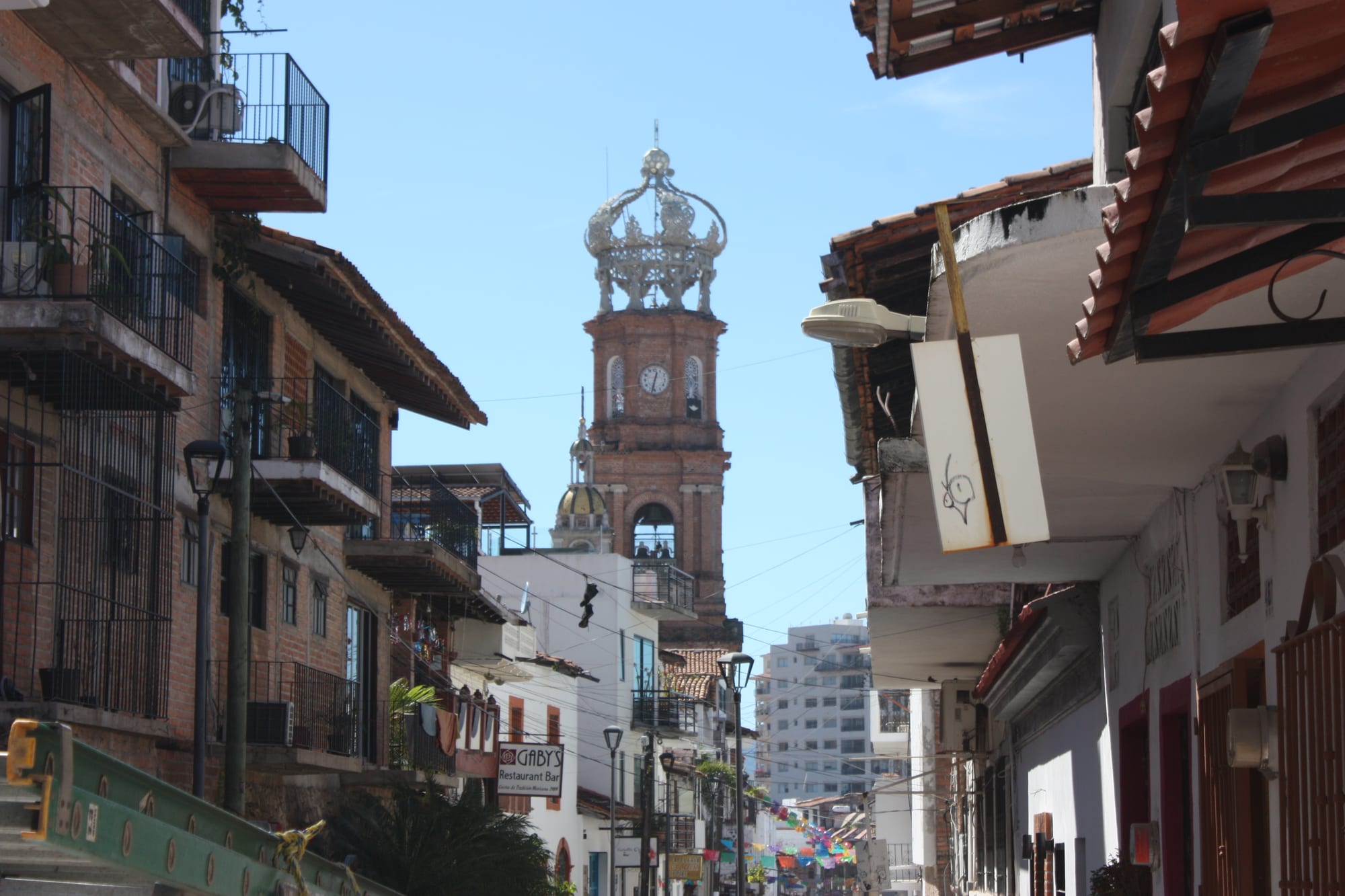
A narrow street of balconied brick houses leading to a red brick church tower topped by an openwork crown

Guadalajara & the Pacific Centre, Mexico

Puerto Vallarta

The crowned tower of the Church of Our Lady of Guadalupe above a street in central Puerto Vallarta. (Feedmepaperr / Wikimedia Commons · CC BY-SA 4.0)

A resort city on Jalisco's Pacific coast, spread along the Bay of Banderas at the foot of the Sierra Madre. A 19th-century village that grew up at the mouth of the Cuale River, it became famous after The Night of the Iguana was filmed nearby in 1963; today tourism drives its economy, from the cobbled old town and the seafront Malecón to the hotel zone and Marina Vallarta.

Neighbourhoods

  • Centro
    • First-time visitors
    • Historic district
    • Waterfront

    The oldest part of town, between the Cuale River and Parque Hidalgo, around the Church of Our Lady of Guadalupe and the main plaza. Steep cobbled lanes climb the hill behind, and the Malecón runs along its seafront.

    Open in Maps
  • Zona Romántica
    • Best for food
    • Nightlife
    • Beaches

    The colonias south of the Cuale River — Emiliano Zapata, Alta Vista and Amapas — often called the Old Town. Small hotels, restaurants and bars fill the streets behind Playa de los Muertos, and it is the centre of the city's LGBTQ scene.

    Open in Maps
  • Hotel Zone
    • Beaches
    • Resort hotels

    The long strip of shoreline between downtown and the airport, lined with hotels, timeshare resorts and residential towers, with city buses running along the main road behind.

    Open in Maps
  • Marina Vallarta
    • Marina and boats
    • Quiet and residential

    A planned development near the airport built around a marina for several hundred boats, with shops, galleries, hotels, condominiums and a golf course just to the north.

    Open in Maps
  • Conchas Chinas
    • Quiet and residential
    • Views

    An affluent hillside area south of the Zona Romántica, with gated communities and large houses looking straight out over the bay, and the city's most secluded beach below.

    Open in Maps

Things to do

Famous landmarks

  • Church of Our Lady of Guadalupelandmark

    The parish church of the Centro, built between 1930 and 1940 on the foundations of an earlier chapel, whose brick tower is topped by an openwork crown.

    Open in Maps
  • The Malecónlandmark

    The mile-long seafront promenade of the Centro and Zona Romántica, first built in the 1930s, rebuilt after Hurricane Kenna in 2002 and lined with contemporary sculptures by artists including Sergio Bustamante and Alejandro Colunga.

    Open in Maps
  • Isla Cualeattraction

    A narrow island at the mouth of the Cuale River, cleared of homes after floods in 1971 and now a place of restaurants, galleries, craft stalls, a small archaeological museum and a statue of John Huston.

    Open in Maps
  • Mirador de la Cruzviewpoint

    A lookout on the hill above the Centro, reached by a steep climb up rough stairs, with wide views over the town and the bay.

    Open in Maps

Beaches

  • Playa de los Muertosbeach

    The city's largest public beach, in the Zona Romántica, whose southern end is a popular gathering spot for gay and lesbian visitors.

    Open in Maps
  • Playa Olas Altasbeach

    The beach from the Cuale River south to the fishing pier, popular with locals and Mexican visitors for swimming despite its name, which means 'high waves'.

    Open in Maps
  • Las Amapas Beachbeach

    A small beach at the southern end of the Zona Romántica, separated from Playa de los Muertos by the rock headland called El Púlpito.

    Open in Maps
  • Playa Camaronesbeach

    The northernmost public beach of the city proper, named after the shrimp fishermen who once landed their catch there.

    Open in Maps

Markets

  • Mercado Río Cualemarket

    One of two large public markets on the banks of the Cuale in the Centro, selling crafts and souvenirs.

    Open in Maps

Short trips from the city

  • Los Arcos National Marine Parkpark

    Rock arches and islets off Mismaloya, a national marine park since 1984 where seabirds nest and snorkellers explore the surrounding reef.

    Open in Maps
  • Mismaloyaattraction

    A small village on the bay south of the city, where The Night of the Iguana was filmed in 1963.

    Open in Maps
  • Boca de Tomatlánattraction

    A small fishing village at the southern edge of the municipality, visited for its beaches and as a boat landing for the coves further south.

    Open in Maps
  • Yelapaattraction

    A beach village in the southernmost cove of the bay with no road for ordinary vehicles, reached by water taxi from Puerto Vallarta or Boca de Tomatlán.

    Open in Maps
  • Vallarta Botanical Gardenpark

    A garden and forest reserve in the hills south of the city, founded in 2004, known for its orchids, agaves and cacti, with trails and a river for swimming.

    Open in Maps
  • Buceríasattraction

    A former fishing village on the Nayarit side of the bay, with cobbled streets, a long sandy beach and a large community of foreign winter residents.

    Open in Maps
  • Marieta Islandspark

    A group of small uninhabited islands off Punta de Mita, protected from fishing and hunting and visited by boat for their marine life.

    Open in Maps

Seasonal events

  • Beef Dip Bear Weeklate January to early February

    An annual LGBTQ event centred on the Zona Romántica.

  • Vallarta PrideMay

    A celebration of LGBTQ events downtown, ending with a pride parade along the Malecón.

  • May Festivallate May to early June

    Celebrations of the founding of the municipality, with outdoor concerts, exhibitions, sporting events and a parade.

  • Festival of the Virgin of Guadalupe1–12 December

    The festival of Mexico's patron saint, held over the first twelve days of December.

Eat and drink

Long-standing places and food districts in Puerto Vallarta. Hours, ratings and directions come from your maps app, always current.

Puerto Vallarta classics

  • Seafood in the Zona Románticaneighborhood

    Ceviche, aguachile and fish tacos in the restaurants around Basilio Badillo street.

    Open in Maps
  • Raicilla barsneighborhood

    Raicilla is an agave spirit from south-western Jalisco with a protected denomination of origin, distilled in simple stills from the agave heart.

    Open in Maps

Food districts and markets

  • Plaza del Pitillalneighborhood

    The square of El Pitillal, once a separate town and now a busy residential district, with street food stalls serving locals rather than visitors.

    Open in Maps

Experience Puerto Vallarta

History

Little is known of the area before the 19th century, though archaeological finds suggest people lived here for more than two thousand years. In the 16th century Spanish ships explored the great bay, later called the Bahía de Banderas, and one tradition holds that Playa de los Muertos takes its name from shipwrecked sailors whose bodies washed ashore. The town itself grew from Las Peñas de Santa María de Guadalupe, whose official founding is dated to 12 December 1851, when Guadalupe Sánchez Torres and his family settled at the mouth of the Cuale River. In the 1860s the village grew as the mouth of the Cuale was used to supply the Union en Cuale company, and by 1885 it had about 800 residents.

The town was renamed in honour of Ignacio Vallarta, a former governor of Jalisco. Its fame came in 1963, when John Huston filmed The Night of the Iguana at Mismaloya; the film drew Richard Burton, Ava Gardner and Elizabeth Taylor, and the off-screen lives of its stars brought the town international attention. The government built an international airport, highways and the El Salado wharf, opened in 1970.

Rapid growth brought informal settlements in the 1980s, and outlying districts still lack good roads and services. Hurricane Kenna damaged the Malecón in 2002, and in 2015 Hurricane Patricia forced evacuations but made landfall to the south. In February 2026 the city was badly affected by the unrest that followed the death of the Jalisco New Generation Cartel's leader.

Culture & Customs

Puerto Vallarta's public face is the Malecón, where people stroll on Sunday evenings among sculptures by Sergio Bustamante, Alejandro Colunga, Ramiz Barquet and others, among them the Boy on the Seahorse, which once stood on the rocks of Las Pilitas. Concerts are held at the bandstand of the Plaza de Armas and on the stage before the arches across the street. The film connection endures: a statue of John Huston stands on Isla Cuale, and his children helped found the city's film festival.

The city is known as one of the most LGBTQ-welcoming places in Mexico, with a scene centred on the Zona Romántica and the southern end of Playa de los Muertos. Vallarta Pride, held in May, ends with a parade along the Malecón, and events such as Beef Dip Bear Week fill the calendar in winter.

Religious tradition remains strong. The Church of Our Lady of Guadalupe is the heart of the old town, and the festival of the Virgin of Guadalupe runs from 1 to 12 December, and the Day of the Dead is marked at the botanical garden south of town with workshops, marigold arrangements and a bonfire dance. Large numbers of retirees and second-home owners from the United States and Canada give some districts a strongly international character.

Daily Life

About 224,000 people lived in the city at the 2020 census, out of about 292,000 in the municipality, and the metropolitan area, which crosses the state line into Nayarit's Bahía de Banderas municipality, had about 480,000. It is the largest urban area in Jalisco after Guadalajara.

Tourism dominates: around 80 per cent of the workforce is employed in hotels, restaurants, personal services and transport. Real estate is a second engine, with foreign retirees and Mexican investors buying condominiums priced in dollars; foreigners hold coastal property through a bank trust. In the Zona Romántica traditional houses have been demolished for condominium towers, a controversial trend.

Most residents live away from the beach, in districts such as El Pitillal, once a separate town, Bobadilla and the dense housing estates built for the city's workforce. Poverty remains a problem, fuelled by migrants seeking work, and some hillside colonias still lack paved roads, water and sewers. The high season, from late November through March, sets the rhythm of work, and the summer rains bring a quieter, cheaper season.

Food

The bay's food is built on seafood. Ceviche and aguachile, raw fish or shrimp cured in lime with chilli, are served piled on tostadas, and some seafood places serve marlin tacos. From the Nayarit coast to the north comes pescado zarandeado, a whole fish split and grilled over wood. Seafood places range from restaurants in the Zona Romántica to local spots in El Pitillal and near the airport that draw residents more than visitors.

Street food is the everyday cooking, and the square in El Pitillal is known for the variety of its stalls, many selling dishes that visitors may not have met before.

The spirit of the coast is raicilla, a colourless or wood-aged agave spirit from south-western Jalisco, made in simple stills for around three centuries and now protected by a denomination of origin. Tequila, from the agave fields inland, is everywhere, along with Mexican beer and the fruit waters called aguas frescas.

Planning tools

Budget

Puerto Vallarta is dearer than Guadalajara and inland Jalisco, with international rates in the winter high season from late November through March and around US spring break. Away from the beachfront, local restaurants, street food in El Pitillal and city buses keep costs down.

Daily Budget Midrange
USD 100–220 (beach or boutique hotel, seafood restaurants, boat trips, taxis)
Daily Budget Shoestring
USD 40–70 (hostel or guesthouse, street food and taco stands, city buses)

Visit outside the Christmas, Easter and northern-winter peaks for lower room prices; walking, swimming and the Malecón cost nothing.

Best Time to Visit

November to April is the dry season, and February to April has the clearest skies; humpback whales are in the bay from about December to March. The rainy season runs from mid-June to mid-October, with most rain between July and September, and it is also the season of Pacific hurricanes and the lowest prices.

Suggested Number of Days

Three or four days covers the town and its beaches. A week allows boat trips along the bay and visits to the Nayarit coast to the north. Many visitors on beach holidays stay longer, and winter residents stay for months.

First Visit
3–4 days
With Surroundings
6–7 days

Transportation

City buses run along the main road from the airport and Marina Vallarta through the Hotel Zone to the Centro, and some take a tunnel bypass straight to the Zona Romántica; buses are flagged down at stops. Taxis and ride-hailing apps operate across the city, and regional buses run north to the Nayarit coast and south to Mismaloya and Boca de Tomatlán. Water taxis serve the coves of the southern bay.

At the airport, buy a taxi only from the official kiosk; other offers of rides inside the terminal usually come from timeshare sellers.

Airport & Station Connections

Licenciado Gustavo Díaz Ordaz International Airport lies inside the urban area about 1 km north of Marina Vallarta, with flights from Mexico, the United States, Canada and the United Kingdom; it is one of the busiest in the country for international passengers. Long-distance buses from the central bus station serve Guadalajara in about four to five hours, and there is no passenger rail service. Cruise ships dock at the El Salado terminal.

Walkability

The Centro and the Zona Romántica are compact and best explored on foot, linked by bridges across the Cuale and by the Malecón. The streets climbing the hills are steep and cobbled, and pavements can be narrow and uneven. The Hotel Zone and Marina Vallarta are spread out along the main road and need a bus or taxi.

Safety

Safety varies enormously by state and even neighbourhood. In February 2026, after the leader of the Jalisco New Generation Cartel was killed in a military operation, two days of roadblocks, arson and clashes were recorded across some twenty states, and Puerto Vallarta airport cancelled its international flights; the city's own article reports it was among the places most affected. Rip currents are common on the region's beaches.

Use the official airport taxi kiosk or ride-hailing apps, swim only where locals do and follow beach warning flags, and keep an eye on local news, as roads and flights can be disrupted at short notice. Check current official travel advice before travelling.

Climate

A tropical wet and dry climate. Average daily highs are around 30°C and lows around 21°C, with high humidity. The rainy season runs from mid-June to mid-October and rain tends to fall in large storms; August is the wettest month. Hurricanes seldom strike the city itself.

Summer
hot, humid and wet — about 30–35°C along the coast in summer; most rain falls between July and September, often in heavy storms
Winter
dry and sunny — around 28°C by day on the coast, with February to April the months of least cloud

Local Customs

Tipping is customary in restaurants and bars, and taxi drivers expect a tip only for extra help such as carrying bags. Beachwear belongs on the beach; cover up to enter the Church of Our Lady of Guadalupe. The city is known as one of the most LGBTQ-welcoming destinations in Mexico. On crowded buses men are expected to give up their seats to women.

Ask before photographing people, especially at church services; dress modestly in churches, and keep alcohol to bars, restaurants and beach clubs rather than the street.

Common Payment Methods

The currency is the Mexican peso. Cards are widely accepted in hotels, restaurants and shops in the tourist districts, and ATMs are common; US dollars are often taken but at poor rates. Cash in pesos is needed for buses, street food, markets and tips.