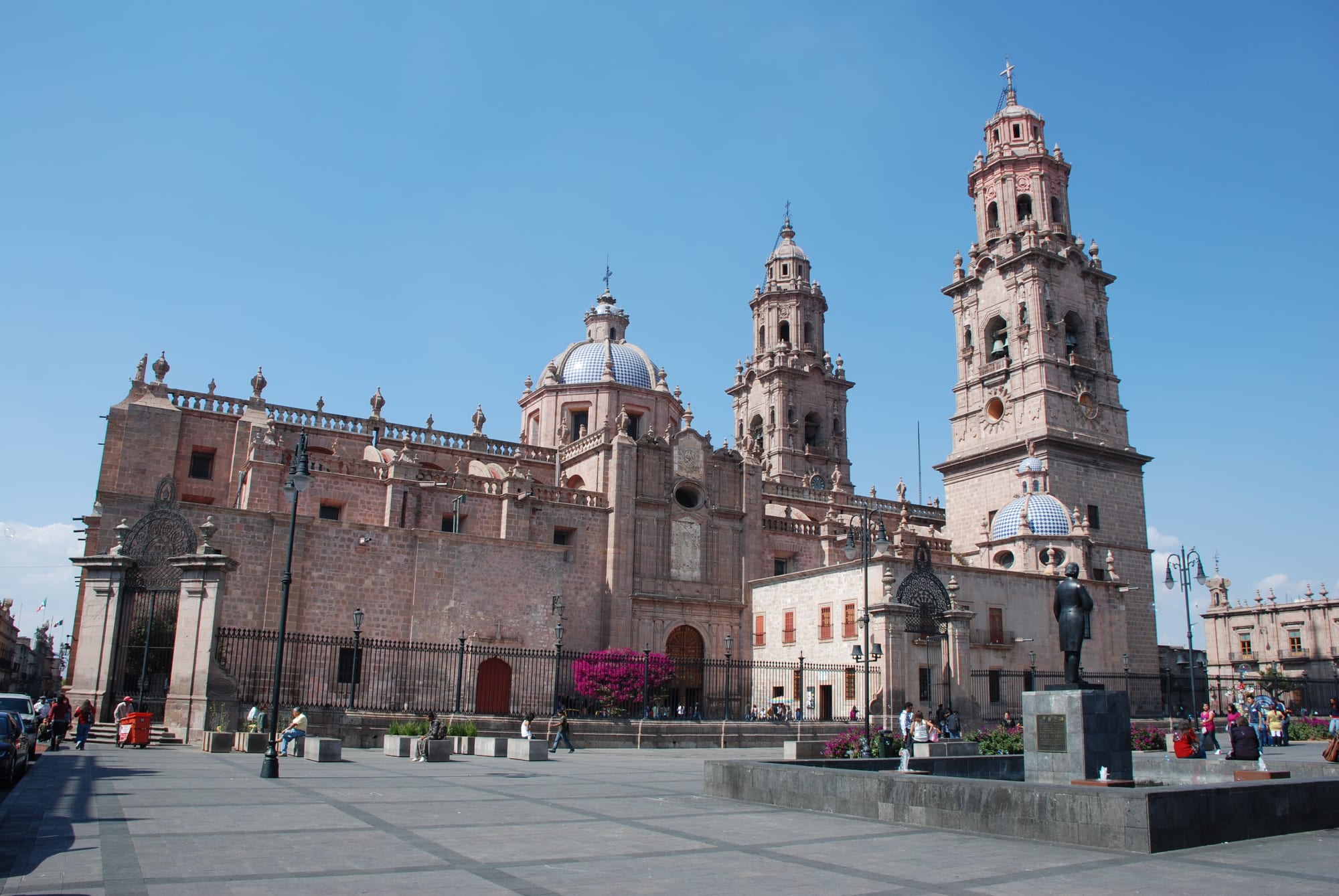
A pink stone baroque cathedral with two tall bell towers and a tiled dome beside a paved square under a blue sky

Guadalajara & the Pacific Centre, Mexico

Morelia

Morelia Cathedral, built of the city's pink stone between 1660 and 1744. (Adavyd / Wikimedia Commons · CC BY-SA 3.0)

The capital of Michoacán, in the Guayangareo Valley of west-central Mexico. Founded in 1541 as Valladolid, it became the seat of colonial Michoacán, educated the independence leaders Hidalgo and Morelos and took Morelos's name in 1828; its centre of pink stone churches, arcades and a long aqueduct has been a UNESCO World Heritage Site since 1991.

Neighbourhoods

  • Centro Histórico
    • First-time visitors
    • Historic district
    • Best for food

    The UNESCO-listed old city, still laid out much as it was in 1541, with gently curving streets and more than a thousand historic buildings, nearly all of pink stone. The cathedral, the main plazas with their arcades, museums, cafés and most hotels are here.

    Open in Maps
  • Around the aqueduct
    • Architecture
    • Cafés and bars

    East of the centre, where the colonial aqueduct runs down the middle of Avenida Acueducto to the Fuente de las Tarascas. The plaza at its foot is surrounded by shops, cafés, bars and restaurants.

    Open in Maps
  • Camelinas and the south
    • Quiet and residential
    • Restaurants
    • Shopping

    Newer, upscale districts south of the centre, with restaurants, shopping malls and the road to Pátzcuaro.

    Open in Maps

Things to do

Famous landmarks

  • Morelia Cathedrallandmark

    The Cathedral of the Transfiguration, built of pink stone between 1660 and 1744, whose two towers can be seen across the valley; inside are a silver baptismal font and a large monumental organ.

    Open in Maps
  • Morelia Aqueductlandmark

    An aqueduct first documented in 1549 and rebuilt after a collapse in the 1780s, which carried water to the city until 1910; its stone arches still line Avenida Acueducto.

    Open in Maps
  • Palacio de Gobiernolandmark

    The former Tridentine seminary of San Pedro opposite the cathedral, where Morelos studied, now the state government seat, its first courtyard covered in murals by Alfredo Zalce.

    Open in Maps
  • Plaza de Armaslandmark

    The largest plaza of the centre, officially the Plaza de los Mártires, surrounded by arcades and colonial buildings, with a bandstand brought from London.

    Open in Maps
  • Fuente de las Tarascaslandmark

    One of the city's most popular fountains, in front of the aqueduct, installed in its present form in 1984, with flower gardens before it and the arches behind.

    Open in Maps

Museums

  • Museo Regional Michoacanomuseum

    A regional museum founded in 1886 in an ornate baroque house, with pre-Hispanic finds, colonial art and the painting Traslado de las Monjas, considered the finest colonial work produced in Michoacán.

    Open in Maps
  • Casa Museo de Morelosmuseum

    The house José María Morelos bought in 1802, now a museum of the independence period holding some of his own belongings.

    Open in Maps
  • Casa Natal de Morelosmuseum

    The site of the house where Morelos was born in 1765, restored and opened as a museum in 1964 with documents he signed and coins he minted.

    Open in Maps
  • Museo de Arte Colonialmuseum

    A collection of colonial documents, old books, religious ornaments and maps whose highlight is more than a hundred figures of Christ made by Indigenous artists from cornstalk paste.

    Open in Maps
  • Casa de la Culturamuseum

    The former Carmelite monastery of 1593, converted from 1977 into the home of the Michoacán Institute of Culture; its church is still in use.

    Open in Maps

Music, sport and markets

  • Conservatorio de las Rosasattraction

    A music conservatory in a historic monastery facing the Jardín de las Rosas, home to the Morelia Boys Choir.

    Open in Maps
  • Mercado de Dulcesmarket

    A long corridor of stalls selling Morelia's traditional sweets and inexpensive souvenirs.

    Open in Maps
  • Estadio Morelosattraction

    The city's football stadium, opened in 1989, home of Atlético Morelia.

    Open in Maps

Short trips from the city

  • Cuitzeoattraction

    A town on Lake Cuitzeo, north of Morelia.

    Open in Maps
  • Pátzcuaroattraction

    The colonial lake town that rivalled Valladolid for control of Michoacán in the 16th century, with the island of Janitzio offshore.

    Open in Maps
  • Monarch Butterfly Biosphere Reservepark

    High-altitude fir forests on the border of Michoacán and the State of Mexico, a World Heritage Site, where the butterflies spend the winter; El Rosario is the largest sanctuary on the Michoacán side.

    Open in Maps

Seasonal events

  • SalsaMichMarch

    A three-day salsa dance competition in the centre of the city that draws dancers from across Mexico.

  • Morelia International Film FestivalOctober

    A festival founded in 2003 and devoted mainly to new Mexican cinema, with a long partnership with the Critics' Week of the Cannes Film Festival.

Eat and drink

Long-standing places and food districts in Morelia. Hours, ratings and directions come from your maps app, always current.

Morelia classics

  • Restaurants under the portalsneighborhood

    Casual café and restaurant tables under the historic arcades of the main plaza.

    Open in Maps
  • Jardín de las Rosasneighborhood

    A shady plaza north-west of the cathedral, ringed by cafés and restaurants with outdoor tables.

    Open in Maps

Food districts and markets

  • Mercado Independenciamarket

    Morelia's main market, above all for fresh produce, meat and regional foods from across the state.

    Open in Maps
  • Mercado de Dulcesmarket

    The sweets market, a long corridor of stalls selling candy and other traditional sweets.

    Open in Maps

Experience Morelia

History

People lived in the Guayangareo Valley from at least the 7th century. The Purépecha dominated it from the 12th century without building a major town, and Matlatzinca settlers lived there with their permission, around what is now Plaza Juárez. The Spanish arrived in 1525–26, and in 1541 Viceroy Antonio de Mendoza founded a new city here. Its rapid growth threatened Bishop Vasco de Quiroga's capital at Pátzcuaro, and a long rivalry followed; the town received city status in 1545 as Valladolid, after Mendoza's home town, and after Quiroga's death the bishopric and government moved here in 1580.

The 17th and 18th centuries built the city that survives: the aqueduct, the cathedral, begun in 1660 and finished in 1744, and many monasteries and convents. Valladolid was a small city of about 20,000 but a centre of learning, and its College of San Nicolás and seminary educated Miguel Hidalgo and José María Morelos. A conspiracy against Spanish rule was uncovered in 1809; in 1810 Hidalgo took the city and proclaimed the end of slavery, and in 1814 the insurgent Mariano Matamoros was shot in the main square. In 1828 the city was renamed Morelia in Morelos's honour.

Liberal and conservative forces fought over Morelia through the 19th century, and the French occupied it in 1863. Factories, the telegraph and, in 1883, the railway followed. In the 20th century the city grew far beyond its colonial core, the historic centre was protected by law, and in 1991 UNESCO declared it a World Heritage Site. Street vendors were moved out of the centre in 2001, and in 2008 a grenade attack in the city killed eight people.

Culture & Customs

Morelia's identity rests on its stone. Almost all of the 1,113 historic buildings in the centre are of pink cantera stone, giving the city a unity that earned it nicknames such as the City of Pink Stone and the Garden of New Spain. The cathedral, dedicated to the Transfiguration of Christ, dominates the skyline.

It is also a city of learning and music. The Universidad Michoacana traces its roots to the College of San Nicolás founded by Vasco de Quiroga, and the Conservatorio de las Rosas, in a historic monastery, is home to the Morelia Boys Choir. The International Music Festival, begun in 1988 with the dream of making Morelia the "Salzburg of the Americas", brings orchestras and soloists from around the world, and the International Film Festival, founded in 2003, has become one of the main showcases for new Mexican cinema.

Pride in the independence heroes runs deep: Morelos's birthplace and his house are museums, and people born on 30 September are traditionally named after the city. The old bullring, the Plaza Monumental, now hosts concerts and lucha libre, and Atlético Morelia carries on the football tradition after the old first-division club moved to Mazatlán in 2020.

Daily Life

About 743,000 people lived in the city at the 2020 census, out of about 849,000 in the municipality and nearly 990,000 in the metropolitan area, which includes Tarímbaro and Charo. Morelia is the largest city in Michoacán and grew by almost 145,000 people between 2010 and 2020.

Services, commerce and tourism, drawn by the colonial centre, are the main economic activities, followed by construction and manufacturing. The Ciudad Industrial houses small and medium-sized firms making cooking oil, flour, cement, plastics and sweets. Crime linked to the drug trade in Michoacán has been a brake on tourism.

Rapid growth has brought problems. Since the 1980s, falling water tables from groundwater pumping have aggravated movement along geological faults beneath the city, damaging buildings, and new suburbs are spreading into the forests to the north that recharge the city's aquifer. Daily life for most residents is in the newer districts outside the centre, where combis, the shared minivans, carry much of the traffic, while the historic centre, cleared of street vendors and much through-traffic, is the place for strolling, shopping and meeting friends in the plazas.

Food

Michoacán's kitchen is one of Mexico's most distinctive, and Morelia is a good place to try it. Uchepos, small soft tamales of sweet fresh corn, are a breakfast staple, and corundas, triangular tamales eaten with cream and salsa, are their savoury counterpart. Sopa tarasca is a smooth bean soup flavoured with dried pasilla chillies and swirled with cream, and enchiladas morelianas, filled with chicken and potatoes, take their deep red colour and slow heat from guajillo chillies. Carnitas, pork slowly cooked in its own fat, are famous across the state, especially from the town of Quiroga.

Sweets are a Morelia speciality. Ate, a dense fruit paste sold in blocks, is the best known, and the Mercado de Dulces is lined with stalls of traditional sweets; a sweets museum is devoted to the craft. The ice-cream and paleta shops called La Michoacana, found all over Mexico, take their name from the state's tradition of fruit ice lollies.

The Mercado Independencia is the city's main food market, with fresh produce, meat and regional foods from across Michoacán, while the restaurants under the portals of the main plaza and around the Jardín de las Rosas serve the classic dishes at outdoor tables.

Planning tools

Budget

Morelia is good value, with prices close to the national average, and far fewer foreign tourists than the coast. Restaurants in the centre are affordable for their quality, and the plazas, churches and many museums cost little or nothing. Tours to the butterfly reserves are the main extra cost in winter.

Daily Budget Midrange
USD 70–150 (hotel in a colonial building, restaurants, museums, taxis and a butterfly tour)
Daily Budget Shoestring
USD 30–45 (hostel or budget hotel, market meals and street food, combis)

Base butterfly trips in Morelia or a nearby town rather than on a long day tour from Mexico City, and book early for the film festival in October.

Best Time to Visit

October to April is dry and sunny, and the butterflies are in the eastern forests from about November to March. Most rain falls from June to September. The film festival in October and Day of the Dead around Lake Pátzcuaro at the start of November make autumn the busiest season.

Suggested Number of Days

Two or three days covers the historic centre and its museums. Four or five allows time for the lakes and the butterfly forests of the state as well. The forests are best seen in winter, so the season changes the number.

First Visit
2–3 days
With Surroundings
4–5 days

Transportation

The centre is compact and walkable. Combis, shared minivans with their destinations written on the windscreen, and city buses cover the rest of the city, and taxis wait at sitios or can be called by radio. The bus station, with separate terminals for first- and second-class buses, is in the north of the city.

In Michoacán, travel on main highways with a reputable operator rather than driving rural roads, and avoid road travel at night.

Airport & Station Connections

General Francisco Mujica International Airport, in the neighbouring municipality of Álvaro Obregón, has flights to Mexico City, Guadalajara, Tijuana and several cities in the United States. Toll motorways link Morelia with Mexico City, three or four hours' drive away, and with Guadalajara, and first-class buses run to both.

Walkability

The historic centre is one of the most walkable in Mexico: its streets are wide, the plazas follow one another around the cathedral, and the aqueduct and the Fuente de las Tarascas are a short walk east. Outer districts such as Camelinas need a taxi or a combi.

Safety

Safety varies enormously by state and even neighbourhood. Michoacán has been badly affected by criminal violence, including extortion of avocado farmers, and the state is subject to 'reconsider' or 'do not travel' advisories. Morelia receives many visitors, but conditions can change quickly; in 2008 eight people were killed in a grenade attack in the city.

Stay on main routes, avoid road travel at night, use radio or app taxis, and follow local advice when visiting the butterfly reserves. Check current official travel advice before travelling.

Climate

A subtropical highland climate with warm days and cool nights all year because of the altitude. Most rain falls in the summer wet season from June to September; the rest of the year is mostly dry.

Summer
the wet season, with most of the year's rain; monthly average temperatures range between 14 and 22°C across the year, and the record high is 38.3°C
Winter
dry, with cool nights — the coolest monthly averages are around 14°C, and the record low is −5.2°C

Local Customs

Morelia is a university city and state capital with strong Catholic traditions, and its people are proud of its heritage and its independence heroes; it is a custom to name people born on 30 September after the city. English is less widely spoken than in coastal resorts. Tipping is customary in restaurants.

Dress modestly in churches and keep quiet during services, and ask before photographing people, especially in markets.

Common Payment Methods

The currency is the Mexican peso. Cards are accepted in most hotels and many restaurants in the centre, and ATMs are common; markets, combis, street food and small shops need cash in pesos.