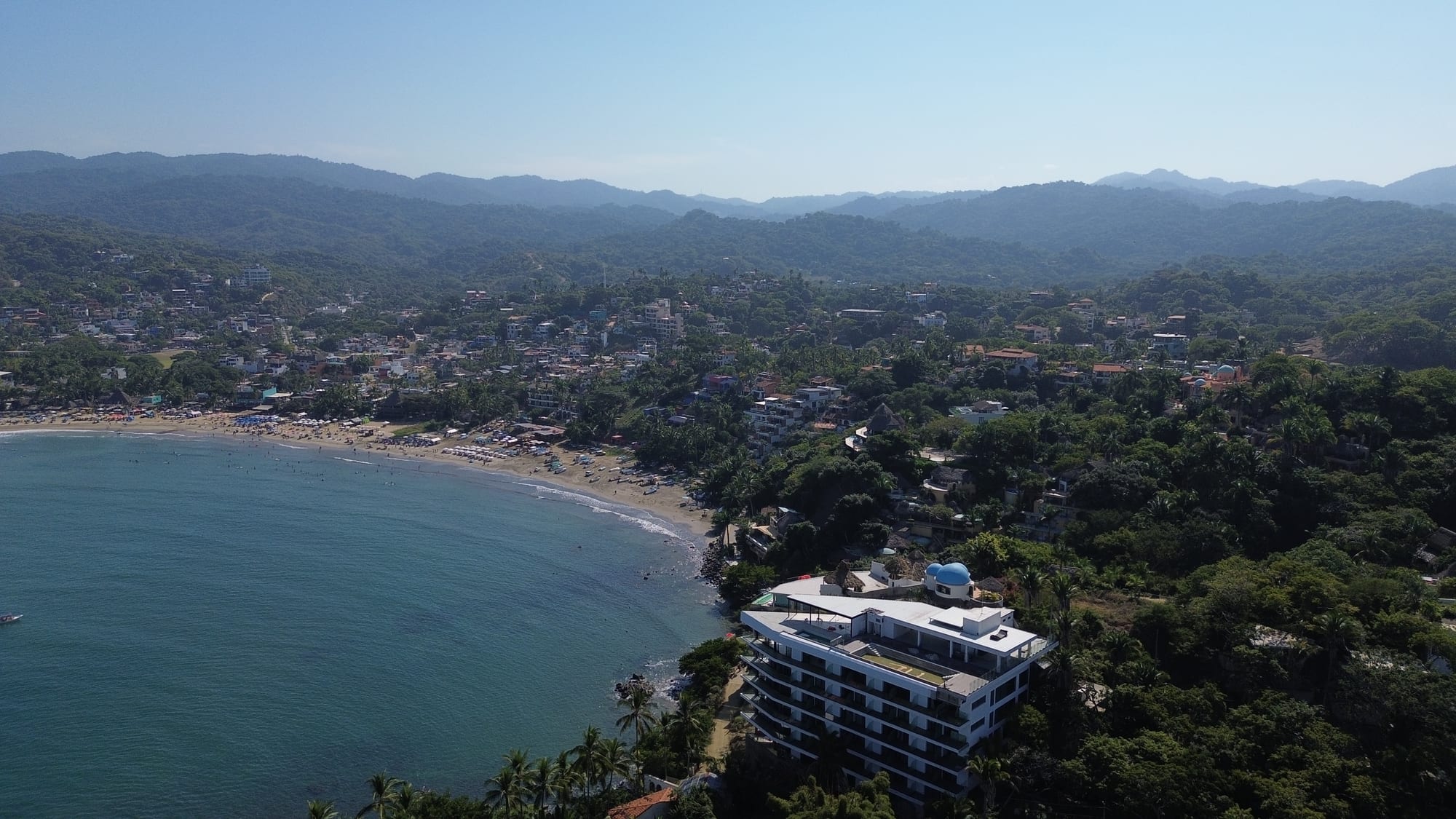
Aerial view of a curving sandy bay with houses spread over green jungle hills and mountains behind

Guadalajara & the Pacific Centre, Mexico

Sayulita

Sayulita's main beach and the town on the hills behind it, seen from the air. (Luisalvaz / Wikimedia Commons · CC0)

A small beach town on the Pacific coast of southern Nayarit, just north of the Bay of Banderas and about 37 km from Puerto Vallarta. It grew from coconut-oil ranches and fishing, and surfers have come since the 1960s; today its gentle waves, taco stands, plaza craft sellers and jungle-covered hills draw crowds every winter.

Neighbourhoods

  • Town centre and Playa Sayulita
    • First-time visitors
    • Beaches
    • Best for food

    A few blocks of streets around the main plaza, where Huichol artisans sell their work, opening onto the main beach. Restaurants, taco stands, surf shops and most places to stay are within a short walk.

    Open in Maps
  • The south end
    • Quiet
    • Beaches
    • Views

    The southern side of the bay, where houses and villas climb the jungle-covered hill and a dirt road leads through the town cemetery to the small Playa de los Muertos.

    Open in Maps

Things to do

Beaches and the water

  • Playa Sayulitabeach

    The main beach in front of the town, shallow far out from the shore, with a sandy-bottomed break that makes it a popular place to learn to surf.

    Open in Maps
  • Playa de los Muertosbeach

    A smaller beach south of the centre, reached by a dirt road through the town cemetery, with a local legend about the dead coming out at night to swim.

    Open in Maps

Markets

  • Huichol crafts in the plazamarket

    Huichol (Wixárika) artisans sell beadwork and other handmade crafts in the main plaza every day.

    Open in Maps

Short trips from the town

  • San Panchoattraction

    San Francisco, a quieter beach town a few kilometres up the coast, known locally as San Pancho.

    Open in Maps
  • Buceríasattraction

    A former fishing village on the Bay of Banderas, with cobbled streets and a long beach of white sand.

    Open in Maps
  • Punta Mitaattraction

    A private peninsula surrounded on three sides by beaches and coves, a 15-minute boat ride from the Marieta Islands.

    Open in Maps
  • Marieta Islandspark

    Small uninhabited islands off Punta de Mita, protected from fishing and hunting and visited by boat for their marine life.

    Open in Maps
  • Puerto Vallartaattraction

    The resort city on the bay to the south, with its Malecón, old town and airport.

    Open in Maps

Eat and drink

Long-standing places and food districts in Sayulita. Hours, ratings and directions come from your maps app, always current.

Sayulita classics

  • Taco stands of the centreneighborhood

    Street-side taco stands around the centre, the cheapest way to eat in town, with fish and meat tacos.

    Open in Maps
  • Beachfront palapa restaurantsrestaurant

    Palm-thatched restaurants on the sand serving fish tacos, tostadas and other seafood.

    Open in Maps

Cafés and bars

  • Bars around the plazaneighborhood

    Beach bars below the plaza and wine and cocktail bars on the square itself.

    Open in Maps

Experience Sayulita

History

The town's name was given by Lauro González Guerra in honour of his home town of Sayula in Jalisco; Sayulita is its diminutive, and Sayula comes from a Nahuatl word meaning a place where flies abound. The first settlers came to work on coconut-palm ranches, part of a hacienda that extracted oil from the nuts of the cohune palm. During the coconut-oil boom many workers died of lung disease from breathing the dust thrown up when the coconuts were split. The hacienda also became an important cattle estate.

In 1936 the livestock was sold and the land handed over to the workers, forming the Sayulita ejido, a communal farm. Coconut production fell sharply in the 1940s, and farming and fishing became the main ways of making a living, with snapper, grouper, shrimp, oysters and lobster among the catch.

Change came with the road. The highway from Las Varas to Puerto Vallarta, built in 1965, opened the coast to visitors, and surfers had already begun to find the beach in the 1960s. A development programme later paved the streets and built squares, a market and pavements. Once a beach of surfers and backpackers, Sayulita has become a busy stop on the Riviera Nayarit, the name given to the Nayarit coast from San Blas south to the Bay of Banderas.

Culture & Customs

Surfing shapes the town's identity. The main beach has a gentle, sandy-bottomed break where beginners learn, and a rockier, more demanding section for experienced surfers, and surf shops and schools line the streets behind the sand. Yoga studios, surf shops and beach bars give the centre an informal air.

The Huichol, or Wixárika, are a visible presence. These Indigenous people of the Sierra Madre in Nayarit and Jalisco sell their beadwork and yarn crafts in the plaza every day, a reminder of the mountain cultures inland.

Local traditions are told with humour. Playa de los Muertos, the beach reached through the town cemetery, carries a legend that the dead rise at night and walk down to the water to enjoy the warm sea, so visitors are told not to stay on the beach after sunset. Small boats take visitors out to fish or, from about November to January, to watch whales.

Daily Life

Sayulita is a small town, a locality of the municipality of Bahía de Banderas in Nayarit, and its population swells with visitors in winter. Tourism is now the main business, from guesthouses and rented villas to restaurants, surf lessons, tours and craft stalls; thousands of visitors pass through each year on the way to and from Puerto Vallarta.

Fishing continues on a smaller scale than before, with dorado, tuna, sierra, marlin, sailfish and roosterfish among the fish landed or caught by sport anglers.

Growth has brought problems. Prices have risen to levels unusual for a town of its size, and the water and sewage systems have struggled to keep up, with sewage at times reaching the swimming areas. The winter season, when the town is full, and the quieter, wetter summer set the rhythm of the year. Buses leave the town's terminal for Puerto Vallarta every 10 to 15 minutes, and beyond the last streets the jungle-covered hills, home to armadillos, coatis, iguanas and deer, begin almost at once.

Food

Sayulita eats from the sea. Fish tacos, spicy tuna tostadas and other seafood dishes are the staples of its restaurants, from palm-thatched palapas on the sand to small places in the centre, and dorado, snapper and tuna are among the local catch. Nayarit's coastal classic is pescado zarandeado, a whole fish split open and grilled over wood.

Street-side taco stands are the cheapest and most popular way to eat, with meat as well as fish tacos, and the town has forty or more restaurants for its size, ranging from traditional Mexican cooking to pizza and international menus aimed at visitors.

To drink, beach bars below the plaza serve margaritas and cold beer, and Mexico's tequilas can be sampled too. Beer bought in the shops around the square comes in returnable bottles, with a deposit paid back when they are brought back. Raicilla, the agave spirit of the Jalisco coast to the south, and tequila from the highlands inland are both easy to find.

Planning tools

Budget

Sayulita has become expensive for its size, with rooms and restaurant meals priced for winter visitors from the United States and Canada. Taco stands, campgrounds and the second-class buses keep costs down, and prices fall outside the winter season.

Daily Budget Midrange
USD 100–200 (boutique hotel or rented bungalow, beachfront restaurants, surf lessons, boat trips)
Daily Budget Shoestring
USD 35–60 (campground or hostel bed, taco stands, local buses)

Book rooms early for Christmas, New Year and the northern winter; rent surfboards rather than bringing them, and use the bus rather than taxis to Puerto Vallarta.

Best Time to Visit

Winter is the busy season, with dry weather and the small, easy waves that suit beginners from January to March; boat trips go whale watching from about November to January. Summer and early autumn are hot and wet, with the risk of Pacific hurricanes, and the town is quieter.

Suggested Number of Days

Two or three days is enough for the town and its beaches. A week allows a relaxed beach and surf stay with time for the coast nearby. Surfers learning the sport often stay longer.

First Visit
2–3 days
With Surroundings
5–7 days

Transportation

The centre is a few blocks across and easily covered on foot. ATVs and horses can be hired for jungle tours, and a car is useful only for staying more than two or three kilometres out of town. Second-class buses run frequently from the town's bus terminal to Puerto Vallarta and less often to San Pancho, Tepic and Compostela.

On the bus, tell the driver where to stop; second-class buses have little room for large suitcases.

Airport & Station Connections

Sayulita is about 37 km north of Puerto Vallarta on Federal Highway 200, a two-lane road. The nearest airport is Licenciado Gustavo Díaz Ordaz International Airport at Puerto Vallarta; from there, frequent green and white Compostela buses marked Sayulita stop across the pedestrian bridge outside the terminal, and taxis also make the trip.

Walkability

The centre, the plaza and the main beach are all within a short walk of each other. Streets are uneven, and the roads to the outlying beaches and hills are dirt tracks, steep in places.

Safety

Safety varies enormously by state and even neighbourhood. Sayulita is part of the Riviera Nayarit, one of the tourist areas of the region that receive many visitors. In February 2026, during two days of unrest across some twenty states, Puerto Vallarta airport, the nearest, cancelled its international flights. On the beach the main hazards are rip currents and stingrays in the shallows. Rapid growth has strained the water system, and at times sewage has reached the swimming areas.

Shuffle the feet when wading to avoid stepping on stingrays, swim where others do and heed local advice about currents and water quality, and use ATMs inside shops rather than on the street. Check current official travel advice before travelling.

Climate

A hot coastal climate, dry and sunny in winter and humid and rainy from about June to October, when Pacific hurricanes can strike. The figures below are the region's for the coast.

Summer
hot and humid on the coast, 30–35°C (the region's figure), with heavy rain
Winter
warm and sunny, around 28°C by day (the region's figure)

Local Customs

Sayulita is a relaxed beach town, and swimwear is normal on the sand. Huichol artisans sell their crafts in the plaza every day. Tipping is customary in restaurants.

Ask before photographing people, especially Huichol vendors; return beer bottles for the deposit; and keep noise down late at night in residential streets.

Common Payment Methods

The currency is the Mexican peso. There are ATMs around the village, but use those inside shops or banks where possible. Many restaurants and shops take cards, though taco stands, buses and plaza craft sellers need cash.