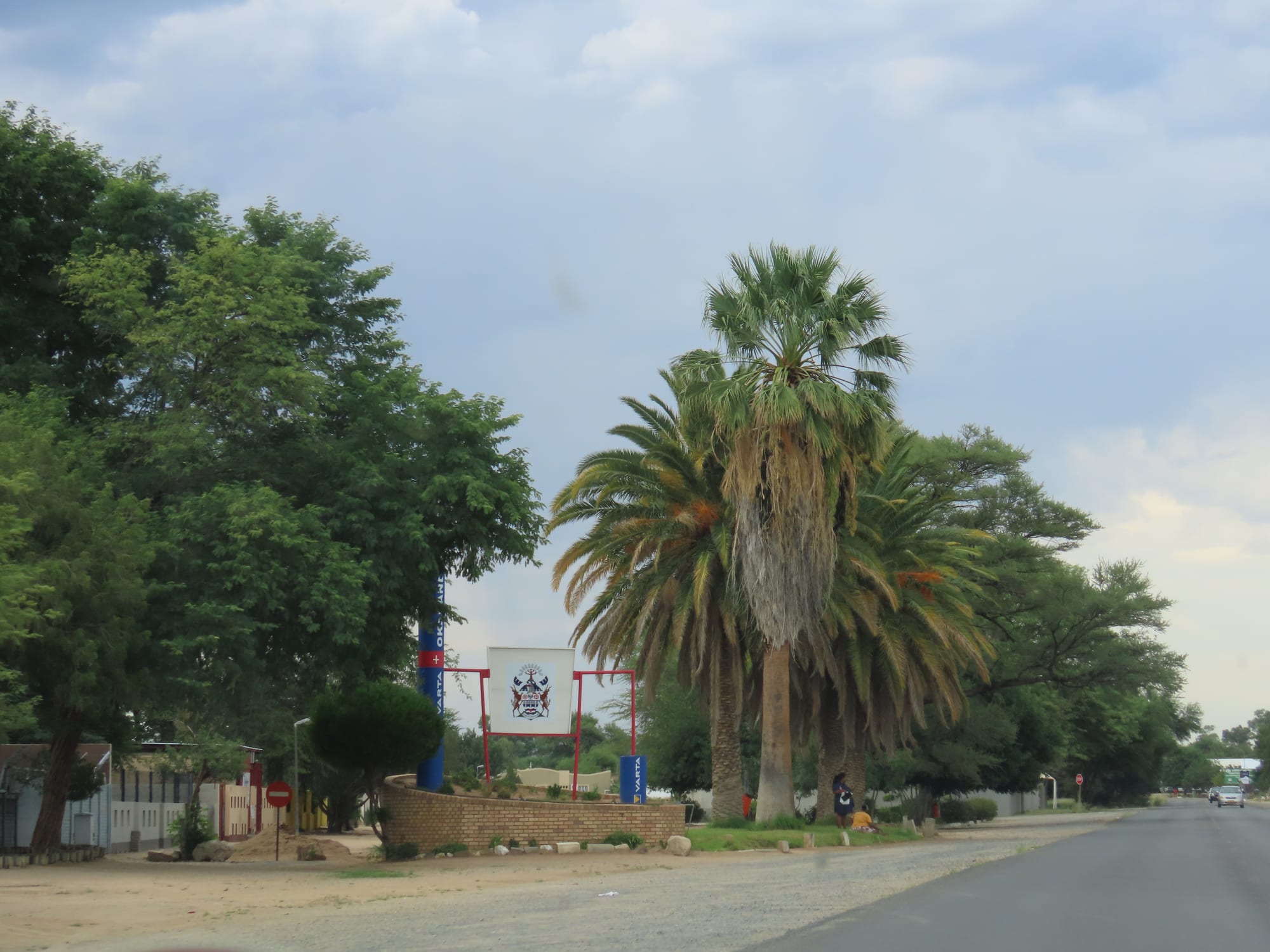
A wide road entering a town past tall palm trees, thorn trees and a low brick wall carrying the town's coat of arms

Windhoek & Central Namibia, Namibia

Okahandja

The main road into Okahandja, with the town's coat of arms beside the palms at the entrance. (Martin Hipangwa / Wikimedia Commons · CC BY-SA 4.0)

A market town on the B1 about 70 kilometres north of Windhoek, where the roads to the coast and to the north divide. It grew around a Rhenish mission of 1844 at the confluence of two seasonal rivers, and is the Herero royal town, where paramount chiefs are buried and where thousands gather each August. Travellers know it for the long rows of woodcarvers' stalls on the main road.

Neighbourhoods

  • The town centre
    • First-time visitors
    • Practicalities
    • Historic district

    A compact grid between the B1 and the railway, with supermarkets, banks, fuel stations, the old mission church and the municipal offices. Most passing traffic stops here for fuel and groceries before turning north or west.

    Open in Maps
  • Nau-Aib
    • Local life
    • Markets

    The township on the northern side of the town, where most of Okahandja's residents live. Its streets hold small shops, bars, churches and open-air meat grills, and new housing areas keep extending it.

    Open in Maps
  • The craft-market strip
    • Shopping
    • Street life

    The stretch of the main road where the woodcarvers' co-operatives and stalls stand in rows under corrugated roofs. Carving, sanding and selling all happen on the spot, and it is the busiest place in Okahandja.

    Open in Maps

Things to do

In the town

  • The woodcarvers' marketsmarket

    Open-air markets of carvers' stalls on the main road, selling animals, bowls, masks, walking sticks and furniture worked mostly in hardwood.

    Open in Maps
  • The graves of the Herero chiefslandmark

    The graves of Herero and Nama leaders buried in the town, among them Maharero, Samuel Maharero, Jan Jonker Afrikaner, Hosea Kutako and Clemens Kapuuo, and the destination of the procession held every August.

    Open in Maps
  • The mission churchlandmark

    The church of the Rhenish mission whose missionaries, Hugo Hahn and Heinrich Kleinschmidt, were assigned to the town in 1844, standing near the centre and still in use by its congregation.

    Open in Maps

Short trips from the town

  • Von Bach Dampark

    A rock-fill dam on the Swakop river a few kilometres south of the town, built in 1968, whose reservoir supplies much of Windhoek's water as well as Okahandja's.

    Open in Maps
  • Gross Barmenattraction

    Hot springs about 25 kilometres west of the town, developed as a resort with thermal pools, on the site of the Rhenish mission station of Barmen, whose ruined mission house can still be seen.

    Open in Maps
  • Windhoekattraction

    Namibia's capital, an hour south on the B1, with the country's museums, restaurants, car-hire firms and the international airport east of it.

    Open in Maps

Seasonal events

  • Herero DayAugust

    A three-day gathering of the Herero people, also called Red Flag Day or Otjiserandu, marked on 26 August, the date on which Samuel Maharero was reburied here in 1923. Men in military-style uniforms and women in the long Herero dress and horned headdress process to the graves of the chiefs, and a church service follows.

Eat and drink

Long-standing places and food districts in Okahandja. Hours, ratings and directions come from your maps app, always current.

Eating in Okahandja

  • Kapana and grills in Nau-Aibmarket

    Strips of beef grilled over open fires and cut up on the spot, dipped in a dry chilli and spice mix and eaten standing with vetkoek, the fried dough balls also called fat cakes.

    Open in Maps
  • The main-road cafés and takeawaysneighborhood

    Fuel-station bakeries, chicken and burger counters and a few sit-down places along the B1 serve most of the town's passing traffic, with steaks, pies, chips and pap.

    Open in Maps
  • Biltong and farm-stall countersmarket

    Butcheries and roadside stalls sell biltong, droëwors and boerewors made from beef and game raised on the surrounding farms, the classic Namibian road-trip supply.

    Open in Maps

Experience Okahandja

History

Okahandja stands where two usually dry rivers, the Okakango and the Okamita, come together, and the water beneath the sand made it a meeting place long before it was a town. Herero and Nama groups settled here around 1800, and in 1844 two missionaries of the Rhenish Mission Society, Hugo Hahn and Heinrich Kleinschmidt, were assigned to the town, bringing a church and, by the 1870s, its first school. The following decades were violent: the Oorlam under Jonker Afrikaner, who had settled at Windhoek to the south, fought the Herero for control of grazing and cattle, and Okahandja changed hands more than once.

By the later nineteenth century it was the seat of the Herero paramount chiefs, and it has remained the Herero royal town ever since. Germany claimed the territory in 1884, and settlers, soldiers and the railway followed; a military post set up in 1894 is the date the town officially recognises as its founding. When the Herero rose in 1904 against the loss of their land and cattle, the war that followed was catastrophic for them: German troops defeated them at the Waterberg to the north-east, survivors were driven into the waterless Omaheke, and Germany has since acknowledged that a genocide was committed.

The bodies of chiefs killed or exiled in those years were later brought back to Okahandja, and the graves became the focus of an annual commemoration that continues today. Under South African rule the town served the surrounding cattle farms and the traffic on the road north. Since independence in 1990 it has grown quickly as a satellite of Windhoek, with new housing, light industry and the craft markets that line the main road.

Culture & Customs

Okahandja's identity is Herero. The graves of the paramount chiefs stand in the town, and on a weekend each August thousands of people converge on it for the commemoration usually called Herero Day: men march in uniforms modelled on nineteenth-century colonial military dress, women wear the long Victorian-style dresses and horn-shaped headdresses that Herero women adopted from missionaries and made their own, and processions move through the streets to the graves. Different Herero groups keep their own flag days, and the occasion is one of mourning and of political assertion as much as of display.

Cattle remain central. Herds are wealth, inheritance and standing, praise names and family history are recited through them, and the holy fire of the homestead still matters in Herero tradition alongside Lutheran church membership, which is near-universal. Ovambo, Damara and Nama families, Afrikaans speakers and a small German-Namibian community share the town, and Otjiherero, Afrikaans, Oshiwambo and English are all heard in the streets.

The other visible culture is craft. The woodcarvers' co-operatives on the main road, many of whose carvers come from the Kavango regions in the far north-east, have made the town the country's best-known place to buy carvings, and haggling over a giraffe or a salad bowl is a ritual of most Namibian road trips.

Daily Life

About 45,000 people lived in Okahandja at the 2023 census, and the town has been one of the fastest-growing in the country, filling with people who work in Windhoek or who came looking for work and stayed. Most live in Nau-Aib and the newer housing areas spreading north of it, where serviced plots, water and electricity lag behind the arrivals; the older centre and the farm-style houses near the river hold a smaller share.

Work comes from the road, the farms and the capital. The B1 traffic supports fuel stations, takeaways, workshops and the craft markets; the surrounding cattle farms send stock to market and buy their supplies here; and there is light industry and building work for the new housing. Many residents commute the hour to Windhoek, and the town has become in part a dormitory for the capital, with cheaper plots and rents.

The rhythm is early, and the middle of the day belongs to the markets and the passing traffic. Water is the recurring worry: the Von Bach Dam nearby supplies Windhoek rather than only the town, and dry years are felt by farmers first. Unemployment among the young, land and housing allocation, and the cost of transport to the capital are the standing local issues.

Food

Beef is the foundation, as it is across central Namibia. The everyday street meal is kapana, thin strips of beef grilled over open fires at the market stalls and roadsides, cut into pieces with a knife, dipped in a dry mix of chilli, salt and spice and eaten from the hand, usually with vetkoek — fried dough balls, also called fat cakes — and a cold drink. Boerewors, a coarse coiled sausage, and grilled chicken are sold the same way.

At home and at guesthouses the staples are pap or oshifima, the stiff porridge of maize or pearl millet eaten with the fingers alongside a relish of meat, beans or wild spinach, and stews cooked slowly in a three-legged potjie pot. Herero households prize omaere, thick soured milk, drunk or eaten with porridge. Braaied meat is the centre of every weekend gathering, and game from the farms — oryx, kudu and springbok — appears on menus and in the biltong and droëwors sold by weight in the butcheries.

The German-Namibian inheritance shows in bakery counters with bread rolls and cakes, in smoked sausage, and in lager brewed in Windhoek an hour down the road, which is the standard drink. Roadside stalls sell melons, maize, tomatoes and, after good rains, wild mushrooms and mopane caterpillars in season.

Planning tools

Budget

Okahandja is cheap, and most travellers pass through rather than stay, stopping to buy carvings, fuel and groceries. Guesthouses and campsites in and around the town cost well below Windhoek prices, and the guest farms and lodges on the roads out charge more for dinner, bed and breakfast. Carvings are bargained for, in cash.

Daily Budget Midrange
USD 120–250 (a guesthouse or nearby guest farm, restaurant meals, a hire car and fuel)
Daily Budget Shoestring
USD 40–70 (a campsite or basic guesthouse, self-catering and street food, a shared hire car)

Prices at the craft markets are negotiable and quoted in Namibian dollars or rand; agreeing a price for several pieces together usually works better than haggling item by item.

Best Time to Visit

May to October is dry, clear and comfortable, and it is also the main travelling season, so the markets are at their busiest. August brings the Herero commemoration, when the town fills and accommodation is scarce for miles around. The rains from about December to April green the hills and fill the dam, with heavy afternoon storms.

Suggested Number of Days

Most people give the town a couple of hours on the way past, which covers the markets and the centre. A night here or on a nearby farm makes sense for the dam, the hot springs and a slower look at the town, or for anyone arriving late from the capital.

First Visit
Half a day
With Surroundings
1–2 days

Transportation

The town is small enough to cross on foot, and everything else is done by road. The paved B1 runs through it, with the B2 to Swakopmund branching west just outside town, so traffic is constant. Shared taxis serve the township and the centre, and minibuses on the Windhoek to northern routes stop here; there is no useful public transport to the dam or the springs.

The stretch of the B1 between Windhoek and Okahandja is one of the busiest roads in Namibia and carries heavy truck traffic, so overtaking needs care.

Airport & Station Connections

Okahandja lies about 70 kilometres north of Windhoek, under an hour by car on the paved B1, and is the junction for the B2 west to Swakopmund and Walvis Bay. Long-distance coaches and minibuses stop on their way north, and the railway still runs freight through the town. Most visitors arrive by hire car from the capital or its international airport, about 100 kilometres away.

Walkability

The centre and the craft markets can be walked in half an hour, and the pavements along the main road are used all day. Beyond the centre the town spreads out, the walk to Nau-Aib is long and hot, and the dam and hot springs are far outside walking range. Crossing the B1 on foot needs care because of the speed of the through traffic.

Safety

Okahandja is a calm town, and the crime visitors meet is opportunistic: bag-snatching and theft from parked cars around the markets and fuel stations, and pressure to buy at the stalls. Road risks matter more — heavy traffic on the B1, livestock and wildlife on the roads at dusk and after dark, and flooded river crossings during summer storms.

Namibia is one of the safer countries in Africa for visitors. Lock valuables out of sight when parked at the markets, carry small notes for buying carvings, avoid driving after dark, and take local advice before walking after dark. Check current official travel advice before travelling.

Climate

Semi-arid highland bush at about 1,350 metres, hot by day and much cooler at night, with almost all rain falling in summer thunderstorms and a dry, cloudless winter. Southern hemisphere seasons apply, so summer runs from December to February and winter from June to August.

Summer
hot, about 31–35°C by day from December to February, with afternoon storms and mild nights
Winter
dry and sunny, about 22–26°C by day from June to August, with cold nights near freezing

Local Customs

This is the Herero royal town, and Herero custom is respected here in a way that visitors should follow: the chiefs' graves are a sacred place rather than a photo stop, and the August commemoration is a solemn occasion as well as a spectacle. Otjiherero, Afrikaans, Oshiwambo and English are all spoken, greetings come before business, and dress at church and at the graves is formal.

Ask before photographing people, especially Herero women in traditional dress and anyone at the graves or in a procession. Tipping is usual at around ten per cent in restaurants and a few dollars for guides and petrol attendants.

Common Payment Methods

The Namibian dollar (N$) is used, pegged one-to-one to the South African rand, and rand notes are accepted. Supermarkets, fuel stations and guesthouses take cards, and there are ATMs in the centre. The craft markets are a cash business, so notes in small denominations are worth carrying before arriving.