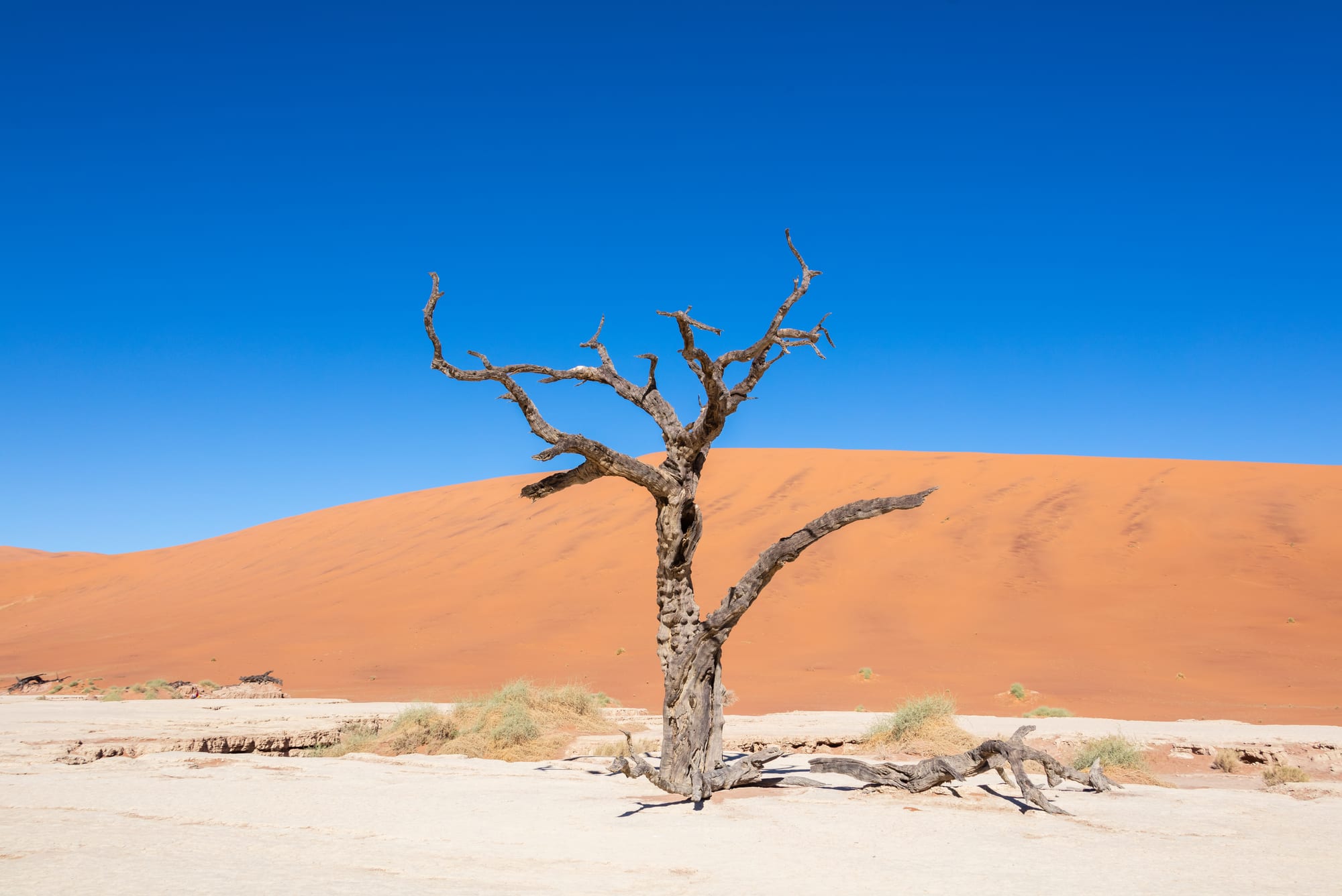
A white clay pan dotted with black dead camelthorn trees beneath a towering orange sand dune under a deep blue sky

Namibia

Deadvlei, a clay pan of dead camelthorn trees thought to have died 600 to 700 years ago, below the dunes of Sossusvlei in the Namib-Naukluft Park. (Diego Delso / Wikimedia Commons · CC BY-SA 4.0)

A vast, arid country on the southwest coast of Africa — the Namib Desert along the Atlantic, the Kalahari inland, and one of the lowest population densities on Earth — with a German and South African colonial past and a strong conservation record.

Explore Namibia

History

The San and the Khoekhoe — hunter-gatherers and herders — were the first inhabitants, followed over centuries by Bantu-speaking farmers and herders such as the Ovambo and Herero, while the Namib Desert kept the coast almost empty. Germany claimed the territory in 1884 as German South West Africa. When the Herero and Nama rose against colonial land seizures in 1904, German forces responded with extermination orders, desert drives, and concentration camps that killed about 80 per cent of the Herero and half the Nama — widely called the first genocide of the twentieth century, and acknowledged as genocide by Germany in 2015.

South Africa occupied the territory during the First World War and governed it first under a League of Nations mandate and then, after the United Nations revoked that mandate, in open defiance of international law, extending apartheid across it. The liberation movement SWAPO began an armed struggle in 1966.

A UN-supervised transition led to independence in 1990 under Sam Nujoma. Namibia has been a stable multiparty democracy since, though SWAPO has won every election. SWAPO was cut to a bare three-seat majority in the National Assembly at the November 2024 election, its weakest showing since independence, and its candidate Netumbo Nandi-Ndaitwah was declared the winner of the presidential vote and sworn in on 21 March 2025 as the country's first woman president. Germany and Namibia continue to negotiate over reparations for the genocide.

  • Namibia: The Desert and the Genocide — A vast, dry, thinly peopled land — Germany's main settler colony, the site of what is often called the 20th century's first genocide, then 75 years of South African rule and a long war for independence

Culture & Customs

Namibia's peoples remain fairly distinct, partly through geography and partly through apartheid-era divisions. The Ovambo of the north are the largest group; the Herero are known for the Victorian-style long dresses and horn-shaped headdresses their women adopted from missionaries and now wear with pride; the Nama and Damara speak Khoekhoe with its click consonants; and the Himba of the remote Kunene keep a semi-nomadic life, the women coating their skin and hair in red ochre and butterfat.

There are also long-settled Afrikaner, German, and mixed communities — Lutheran churches, German bakeries, and an Oktoberfest in Windhoek are part of the national fabric. Christianity, mostly Lutheran, is dominant.

A strong conservation ethic runs through public life. Community conservancies, in which residents manage wildlife and tourism on communal land and share the income, have helped desert-adapted elephant and black rhino recover from very low numbers.

  • Namibia: Many Peoples, One Handshake — A largely Christian country of many languages and peoples, where greetings are never skipped, traditional authorities still gather their communities, and a marula harvest, a horned headdress and a three-part handshake all say something about who Namibians are

Daily Life

Around three million people live in a country more than twice the size of Germany, making Namibia one of the emptiest places on Earth. Windhoek, in the central highlands, is the one real city; Swakopmund and Walvis Bay sit on the coast; and the densely settled Ovambo areas of the far north hold much of the rural population on small millet farms.

The economy runs on mining — diamonds dredged from the seabed, uranium from the desert, and newer prospects in green hydrogen and offshore oil — together with fishing on the cold, productive Benguela current, cattle ranching, and tourism. By average income Namibia is upper-middle-income, but it is among the most unequal countries in the world, and recurring drought hits farmers and herders hard.

Life in the towns is comfortable and car-dependent; life in the communal north and the Kunene is close to the land, organised around cattle, millet, and the rains.

  • Namibia: A Day Measured in Kilometres — A household of around four spread across a country more than twice the size of Germany, children who board at a school hostel during term, and a nation where the drive is as much a part of daily life as the destination

Food

Namibian eating is built on meat: beef and game such as kudu, oryx, and springbok, grilled over a braai or dried into biltong, and slow stews cooked in a three-legged potjie pot. The barbecue is a social institution shared with South Africa.

The German legacy shows in bread, cakes, schnitzel, sausages, and lager brewed to the old purity law — Windhoek Lager and Tafel are the national beers. In the north, the staple is oshifima, a stiff porridge of pearl millet (mahangu), eaten with meat or a spinach relish, and mopane caterpillars are a seasonal protein. On the coast there is fresh line fish.

  • Namibia: Food and the National Dish — A pearl millet porridge from the country's north, dried game meat from its deserts, and a genuine German brewing tradition left behind by colonial rule

Attractions & Natural Wonders

Sossusvlei, in the Namib-Naukluft Park, has some of the world's highest dunes — Big Daddy stands about 325 metres — and the white clay pan of Deadvlei, studded with black skeletons of camelthorn trees. The Skeleton Coast to the north is a fog-bound shore of shipwrecks, a huge Cape fur seal colony at Cape Cross, and desert-adapted wildlife. Between them, Swakopmund is a German-flavoured seaside town ringed by dunes and adventure sports, and the Walvis Bay lagoon is rich in birdlife.

Etosha National Park, built around a vast salt pan, offers some of Africa's easiest self-drive game viewing, with elephant, lion, rhino, and giraffe gathering at its waterholes. Damaraland and Kaokoland hold the rock engravings of Twyfelfontein, a World Heritage Site, the granite dome of Spitzkoppe, the Brandberg with its ancient paintings, and free-ranging desert elephant and rhino.

In the south, Fish River Canyon is the largest canyon in Africa, about 160 kilometres long and almost 550 metres deep in places, with a famous multi-day hike, and the Quiver Tree Forest stands near Keetmanshoop. The lush Zambezi Region in the far northeast, a strip of rivers and floodplains, offers a completely different, water-rich Namibia of hippos and birdlife.

  • Namibia: Seven Attractions and Natural Wonders — The oldest desert on earth, dead trees standing in a bone-white clay pan, one of Africa's great wildlife parks built around a salt pan, and a coastline littered with shipwrecks called the Skeleton Coast

Planning basics

Budget

Namibia is a self-drive country, and the vehicle is the main cost, along with fuel over long distances and park fees. Camping and guest farms are affordable; lodges in the desert and near Etosha run high. Book vehicles and popular lodges months ahead in the dry season.

Daily Budget Midrange
NAD 2,500–6,000 / USD 140–330 per person (guesthouses and mid-range lodges, a 4x4, guided activities)
Daily Budget Shoestring
NAD 700–1,300 / USD 40–75 per person (camping, self-catering, a shared hire car, park fees)

Splitting a 4x4 and its fuel between three or four people is by far the biggest saving on a Namibian trip.

Visa Requirements

Namibia ended visa-free entry for 33 countries, among them the United Kingdom, the United States, Germany and most of the EU, on 1 April 2025, citing the lack of reciprocal arrangements for Namibians. Those nationals now buy a visa on arrival, or a simplified e-visa in advance, for a stay of up to 90 days; the visa on arrival costs about N$1,600 for citizens of non-African countries. Other nationalities still need a visa arranged beforehand. Check the current position before booking.

Typical Stay
Up to 90 days, on a visa on arrival or an e-visa for most Western nationalities

Confirm the latest rules with a Namibian mission, as the visa-fee policy is recent and still evolving.

Safety

Namibia is one of the safer countries in Africa for visitors. Opportunistic theft and occasional mugging occur in central Windhoek, especially after dark, but the real dangers are road-related: gravel-road rollovers, wildlife on the road, fatigue over long distances, and getting stuck far from help.

Health
Malaria is a risk in the far north and the Zambezi Region during the rains — take precautions there

Keep speeds down on gravel, don't drive at night, carry recovery gear and water, and lock valuables out of sight in Windhoek.

Climate

Desert and semi-desert, hot and very dry. The Atlantic coast is cool and often fog-bound, cooled by the Benguela current. The interior has hot days and cool nights, with cold nights and occasional frost in winter. Erratic rains fall between November and April, greening the land briefly.

Coast
Mild and foggy, 12–22°C year-round
Interior
Summer days 30–38°C; winter nights near or below freezing

Transportation

Windhoek's Hosea Kutako airport is the main gateway. Distances are enormous and there is almost no public transport, so nearly everyone self-drives — well-graded gravel roads on the main routes, and a 4x4 for the northwest and the parks. Fly-in safaris link remote lodges by light aircraft.

Drive slowly on gravel, watch for animals and soft sand, carry two spare tyres and plenty of water, and expect no phone signal for long stretches.

Best Time to Visit

May to October, the dry season, is best: cool, clear, and prime for game viewing as animals gather at Etosha's waterholes, with sharp light on the dunes. The green season from January to April brings dramatic skies, newborn animals, and migrant birds, but some gravel roads flood and wildlife disperses.

Events
Windhoek Oktoberfest (October); Herero Day gatherings; the /Ae//Gams Arts Festival in Windhoek

Currency

The Namibian dollar (NAD) is pegged one-to-one to the South African rand, and rand is accepted everywhere in Namibia (Namibian dollars are not accepted in South Africa). Cards work in towns and lodges; carry cash for fuel stations, small shops, and tips.

Symbol
N$
Currency Code
NAD — Namibian dollar (pegged to the South African rand)

Language

English is the sole official language, chosen at independence in place of the colonial-era Afrikaans and German, though few Namibians speak it as a first language. Afrikaans is widely used and German survives in a smaller community; Oshiwambo is the most common home language; and Khoekhoegowab (Nama/Damara), Otjiherero, Rukavango, and San languages are all spoken.

Widely Spoken
Oshiwambo, Afrikaans, Khoekhoegowab, Otjiherero, with German in a smaller community
Official Language
English