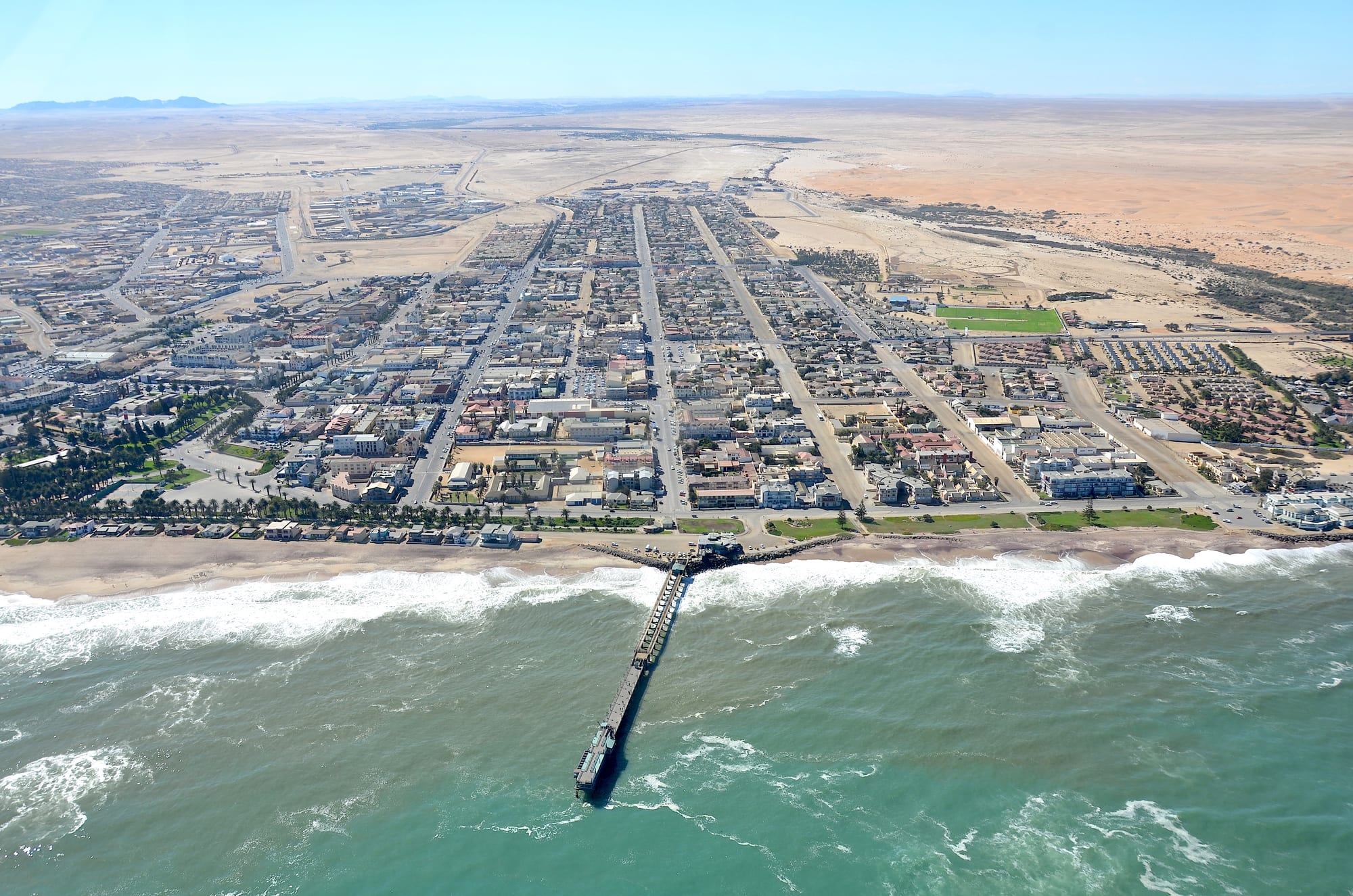
Aerial view of a low coastal town on a grid of streets between breaking Atlantic surf and open desert, with a long jetty reaching into the sea

Swakopmund, Damaraland & the Skeleton Coast, Namibia

Swakopmund

Swakopmund seen from the air, with its jetty reaching into the Atlantic and the Namib Desert behind the town. (Olga Ernst & Hp.Baumeler / Wikimedia Commons · CC BY-SA 4.0)

A seaside town on Namibia's Atlantic coast where the Namib Desert meets a cold, fog-bound ocean. Founded in 1892 as the main port of German South West Africa, it keeps streets of German colonial buildings, a jetty and palm-lined promenade, and lives today from tourism, holiday-makers from Windhoek and the uranium mines in the desert behind it.

Neighbourhoods

  • The old town centre
    • First-time visitors
    • Historic district
    • Cafés

    The grid of streets behind the seafront, where most of the German colonial buildings, the museum, bookshops, cafés, craft stalls and restaurants stand within a few blocks. Nearly everything a visitor wants is walkable from here.

    Open in Maps
  • The seafront and the Mole
    • Beaches
    • Walks and views
    • Families

    The promenade, lawns and palm trees along the shore, running from the sheltered beach beside the old Mole breakwater to the jetty. Cold water, wind and fog keep swimming brief, but the walk and the sunsets are the town's daily ritual.

    Open in Maps
  • Vineta and the northern suburbs
    • Quiet and residential
    • Self-catering stays

    Low streets of houses and holiday flats north of the centre, busy in the Namibian summer holidays and half-empty the rest of the year. Quiet, close to the beach and a short walk or drive from the centre.

    Open in Maps
  • Mondesa and Tamariskia
    • Local life
    • Street food
    • Markets

    The neighbourhoods east of the centre, built for black and mixed-race residents under apartheid-era planning and now home to most of the town's population, with churches, bars, kapana grills and craft markets. Community-run tours visit from the centre.

    Open in Maps
  • Kramersdorf and the desert edge
    • Quiet and residential
    • Desert views

    Older residential streets on the inland side of town, where gardens give way abruptly to gravel plains and dunes. The Swakop riverbed and the road towards the Welwitschia plains begin here.

    Open in Maps

Things to do

German colonial architecture

  • Woermannhauslandmark

    A merchant house of 1906 with a prominent lookout tower, the Damara tower, one of the oldest buildings in the town and now holding a public library.

    Open in Maps
  • Swakopmund Lighthouselandmark

    The red-and-white striped lighthouse, built in granite by the German Schutztruppe in 1902 beside the old state house, and the most photographed landmark in the town.

    Open in Maps
  • Hohenzollernhauslandmark

    An exuberant building of 1904 to 1906 in neo-baroque style, put up for the merchant Hermann Dietz and later run as the Hohenzollern Hotel; a national monument since 1972, it now holds flats.

    Open in Maps
  • Swakopmund Jettylandmark

    The pier first built in wood in 1905, after the Mole silted up, and replaced by a steel structure begun in 1914; it runs out over the surf and is now a pedestrian walkway.

    Open in Maps

Museums and exhibitions

  • Swakopmund Museummuseum

    The town's museum on the seafront near the lighthouse and the Mole, covering archaeology, minerals, the natural history of the coast, Namibia's peoples and the German colonial period.

    Open in Maps
  • Kristall Galerieattraction

    A purpose-built mineral museum and shop, known in German as the Kristallgalerie, showing Namibian crystals and gemstones.

    Open in Maps
  • National Marine Aquarium of Namibiaattraction

    A small aquarium on the seafront showing fish, rays and other life of the cold Benguela current, with a walk-through tunnel.

    Open in Maps

The beach and the dunes

  • The Molebeach

    The stone breakwater built by the Germans to shelter shipping, whose silting up left the sheltered town beach beside it.

    Open in Maps
  • Dune 7viewpoint

    A landmark dune in the belt that runs down the coast to Walvis Bay, named for standing seven miles from that town, now inside Dorob National Park and charging an entry fee; a steep climb of soft sand.

    Open in Maps
  • Martin Lutherlandmark

    A steam traction engine built in Leeds in 1895 and brought out to haul freight inland; it ground to a halt in the desert about 4 km outside town in early 1897 and was left there, restored in 1973 and again between 2000 and 2004.

    Open in Maps

Short trips from the town

  • Moon Landscapeviewpoint

    A valley of eroded granite hills above the Swakop river, cut into ridges and gullies that give the place its name.

    Open in Maps
  • Walvis Bayattraction

    The port city to the south, with a lagoon full of flamingos and pelicans and boat trips out to the seals at Pelican Point.

    Open in Maps
  • Cape Crossattraction

    A headland where the Portuguese navigator Diogo Cão set up a stone cross in January 1486, now marked by replicas since the original went to Berlin, and a state seal reserve holding one of the world's largest colonies of Cape fur seals.

    Open in Maps
  • Spitzkoppelandmark

    A group of bald granite peaks rising sharply from the plains between Usakos and Swakopmund, the highest about 670 metres above the desert floor, with prehistoric rock paintings and a community campsite among the boulders.

    Open in Maps

Eat and drink

Long-standing places and food districts in Swakopmund. Hours, ratings and directions come from your maps app, always current.

Swakopmund classics

  • German bakeries and cafés in the old centrecafe

    Rye bread, Brötchen, Apfelstrudel, Black Forest cake and strong coffee, a survival of the town's German kitchen that Namibians drive from Windhoek for.

    Open in Maps
  • Seafront restaurants and the jettyneighborhood

    Hake, kingklip, kabeljou, calamari and oysters from the cold Benguela current, served along the promenade and at the end of the jetty.

    Open in Maps
  • Beer halls and game menusneighborhood

    Eisbein, schnitzel and sausage alongside oryx, kudu and springbok steaks, with Namibian lagers brewed to the German purity law.

    Open in Maps

Markets and township food

  • Craft markets in the centremarket

    Open-air stalls of carvings, baskets and stone, with vendors from across Namibia and neighbouring countries; snacks and drinks are sold alongside.

    Open in Maps
  • Mondesa kapana grillsneighborhood

    Strips of beef grilled over coals and eaten with a dry chilli mix, sold at stalls in the township east of the centre and usually visited on a community tour.

    Open in Maps

Experience Swakopmund

History

The coast here was empty of settlement for centuries: fog, surf and desert deterred landings, and the Swakop river reaches the sea only after rare floods. When Germany claimed South West Africa in the 1880s it found that the one good natural harbour, Walvis Bay, was already British, so in 1892 a landing party marked out a town at the mouth of the Swakop and called it Swakopmund. Goods and troops were landed through the surf into small boats; a stone breakwater, the Mole, was built to shelter them and silted up within a few years, and a wooden jetty followed in 1905, itself replaced by a steel one begun in 1914.

The town grew as the colony's front door, with a railway inland to Windhoek, customs houses, merchant villas and a garrison, and much of its German architecture dates from this decade of building. It was also a place of suffering: during the Herero and Nama genocide of 1904 to 1908 prisoners were held in a camp here and worked on the harbour and railway, and many died. South African forces took the town in 1915, and trade shifted to Walvis Bay, leaving Swakopmund to decline into a quiet seaside resort for inland farmers and officials.

Uranium mining at Rössing from the 1970s, and later at Husab, brought steady work and population back to the coast, while independence in 1990 opened the town to international tourism. Swakopmund became Namibia's adventure and holiday capital, adding dune sports, hotels and restaurants, and expanding rapidly on its eastern side, where Mondesa and newer informal settlements now hold most of the town's residents.

Culture & Customs

Swakopmund's German character is the first thing visitors notice: street names, Lutheran and Catholic churches, bakeries selling Brötchen and Kuchen, half-timbered gables, a carnival and a shooting club. German is a home language for part of the population and a working language in some businesses, and the town has German schools and a German-language press. The effect is of a small Wilhelmine seaside resort transplanted to the desert.

That is only one layer. Most residents are Oshiwambo, Damara, Nama or Herero speakers living in Mondesa, Tamariskia and the settlements beyond, where church choirs, kapana grills and shebeens shape social life, and community-run tours bring visitors across a line that apartheid-era planning drew through the town. The colonial past is present and contested: the genocide, the graves and the street names are subjects of continuing public debate, and some names have been changed since independence.

The town also has a strong outdoor and adventure culture — sandboarding, quad biking, skydiving, fishing, surfing and desert running — and a long-running tradition of Namibians from Windhoek and the interior coming down to the coast in December for their summer holidays, when the population swells and the beachfront fills. Namibians call this migration "going to the coast", and the town's year is organised around it.

Daily Life

About 75,000 people live in Swakopmund, making it Namibia's fourth largest town and, with Walvis Bay 35 km down the coast, the country's second urban centre. The population divides sharply by area: the old centre and the seafront suburbs are low-density and often half-empty outside holiday season, while Mondesa, Tamariskia and the informal settlements to the east are crowded and growing quickly as people move in from the north looking for work.

Tourism is the visible economy — hotels, tour operators, restaurants, craft markets and the activity industry — but mining pays many of the steady wages, with the uranium mines in the desert inland running shift buses to the town. Fishing and the port at Walvis Bay, retirement, property and the public service fill out the rest. Green hydrogen projects on this coast are much discussed as a future employer.

Days begin under fog that often lifts by late morning, and the seafront fills in the late afternoon with walkers, joggers and anglers. Water and housing are the persistent problems: the town depends on desalination and boreholes in a desert, and informal settlements have grown faster than services. The contrast between the tidy colonial centre and the crowded eastern townships is the town's central social fact.

Food

Seafood from the cold Benguela current is the coast's great asset. Hake, kingklip, kabeljou and monkfish appear grilled and fried on almost every menu, with calamari, mussels and rock lobster in season, and oysters farmed in the lagoon at Walvis Bay are sold as a local speciality. Anglers work the beaches for kob and steenbras, and fish and chips is an everyday staple.

The German legacy runs deep in the kitchens. Bakeries turn out rye loaves, Brötchen, pretzels, Apfelstrudel and Black Forest cake; beer halls and restaurants serve Eisbein, schnitzel, Bratwurst and sauerkraut; and the local lagers, brewed to the old German purity law, are drunk with them. Coffee and cake in the afternoon is a genuine local habit rather than a tourist performance.

Namibian cooking sits alongside it. Game meat — oryx, kudu, springbok and zebra — is served as steaks, stews and carpaccio, and biltong and dried sausage are sold in butchers' shops. In Mondesa the everyday food is kapana, thin strips of beef grilled over coals and dipped in a chilli and salt mix, eaten with fat cakes (vetkoek) and pap. The Topnaar people of the Kuiseb valley south of town harvest the !nara melon, whose seeds are sold roasted and pressed for oil.

Planning tools

Budget

Swakopmund has the widest choice of accommodation in Namibia outside Windhoek, from backpacker hostels to seafront guesthouses and hotels, and food and drink cost less than in Europe. Adventure activities — quad biking, sandboarding, skydiving, scenic flights and dune tours — are the real expense, and prices climb in the Namibian holiday season from December to early January.

Daily Budget Midrange
USD 150–400 (guesthouse or hotel, seafood dinners, a hire car and a guided dune or desert trip)
Daily Budget Shoestring
USD 45–80 (hostel bed or camping, self-catering and bakery lunches, walking the town, one shared activity)

Book rooms and activities well ahead for late December and early January, when Namibians fill the town for their summer holidays.

Best Time to Visit

The coast works all year because the sea keeps temperatures even. September to November and March to May are pleasant and quiet, with more sun and fewer people. December and January are warmest and busiest, when Namibian families arrive. Winter, from June to August, is cool, grey and often foggy, but clear inland for desert trips.

Suggested Number of Days

Two or three days is enough for the town itself and one outing into the desert or the dunes. Four to six days suits anyone adding trips along the coast or inland. Activity bookings, fog-bound mornings and long driving distances all push the number up.

First Visit
2–3 days
With Surroundings
4–6 days

Transportation

The town is small and laid out on a grid, and most visitors walk in the centre. Taxis are cheap and run to Mondesa and the suburbs, and shared taxis and minibuses link Swakopmund with Walvis Bay through the day. Tour operators collect from accommodation for dune, desert and coastal trips, and a hire car is useful for anything inland.

The salt road north along the coast becomes slippery in fog and damp air, and sand blows across the tar between the town and Walvis Bay, so speeds should be kept moderate.

Airport & Station Connections

Most visitors drive: the paved B2 from Windhoek takes about four hours through Karibib and Usakos, and the coast road from Walvis Bay about half an hour. Walvis Bay's international airport, some 40 km south, has scheduled flights from Windhoek and regional connections, and Swakopmund has a smaller airport used mainly by charters and light aircraft.

Walkability

One of the easiest Namibian towns to explore on foot. The old centre is flat, compact and laid out in a grid, the seafront promenade runs for well over a kilometre, and the museum, jetty, shops and restaurants are all within ten or fifteen minutes of one another. Mondesa and the eastern suburbs are too far to walk comfortably, and the wind off the sea can be cold even in summer.

Safety

Swakopmund is a relaxed and generally safe town, with theft from parked cars, from beaches and occasional bag-snatching after dark the main problems. The Atlantic is cold and has strong currents and few lifeguards, the desert immediately behind the town is easy to underestimate, and adventure activities carry their own risks, so operators' safety records matter.

Carry extra water, fuel and two spare tyres, tell lodges the route, keep well back from elephants and do not swim on the open coast. Check current official travel advice before travelling.

Climate

Cool, dry and often foggy, one of the mildest climates in Africa. The cold Benguela current holds temperatures down and brings sea fog inland on many mornings, while rain is almost unknown. Being in the southern hemisphere, summer falls in December to February and winter in June to August. Easterly berg winds occasionally push hot desert air over the town.

Summer
mild, about 17–25°C, with morning fog that often clears by midday
Winter
cool and grey, about 12–20°C, with damp fog and cold wind off the sea

Local Customs

German is still widely spoken alongside English, Afrikaans, Oshiwambo and Khoekhoegowab, and German-language signs, churches and street names remain part of the town. Dress is casual but warm layers are normal even in summer. The colonial past, including the concentration camp that stood here during the Herero and Nama genocide, is a serious subject discussed plainly rather than avoided.

Tipping of around ten per cent is usual in restaurants, and a small tip for guides and car guards; ask before photographing people in the townships or at market stalls.

Common Payment Methods

The currency is the Namibian dollar, pegged one to one with the South African rand, which is accepted everywhere. Cards work in hotels, shops and restaurants and ATMs are easy to find in the centre. Craft stalls, taxis, tips and car guards need cash, and small notes are worth carrying.