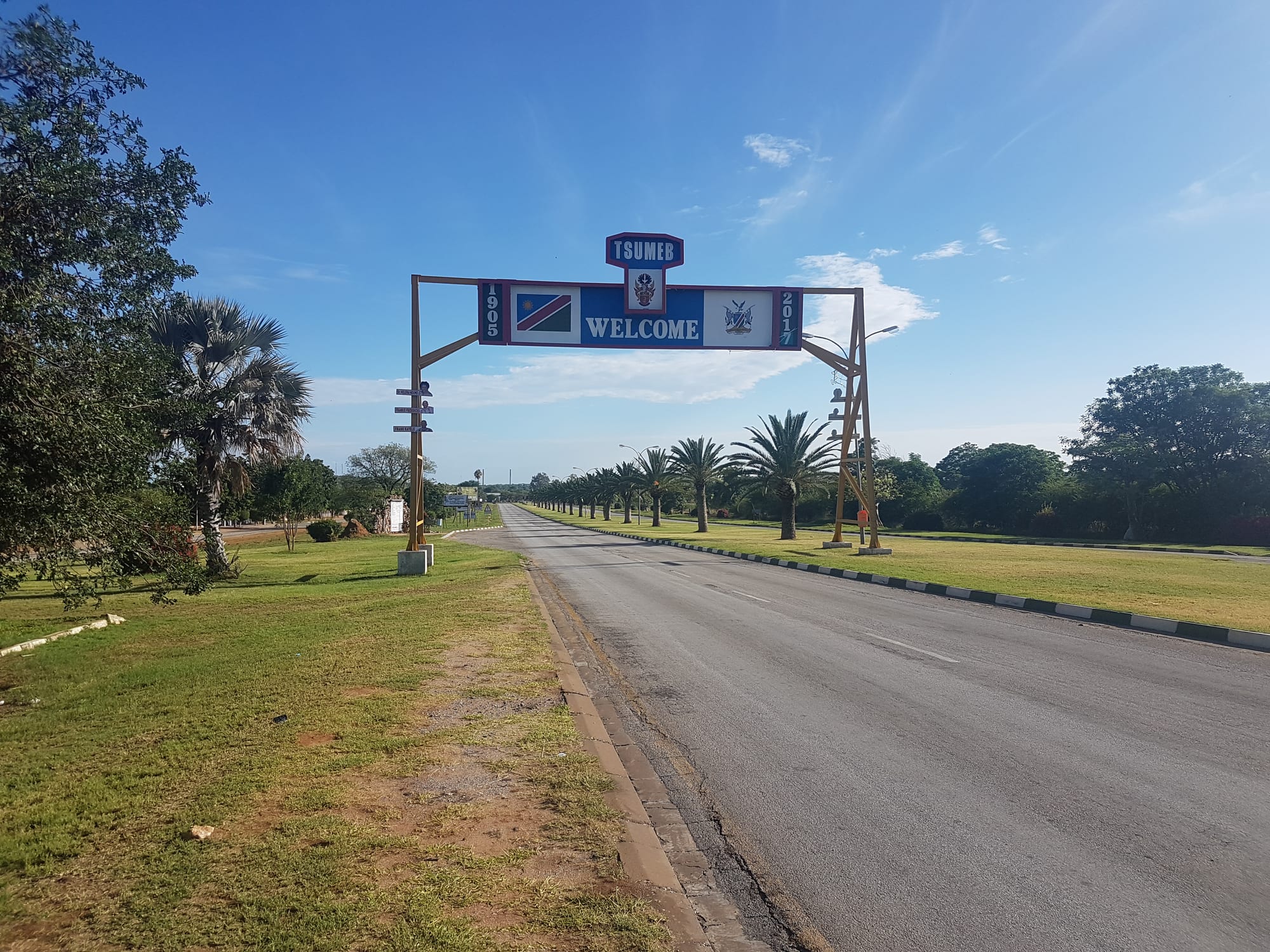
A palm-lined road running into a green town beneath a blue sky, passing under a painted welcome gantry

Etosha & the North, Namibia

Tsumeb

The palm-lined approach road into Tsumeb, with the town's welcome gantry across it. (Volly247 / Wikimedia Commons · CC BY-SA 4.0)

A mining town in northern Namibia, the largest town of the Oshikoto Region and its capital until 2008, built on an ore body so rich and so varied that its minerals sit in museum collections around the world. Copper, lead and zinc were dug here from the early 1900s, and the town that grew around the shafts is green, orderly and shaded, and serves as the usual eastern gateway to Etosha.

Neighbourhoods

  • The town centre
    • First-time visitors
    • Practicalities
    • Historic district

    A shaded grid of wide streets planted with jacarandas and bougainvillea, laid out around the mine, with the museum, churches, banks, supermarkets and most of the guesthouses. It is the last full-sized shopping stop before Etosha's eastern gate.

    Open in Maps
  • Nomtsoub
    • Local life
    • Markets

    The township north of the centre, built for mineworkers under South African rule and now home to a large part of the town's population, with small shops, bars, churches and open-air grills along its main roads.

    Open in Maps
  • The mine side
    • Industrial heritage
    • Quiet and residential

    The eastern edge of town, where headgear, dumps and processing works stand behind fences alongside the old company housing. It is a working industrial area rather than a place to wander, but it explains why the town is here.

    Open in Maps

Things to do

In the town

  • Tsumeb Museummuseum

    The town museum, with a mineral collection from the mine, the German field guns recovered from Lake Otjikoto in the years after 1915, and displays on colonial history and local cultures.

    Open in Maps
  • St Barbara's Catholic Churchlandmark

    The Catholic church of the mining town, named for Saint Barbara, the patron saint of miners, with a spire above the centre.

    Open in Maps
  • The mine headgear and dumpslandmark

    The winding gear, waste dumps and processing works on the eastern edge of town, the remains of an ore body worked from 1905 to 1996 and listed by the International Union of Geological Sciences among a hundred geological heritage sites worldwide.

    Open in Maps

Short trips from the town

  • Lake Otjikotoattraction

    A sinkhole lake about 20 kilometres north-west of the town, formed by a collapsing karst cave and a national monument since 1972, into which German troops dumped weapons and ammunition in June 1915 before surrendering.

    Open in Maps
  • Lake Guinasattraction

    The larger of Namibia's only two permanent natural lakes, a sinkhole about 38 kilometres west of the town on private farmland, known for its clear blue water and for Tilapia guinasana, a cichlid native to it alone.

    Open in Maps
  • Namutonilandmark

    The whitewashed German fort of 1896, destroyed in the battle of 1904 and rebuilt soon after, standing beside a rest camp and waterhole on the edge of the pan, about ten kilometres inside the Von Lindequist Gate.

    Open in Maps
  • Grootfonteinattraction

    A farming and army town in limestone hills south-east of Tsumeb, where the road to Rundu and the Zambezi region begins.

    Open in Maps
  • Hoba meteoritelandmark

    The largest known intact meteorite, a slab of iron and nickel estimated at more than 60 tonnes, lying where it fell on a farm west of Grootfontein and never moved.

    Open in Maps

Seasonal events

  • Tsumeb Copper FestivalVaries

    A four-day festival organised by the municipality, with music, trade stands and sport, which draws crowds from across the country to the mining town.

Eat and drink

Long-standing places and food districts in Tsumeb. Hours, ratings and directions come from your maps app, always current.

Eating in Tsumeb

  • The centre's cafés and steakhousesneighborhood

    Steaks and game from the surrounding farms, schnitzel, burgers, pies and bakery counters in the guesthouse restaurants and fuel-station cafés around the middle of town.

    Open in Maps
  • Grills and markets in Nomtsoubmarket

    Beef grilled over open fires and cut up on the spot, eaten with a dry chilli and spice mix and fat cakes, alongside stalls of vegetables, dried fish and mahangu meal.

    Open in Maps
  • Supermarkets and butcheriesmarket

    The last large food shops before Etosha's eastern gate, with biltong, boerewors and droëwors counters, bread and everything needed for self-catering in the park.

    Open in Maps

Experience Tsumeb

History

The hill of oxidised copper ore at Tsumeb was known and worked long before any European reached it: local people dug the coloured rock for smelting and for pigment, and traders carried copper from here across the region. Explorers and prospectors arrived in the 1850s and after, and by the end of the century the size of the deposit was understood. It proved to be one of the most remarkable ore bodies ever found — a narrow pipe of rock carrying copper, lead, zinc, silver and germanium, and a range of minerals so wide that specimens labelled Tsumeb are in collections worldwide.

Large-scale mining began in the first years of the twentieth century under a German company, which built a narrow-gauge railway to the coast at Swakopmund to carry the ore out — the line that also created Otjiwarongo and the other towns along it. A company town grew beside the shafts, with a hospital, a Catholic church, schools and wide planted streets, and the mine drew workers from the Owambo areas to the north under the contract labour system that shaped northern Namibia for decades.

Ownership passed to South African and then international hands; the mine worked through most of the twentieth century, and the lower workings closed in 1996, after which a smelter beside the town continued to process concentrates. Tsumeb was the capital of the Oshikoto Region until 2008, when Omuthiya was proclaimed a town and took the role, and its economy has broadened into government, services, farming and the traffic bound for Etosha.

Culture & Customs

Tsumeb was built as a company town, and something of that survives in its plan: wide streets, planted avenues of jacaranda and flamboyant, sports fields, a swimming pool and a club culture, with housing that was once allocated by grade and by race. Apartheid-era divisions put mineworkers in Nomtsoub, away from the centre, and the town still carries the shape of that arrangement even though the rules went with independence in 1990.

Its people come from everywhere in the country, because mines recruit widely. Oshiwambo is the most common home language, with Otjiherero, Khoekhoegowab, Afrikaans, German and Rukwangali all heard, and English used between them. Lutheran and Catholic congregations are the main social institutions alongside sports clubs, and church on Sunday, football on Saturday and a weekend braai are the fixed points of the week.

Minerals are a local identity of their own. Tsumeb specimens — dioptase, duftite, tsumebite and many others first described here — are famous among collectors, the museum keeps a collection of them, and the town has long had people who know rock. The other cultural current comes from the traffic: guides, lodge staff and drivers working the Etosha route, and the steady flow of travellers who stop for a night, give a small town a wider outlook than its size suggests.

Daily Life

About 35,000 people live in Tsumeb, in a town that remains compact and green by Namibian standards. Nomtsoub and the newer housing areas north of the centre hold most of the population, and informal housing has spread at the edges as people have come looking for work; the old centre and the former company suburbs are quieter and shaded.

The economy has moved on from underground mining without leaving it behind: processing and smelting work continues beside the town, and mining companies in the wider district still recruit here. Around that sit government offices, a hospital and schools serving a wide rural area, farming — cattle, maize and other crops on the better-watered land around the town — and tourism, since almost everyone driving to Etosha's eastern gate passes through and many stay the night.

Life runs early and slows in the heat of the afternoon. Wages from mining and government support a large number of dependants, unemployment among the young is high, and water supply, housing plots and the environmental record of the processing works are the standing local concerns. In December many families travel north to the Owambo regions for the holidays.

Food

Tsumeb eats northern Namibian food alongside the beef-and-braai cooking of the central farms. The staple from the north is oshifima, a stiff porridge of pounded mahangu, the pearl millet grown across the Owambo regions, eaten with the fingers with a relish of meat, beans or ombidi, a wild spinach. Oshikundu, a lightly fermented millet drink, is made at home and sold at markets, and dried fish carried down from the north is a common flavouring.

The street food is kapana: strips of beef grilled over open fires at the markets, cut up and dipped in a dry chilli and spice mix, eaten standing with vetkoek, the fried dough balls also called fat cakes. Grilled chicken, boerewors sausage and pap are the everyday alternatives. Restaurants in the centre serve steaks from the surrounding cattle farms and game such as oryx and kudu, often with potjie-style stews cooked slowly in three-legged iron pots.

Seasonal foods matter here. After good rains, omajowa — the large mushrooms that grow from termite mounds — are sold at the roadside, and omagungu, mopane caterpillars, are dried and fried as a protein. Marula fruit from the north makes omaongo, a fermented drink brewed for celebrations. Lager brewed in Windhoek is the standard drink, and German-style bread and cakes are sold in the bakeries.

Planning tools

Budget

The town is inexpensive, with plain guesthouses, campsites and cheap food, and it is a common place to sleep the night before entering Etosha in order to avoid lodge prices at the gates. Park fees, fuel and a hire car are the real costs of a trip built around Tsumeb, along with the rest-camp or lodge beds inside and outside the park.

Daily Budget Midrange
USD 140–350 (a guesthouse in town or a lodge near the gate, restaurant meals, a hire car, park fees and a guided drive)
Daily Budget Shoestring
USD 45–80 (a campsite or basic guesthouse, self-catering, a shared hire car, park fees)

Fuel, cash and groceries are easier to find in Tsumeb than anywhere closer to the park, so stock up before driving to the gate.

Best Time to Visit

June to October, the dry season, is the time most travellers come, because the bush around Etosha thins out and animals gather at the waterholes; September and October are the best for sightings but very hot. The rains from about December to April bring green country, storms, newborn animals and a higher malaria risk.

Suggested Number of Days

The town and its museum take half a day, and most people stay a single night on the way to or from the park. Two or three days allow for the sinkhole lakes, the caves and farm country around the town, and for an unhurried entry into Etosha.

First Visit
1 day
With Surroundings
2–3 days

Transportation

Everything is done by road. The paved B1 passes the town, with the C38 running north-west to Etosha's eastern gate, and the roads to the lakes and farms are gravel but manageable in an ordinary car. Shared taxis work within the town and minibuses run along the main highways between Grootfontein, Ondangwa and the south; none of them go into the park.

Fill the tank in Tsumeb: fuel inside Etosha is limited to the rest camps and can run out.

Airport & Station Connections

Tsumeb lies on the B1 about 430 kilometres north of Windhoek, roughly five to six hours by car, and about 100 kilometres from Etosha's eastern gate. Long-distance minibuses and coaches serve the town on the Windhoek to Oshakati and Grootfontein routes. A small airfield on the edge of town takes light aircraft and charters, and the railway from the coast, built to carry the ore, still reaches the town.

Walkability

The centre is flat, shaded and easy to walk, and the museum, shops and guesthouses sit within a few blocks of one another. Beyond it the town spreads out, with long hot walks to Nomtsoub and the mine side, and everything outside town needs a vehicle. Streets are quiet after dark and lighting is patchy.

Safety

Tsumeb is a quiet town with ordinary petty crime — theft from parked cars, bag-snatching around the shops — and little that affects visitors by day. The greater risks are malaria during and after the rains, road accidents on the B1 with livestock and wildlife at dusk, and the rule inside Etosha that no one may leave the vehicle outside fenced areas.

Namibia is one of the safer countries in Africa for visitors. Take malaria precautions in the rainy months, avoid driving after dark, keep to Etosha's gate times, and leave nothing visible in a parked car. Check current official travel advice before travelling.

Climate

Hot semi-arid bush country at about 1,300 metres, wetter than the centre and south of Namibia. Rain falls in heavy summer thunderstorms, and winter is dry, sunny and cooler. Southern hemisphere seasons apply, so summer runs from December to February and winter from June to August.

Summer
hot and humid, about 32–36°C by day from December to February, with afternoon storms and warm nights
Winter
dry and sunny, about 25–28°C by day from June to August, with cool nights around 8–12°C

Local Customs

Tsumeb is a mixed town: Oshiwambo speakers are the largest group, with Herero, Damara, Nama, San, Afrikaans and German-speaking Namibians alongside them, and English is the shared language. Lutheran and Catholic churches are central to community life, greetings are exchanged before business, and dress is neat but informal.

Ask before photographing people, and do not photograph the mine, its fences or its workings. Tipping is usual at around ten per cent in restaurants and a few dollars for guides and petrol attendants.

Common Payment Methods

The Namibian dollar (N$) is used, pegged one-to-one to the South African rand, and rand notes are accepted. Supermarkets, fuel stations and guesthouses take cards, and there are ATMs in the centre. Carry cash for market stalls, street food, tips and the smaller settlements on the way to the park, where card machines are unreliable.