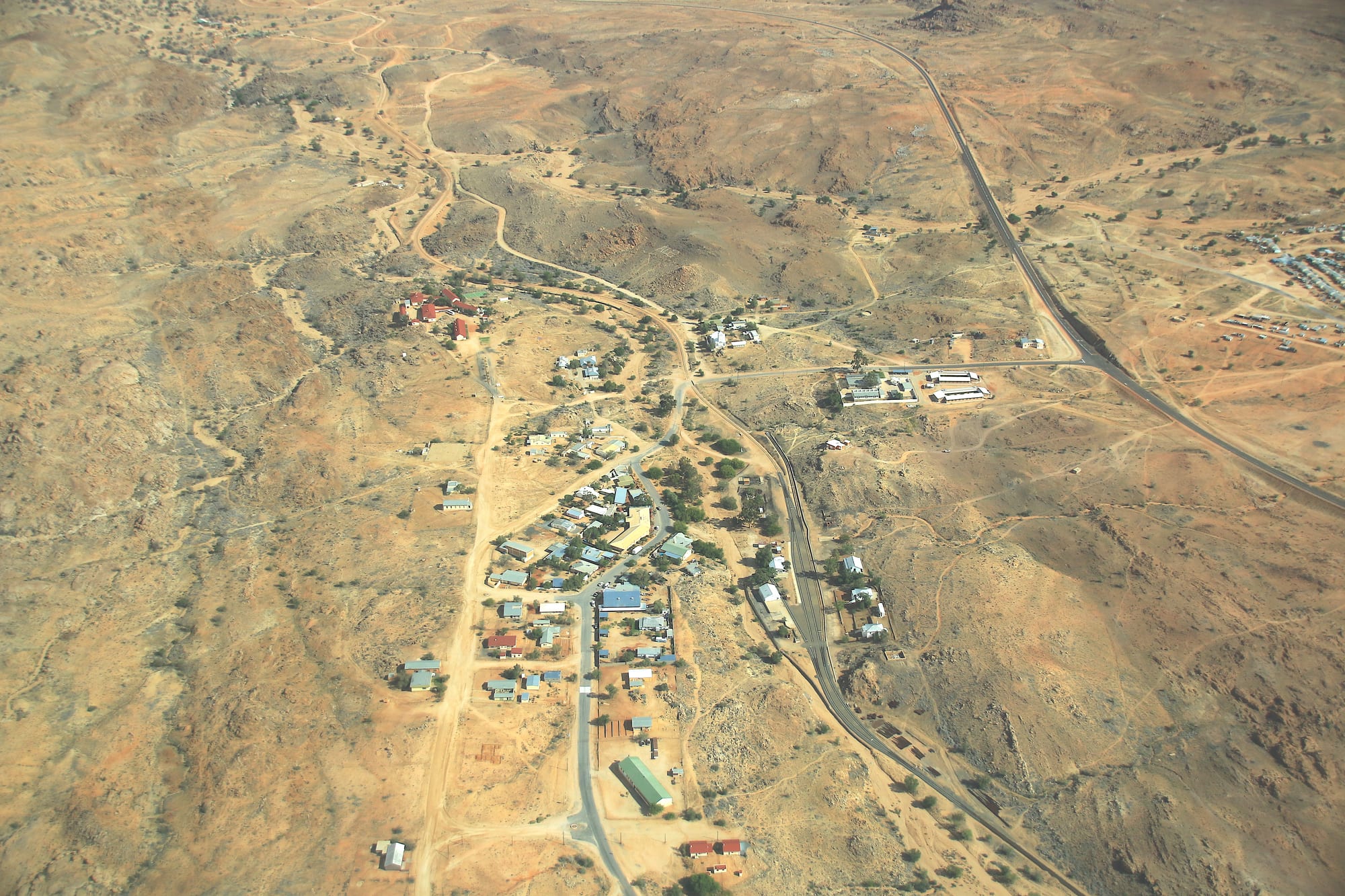
Aerial view of a small village of scattered houses among bare rocky hills, with a road and railway crossing the desert beyond

Sossusvlei, Fish River Canyon & the South, Namibia

Aus

The village of Aus in the hills of southern Namibia, with the road and railway to Lüderitz running across the plain beyond it. (Hp.Baumeler / Wikimedia Commons · CC BY-SA 4.0)

A small village in the dry hills of southern Namibia, on the B4 road and the railway between Keetmanshoop and the coast at Lüderitz. It grew around a station and a First World War prisoner-of-war camp, and is best known now for the feral horses that live on the gravel plains to the west, where a waterhole at Garub draws them into view.

Neighbourhoods

  • The village centre
    • First-time visitors
    • Services
    • Quiet and residential

    A handful of streets below the hills, with a filling station, a shop, a garage, a police station and the village's few places to stay. Everything is within a couple of minutes' walk, and the pace is slow enough that traffic on the B4 is the loudest thing in the day.

    Open in Maps
  • The station side
    • Railway history
    • Photography

    The lower ground east of the village, where the line from Lüderitz to Keetmanshoop runs past the old station buildings. Old railway buildings stand among the gravel and thorn scrub, and the site of the wartime camp lies nearby.

    Open in Maps
  • The Garub plains
    • Wildlife watching
    • Desert scenery

    The open gravel flats west of the village, dropping towards the Namib proper. This is horse country — a waterhole with a viewing shelter stands beside the road, and oryx, ostrich and springbok cross the same ground under very large skies.

    Open in Maps
  • The hill farms south of the village
    • Stargazing
    • Guest farms
    • Hiking

    The rocky country rising south and east towards the Tiras mountains, where farms carry sheep and game across enormous paddocks and take a few guests. The nights are cold, dark and clear, and walking routes run up into the granite.

    Open in Maps

Things to do

In the village

  • The prisoner-of-war camp sitelandmark

    The site of the camp where South African forces held German prisoners taken in the First World War, from 1915 until the last of them left in May 1919; the number held reached about 1,500, and the men, at first in tents, later built themselves brick houses.

    Open in Maps
  • Aus railway stationtransit hub

    The station on the line from Keetmanshoop, the reason the village exists. Trains from Keetmanshoop now end their journey at Aus, and the section on to Lüderitz is out of use.

    Open in Maps

The desert plains

  • The feral horses of the Namibattraction

    A population of free-ranging horses that has lived on the plains west of Aus for about a century; their origin is debated, with German military mounts and a nearby stud farm among the explanations.

    Open in Maps
  • Garub waterholeviewpoint

    An artificial water hole on the plains west of the village, at Garub Pan, with a hide built so that the horses and other animals that come to drink can be watched without disturbance.

    Open in Maps

Short trips from the village

  • Kolmanskopattraction

    A diamond-rush town founded after the 1908 find, abandoned in 1956 and slowly filling with sand, whose houses, hospital and ballroom are visited on permit tours.

    Open in Maps
  • Lüderitzattraction

    The harbour town on a cold, windy Atlantic bay, with colonial architecture including Art Nouveau work, the Felsenkirche of 1912 on Diamond Hill, and fishing boats at its quays.

    Open in Maps

Seasonal events

  • The horses after the rainslate summer and autumn, roughly February to May

    The condition of the desert horses follows the rainfall — grazing on the plains recovers after a wet late summer and the herds look their best, while dry years tell on them visibly.

  • Independence Day21 March

    The anniversary of Namibian independence in 1990, a national public holiday marked in villages across the country.

  • Winter cold snapsJune to August

    The area has the coldest winters recorded in Namibia, and snow has fallen on the hills here, as in the winter of 1963.

Eat and drink

Long-standing places and food districts in Aus. Hours, ratings and directions come from your maps app, always current.

What is eaten here

  • Karas lamb and gamerestaurant

    Lamb from the dry veld and game from the surrounding farms — gemsbok, springbok and kudu — grilled over coals or slowly stewed in a potjie, the standard cooking of the southern farms.

    Open in Maps
  • Roosterkoek and vetkoekcafe

    Bread rolls baked directly on the grill and fried dough filled with mince or jam, sold and made at home across the south and usual fare at any gathering.

    Open in Maps
  • The village shopmarket

    A single general store and filling station keep the village in bread, tinned goods, biltong and cold drinks; there is nothing resembling a supermarket before Lüderitz or Keetmanshoop.

    Open in Maps

Along the road west

  • Lüderitz seafoodneighborhood

    The harbour town at the end of the B4 lands fish from the cold Atlantic and is the nearest thing to a restaurant district for anyone staying at Aus.

    Open in Maps

Experience Aus

History

Aus exists because of the railway. The German colonial administration pushed a line inland from the harbour at Lüderitz in the first years of the twentieth century, during and after the wars of 1904 to 1908 against the Nama and Herero, and a siding and small settlement grew where the track climbed into the hills at a point with water. The name comes from the Khoekhoe for "big snake", the country having been Nama grazing land long before the track arrived.

The village's best-known chapter came with the First World War. South African forces occupied German South West Africa in 1915, and the German troops who surrendered were interned at Aus, in a camp on the slopes above the settlement whose numbers reached about 1,500. The inmates lived at first in tents, in extreme heat and winter frost, and later built themselves brick houses. The last of them left in May 1919 and the camp closed.

After the war the camp closed and Aus settled back into being a railway halt and a service point for the surrounding sheep farms. The horses left loose on the plains during and after the fighting are usually given as one origin of the feral herds that still live there. Trains from Keetmanshoop now end their journey at the village and the line on to Lüderitz is out of use, leaving a small place that lives on the road, the farms and the travellers who stop between Keetmanshoop and the coast.

Culture & Customs

Life in Aus is shaped by distance. Everything is a long drive away, so people plan around trips to Keetmanshoop or Lüderitz, and news, post, fuel and stock feed all arrive with someone coming back along the B4. Neighbours on farms 50 kilometres apart count as close, and hospitality to passers-by is a practical habit in a place where help can be hours off.

The village is Nama in language and family, like much of the south. Khoekhoegowab is spoken with Afrikaans, English belongs to the school and to officialdom, and German survives in place names, farm names and the buildings along the track. Church life provides the main regular gathering, and funerals and weddings bring relatives in from Lüderitz, Keetmanshoop and Windhoek.

Two things dominate local identity. One is the desert horses: they are a source of pride and of long argument about how they arrived, how they should be managed, and what to do when drought or predation cuts their numbers, and researchers have followed the herd for decades. The other is the weather. Aus is one of the coldest places in the country in winter, and snow on the hills, rare as it is, is remembered and retold as the village's particular distinction.

Daily Life

Aus is a small settlement, counted in the hundreds rather than the thousands; the last published count, in 1970, recorded 767 people. It has a hotel, a police station, a garage and a shop, and that is close to the whole of its infrastructure; anything more substantial means driving.

Work comes from three sources. The sheep and game farms of the district employ labour and take a few guests; tourism supplies the rest, with lodges and campsites in and around the village serving traffic between the canyon country and the coast; and the road and railway themselves need maintenance crews. Government jobs at the school and clinic make up much of the salaried employment. Unemployment is high and young people leave for Lüderitz, Windhoek or the coast.

The rhythm of the day follows the heat and the light: early starts, a slow middle of the day, and evenings outdoors once the sun drops behind the hills. Water and drought are the recurring worries, thinning flocks and pressing on the grazing that the wild horses share. Green hydrogen projects planned near Lüderitz are watched here as the region's main hope of new work, along with the steady trickle of visitors.

Food

Food in Aus is southern farm cooking, and mostly cooked where people sleep. Lamb raised on the aromatic shrubs of the dry veld is the meat the district is proud of, grilled as chops over coals at a braai or left for hours in a three-legged potjie with vegetables and stock. Game from the same farms — gemsbok, springbok and kudu — is eaten as steaks and stews, and both meat and game become biltong, salted and air-dried in a climate ideally suited to it, and droëwors, the thin dried sausage that travels well in a car.

Around the meat sit the staples shared with Afrikaans and Nama kitchens across the south: mealie pap, a stiff maize porridge served with a tomato and onion sauce; vetkoek, fried dough split and filled with curried mince or jam; roosterkoek, bread rolls baked straight on the grill; and potbrood baked in a cast-iron pot under coals. Farm kitchens still bake their own bread because the nearest bakery is a long way off.

Two outside influences reach the village table. German settlement left rye bread, cured sausage and cake in the shops of the bigger towns, and the cold Atlantic at Lüderitz, an hour and a half west, supplies the fish that appears on menus at guest farms here. Rooibos tea, strong coffee and Namibian lagers such as Windhoek and Tafel are the usual drinks.

Planning tools

Budget

Aus itself is inexpensive, but choice is very limited: a few guest farms and campsites in and around the village set the price, and there is no competition to push it down. Fuel and the hire car dominate any budget here, since the village sits between long empty stretches of the B4 and almost every visitor is driving.

Daily Budget Midrange
USD 140–280 (a guest farm room, dinner where staying, a hire car and fuel, a Kolmanskop permit tour)
Daily Budget Shoestring
USD 40–75 (a campsite or basic room, self-catering bought in Keetmanshoop or Lüderitz, a shared hire car, fuel)

Carry food and water in the car: the village shop is small and the next real supermarkets are a long drive in either direction.

Best Time to Visit

April to October brings mild days and clear skies, and the cool months are the easiest for walking in the hills and watching the plains. The horses are visible all year at the waterhole, and are in their best condition after rain. Midsummer, from December to February, is very hot by day on the gravel flats, and the wind off the coast is constant in spring.

Suggested Number of Days

A night is the usual stop, and it covers the village and the plains beside it. Two or three days suit anyone using Aus as a base for the longer drives west towards the coast, or staying on a farm for the walking and the night skies.

First Visit
1 day
With Surroundings
2–3 days

Transportation

There is no public transport of any kind in the village, and no vehicle hire. Almost everyone arrives in their own or a hired car on the paved B4, which runs east to Keetmanshoop and west to Lüderitz; lifts and long-distance minibuses passing on that road are the only alternative. The village is small enough to cross on foot, but everything outside it needs a vehicle.

Fill up in Keetmanshoop or Lüderitz rather than relying on the village pump, keep speed down on gravel side roads, and avoid driving after dark because of horses, oryx and other animals on the road.

Airport & Station Connections

Aus lies on the B4 about 230 kilometres west of Keetmanshoop, some two and a half hours' driving on a paved road, and about 125 kilometres east of Lüderitz, an hour and a half further west. Lüderitz has a small airport on the B4 outside the town, and Windhoek, far to the north-east, has the country's international flights. Trains from Keetmanshoop end their journey at the village and the line on to Lüderitz is out of use, so the road carries everything that passes.

Walkability

The village is tiny and entirely walkable — a few streets, a shop and a filling station, with the hills starting at the edge of the houses. Nothing else is within walking distance: the waterhole on the plains is well outside walking range and the road out of the village carries fast traffic, so a vehicle is needed for everything beyond the settlement.

Safety

Aus is a quiet village where crime is rare and the risks are those of a very remote place: heat and dehydration on the plains, cold nights in winter, long distances between fuel and help, and animals on the road at dusk. The former diamond Sperrgebiet along the road west is restricted ground, entered only with a permit or on an authorised tour.

Namibia is one of the safer countries in Africa for visitors. Carry plenty of water and warm clothing, keep out of restricted diamond areas, tell someone the route before long drives, and do not approach or feed the horses. Check current official travel advice before travelling.

Climate

Arid and high, with the desert plains on one side and the coastal fog reaching inland on the other. Rain is very scarce and falls mostly in late summer, the wind is persistent, and the gap between day and night temperatures is wide. Being in the southern hemisphere, summer runs from December to February and winter from June to August.

Summer
hot and dry, with afternoons often 30–36°C on the plains and warm, windy evenings
Winter
cool sunny days of about 17–22°C with cold nights — the coldest winters recorded in Namibia — and snow on the hills in rare years such as 1963

Local Customs

This is Nama country, and Khoekhoegowab and Afrikaans are the everyday languages, with English used officially. Village life is small and unhurried: people greet each other, and a greeting before a question is expected. Church is central to Sundays, dress is practical and modest, and the farms either side of the road are private land reached through their gates.

Ask before photographing people, ask at the farmhouse before leaving marked tracks, and keep a distance from the desert horses, which are wild animals and must not be fed or watered.

Common Payment Methods

The currency is the Namibian dollar, pegged one-to-one to the South African rand, and rand is accepted. There is no bank or reliable cash machine in the village, and card payment can fail when the network drops, so cash drawn in Keetmanshoop or Lüderitz is worth carrying for fuel, the shop and farm entry fees.