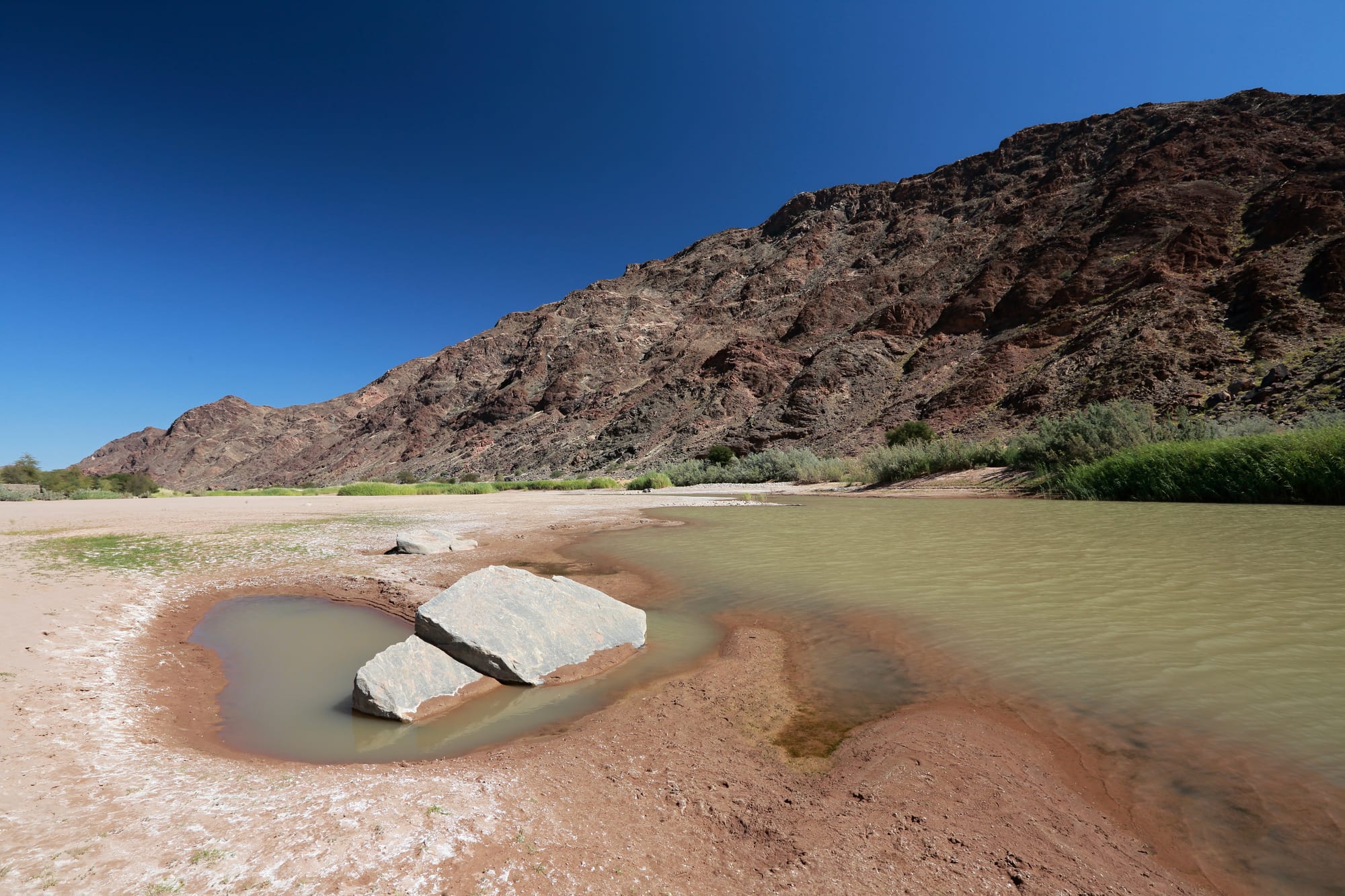
A shallow green river pool on pale sand below steep dark red rock slopes under a deep blue sky

Sossusvlei, Fish River Canyon & the South, Namibia

Ai-Ais

The Fish River in its canyon near Ai-Ais, where the hot-spring resort stands on the valley floor beyond the bend. (Martin Cígler / Wikimedia Commons · CC BY-SA 3.0)

A hot-spring resort deep in the Fish River valley in southern Namibia, at the lower end of the Fish River Canyon and at the finish of its multi-day hiking trail. Little more than a state-run camp of chalets, campsites and thermal pools among red rock walls, it takes its name from the Khoekhoe for 'fire-fire', or scalding hot.

Neighbourhoods

  • The spa and chalets
    • First-time visitors
    • Hot springs
    • Comfort

    The core of the resort is a cluster of chalets and rooms around indoor and outdoor thermal pools, a restaurant, a shop and a fuel pump, set on the valley floor against the canyon wall. Everything is within a few minutes' walk.

    Open in Maps
  • The campsite by the river
    • Camping
    • Quiet and residential

    Shaded pitches lie along the riverbed under tall trees, used by self-drive travellers and by hikers recovering at the end of the trail. Nights are warm, the rock radiates the day's heat, and there is no light pollution at all.

    Open in Maps
  • The road in from the canyon
    • Views
    • Wildlife

    The gravel approach drops from the plateau into the valley in a series of bends, with viewpoints over the lower canyon and a good chance of seeing klipspringer, kudu and baboons. It is the only way in and out by road.

    Open in Maps

Things to do

The canyon and the river

  • Fish River Canyonattraction

    An enormous gorge cut into the southern plateau, about 160 km long and up to some 550 metres deep, the largest canyon in Africa; its multi-day hiking trail ends at Ai-Ais.

    Open in Maps
  • Fish Riverattraction

    A river of some 650 km draining the southern interior, flowing strongly only after summer rain and otherwise a chain of pools along a sandy bed through the canyon.

    Open in Maps
  • Ai-Ais/Richtersveld Transfrontier Parkpark

    A protected area joining the Namibian canyon park with the Richtersveld in South Africa across the Orange River, created to manage the desert mountains on both banks as one.

    Open in Maps

Short trips from the resort

  • Hobasviewpoint

    The entrance camp and campsite on the plateau near the classic viewpoints over the canyon's bends, where hiking permits are issued; the trail itself starts from a car park 13 km further west.

    Open in Maps
  • Noordoewerattraction

    A small settlement at the South African border crossing, set among irrigated vineyards on the Orange River, where canoe and rafting trips on the river begin.

    Open in Maps
  • Orange Riverattraction

    The river that divides Namibia from South Africa, a green line of reeds and vines through bare desert mountains, used for irrigation and multi-day canoe trips.

    Open in Maps

Eat and drink

Long-standing places and food districts in Ai-Ais. Hours, ratings and directions come from your maps app, always current.

Eating at the resort

  • The resort restaurantrestaurant

    The only cooked meals for a long way, with buffets and set menus built on beef, lamb and game — oryx and springbok — along with stews, salads and breakfasts for hikers coming off the trail.

    Open in Maps
  • The camp shop and braai sitesmarket

    A small shop sells firewood, cold drinks, ice and basic groceries, and most campers cook their own meat over coals at their pitch, with roosterkoek baked on the grid.

    Open in Maps
  • Farm and river produce of the far southmarket

    The country around supplies lamb from the dry veld, dried biltong and, from the irrigated farms along the Orange River, table grapes and dates.

    Open in Maps

Experience Ai-Ais

History

The springs were known and used long before any building stood here. This is Nama country, and the name Ai-Ais comes from Khoekhoegowab, meaning 'fire-fire' or scalding hot — a description of the mineral-rich water, which averages about 60°C, that rises through the fault lines at the foot of the canyon. Khoekhoe herders watered stock in the valley and used the springs, and San hunter-gatherers were in the region long before them.

European accounts of the springs date from the nineteenth century, and the story usually told locally is that a Nama herder led the first settlers to the water while searching for stray sheep. Simple bathing facilities were put up in stages, and the springs were declared a national monument in 1964. It was developed as a resort with chalets and a spa under South African administration, and became part of the protected area created around the Fish River Canyon, the Ai-Ais Hot Springs Game Park.

Floods are part of its history: the Fish River, dry for most of the year, has come down in spate in 1972, 1974 and 1988, each time closing the camp, which has been rebuilt and renovated more than once. Since independence the park has been run by Namibia Wildlife Resorts, the state tourism operator, which also issues the canyon hiking permits. In 2003 Namibia and South Africa agreed to join the park with the Richtersveld across the Orange River, forming the Ai-Ais/Richtersveld Transfrontier Park, one of southern Africa's cross-border conservation areas.

Culture & Customs

Ai-Ais has no resident community of its own; its culture is that of a park camp, and it belongs to two groups of people. One is the staff — receptionists, cooks, cleaners, maintenance workers and rangers, mostly from Karas towns such as Keetmanshoop, Karasburg and the Nama villages of the south — who live on site in staff quarters and work in rotations. Khoekhoegowab and Afrikaans are what is spoken among them, with English for guests.

The other is the hikers. The multi-day trail down the canyon ends at Ai-Ais, and its finish gives the place its particular atmosphere: walkers arriving dusty and sunburnt after days in the gorge, going straight into the thermal pools, and the long comparing of notes that follows. The trail is open only in the cooler months, is limited to groups, and requires a permit and a medical certificate arranged in advance through the parks operator, so those who arrive have planned it for a long time.

Bathing custom is simple and public — the springs are used as a spa rather than a sacred site, though their Nama name and long use by herders are part of what the place means locally. Beyond that, the etiquette is park etiquette: quiet at night, food kept away from baboons, rubbish carried out, and no driving off the roads. The night sky, undimmed by any settlement for a hundred kilometres, is one of the things people come for.

Daily Life

Nobody lives at Ai-Ais in the ordinary sense. The permanent presence is a small staff, a few dozen people at most, housed at the resort and working shifts before returning to their homes in the south. Beyond the park boundary the country is enormous sheep and goat farms on very dry ground, worked by a handful of people each, and the nearest settlements of any size — Karasburg, Noordoewer and Keetmanshoop — are one to three hours away by road.

Everything is brought in. Supplies arrive by truck from Keetmanshoop or across the South African border, water comes from the river and the springs, and power and communications are limited; a break in the road after a storm is felt at once in the kitchen and the shop. Medical emergencies mean a long drive or a flight from the airstrip, which is why the hiking trail is so tightly controlled.

The working year follows the season. The resort is busy through the cool months, when the trail is open and the canyon fills with visitors, and very quiet in the heat of high summer, when the valley floor becomes one of the hottest places in the country. Days start early and stop in the middle of the afternoon, and by dark the only sounds are baboons on the slopes, wind in the thorn trees and the river if it happens to be running.

Food

There is no local cuisine here in the ordinary sense — the resort kitchen and the braai fire are the two ways of eating. The restaurant serves southern African country cooking: lamb from the dry veld of the south, beef from the farms, game such as oryx and springbok as steaks or stews, with rice, pap and vegetables trucked in from far away, and generous breakfasts aimed at people about to walk or who have just finished walking.

Campers cook for themselves, and the standard meal is a braai — chops, boerewors coiled on the grid, and roosterkoek, bread rolls baked directly on the coals and eaten with butter and jam. Potjiekos, a stew left to simmer for hours in a three-legged iron pot, suits the long evenings, and biltong and dried sausage are the food of the road and the trail, along with dried fruit from the irrigated farms along the Orange River.

Drinks are simple: Namibian lager brewed to the German purity law, South African wine, rooibos tea and a great deal of water, which visitors underestimate in this heat. Hikers finishing the canyon trail have their own ritual of a cold drink at the pools, and the grapes and dates grown under irrigation down on the Orange are the one fresh local produce that reaches the valley regularly.

Planning tools

Budget

Ai-Ais is a state-run resort, so prices are moderate by Namibian standards: camping is cheap, chalets are mid-range, and park entry is charged per person and per vehicle. There is nowhere else to eat or buy supplies nearby, which pushes food costs up, and fuel for the long gravel approach is a real part of the budget.

Daily Budget Midrange
USD 150–430 (a chalet at the resort, meals in the restaurant, a hire car, park fees and a canyon viewpoint trip)
Daily Budget Shoestring
USD 45–80 (a campsite pitch shared, self-catering, a shared hire car, park fees)

Accommodation and the hiking trail are booked through the national parks operator, often months ahead, and supplies are best bought in Keetmanshoop or across the border before the drive in.

Best Time to Visit

The cooler months from about May to September, when the canyon is comfortable and the springs are pleasant rather than punishing. This is also when the canyon's multi-day hiking trail is open, as the parks authority closes it through the hot months. From November to March temperatures on the valley floor are among the highest in Namibia.

Suggested Number of Days

A night or two is the usual stay. Three or four days suit visitors who also want the viewpoints on the plateau and the river country to the south. The multi-day canyon hike is a separate undertaking and takes far longer, with its own permits and season.

First Visit
1–2 days
With Surroundings
3–4 days

Transportation

There is nothing to move around in at the resort itself, and everything else needs a vehicle. Gravel roads link Ai-Ais with the main canyon camp on the plateau and with the paved B1 towards Keetmanshoop and the border, and a saloon car manages them in dry conditions. There is no public transport, and hikers arrange transfers through the parks operator or their accommodation.

Fuel is sold at the resort but should not be relied on, and the approach road can be closed or washed out after a summer storm, so it is worth asking about conditions before setting off.

Airport & Station Connections

The resort lies about 225 km south-west of Keetmanshoop and roughly 100 km from the Noordoewer border crossing with South Africa, reached on gravel roads off the paved B1 — around three hours' driving from Keetmanshoop. There is an airstrip for charter aircraft, but nearly everyone arrives by car, and many visitors come from the canyon viewpoints to the north.

Walkability

The resort is small and entirely walkable — pools, restaurant, chalets and campsite stand within a few hundred metres of each other, and short walks lead along the riverbed and up the valley. Beyond that the terrain is rough, hot and waterless, and walking any distance into the canyon is a serious undertaking rather than a stroll.

Safety

There is effectively no crime here. The hazards are heat, which on the valley floor can be extreme, dehydration, and the canyon itself, where falls, flash floods after rain upstream and the distance from help make rescue slow. Baboons raid campsites for food, and mobile signal is weak or absent.

Start dune and canyon walks at dawn with plenty of water and sun protection, drive slowly on gravel, and keep out of restricted diamond areas. Check current official travel advice before travelling.

Climate

Hot desert, and the enclosed valley traps the heat: this is one of the hottest inhabited spots in Namibia. Rain is rare and falls, if at all, in summer thunderstorms over the interior, which can send the Fish River down in flood. In the southern hemisphere summer runs from December to February.

Summer
extremely hot, often 38–42°C by afternoon on the valley floor, with warm nights
Winter
warm sunny days of about 22–27°C and cool to cold nights

Local Customs

This is a park resort staffed by Namibians from the surrounding Karas region and further afield, where English and Afrikaans are the working languages and Khoekhoegowab is widely spoken. Dress is informal, and swimwear belongs at the pools rather than in the restaurant. Park rules govern the rest — no fires outside the sites, no feeding of baboons, and no litter left in the riverbed.

Ask before photographing staff or other guests, tip restaurant and camp staff modestly, and keep food locked away from baboons, which take it from open tents and cars.

Common Payment Methods

The Namibian dollar is used, at parity with the South African rand, which is also accepted. Cards are taken at the resort reception, restaurant and shop, but there is no bank or ATM anywhere nearby, so cash for tips and small purchases has to be brought in from Keetmanshoop or the border.