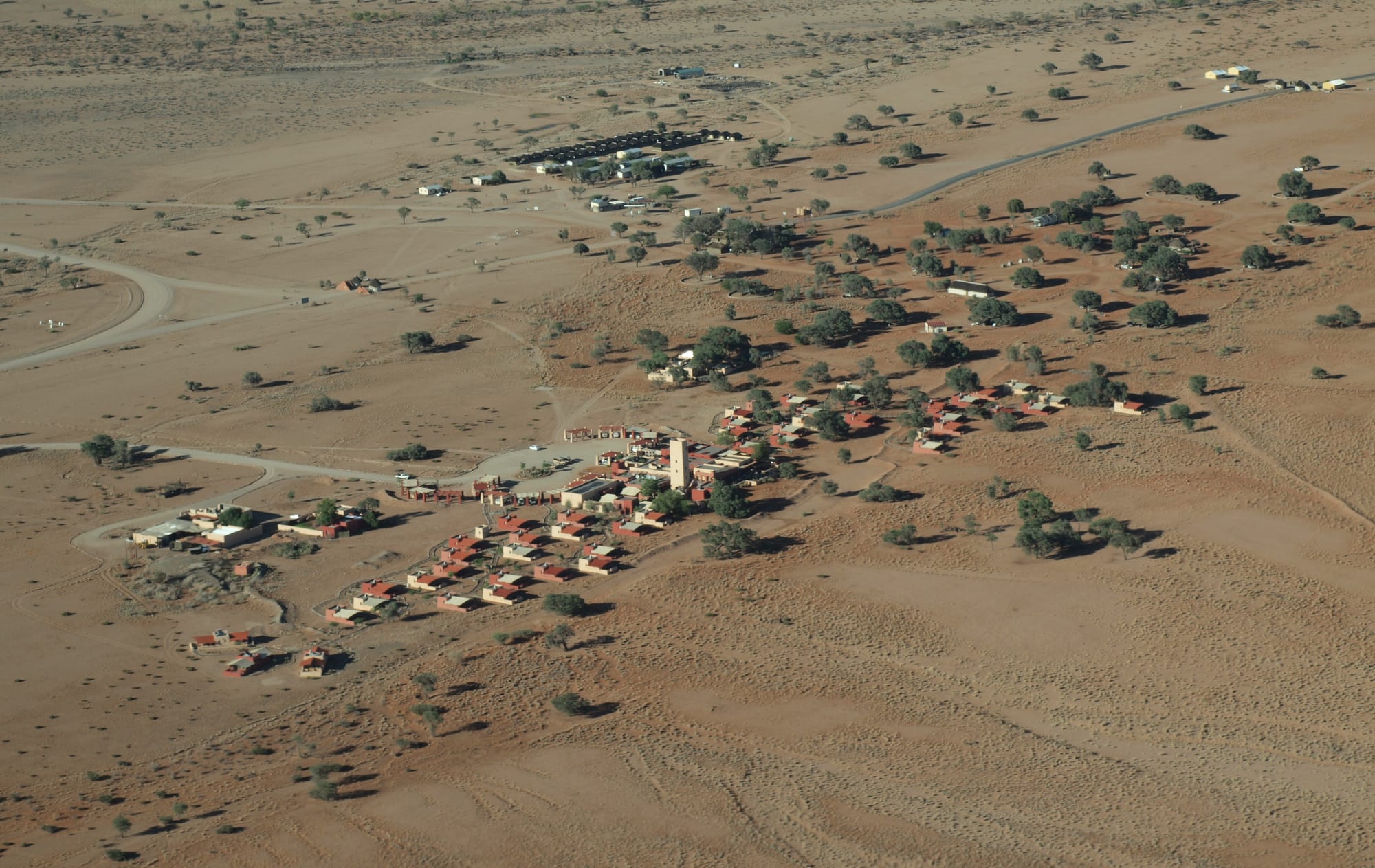
Aerial view of a small desert settlement of red-roofed buildings and camelthorn trees on pale sand, with gravel tracks running out across the plain

Sossusvlei, Fish River Canyon & the South, Namibia

Sesriem

The settlement at Sesriem seen from the air, scattered among camelthorn trees on the desert plain at the edge of the Namib-Naukluft National Park. (User:Digr / Wikimedia Commons · CC BY-SA 3.0)

A tiny settlement in the Namib Desert of southern Namibia that exists for one reason — it stands at the gate into the Sossusvlei dune valley in the Namib-Naukluft National Park. A campsite, an airstrip, a fuel pump and a scattering of lodges sit among camelthorn trees beside the shallow Sesriem Canyon, with red dunes rising to the west.

Neighbourhoods

  • Inside the park gate
    • First-time visitors
    • Early starts
    • Camping

    The state campsite, offices and fuel pump stand within the park boundary beside the gate. Staying inside means being on the dune road at first light, ahead of vehicles waiting outside, and the camelthorn trees, the shop and the pool are the whole of the place.

    Open in Maps
  • Outside the gate
    • Comfort
    • Quiet and residential

    Lodges and campsites are spread along the gravel roads for tens of kilometres east and south of the entrance, most of them isolated on private land with long approach tracks, wide views of the escarpment and very dark night skies.

    Open in Maps
  • The airstrip and the crossroads
    • Arrivals
    • Scenic flights

    A gravel airstrip beside the road takes charter flights that link the desert with Windhoek, Swakopmund and the coast, and hot-air balloons lift off from the plain nearby on still mornings. A few staff houses and workshops make up the rest.

    Open in Maps

Things to do

At the gate

  • Sesriem Canyonattraction

    A narrow gorge a few kilometres from the gate, cut about 30 metres deep into sedimentary rock by the Tsauchab River, with pools that hold water long after rain and a floor that can be walked between the walls.

    Open in Maps
  • Namib-Naukluft National Parkpark

    One of Africa's largest national parks, taking in the dune sea, gravel plains and the Naukluft mountains; the Sesriem gate is its best-known entrance.

    Open in Maps

Short trips into the dunes

  • Sossusvleiattraction

    A clay pan ringed by red star dunes at the end of the Tsauchab valley, the highest dune, Big Daddy, rising about 325 metres above it; the last stretch is deep sand for 4x4s or the park shuttle.

    Open in Maps
  • Deadvleiattraction

    A white clay pan studded with the blackened skeletons of camelthorn trees that died centuries ago when the dunes cut off the river, reached on foot over a dune ridge.

    Open in Maps
  • Dune 45viewpoint

    A star dune named for its distance in kilometres from the gate, climbed along its ridge for a view over the sand sea at sunrise.

    Open in Maps
  • Namib Sand Seaattraction

    The coastal dune field shaped by fog and wind, inscribed as a UNESCO World Heritage Site for its dune forms and the life adapted to them.

    Open in Maps

Short trips further afield

  • Solitaireattraction

    A lone settlement at a road junction with the only fuel pump, bakery, cafe and general dealer between the dunes and the coast, and a standard stop on the drive.

    Open in Maps
  • NamibRand Nature Reservepark

    A large private reserve of dunes, grass plains and mountains bordering the park, known for its dark skies and designated an international dark sky reserve.

    Open in Maps

Eat and drink

Long-standing places and food districts in Sesriem. Hours, ratings and directions come from your maps app, always current.

Eating at the gate

  • The camp shop and fuel stopmarket

    The small shop at the gate sells firewood, ice, cold drinks, tinned food and braai meat — the supplies campers cook over coals at their own site, since there is no village shop of any kind nearby.

    Open in Maps
  • Lodge and camp kitchensrestaurant

    Set dinners and buffets at the places to stay are the only cooked meals for a long way, built around oryx and kudu steaks, beef, stews from a three-legged potjie and bread baked on the coals.

    Open in Maps
  • The bakery at Solitairecafe

    The bakery at the road junction north of Sesriem is the only one between the dunes and the coast, a standard stop for coffee and something fresh beside the fuel pumps.

    Open in Maps

Experience Sesriem

History

For most of its history this corner of the Namib was a place people passed through rather than lived in. The Tsauchab River, which flows only after rain on the escarpment, ends in the sand west of here, and its valley gave the San and later Nama herders a route between the plains and the dune sea. The name Sesriem is Afrikaans and means "six thongs" — the number of joined oxhide riems, or leather straps, said to have been needed to lower a bucket from the rim of the canyon to the water below, in the era of ox-wagon travel.

German colonial administration brought the first formal protection to the surrounding desert early in the twentieth century, when a large game reserve was proclaimed across the Namib. The boundaries were redrawn repeatedly and the present Namib-Naukluft National Park took shape under South African rule, growing by stages into one of the largest protected areas in Africa. The farmland around the park was settled by ranchers running sheep and cattle on very dry ground, and many of those farms later became guest farms and reserves.

Sesriem itself grew from the park gate and its campsite, planted with camelthorn trees, which for decades was the only accommodation near the dunes. Tourism to Sossusvlei expanded sharply after independence in 1990; lodges spread along the gravel roads outside the boundary, the road into the valley was tarred for most of its length, and the dune field was inscribed as the Namib Sand Sea World Heritage Site.

Culture & Customs

Sesriem has no settled community in the ordinary sense. Its culture is that of a park station and a tourism outpost: rangers and gate staff, camp attendants, lodge cooks, guides, drivers and pilots, most of them from Windhoek, Maltahöhe, Keetmanshoop or the Nama villages of the south, living on site in staff quarters for weeks at a time before going home. English is the official language of work, Afrikaans is widely spoken, and Khoekhoegowab and Oshiwambo are heard among staff.

The rhythm of the place is set by the gate. People are awake in the dark, and the queue of vehicles at the barrier before sunrise is the day's one crowd; by mid-morning the settlement empties, and it fills again at dusk when the park closes. Guides and drivers take their break in the heat of the afternoon, and conversation at the campsite runs on tyre pressures, sand driving and where the light will be best.

Conservation etiquette is the strongest local custom. Driving off the marked roads damages crusts and plants that take decades to recover, and it is treated seriously; so is leaving the pans untouched, taking rubbish out, and keeping noise down at night, when the sky is one of the darkest in the world and much of the camp is out looking at it. Guiding in the desert also carries a body of knowledge — tracks in the sand, the beetles and lizards that live off the fog — that is passed between guides rather than learned from books.

Daily Life

Almost nobody lives here permanently. The resident population runs to a few hundred at most, nearly all of them staff at the gate, the campsite, the airstrip and the lodges scattered along the gravel roads, housed in quarters attached to their workplaces and working shifts of several weeks. Families and homes are elsewhere, usually hundreds of kilometres away.

Everything has to be brought in. Water comes from boreholes, electricity from generators and solar arrays, and supplies arrive by truck from Windhoek or Mariental; a delivery delayed by a washed-out road is felt immediately in the shop. There is no bank, no hospital and no secondary school, and the nearest substantial towns — Maltahöhe and Solitaire to the north and east — are small in themselves. Serious medical cases are flown out from the airstrip.

Work is seasonal, busiest in the cool months and over the Namibian holidays, and almost entirely tied to tourism, which has made the desert around the dunes one of the higher-earning parts of the region. The wider Hardap countryside is sheep and cattle farming on very large, very dry properties, and drought is the constant background concern. Days start before dawn and end early: by nine in the evening the camp is quiet and the sky is full of stars.

Food

Sesriem has no food tradition of its own — it has camp cooking and lodge kitchens. At the campsite the standard meal is a braai, meat grilled over camelthorn coals with roosterkoek, bread rolls baked on the grid, or a potjie, the three-legged iron pot in which a stew of meat, vegetables and stock is left to simmer slowly for hours. Supplies are bought far in advance and packed into a cool box, because the shop at the gate carries only basics.

Lodge menus follow Namibian country cooking: oryx, kudu and springbok steaks and carpaccio, beef from the farms, lamb from the dry south, and biltong and dried sausage set out for the road. Vegetables are trucked in and treated as precious. Breakfast tends to be early and large, since guests leave for the dunes in the dark, and packed breakfasts eaten at the pan are common.

The drive north brings the one reliable stop, the bakery and cafe at Solitaire, the only one between the dunes and the coast and a fixture of a Namibian road trip. Namibian lagers brewed to the German purity law, South African wines and rooibos tea are the usual drinks, and water is consumed in quantities that surprise first-time visitors.

Planning tools

Budget

Sesriem is one of the more expensive places to sleep in Namibia. The state campsite inside the gate is cheap and fills months ahead, while the desert lodges outside are priced well above the Namibian average, often with dinner and breakfast included because there is nowhere else to eat. Park entry fees, fuel and the shuttle to the last stretch of sand add up.

Daily Budget Midrange
USD 150–430 (a desert lodge with dinner and breakfast, a hire car, park fees and the Sossusvlei shuttle)
Daily Budget Shoestring
USD 45–80 (a campsite pitch shared, self-catering, a shared hire car, park fees)

A balloon flight over the dune sea is the single biggest optional cost here and needs booking well in advance; park entry is charged per person and per vehicle.

Best Time to Visit

May to September, when days are clear and cool enough to climb a dune and nights are cold. March and April can be beautiful after rain, with grass on the plains and the chance, in a rare year, of water in the pan. From November to February the heat is severe by mid-morning and walking on the sand becomes dangerous.

Suggested Number of Days

Two days is the usual length of stay, since the dune road is best in the early morning and the light is hard in the middle of the day. Three or four days suit anyone adding a balloon flight, the canyon and the reserves south of the gate, or simply wanting the desert at a slower pace.

First Visit
2 days
With Surroundings
3–4 days

Transportation

There is nothing here to move around in — the gate, the campsite and the canyon are within a few kilometres of each other, and everything else needs a vehicle. A saloon car reaches the gate and most of the park road; the last six kilometres to Sossusvlei are deep sand for 4x4s, with a shuttle running from the 2x4 car park for everyone else. Lodges run their own guided drives.

Fuel is sold at the gate but supply can be uncertain, so tanks are usually filled at Solitaire or Maltahöhe; the park road opens at sunrise and closes at sunset.

Airport & Station Connections

Sesriem lies on gravel roads about five to six hours south-west of Windhoek by way of the Remhoogte or Spreetshoogte passes, and roughly a day's drive from Swakopmund through Solitaire and the Kuiseb canyon. Most visitors self-drive; the rest fly in by charter aircraft to the airstrip or to lodge strips nearby, and there is no scheduled public transport.

Walkability

Only the immediate settlement can be walked — the campsite, the shop and the gate. The canyon is a short drive or a long hot walk away, the lodges lie kilometres apart along gravel roads, and the dunes are far too distant to reach on foot. Walking in the open here means sun, sand and no shade.

Safety

There is effectively no crime; the dangers are the desert itself. Heat, dehydration and exhaustion on the dunes are the common emergencies, the sand surface becomes burning hot by late morning, and people who wander from the marked route between Deadvlei and the car park lose sight of it easily. Gravel roads, distance from help and patchy phone signal do the rest.

Start dune and canyon walks at dawn with plenty of water and sun protection, drive slowly on gravel, and keep out of restricted diamond areas. Check current official travel advice before travelling.

Climate

Hyper-arid desert, with intense sun, huge daily temperature swings and rainfall that may amount to a few showers a year or none at all. Any rain comes in summer thunderstorms over the escarpment, which occasionally send the Tsauchab down its valley. In the southern hemisphere summer runs from December to February.

Summer
very hot, commonly 35–40°C by afternoon, with warm nights and rare storms
Winter
clear days of about 20–25°C and nights near or below freezing

Local Customs

This is a park settlement staffed by people from across Namibia, where English and Afrikaans are the working languages and dress is practical. Park rules shape the etiquette more than anything else — vehicles keep to the road, sand is not driven on outside marked areas, nothing is taken from the pans, and the gate times are strictly kept.

Ask before photographing staff or guides, carry rubbish out of the park, and tip guides and camp staff modestly; quiet is valued at the campsite, where most people rise before dawn.

Common Payment Methods

The Namibian dollar is used, at parity with the South African rand, and rand is accepted. Cards are taken at the gate office, the shop and the lodges, but there is no bank or ATM, so cash for tips, community fees and small purchases has to be brought in from Windhoek, Maltahöhe or Keetmanshoop.