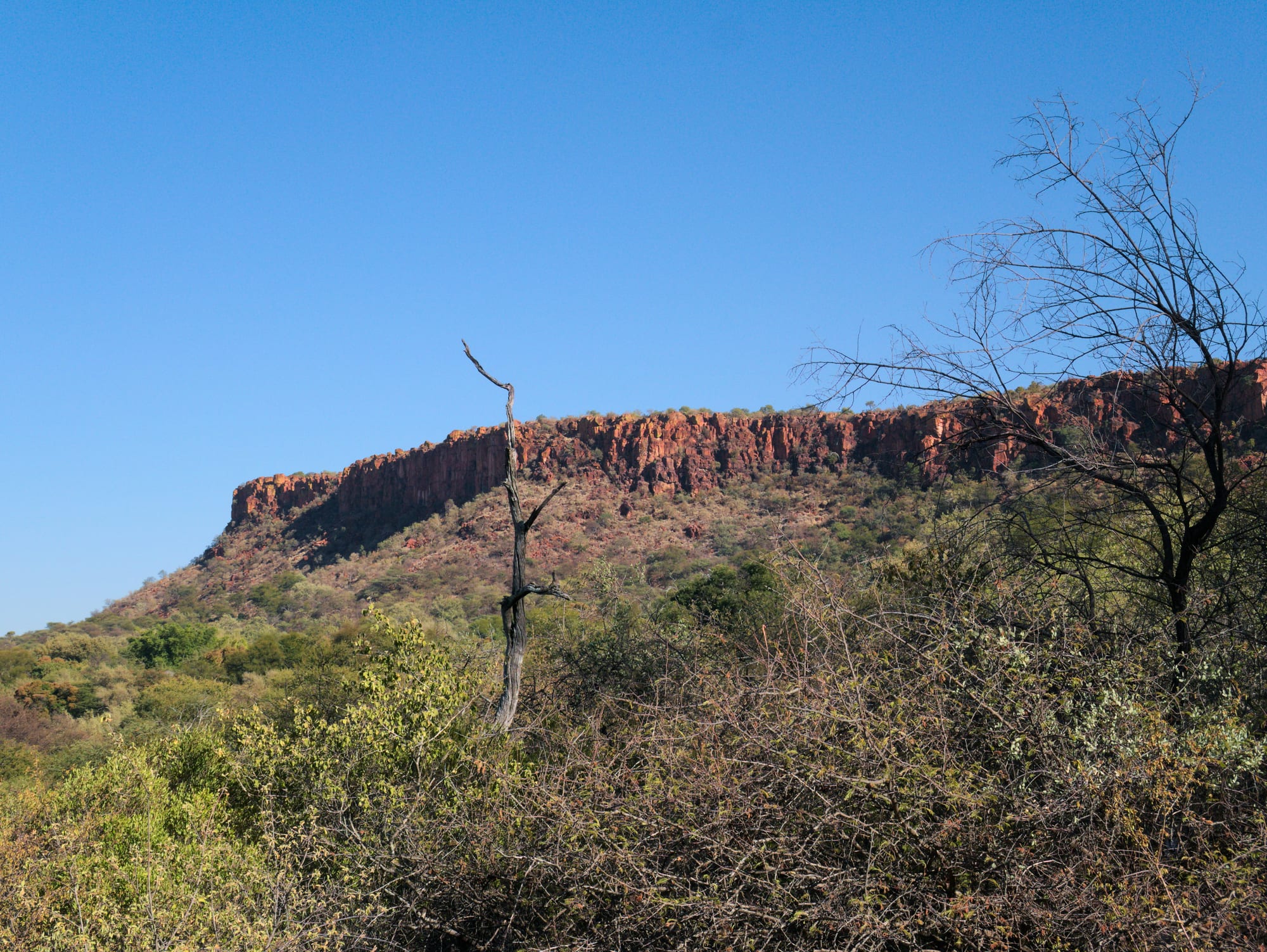
A long red sandstone cliff along the top of a hill above green and bare bush under a clear blue sky

Namibia

Windhoek & Central Namibia

The red sandstone cliffs of the Waterberg plateau seen from below its rest camp. (Daniel Kraft / Wikimedia Commons · CC BY-SA 3.0)

The central highlands of Namibia — the capital Windhoek in the Khomas hills, the cattle country and game reserves of Otjozondjupa around the Waterberg plateau, and the Omaheke sandveld running east to the Botswana border — the country's political centre and the landscape where the Herero war of 1904 was fought.

Explore Windhoek & Central Namibia

History

The central plateau was grazing land for the Herero, cattle herders who moved in from the north several centuries ago, while San hunter-gatherers lived in the eastern sandveld of the Omaheke. In the 1840s the Oorlam leader Jonker Afrikaner, whose people had migrated from the Cape, settled at the hot springs that the Nama called Ai-//Gams, and the settlement that became Windhoek grew around his base; decades of conflict followed between Oorlam, Nama and Herero groups.

Germany claimed the territory in 1884, and in 1890 the German commander Curt von François built the Alte Feste fort at Windhoek, which became the colonial capital. The Herero rose in 1904 against the loss of land and cattle, and in August that year German troops under Lothar von Trotha fought them at the Waterberg; the survivors fled east into the waterless Omaheke, where most died after the Germans sealed off the wells, and von Trotha then issued his extermination order. The Nama rising followed in the south. Germany acknowledged in 2015 that a genocide had been committed, and in 2021 agreed a development-aid deal with Namibia.

South Africa took over in 1915 and made the highlands the heart of a settler ranching economy. In Windhoek, black residents of the Old Location were forced to move to the new township of Katutura; the police shooting of protesters on 10 December 1959 is remembered each year as Namibia's Human Rights Day. Windhoek became the capital of independent Namibia in 1990.

Culture & Customs

Windhoek is the one place where all of Namibia meets: Ovambo migrants from the north, Herero, Damara and Nama families, Afrikaans-speaking and German-speaking Namibians, and a growing middle class of every background. German street names, bakeries and Lutheran churches sit alongside Katutura's markets, shebeens and churches, and many residents still describe themselves by their home region. Afrikaans remains a common everyday language in the city alongside English and Oshiwambo.

The Herero heartland runs through Okahandja and the Otjozondjupa and Omaheke regions. Every August, Herero men in uniforms modelled on colonial military dress and women in long Victorian-style dresses and horn-shaped headdresses march to the graves of their chiefs at Okahandja, a commemoration of the war and of Herero leaders. Cattle remain central to Herero identity and wealth.

In the north-east of Otjozondjupa, the Ju/'hoansi San of the Nyae Nyae Conservancy around Tsumkwe keep hunting and gathering skills alive alongside modern life. German traditions survive in Windhoek's Oktoberfest and carnival, and the city's arts scene gathers at the National Theatre and the National Art Gallery.

Daily Life

Windhoek has more than 400,000 people and has grown fast since independence, most of all in the informal settlements on the north-western edge of Katutura, where many new arrivals live in corrugated-iron shacks without proper water or sanitation. The city centre and the leafy eastern suburbs look very different, and the contrast is a daily reminder of how unequal Namibia is.

Government, services, retail and the university support the capital. Elsewhere the central region is ranching country: commercial cattle and game farms, many still owned by white families, cover the highlands, and land reform is a constant political topic. Okahandja, Otjiwarongo and Grootfontein serve the farms, and Gobabis in the Omaheke sits in the heart of the country's cattle farming area. Hunting and game-farm tourism have become important alongside beef.

The working day starts early and ends early, weekend braais are the social centre of life, and many Windhoek residents head to a farm or to the coast at Swakopmund for the December holidays. Water shortage is a real concern in dry years, and the capital recycles its waste water into drinking water.

Food

Windhoek eats like a German-Namibian country town and a southern African city at once. The German side brings bakeries with rye bread, Brötchen rolls and Apfelstrudel, cafés serving Schwarzwälder Kirschtorte, schnitzel and sausages, and lager brewed in Windhoek by Namibia Breweries under the old German purity law. The Oktoberfest is its big annual party.

The street side is kapana: strips of beef grilled over open fires at the Single Quarters market in Katutura and elsewhere, dipped in spice and chilli and eaten standing, with fat cakes and cold drinks. Game meat is a speciality across the region — oryx, kudu and springbok steaks in restaurants, and biltong and dry droëwors sausage everywhere.

Herero households prize omaere, soured milk, and cook maize porridge with meat. The Omaheke sandveld yields Kalahari truffles after good rains, sold at the roadside in season, and farm kitchens serve lamb, beef and potjie stews cooked in three-legged pots.

Attractions & Natural Wonders

Windhoek is small enough to see in a day. The Christuskirche, a Lutheran church completed in 1910, stands on a rise beside the Tintenpalast, a German colonial administration building that now houses parliament, and the Alte Feste; the Independence Memorial Museum tells the story of the liberation struggle, and Katutura can be visited on community tours. Daan Viljoen game park lies in the Khomas hills just west of the city.

North along the B1, Okahandja holds the graves of Herero chiefs. The Waterberg Plateau Park protects a sandstone massif rising high above the plain, with rare antelope such as sable and roan, rhinos, buffalo, leopards and cheetahs; trails climb to viewpoints over the bush. Okonjima, near Otjiwarongo, is the base of the AfriCat Foundation, where leopards and cheetahs are tracked on foot and by vehicle. The Hoba meteorite, the largest known on Earth, lies near Grootfontein.

East of Windhoek, the land flattens into the Omaheke, the western edge of the Kalahari: red sand, thornveld and cattle ranches around Gobabis, and Buitepos on the Botswana border.

Cities in Windhoek & Central Namibia

Planning basics

Budget

Windhoek is the easiest and cheapest place in Namibia to organise a trip: car hire, supermarkets, backpacker lodges and guesthouses are plentiful, and the central region's guest farms charge moderate rates for dinner, bed and breakfast. Private reserves such as Okonjima are priced at the top end, and Waterberg's state-run camp is good value.

Daily Budget Midrange
USD 150–370 (guesthouses and guest farms, a hire car, guided drives at the private reserves)
Daily Budget Shoestring
USD 45–80 (Windhoek hostels, camping at Waterberg or on guest farms, self-catering, a shared hire car)

Collect the hire car and stock up in Windhoek; supermarket prices in the smaller towns are higher and choice is thinner.

Safety

Windhoek is the one place in the region where crime is a real concern: bag-snatching, phone theft, car break-ins and occasional muggings, especially in the centre after dark and around taxi ranks. The countryside is calm, and the main risks are road accidents on long straight roads, wildlife and livestock at night, and fatigue.

Walk in central Windhoek in daylight, use registered taxis at night, keep nothing on view in parked cars, and avoid driving after dark. Check current official travel advice before travelling.

Climate

The central highlands sit at 1,500–1,700 metres, which keeps them cooler than their latitude suggests. Summers are hot by day with thunderstorms from about November to April, heavier in the north around the Waterberg than in the Omaheke. Winters are dry, sunny and mild by day, with cold nights and occasional frost.

Summer
warm to hot, 28–34°C, with afternoon thunderstorms; nights mild
Winter
dry and sunny, 18–24°C by day; cold nights near or below 0°C, especially in the Omaheke

Transportation

Hosea Kutako International Airport lies about 45 km east of Windhoek, and almost every Namibian road trip starts in the capital. The paved B1 runs north through Okahandja and Otjiwarongo, and the Trans-Kalahari Highway runs east through Gobabis to Botswana. Intercity minibuses leave from Windhoek, but public transport does not reach the reserves; a hire car is needed, and an ordinary saloon is enough for the main routes.

Windhoek to Waterberg is about three and a half hours by car; the private reserves arrange transfers from the capital.

Best Time to Visit

May to October is the easiest season, with clear skies, cool nights and animals gathered at waterholes at Waterberg and the private reserves. The rains from about December to April turn the highlands green and bring dramatic storms. Windhoek's Oktoberfest falls in October, and the Herero gathering at Okahandja takes place in August.