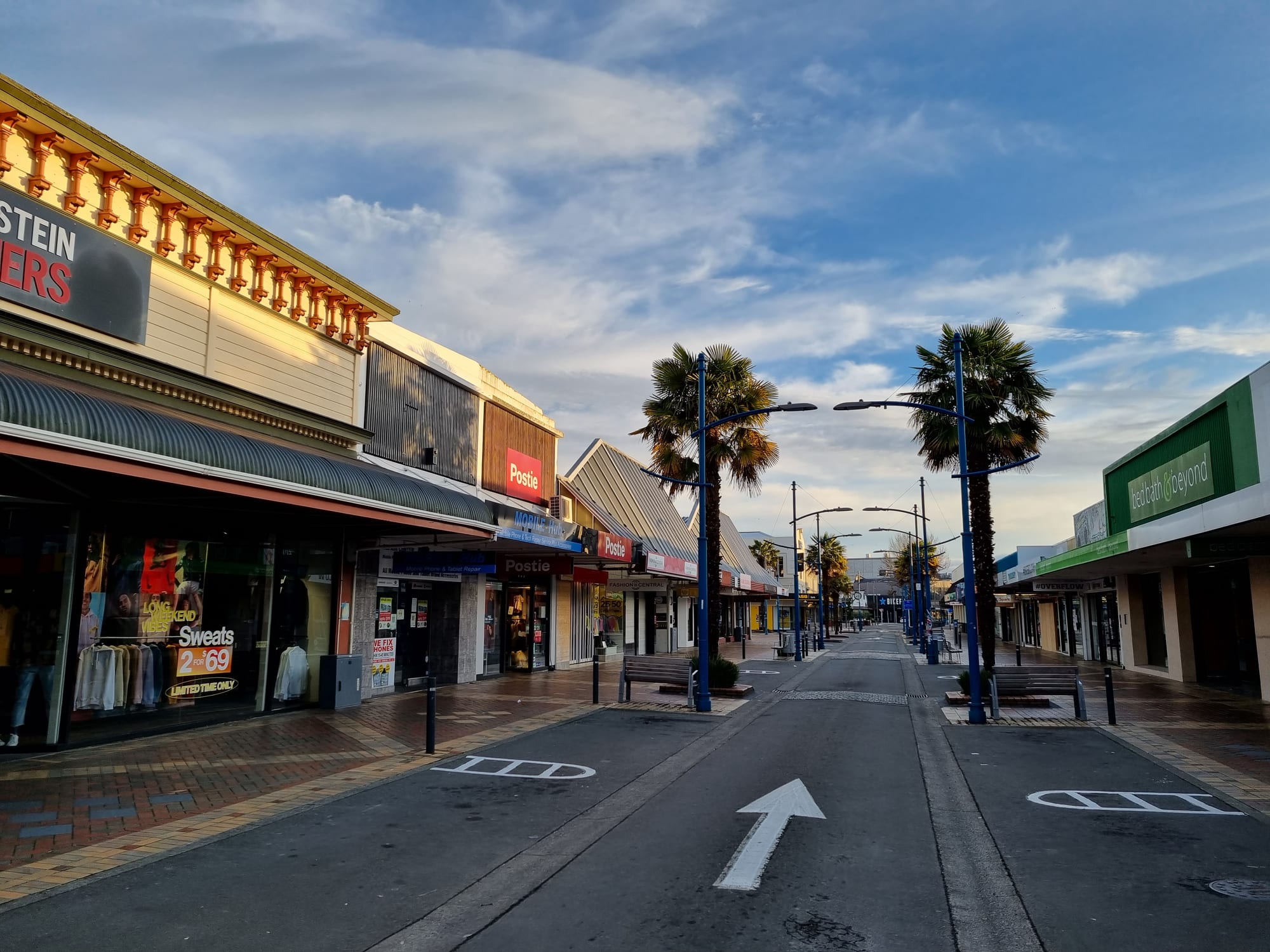
A wide town shopping street lined with low shopfronts, awnings and palm trees under a blue sky with scattered cloud

Nelson, Marlborough & the West Coast, New Zealand

Blenheim

Market Street in the centre of Blenheim, the main shopping street of the Marlborough wine district. (Maksym Kozlenko / Wikimedia Commons · CC BY-SA 4.0)

The main town of Marlborough, on the flat Wairau plains at the north-east corner of New Zealand's South Island. Founded on swampy ground beside the Taylor and Ōpaoa rivers, it took the provincial seat from Picton in the 1860s and grew on sheep and cropping. Since vines were planted in the 1970s it has become the centre of the country's largest wine district.

Neighbourhoods

  • The town centre
    • First-time visitors
    • Close to public transport
    • Best for food

    A grid of low streets around Market Street and the riverside gardens of Seymour Square, holding the shops, cafés and hotels, with the war memorial and clock tower of 1928 standing in the square. Everything is flat and close together, and the coach stops and railway station are a short walk away.

    Open in Maps
  • Along the Taylor River
    • Walks and viewpoints
    • Quiet and residential

    The Taylor River flows through the middle of town on its way to join the Ōpaoa, with reserves and riverside paths following it past playing fields, gardens and suburban streets. It is the route locals use for a morning walk or a bike ride to work.

    Open in Maps
  • Springlands and the western suburbs
    • Quiet and residential
    • Close to the wineries

    Streets of single-storey houses and newer subdivisions spreading west from the centre towards the vineyards, with the main supermarkets and retail parks along the highway. Convenient for driving out to the cellar doors of the Wairau Valley.

    Open in Maps
  • Renwick and the Wairau Valley
    • Wine tasting
    • Cycling

    A village of about two and a half thousand people some twelve kilometres west, surrounded by cellar doors. Flat lanes between the vines make it the usual base for tasting by bicycle, with a few places to eat and stay among the vineyards.

    Open in Maps
  • Riverlands and Ōpaoa
    • Quiet and residential

    The low, working edge of town towards the coast, where wineries, packhouses and light industry stand among paddocks on the road to the Wairau's river mouth and the beaches at Rārangi.

    Open in Maps

Things to do

Wine country

  • Cloudy Bay Vineyardsattraction

    One of the wineries that made Marlborough sauvignon blanc internationally known, founded in 1985 in the Wairau Valley west of town, with a cellar door among the vines.

    Open in Maps
  • Renwickneighborhood

    The small village at the heart of the wine district, ringed by cellar doors close enough together to visit by bicycle on flat country lanes.

    Open in Maps
  • Wairau Riverattraction

    The river whose free-draining gravels give Marlborough wine its character, running 170 kilometres from the Spenser Mountains past the vineyards to Cloudy Bay.

    Open in Maps

Museums and gardens

  • Omaka Aviation Heritage Centremuseum

    A collection of First and Second World War aircraft displayed in theatrical sets built with the help of New Zealand film workshops, at Omaka Aerodrome south-west of the town.

    Open in Maps
  • Omaka Aerodromeattraction

    A private airfield a few kilometres south-west of the town, owned by the local aero club and used by general aviation, home to the aviation collection and host to the Easter airshow.

    Open in Maps
  • Taylor Rivertrail

    The river through the middle of town, followed by a reserve and path used for walking, running and cycling past gardens and playing fields.

    Open in Maps
  • Rārangibeach

    A small settlement on the Cloudy Bay coast about fifteen kilometres north-east of town, where the beach faces the open bay.

    Open in Maps

Short trips from the town

  • Pictonneighborhood

    The Cook Strait ferry port at the head of Queen Charlotte Sound, under half an hour north, and the gateway to boat trips in the Marlborough Sounds.

    Open in Maps
  • Wairau Barattraction

    A gravel bar at the river mouth east of town, one of the earliest known human settlements in New Zealand, dated to about 1300, whose ancestral remains were reburied by Rangitāne in a formal ceremony.

    Open in Maps
  • Havelockneighborhood

    A village at the head of Pelorus Sound about forty minutes north-west, known for green-lipped mussels and boat trips into the Sounds.

    Open in Maps
  • Kaikōuraattraction

    A coastal town roughly two hours south where a deep undersea canyon close to shore brings sperm whales, dolphins and seals within reach of boat trips.

    Open in Maps

Seasonal events

  • Marlborough Wine and Food FestivalSummer

    The district's annual wine and food festival, with tastings from Marlborough producers, food and music.

  • Classic Fighters OmakaEaster, in odd-numbered years

    An airshow at Omaka Aerodrome flying vintage and wartime aircraft, staged with mock battles and ground displays.

  • The grape harvestAutumn

    Harvest fills the valley with machinery, trucks and seasonal workers day and night, and the wineries and their restaurants are at their busiest.

Eat and drink

Long-standing places and food districts in Blenheim. Hours, ratings and directions come from your maps app, always current.

Blenheim classics

  • Cellar-door restaurants in the Wairau Valleyneighborhood

    Several of the larger wineries west of town serve lunch among the vines, matching Marlborough wines with local lamb, salmon and cheese.

    Open in Maps
  • Market Street and High Streetneighborhood

    The town centre's cafés, bakeries, bistros and pubs, many of them pouring wine made a few kilometres away.

    Open in Maps

Nearby food

  • Havelock mussel restaurantsneighborhood

    The village at the head of Pelorus Sound is the place locals drive for green-shell mussels straight from the Sounds.

    Open in Maps

Experience Blenheim

History

The Wairau plains were settled early in Māori history: the Wairau Bar at the river mouth is one of the country's oldest known Polynesian sites, where burials, moa bone and tools show a community living there some seven centuries ago. Later the plains and the Sounds were held by iwi of Te Tau Ihu, the top of the South Island, with Rangitāne o Wairau among those with long-standing claims to the valley.

European settlement of the Wairau began with sheep runs in the 1840s, and tension over the New Zealand Company's claim to the valley led to the Wairau Affray of 1843, in which twenty-two settlers and four Māori died. The town that grew at the junction of the Taylor and Ōpaoa rivers was so wet and prone to flooding that it was nicknamed Beavertown before being named Blenheim after the 1704 battle. When Marlborough became a province in 1859 the capital was at Picton, but Blenheim's position on the farmland won the argument and the seat moved there in the 1860s.

For a century the town lived on wool, wheat, sheep and later cherries and market gardens, with flood protection works gradually taming the rivers. Everything changed after 1973, when Montana planted large blocks of vines in the Wairau Valley; the sauvignon blanc that resulted found export markets in the 1980s, and Marlborough grew into by far the country's biggest wine region. Vineyards replaced paddocks, wineries and contractors multiplied, and the town reorganised itself around grapes, with tourism, aviation heritage and food following the wine.

Culture & Customs

Blenheim's culture is built on wine and on farming, and the two sit closely together: the same families often run vines, sheep and cropping, and the year is structured by pruning, flowering, harvest and vintage. The summer wine and food festival is the district's social centrepiece, and the arrival of thousands of seasonal workers each autumn, many from the Pacific Islands and from overseas working-holiday schemes, gives the town a temporary international character.

Aviation is an unexpected second thread. The Omaka collection and the airshow staged at the aerodrome at Easter in odd-numbered years draw enthusiasts from around the world, and the displays owe much to the model makers and set builders of the New Zealand film industry, several of whom have supported the museum. Military connections run deeper still, since the airfield at Woodbourne has long been a Royal New Zealand Air Force base.

Beyond that, the town is recognisably provincial New Zealand: rugby and netball clubs, a Saturday of sport followed by the pub, an A&P show, choirs and amateur theatre, and a strong volunteer culture in a place small enough that people overlap. Manners are informal and understated, boasting is disliked, and conversations with strangers start easily. Māori identity is expressed through Rangitāne o Wairau, whose marae, language and role in the region's governance have grown more visible since its treaty settlement.

Daily Life

Around thirty thousand people live in Blenheim, which makes it one of the larger towns of the upper South Island and the service centre for a district of farms, vineyards and coastal settlements. Wine dominates employment, directly in the vineyards and wineries and indirectly through nurseries, bottling, engineering, laboratories and freight. Sheep and beef farming, cropping, food processing, the air force base, aviation engineering and tourism make up much of the rest.

Housing is mostly single-storey and suburban, with older weatherboard streets near the centre, newer subdivisions to the west and south, and lifestyle blocks among the vines. It has long been one of the more affordable parts of the country to buy in, and a steady flow of retirees arrives for the sunshine, so the population is older on average than the national figure.

Days start early, especially in the vineyards, and the town is quiet by evening. Shopping, sport and schooling happen locally, while hospital specialists, university study and big retail mean trips to Nelson, Wellington or Christchurch. Recurring local concerns are water — irrigation demand, river flows and the plains' dry summers — along with housing and transport for seasonal workers, the resilience of roads and rail after storms and earthquakes, and how much further vineyards should spread across remaining farmland.

Food

Wine comes first. Marlborough sauvignon blanc, with its sharp, aromatic character, is New Zealand's biggest wine export, and the valley also produces pinot noir, chardonnay, riesling, pinot gris, aromatic whites and traditional-method sparkling wine. Cellar doors around Renwick and the Wairau Valley pour all of them, often beside a kitchen serving platters of local produce, and the wineries have helped raise the standard of cooking across the town.

The food that goes with it is regional. Green-lipped mussels and king salmon come from the Marlborough Sounds, blue cod and crayfish from the coast, and lamb and beef from the surrounding hills; Marlborough also has the second-largest area of horticultural land in the country after Canterbury, growing fruit, vegetables and olives pressed for oil. Market stalls carry the fruit, cheese, bread and preserves that follow the seasons.

Everyday eating is straightforward and familiar: the bakery pie and sausage roll, the flat white and its accompanying slice, fish and chips, the barbecue on a long summer evening, and pavlova with cream and fruit at a family gathering. Whitebait fritters appear in their short season, and hāngī, food cooked in an earth oven, is prepared for community and marae occasions.

Planning tools

Budget

Blenheim is an ordinary New Zealand country town for costs, with motels along the main roads and a supermarket in the centre, and it is generally cheaper than Nelson or Queenstown. Prices rise around the summer wine festival and during the grape harvest, when seasonal workers take up much of the cheap accommodation. Wine tours, tastings and bicycle hire are the main discretionary spend.

Daily Budget Midrange
USD 150–280 (motel or vineyard lodge, restaurant meals, a hire car, a guided winery tour)
Daily Budget Shoestring
USD 55–90 (hostel or holiday park, supermarket food, a hired bicycle between cellar doors)

Book accommodation early for the wine and food festival and for the harvest weeks; Seymour Square, Pollard Park and the riverside paths are free.

Best Time to Visit

Late spring to early autumn, from November to April, gives the long, dry, sunny days the district is known for, with the vines in leaf and the cellar doors fully open. The autumn harvest brings machinery, trucks and settled weather. Winter is cool, frosty and quiet, with bare vines and shorter hours at some wineries, but clear skies and low prices.

Suggested Number of Days

A night or two covers the town and a round of cellar doors. Three or four days suit those adding the Marlborough Sounds, the coast or the museums, and anyone touring the wine district slowly by bicycle.

First Visit
1–2 days
With Surroundings
3–4 days

Transportation

The town is flat and small, so walking and cycling work well inside it, and hire bicycles are common for the vineyard lanes. There is no urban rail or tram, and local buses are limited, so a hire car, a taxi or a guided tour is the usual way to reach the cellar doors, Omaka and the coast. Tour vans collect visitors from accommodation for wine tasting.

Drink-driving limits are strictly enforced, so use a tour, a driver or bicycles when tasting.

Airport & Station Connections

Marlborough Airport at Woodbourne, about eight kilometres west of the centre, has regular flights to Auckland, Wellington and Christchurch. The Cook Strait ferries dock at Picton, under half an hour north by road, and the Coastal Pacific train between Picton and Christchurch stops in Blenheim in the warmer months. State Highway 1 links the town north to Picton and south to Kaikōura and Christchurch.

Walkability

Central Blenheim is level and compact, and the shops, gardens and riverside paths are easily covered on foot. The town spreads out into low-density suburbs, though, and the wineries are scattered across several kilometres of countryside, so anything beyond the centre needs a bicycle, a car or a tour.

Safety

Blenheim is a quiet and safe town with little crime that affects visitors, beyond occasional theft from parked cars. The practical risks are rural: narrow roads shared with heavy harvest traffic, cycling between cellar doors after tasting, sunburn on hot clear days, and swimming in braided rivers whose currents and channels shift. The region lies in an active earthquake zone.

Use a tour or a designated driver when wine tasting, wear a helmet on hired bicycles, and take sun protection seriously in a district that records some of the country's highest sunshine hours. Check current official travel advice before travelling.

Climate

One of the sunniest and driest parts of New Zealand, sheltered by mountains on three sides. Summers are warm and settled with cool nights, which is what suits the vines; winters are cold at night and often brilliantly clear by day. In the southern hemisphere summer falls in December–February.

Summer
warm, dry and sunny, with days usually in the low twenties °C and cool evening sea breezes
Winter
cool and crisp, with days in the low teens °C and cold nights

Local Customs

Tipping is not expected and service charges are rare. Dress is casual, even at wineries, and greetings are informal and first-name; 'kia ora' is in everyday use. The area is the rohe of Rangitāne o Wairau and other iwi of the top of the South Island, and the Wairau Bar is a burial site treated with respect. Wine talk is welcome, but the region is a working farming district rather than a resort.

Alcohol requires identification and is sold in licensed premises and supermarkets; drinking in public places is restricted. Ask before walking onto vineyard or farm land, which is private and often under machinery.

Common Payment Methods

The currency is the New Zealand dollar. Cards and contactless payment are taken almost everywhere, including at cellar doors and markets, sometimes with a small surcharge on credit cards. ATMs are in the town centre; a little cash is handy at market stalls and small rural stops.