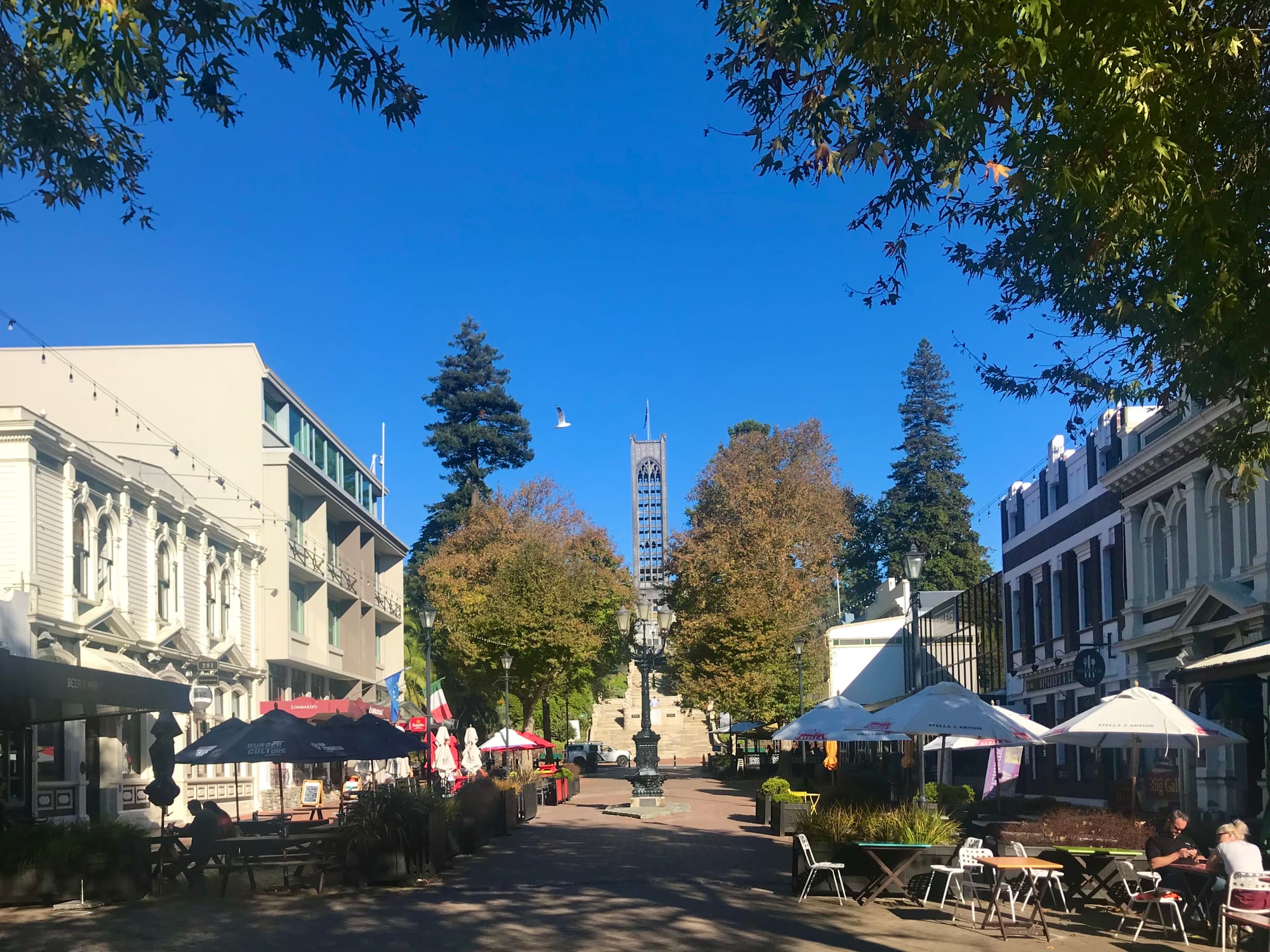
A café-lined pedestrian street ending in steps and a tall stone cathedral tower under a deep blue sky

Nelson, Marlborough & the West Coast, New Zealand

Nelson

Upper Trafalgar Street in Nelson, looking to the steps and tower of Christ Church Cathedral. (Ann Woolliams / Wikimedia Commons · CC BY-SA 4.0)

A small city at the head of Tasman Bay, at the top of New Zealand's South Island, settled by the New Zealand Company in 1841 and known as Whakatū to Māori. Sheltered by hills and among the sunniest places in the country, it lives on fishing, horticulture, hops and art, and serves as the gateway to Abel Tasman and two other national parks.

Neighbourhoods

  • The city centre
    • First-time visitors
    • Galleries and shops
    • Close to public transport

    A flat grid around Trafalgar Street, which runs from the river up to the cathedral steps. Cafés, galleries, craft shops, the museum and the Saturday market are all within a few blocks, and most hotels and backpackers are close by.

    Open in Maps
  • The Wood and Britannia Heights
    • Historic homes
    • Quiet and residential
    • Viewpoints

    The oldest residential streets, immediately north and west of the centre, where colonial cottages and villas climb the hills. Lanes and steps lead up to lookouts over the city, the haven and the bay, and the botanical hill with the Centre of New Zealand monument is at the eastern edge.

    Open in Maps
  • Tāhunanui
    • Beaches
    • Families
    • Camping

    The beach suburb about four kilometres from the centre, with a long shallow sand beach, dunes, a holiday park, a playground and motels along the main road. It is where the city swims, walks and watches the sunset.

    Open in Maps
  • Wakefield Quay and the port
    • Seafood
    • Sea views
    • Walks

    The waterfront road between the centre and Tāhunanui, running past the fishing fleet, the rock wall and the Boulder Bank offshore. Seafood restaurants, the yacht club and a memorial to the settler ships look across the water.

    Open in Maps
  • Stoke
    • Local life
    • Shopping
    • Close to public transport

    A large suburb halfway to Richmond, with shopping centres, sports grounds and the Saxton Field sports complex nearby. It has its own historic houses and gardens and is the practical, everyday side of Nelson.

    Open in Maps
  • Richmond
    • Quiet and residential
    • Close to the wineries

    A separate town about twelve kilometres south-west, effectively joined to Nelson, with its own centre, schools and industry. It sits at the start of the Waimea plains and their vineyards, orchards and hop gardens.

    Open in Maps

Things to do

Landmarks and museums

  • Christ Church Cathedrallandmark

    The Anglican cathedral above the centre, built in marble from near Tākaka between 1925 and 1965, at the top of Trafalgar Street's steps.

    Open in Maps
  • The Suter Art Gallerymuseum

    A public art gallery established in 1899, beside Queens Gardens, holding a collection of regional and national art.

    Open in Maps
  • Nelson Provincial Museummuseum

    The region's museum in the centre, covering Te Tau Ihu iwi, the New Zealand Company settlement and the Wairau Affray.

    Open in Maps
  • Founders Heritage Parkattraction

    A reconstructed colonial village of relocated and replica buildings, with a windmill, workshops, a brewery and a railway, north-east of the centre.

    Open in Maps
  • Centre of New Zealandviewpoint

    A monument on Botanical Hill marking an old survey reference point rather than the country's true geographic centre, reached by a short steep walk with views over the city and bay.

    Open in Maps

Beaches and the waterfront

  • Tāhunanui Beachbeach

    The city's main beach, a wide stretch of sand with shallow, warm water, dunes behind and views across Tasman Bay.

    Open in Maps
  • Boulder Bankattraction

    A natural wall of granite boulders some thirteen kilometres long that shelters Nelson Haven, with a lighthouse of 1862 near its southern end.

    Open in Maps
  • Moturoa / Rabbit Islandpark

    A long pine-planted island of beaches and picnic reserves off the mouth of the Waimea River, reached by road bridge or, on the Great Taste Trail, by the Māpua ferry.

    Open in Maps

Parks, gardens and walks

  • Queens Gardenspark

    A public garden of ponds, lawns and mature trees in the centre, next to the Suter gallery.

    Open in Maps
  • Isel Parkpark

    Parkland and specimen trees around the historic Isel House at Stoke, part of the legacy of the Marsden family.

    Open in Maps
  • Grampians Reservetrail

    A bush-covered hill immediately behind the city with tracks to a summit lookout over Nelson and the bay.

    Open in Maps

Markets and events venues

  • Nelson Saturday Marketmarket

    A weekly market in the centre where growers and local artists sell produce, food, crafts and art, and one of the city's fixtures.

    Open in Maps
  • Trafalgar Centreattraction

    The city's indoor arena beside the river, used for basketball, concerts and exhibitions.

    Open in Maps

Short trips from the city

  • Abel Tasman National Parkpark

    The smallest national park in the country, of golden beaches, granite headlands and clear bays, reached by road to Mārahau and then on foot, kayak or water taxi.

    Open in Maps
  • Kahurangi National Parkpark

    New Zealand's second-largest national park, of limestone, forest and tussock tops west of the city, crossed by the Heaphy Track.

    Open in Maps
  • Nelson Lakes National Parkpark

    Beech forest and two glacial lakes at the northern end of the Southern Alps, about an hour and a half inland.

    Open in Maps
  • Motuekaneighborhood

    A horticultural town about forty kilometres west, the last stop before Abel Tasman and the centre of the hop and apple country.

    Open in Maps
  • Māpuaneighborhood

    A village on the Waimea Inlet with a converted wharf of cafés, a smokehouse and galleries, on the cycle trail from Richmond.

    Open in Maps

Seasonal events

  • Nelson Arts FestivalOctober

    Theatre, music, readings and street events across venues in the city centre.

  • Nelson Jazz & Blues FestivalJanuary

    Concerts and free outdoor performances in the centre and in bars and cafés over several days of summer.

  • MarchfestMarch

    A craft beer and music festival drawing on the region's breweries and hop growers.

  • Nelson Saturday Marketevery Saturday, all year

    The weekly produce, craft and food market in the city centre, busiest through summer.

Eat and drink

Long-standing places and food districts in Nelson. Hours, ratings and directions come from your maps app, always current.

Nelson classics

  • Nelson seafoodrestaurant

    The biggest fishing port in Australasia lands hoki, snapper, scallops and green-lipped mussels, and the restaurants along Wakefield Quay make the most of them.

    Open in Maps
  • Nelson hops and craft beercafe

    Hops grown around Nelson and Motueka, among them locally bred varieties such as Nelson Sauvin and Motueka, are prized by brewers, and the city and its surroundings have a dense cluster of small breweries and taprooms.

    Open in Maps

Food districts and markets

  • Nelson Saturday Marketmarket

    Saturday stalls of Tasman fruit and vegetables, bread, cheese, smoked fish, coffee and cooked food in the middle of town.

    Open in Maps
  • Trafalgar Street and Hardy Streetneighborhood

    The centre's two main streets and the lanes between them hold most of the city's cafés, bakeries, bars and restaurants.

    Open in Maps
  • Māpua wharfneighborhood

    An old wharf on the inlet west of Richmond converted into cafés, a fish smokehouse, an ice creamery and a brewery.

    Open in Maps

Experience Nelson

History

The district was known to Māori as Whakatū, and the iwi of Te Tau Ihu — including Ngāti Toa, Te Āti Awa, Ngāti Rārua, Ngāti Tama and Ngāti Kuia — held the bays, the haven and the plains, having reached the top of the South Island through the upheavals of the 1820s and 1830s. The sheltered water behind the Boulder Bank had long been a source of fish and shellfish and a stopping place on coastal journeys.

Nelson was the New Zealand Company's second settlement. Ships carrying British migrants arrived in 1841 and 1842 to a town site chosen in haste, with far less usable land than promised, and early years were hungry. In 1843 a dispute over the company's claim to the Wairau Valley led an armed settler party to try to arrest the Ngāti Toa chiefs Te Rauparaha and Te Rangihaeata; in the clash that followed, 22 settlers and four Māori were killed, an event that shook the young colony. Nelson received city status in 1858 and, despite losing the provincial influence it once had, became the commercial centre of the top of the south.

Its later story is one of fruit, fish and art. Orchards and hop gardens spread across the Waimea plains and the Moutere hills, the port grew into one of the country's biggest fishing bases, and forestry and horticulture followed. Nelson College, opened in 1856, is the oldest state secondary school in the country, and the physicist Ernest Rutherford was one of its pupils. From the 1960s craftspeople settled in the region for its climate and cheap land, and the World of WearableArt show began in Nelson in 1987 before moving to Wellington.

Culture & Customs

Nelson calls itself an arts city and can largely justify it. Potters, jewellers, glassblowers, weavers and painters work throughout the region, selling from studios and galleries and at the Saturday market, and the Suter has shown New Zealand art since the 1890s. The Nelson Arts Festival in October is the year's cultural high point, and the World of WearableArt's local origins are still a point of pride.

Life is organised around the outdoors and the climate. Sunshine hours are quoted competitively against other cities, the beach at Tāhunanui functions as a public park, and weekends go to tramping, mountain biking, sailing, kayaking and fishing. The region's produce — hops and craft beer, wine, apples, berries, scallops and mussels — fills markets and festivals, and a strong local-food culture links growers to restaurants.

Underneath the holiday image is a working provincial city: fishing crews, packhouses, seasonal orchard workers from the Pacific Islands and beyond, and long-established farming families. Iwi of Te Tau Ihu run businesses in fishing, forestry and property, and te reo Māori names and greetings are in general use. Manners are informal and understated, and newcomers are expected to muck in with clubs, school fairs and volunteer conservation work.

Daily Life

About 55,000 people live in Nelson city and roughly 110,000 in the wider Nelson and Tasman districts, including Richmond, Motueka and the smaller towns. Housing is mostly detached, on the flat around Tāhunanui and Stoke and on the hills behind the centre, where views come with steep driveways. Richmond has taken much of the recent growth, and the built-up area now runs almost unbroken between the two.

Work comes from seafood, horticulture and forestry, and from health, education, building and tourism. The port handles fish, logs and fruit, packhouses run hard from summer into autumn, and the hop harvest in February and March draws attention from brewers worldwide. Nelson also has a notably large population of retired people and a steady flow of newcomers escaping bigger cities, which keeps house prices high relative to local wages.

The rhythm is early and outdoors: the market on Saturday morning, sport for children at weekends, evening walks on the beach or the Grampians, and boats out of the haven whenever the weather allows. Local worries include housing affordability and rentals for seasonal workers, pressure on the hospital, the risk of drought and wildfire in a dry, sunny region, and the damage that storms and floods have done to roads and rivers in recent years.

Food

Seafood comes first. Nelson's fleet lands hoki, snapper, tarakihi, gurnard and squid, Tasman Bay and the Sounds supply green-lipped mussels and farmed salmon, and scallops, when the beds allow, are a local delicacy. Smoked fish from Māpua's smokehouse, fish and chips on Wakefield Quay and a bag of mussels steamed at home are all standard Nelson meals.

The land supplies the rest. The Waimea plains and Moutere hills grow apples, pears, kiwifruit, boysenberries, raspberries and stone fruit, sold at roadside stalls through summer, and olive oil, goat's cheese and honey come from the same valleys. Hops have been grown around Nelson and Motueka since the settlement's early years, and varieties bred there, such as Nelson Sauvin and Motueka, have become famous among brewers, with a high concentration of small breweries in the region. Vineyards nearby make chardonnay, pinot noir and aromatic whites, lighter in style than Marlborough's.

In the city itself the cooking is modern New Zealand with a strong café culture: brunch, flat whites, bakeries, wood-fired pizza and restaurants built around market produce, plus Asian, Indian and Mediterranean kitchens. Hāngī and seafood boils appear at community events, and summer ends with cherries, plums and ice cream eaten on the beach.

Planning tools

Budget

Nelson is moderately priced by New Zealand standards, with hostels, holiday parks and motels as well as boutique hotels and lodges. Beds tighten and prices climb from late December through January, when New Zealanders take their summer holidays, and during the arts festival. Water taxis, kayak trips and hut or campsite fees for Abel Tasman are the main extra costs of a visit.

Daily Budget Midrange
USD 150–290 (motel or lodge, restaurants, a hire car, a kayak trip or winery visit)
Daily Budget Shoestring
USD 55–90 (hostel or holiday park, market and supermarket food, beaches and bush walks)

Book Abel Tasman transport, campsites and huts and January accommodation well in advance; the beaches, gardens and hill tracks are free.

Best Time to Visit

December to April, with February and March the most settled and past the school holidays — warm, dry and long-lit, and the best conditions for the coast tracks and kayaking. Autumn brings the grape and hop harvests and the arts festival is in October. Winter is cool but often bright and clear, and the city stays busy with its own life.

Suggested Number of Days

Two days suit the city itself, which is compact and walkable. Four to six allow for the national parks, the beaches and the orchard and hop country inland. Multi-day walks and sea-kayak trips add as many days again.

First Visit
2 days
With Surroundings
4–6 days

Transportation

The centre is walkable and the eBus network links it with Tāhunanui, Stoke, Richmond and the airport, with fewer services in the evenings and at weekends. Most visitors hire a car, since Abel Tasman, Golden Bay and the wineries are spread out; shuttles and water taxis serve the park trailheads in season. Cycle trails run from the city along the coast towards Richmond and Māpua.

The road over the Tākaka Hill to Golden Bay is steep and winding, and the drive to the West Coast glaciers takes a full day.

Airport & Station Connections

Nelson Airport is about six kilometres south-west of the centre at Annesbrook, the busiest airport in New Zealand without scheduled international flights, with frequent flights to Auckland, Wellington and Christchurch and a short taxi or bus ride into town. By road, Nelson is a couple of hours from Picton and the Cook Strait ferries, a little less from Blenheim, and around six hours from Christchurch. There is no passenger rail service.

Walkability

The centre is flat, small and easy on foot, with the cathedral, market, museum and galleries within ten minutes of each other. The older suburbs climb steeply, and lanes and steps shorten the hill walks. Tāhunanui Beach is about four kilometres from the centre, a pleasant walk or cycle along the waterfront, while Stoke and Richmond need a bus or car.

Safety

Nelson is a safe city with low levels of serious crime; theft from cars parked at beaches and trailheads is the usual problem. The hazards are outdoors: strong tidal currents in the haven and inlets, tide-dependent crossings on the Abel Tasman Coast Track, rivers that rise quickly in rain, and sandflies in the parks. Earthquakes are possible across the region.

Check tide times before walking the Abel Tasman estuary crossings, take insect repellent, swim between the flags where beaches are patrolled, and leave word of any tramping plans. Check current official travel advice before travelling.

Climate

Sheltered by mountains on three sides, Nelson is one of the sunniest places in New Zealand, with warm, dry summers, mild autumns and cool, frosty but bright winters. Rain falls mainly in short spells, and the region can be dry enough for water restrictions in late summer. Summer runs from December to February in the southern hemisphere.

Summer
warm and sunny, with daytime highs usually around 22–25°C and cool nights
Winter
cool and often clear, with daytime highs around 12–14°C and frosts inland

Local Customs

Informal and outdoorsy: shorts, bare feet in summer, first names and easy conversation. Tipping is not expected. Nelson has a long-standing artistic and alternative streak, with potters, jewellers and galleries throughout the region. The area is the rohe of the iwi of Te Tau Ihu, and Whakatū is the city's Māori name; marae are visited by invitation, and pounamu is treated as a taonga, properly given rather than bought for oneself.

Photo identification is asked for when buying alcohol, and supermarkets sell beer and wine but not spirits. Permission should be sought before photographing people, marae or wāhi tapu, and shoes are removed on entering many homes.

Common Payment Methods

The currency is the New Zealand dollar. Cards and contactless payment are accepted almost everywhere, sometimes with a small credit-card surcharge, though a little cash is handy for market stalls, honesty boxes at farm gates and some small galleries. ATMs are in the centre, Stoke and Richmond, and tipping is not added to bills.