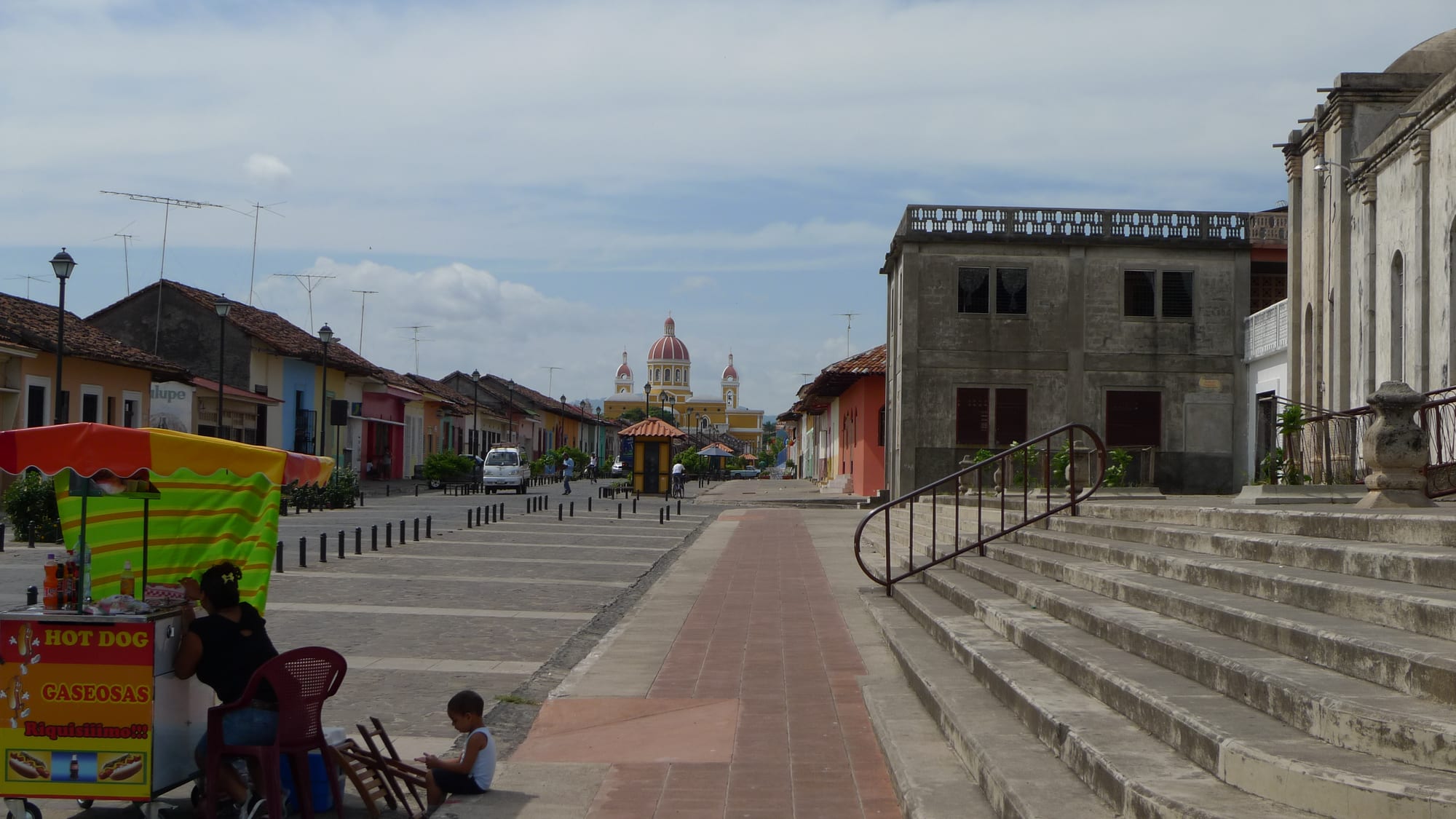
A wide paved street of low pastel-coloured houses leading to a yellow cathedral with a red dome, church steps on the right

Granada, León & the Pacific, Nicaragua

Granada

A street of single-storey colonial houses in Granada, with the cathedral at its end. (nakashi / Wikimedia Commons · CC BY-SA 2.0)

A colonial city on the north-western shore of Lake Nicaragua, founded by the Spanish in 1524 and grown rich on lake trade with the Atlantic. Burned by William Walker's retreating forces in 1856 and rebuilt, it is now a low town of painted houses and churches beneath the Mombacho volcano, restored in recent decades and a centre of the country's tourism.

Neighbourhoods

  • Parque Central and the colonial centre
    • First-time visitors
    • Historic district

    The shaded central park and the Plaza de la Independencia beside it, framed by the yellow cathedral, the Episcopal Palace and the town hall. Most of the restored colonial houses, with their interior courtyards, guesthouses and cafés, lie within a few blocks of here.

    Open in Maps
  • Calle La Calzada
    • Best for food
    • Nightlife

    The street that runs east from the cathedral past the Guadalupe church towards the lake, turned into a pedestrian street with Spanish government help. Restaurants and bars put tables out along it, and it is the busiest part of town in the evening.

    Open in Maps
  • Xalteva and Calle Real
    • Historic district
    • Quiet and residential

    The western side of the old town, around the Xalteva church and along Calle Real towards the old Pólvora fortress. It is quieter and more residential than the centre, with La Merced's bell tower on the way.

    Open in Maps
  • The market district
    • Local life
    • Markets

    A few blocks south of the centre, along Calle Atravesada, the large and crowded central market is where most Granadans do their shopping, with stalls spilling out around the old market hall and buses leaving from nearby streets.

    Open in Maps
  • The lakeshore and the Asese peninsula
    • Boat trips
    • Nature

    East of the old town the city meets Lake Nicaragua, with its port at the end of La Calzada and lakeside beaches that fill around Holy Week. South of the city the Asese peninsula is the starting point for boats into the islets.

    Open in Maps

Things to do

Churches and colonial landmarks

  • Granada Cathedrallandmark

    The neoclassical cathedral of Our Lady of the Assumption on the central park, rebuilt several times since the first church of around 1525; the iron frame of its dome was brought from the United States in 1916.

    Open in Maps
  • La Merced Churchlandmark

    One of the city's six main churches, west of the centre, whose bell tower can be climbed for a view over the rooftops, the cathedral and the lake.

    Open in Maps
  • San Francisco Church and Museummuseum

    A church and former convent that now holds a museum, including pre-Columbian stone statues found on Zapatera island in the lake.

    Open in Maps
  • Xalteva and Guadalupe churcheslandmark

    Two more of the six main colonial churches, Xalteva on the western side of the old town and Guadalupe on Calle La Calzada towards the lake.

    Open in Maps
  • Fuerte La Pólvoralandmark

    An 18th-century fort, built in 1748, at the top of Calle Real.

    Open in Maps

The lake

  • Las Isletasattraction

    A group of 365 small volcanic islands around the Asese peninsula, formed when Mombacho blew much of its cone into the lake; many are inhabited or hold holiday homes, and boat tours weave between them.

    Open in Maps

Short trips from the city

  • Mombachopark

    The 1,344-metre volcano south of the city, a nature reserve with cloud forest and dwarf forest near its summit, a trail around the main crater and a steeper guided trail; it last erupted in 1570.

    Open in Maps
  • Laguna de Apoyopark

    The largest volcanic crater lake in Nicaragua, between Granada and Masaya, a nature reserve since 1991 where motorised boats are not allowed.

    Open in Maps
  • Masaya Volcanopark

    Nicaragua's first and largest national park, a caldera whose active Santiago crater constantly gives off sulphur dioxide; a road climbs to the rim.

    Open in Maps
  • Zapateraattraction

    The second-largest island in Lake Nicaragua, an inactive shield volcano and protected area with an archaeological site, visible from the city on a clear day.

    Open in Maps

Seasonal events

  • International Poetry Festivalmid-February

    An annual gathering of poets from around the world, held in Granada since 2005, which has earned the city the nickname 'the Paris of Central America'.

  • Holy WeekMarch or April

    Easter week, when Granadans crowd the beaches on the lakeshore.

  • La Purísima and La Griteríaearly December

    The feast of the Virgin's Immaculate Conception, when families build altars and neighbours go from house to house singing to receive sweets.

Eat and drink

Long-standing places and food districts in Granada. Hours, ratings and directions come from your maps app, always current.

Granada classics

  • Vigorón kiosks in the Parque Centralmarket

    Kiosks in the central park serve vigorón, the city's own dish of boiled cassava, crisp pork rind and cabbage salad on a plantain leaf.

    Open in Maps
  • Restaurants on Calle La Calzadaneighborhood

    The pedestrian street between the cathedral and the lake, lined with restaurants and bars serving both Nicaraguan and international food.

    Open in Maps

Food districts and markets

  • Granada Central Marketmarket

    The large, chaotic central market on Calle Atravesada, with fruit, vegetables, meat and stands selling sweet drinks such as cacao with milk.

    Open in Maps

Experience Granada

History

The Spanish conquistador Francisco Hernández de Córdoba founded Granada in 1524 on land with a large Indigenous population, naming it after the Andalusian city whose capture had completed the Reconquista. It has long claimed to be among the first European cities on the American mainland. Through Lake Nicaragua and the San Juan River it traded directly with the Atlantic, grew rich on commerce, and drew attacks from English, French and Dutch pirates. The first cathedral, of stone, brick and a straw roof, went up around 1525 and had burned twice by 1578.

For generations Granada, favoured by the Conservatives, fought León, the city of the Liberals, for control of Nicaragua, and the quarrel turned violent more than once; in the mid-19th century Managua, between the two, was chosen as the capital. Around 1850 Granada had about 10,000 people. In the war of the 1850s the American filibuster William Walker made the city his residence, and when his forces retreated in 1856 his general Charles Frederick Henningsen set it on fire, destroying much of the colonial town and leaving an inscription reading "Here was Granada" in the ruins.

Granada was rebuilt and escaped much of the fighting of the Sandinista era, but its buildings and streets decayed during the economic collapse of the 1980s. Restoration began in the following decades with Spanish government help. A property boom brought foreign buyers until it slowed in 2007, and after the 2018 protests the US government issued a travel advisory.

Culture & Customs

Granada's nickname, La Gran Sultana, refers to an Andalusian, even Moorish, look that sets it apart from León's more Castilian style: low colonial houses painted in strong colours and built around shaded courtyards. Six main churches anchor the town, and the cathedral's yellow front on the central park is its emblem.

The city sees itself as a cultural capital. Its International Poetry Festival, held every year since 2005, brings poets from many countries and has earned Granada the title of the Paris of Central America, and UNESCO has named it a Creative City of Design. The hípica, a parade of horses and riders, is one of its best-known fiestas, and the lakeside beaches fill during Holy Week.

Like the rest of the Pacific, Granada is Spanish-speaking, Catholic and largely mestizo, with a conservative reputation that dates back to its old rivalry with León. It also has a foreign community from the United States, Canada and much of Europe, many of whom bought and restored colonial houses during the boom years.

Daily Life

An estimated 106,000 people lived in the city in 2022, making it the ninth-largest in Nicaragua and the capital of Granada department. It has a long history of trade, once in timber, gold and silver, and today the economy depends heavily on tourism, alongside farms in the surrounding municipality that grow organic coffee and cacao, plantains and bananas and raise cattle.

Most Granadans live outside the restored blocks around the central park, in the plainer streets that spread west and south of the colonial core, and they shop at the crowded central market and the supermarkets rather than on La Calzada. The climate shapes the day: business starts early, the streets go quiet in the midday heat, and families sit outside their doors in the evening.

Since 2018 tourism has been much less reliable than in the boom years, and the foreign buying that drove up property prices had already slowed in 2007. As across Nicaragua, many families rely on relatives working abroad, and people tend to be careful about what they say in public.

Food

Granada's signature is vigorón, a dish found across the country but claimed by this city: boiled cassava (yuca) topped with chicharrón, crisp fried pork rind, and a sharp salad of cabbage, tomato and onion, served on a plantain leaf. Kiosks in the central park sell it, and it is eaten on the park benches.

The lake supplies the fish. Guapote and mojarra, both caught by local fishermen, are usually fried whole and served with tostones, fried green plantain. The everyday plates of the comedores are the national ones: gallo pinto, rice and beans fried together, with soft cuajada cheese, eggs and tortillas at breakfast, and nacatamales, large banana-leaf parcels of maize dough and pork, at weekends.

The central market's stands sell sweet, cold drinks made from cacao with milk, linseed or beetroot, alongside fresh fruit frescos and pinolillo, the toasted maize and cacao drink. The restaurants along La Calzada and around the centre mix local and international flavours, and some work with local growers and producers. Toña and Victoria beers and Flor de Caña rum are the standard drinks in the bars.

Planning tools

Budget

Granada is one of the more expensive places in Nicaragua, because so much of the country's tourism is concentrated here, but it is still cheap by regional standards. Restored colonial guesthouses and the restaurants of La Calzada cost most; market food, park kiosks and chicken buses cost very little. Boat trips to the islets and guided volcano visits add to the bill.

Daily Budget Midrange
USD 60–130 (courtyard guesthouse or boutique hotel, restaurant meals, shuttles, an islets or volcano tour)
Daily Budget Shoestring
USD 25–45 (hostel or hospedaje, market and kiosk meals, chicken buses)

Carry small córdoba and US-dollar notes for kiosks, market stalls and buses.

Best Time to Visit

The dry season, November to April, is the easiest time, with clear skies over the lake; the first months, before the heat peaks, are the most comfortable. The rains of May to October turn Mombacho and the countryside green and bring heavy afternoon storms. Holy Week and the Purísima in December are the busiest local holidays.

Suggested Number of Days

Two or three days cover the colonial city and the lake. Allow four or five to include the volcanoes and the crater lake nearby. Travellers who come by bus rather than with a tour or driver need a little more time.

First Visit
2–3 days
With Surroundings
4–5 days

Transportation

The old town is small, and most visitors walk, with taxis for longer hops. Many streets are narrow and one-way, which makes driving awkward. Chicken buses and faster minibuses leave from near the central market for Managua, Masaya and the surrounding towns, and tourist shuttles serve the main destinations.

Agree a taxi fare before getting in, and avoid driving outside the city at night.

Airport & Station Connections

Augusto C. Sandino International Airport in Managua is the nearest airport; the trip to Granada takes about 40 minutes by taxi or airport shuttle. Buses from Managua leave from the UCA terminal and the Huembes market. There is no direct public bus from León, so travellers change in Managua or take a shuttle. Coaches from Costa Rica and Honduras stop in Granada, and slow boats cross the lake to Ometepe.

Walkability

The colonial centre is flat and compact, and everything from the Xalteva church to the lakeshore is within walking distance on a grid of narrow streets. The heat is the main obstacle in the middle of the day. Pavements are often narrow, uneven or broken by steps.

Safety

Nicaragua has historically had lower violent crime than its northern neighbours, but the political situation is now the dominant concern. The cities of this region were the centre of the 2018 protests and the crackdown that followed. The lakeshore beach area is best avoided at night, and walking in company after dark is sensible everywhere. Volcano trails are steep and hot.

Use taxis arranged by guesthouses at night, stay away from demonstrations, do not photograph police, and keep conversations away from politics. Check current official travel advice before travelling.

Climate

Granada is hot all year, with an average annual temperature of about 26°C and a dry season from November to April and rains from May to October. Across the Pacific lowlands days are commonly 30–35°C. The slopes of Mombacho are cooler and often in cloud.

Summer
rainy season May–October, around 27–33°C in the Pacific lowlands, with heavy afternoon storms
Winter
dry season November–April, around 30–36°C in the Pacific lowlands, dusty and very hot by March

Local Customs

Granada is Catholic and fairly conservative, and its churches are places of worship as well as sights: modest dress and quiet are expected inside. Greetings matter — a 'buenos días' or 'buenas tardes' on entering a shop. People are often guarded about politics, and it is best not to raise it.

Cover shoulders and knees in churches, ask before photographing people, never photograph police or soldiers, and do not take part in or film any protest.

Common Payment Methods

The currency is the córdoba (NIO). US dollars are widely accepted by hotels and tour operators, often with change given in córdobas. Cards work in larger hotels and restaurants; markets, kiosks and buses take cash only. There are ATMs in the centre.