💰 Budget
Managua is inexpensive by international standards: city buses and street food cost very little, and shared and private taxis are cheap by the standards of most capitals. Business hotels and restaurants along the Carretera a Masaya and in Los Robles cost more, and tourist shuttles or private drivers to Masaya and Granada add to the bill.
- Daily Budget Midrange
- USD 60–130 (mid-range hotel, restaurant meals, private taxis, a volcano or lagoon trip)
- Daily Budget Shoestring
- USD 25–45 (hostel or hospedaje, market and comedor meals, city buses)
Carry small córdoba notes for buses, market stalls and taxis, and agree every taxi fare before setting off.
📅 Best Time to Visit
November to February, after the rains, when the heat is easiest to bear. March and April are the hottest and dustiest months, and the rainy season from May to October brings afternoon storms. Early August is the time of the Santo Domingo festival, when processions and crowds fill the city.
⏳ Suggested Number of Days
Most travellers spend a day or two in the capital, often at the start or end of a trip. Three or four days allow time for the volcano, the crater lakes and the colonial towns nearby. The city is spread out, so time depends heavily on traffic.
- First Visit
- 1–2 days
- With Surroundings
- 3–4 days
🚆 Transportation
Managua is a sprawling, car-based city. Numbered city buses cover it cheaply from early morning, but there is no night service and they are crowded, so most visitors use private taxis, which have no fixed rates. Shared taxis pick up other passengers along the way. Addresses are given from landmarks rather than street numbers, often from places that no longer exist. Buses and minibuses to Masaya, Granada and León leave from the Roberto Huembes and Israel Lewites markets and the UCA terminal.
Use licensed private taxis, check the licence and plate before getting in, and avoid unlicensed cars.
🛬 Airport & Station Connections
Augusto C. Sandino International Airport, the country's main international gateway, lies on the eastern side of the city about 11 km from downtown; most arrivals take a taxi, and city buses also run along the Carretera Norte. International coaches link Managua with other Central American capitals, and buses from every part of Nicaragua terminate at the city's markets.
🚶 Walkability
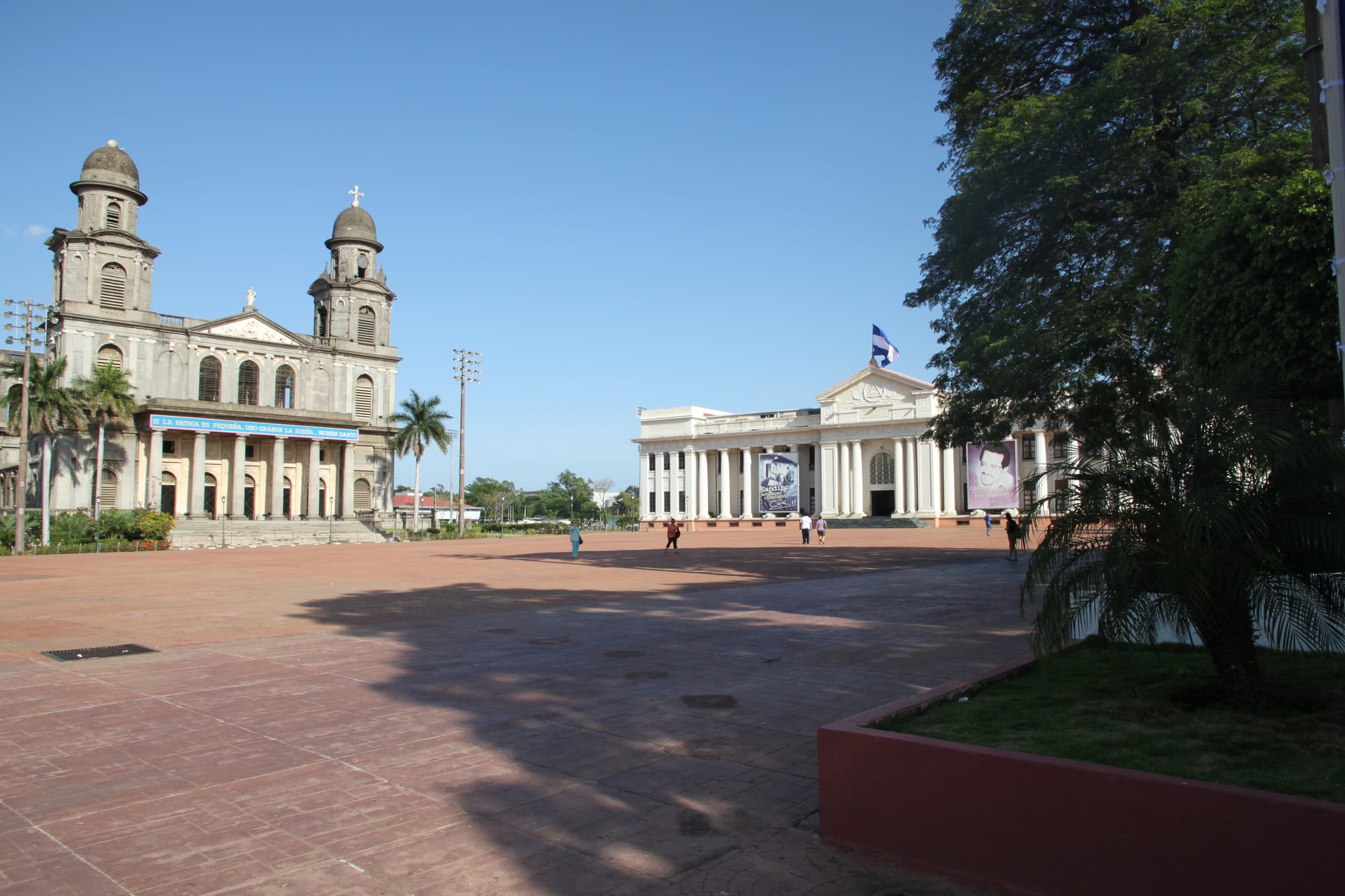
Not a walking city: it is very spread out, crossed by fast roads and roundabouts, and locals avoid long walks when they can. The rebuilt old centre and lakefront around the Plaza de la Revolución and Puerto Salvador Allende are the best areas on foot, and the Loma de Tiscapa is a short climb from there. Pavements are now common, but drivers rarely respect crossings.
🛡️ Safety
Nicaragua has historically had lower violent crime than its northern neighbours, but the political situation is now the dominant concern. In Managua, pickpocketing and grab-and-run theft are common in markets and crowded buses, robbery occurs especially after dark and in taxis hailed on the street, and shared taxis carry a higher risk. The city was at the centre of the 2018 protests and the crackdown that followed.
Use taxis arranged by hotels or licensed private taxis, keep bags in front on buses and in markets, avoid demonstrations and political conversations, and do not photograph police. Check current official travel advice before travelling.
🌦️ Climate
Tropical and hot all year, with average temperatures between about 28 and 32°C. The dry season from November to April is almost rainless and turns the countryside dusty; the rainy season from May to October brings afternoon storms.
- Summer
- rainy season May–October — hot and humid, averaging about 28–32°C, with heavy afternoon storms
- Winter
- dry season November–April — averaging about 28–32°C and almost rainless, hottest in March and April
🤝 Local Customs
Directions are given from landmarks with the words al lago (north, towards the lake), arriba and abajo (east and west) and al sur (south), and taxi drivers expect them. Managua is religious and conservative in many ways, and the Santo Domingo festival mixes devotion with street celebration. Political topics are sensitive and best avoided with strangers.
Dress modestly in churches, ask before photographing people, never photograph police, soldiers or government buildings, and avoid any public political or religious activism.
💳 Common Payment Methods
The currency is the córdoba (NIO). US dollars are widely accepted for larger purchases and by hotels, often with change given in córdobas. Cards work in shopping centres, hotels and restaurants, while buses, markets and most taxis take cash only.