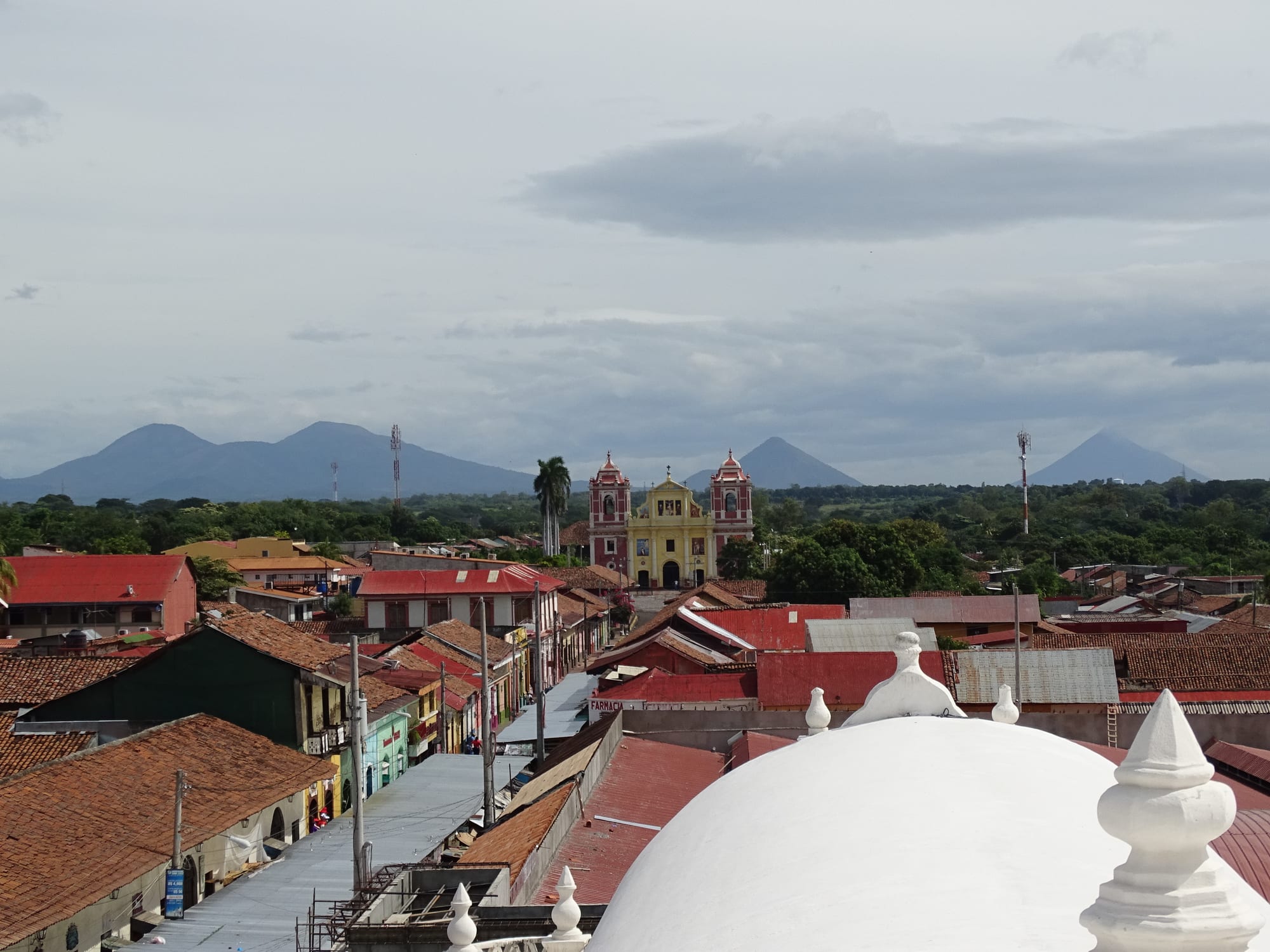
Red and rust-coloured rooftops of León seen from a white cathedral roof, with a yellow twin-towered church and volcanoes beyond

Granada, León & the Pacific, Nicaragua

León

León's rooftops and the El Calvario church seen from the roof of the cathedral, with volcanoes on the horizon. (Adam Jones from Kelowna, BC, Canada / Wikimedia Commons · CC BY-SA 2.0)

Nicaragua's second city, on the hot north-western plain about 90 km from Managua and 18 km from the Pacific, moved here after earthquakes led the settlers to abandon the first León in 1610. For centuries the Liberal and intellectual capital, it has the largest cathedral in Central America, a university founded in 1812, revolutionary murals and a ring of volcanoes on the skyline.

Neighbourhoods

  • Parque Central and the colonial centre
    • First-time visitors
    • Historic district

    The blocks around the central park and the cathedral, with most of the colonial churches, the museums, the university buildings and many guesthouses within a short walk. Street murals appear on walls throughout the centre.

    Open in Maps
  • The north-east commercial quarter
    • Local life
    • Markets
    • Close to public transport

    The busy shopping district north-east of the central park, with the banks, most of the shops, the municipal markets behind the cathedral and by the San Juan church, and the main bus terminal further out.

    Open in Maps
  • Sutiava
    • Historic district
    • Quiet and residential

    About fourteen blocks west of the cathedral, an Indigenous town older than León that was once separate from it. It has its own colonial church and square, a small market, chapel ruins and the buses for the Pacific beaches.

    Open in Maps
  • Las Peñitas and Poneloya
    • Beaches
    • Surfing

    Two neighbouring fishing villages on the Pacific about 17 km away, where many visitors stay by the sea. Las Peñitas has a mellow pace and is popular with surfers; Poneloya, less touristic, is a holiday-home area for wealthy Nicaraguans.

    Open in Maps

Things to do

Churches and landmarks

  • León Cathedrallandmark

    The largest cathedral in Central America, built between 1747 and 1814 and made a UNESCO World Heritage Site in 2011; Rubén Darío is buried inside, and visitors can climb onto its white roof.

    Open in Maps
  • Iglesia de San Juan Bautista de Sutiavalandmark

    The church of the Indigenous district of Sutiava, completed in 1710 and the oldest intact church in León, known for its carved timber ceiling with a sun motif.

    Open in Maps
  • Iglesia El Calvariolandmark

    An 18th-century church at the east end of Calle Real, its yellow and dark red front decorated with reliefs of the Passion.

    Open in Maps
  • Iglesia de la Recolecciónlandmark

    A church begun in 1786 whose Mexican baroque front is one of the most admired in the city.

    Open in Maps
  • Ruins of San Sebastiánlandmark

    The remains of an old adobe church bombed during the 1979 revolution, now protected by a modern roof.

    Open in Maps

Museums and murals

  • Museum of Traditions and Legendsmuseum

    Housed in the former XXI prison, where political prisoners were held and tortured from 1921 to 1979; figures in the cells now tell Nicaraguan folk tales while murals recall the prisoners.

    Open in Maps
  • Ortiz-Gurdián Art Museummuseum

    The art museum of the Ortiz Gurdián foundation, a short walk west of the central park.

    Open in Maps
  • Rubén Darío Museummuseum

    The colonial house where the poet who founded the modernismo movement spent his childhood, west of the central park.

    Open in Maps
  • Street muralsattraction

    Large and small murals on walls around the city, many commemorating events such as the killing of protesting students by soldiers in 1959.

    Open in Maps

Short trips from the city

  • Cerro Negropark

    A black cinder cone that first appeared in 1850, the youngest volcano in Central America; visitors hike up its loose slope and slide down on boards.

    Open in Maps
  • León Viejolandmark

    The ruins of the first León, founded in 1524 beside Lake Managua and abandoned after the earthquakes of 1610; a UNESCO World Heritage Site where 16 ruins around the main square have been partly restored.

    Open in Maps
  • Poneloyabeach

    A Pacific beach town of holiday homes and fishermen's houses, with long beaches and strong waves.

    Open in Maps
  • Juan Venado Island Natural Reservepark

    A protected island and mangrove estuary beside Las Peñitas, explored by boat or kayak, with sea turtles and caimans.

    Open in Maps

Seasonal events

  • Holy WeekMarch or April

    Religious processions leave the city's many churches throughout the week.

  • Festival Azul Daríolate July

    A celebration of Rubén Darío's book Azul, first published in 1888, which began modernism in Spanish-language literature.

  • La Gritería Chiquita14 August

    A smaller local Gritería on the eve of the Assumption, first held in 1947 as a penance after an eruption of Cerro Negro.

  • San Jerónimolate September

    The statue of Saint Jerome is carried from the cathedral to Sutiava and back, while people parade and dance dressed as devils, witches, skeletons, conquistadors and priests.

  • La Gritería7 December

    The feast of the Immaculate Conception, celebrated across Nicaragua but most intensely in León, where the tradition began.

Eat and drink

Long-standing places and food districts in León. Hours, ratings and directions come from your maps app, always current.

León classics

  • Quesillo standsneighborhood

    Quesillo, a maize tortilla filled with soft cheese and onion, is León's fast food, sold in the central park and on street corners around the centre.

    Open in Maps
  • Seafood on the coastneighborhood

    The beach villages of Poneloya and Las Peñitas are known for fresh seafood, ceviche and grilled fish.

    Open in Maps

Food districts and markets

  • Mercado Centralmarket

    The central municipal market behind the cathedral, with food stalls among the produce and household goods.

    Open in Maps
  • Sutiava marketmarket

    A small local market in the Indigenous district west of the centre.

    Open in Maps

Experience León

History

The first León was founded in 1524 by Francisco Hernández de Córdoba beside Lake Managua, about 30 km east of the present city. Volcanic activity, culminating in the earthquakes of 1594 and 1610, led the settlers to abandon it in 1610, and they rebuilt León next to the Indigenous town of Sutiava, over its people's objections. The ruins of the old city, slowly buried by ash from Momotombo, were rediscovered in the 1960s. León was the seat of the colonial government and of Nicaragua's first bishopric, and its university, founded in 1812, is the second oldest in Central America.

After independence León became the capital and the stronghold of the Liberals, and the capital moved back and forth between León and Conservative Granada until Managua was chosen as a compromise in 1852. The rivalry continued in civil wars; cannons were placed on the cathedral's roof during a siege by Conservative forces in 1824. In 1950 the city had about 31,000 people. President Anastasio Somoza García was shot and mortally wounded in León in September 1956, and in 1959 soldiers killed students protesting against the dictatorship.

The revolution of 1979 brought heavy fighting. Cannons went onto the cathedral roof again, the adobe church of San Sebastián was bombed, the town hall was damaged and the front of the XXI prison was destroyed. In April 2018 protests that began in Managua spread to León, with barricades and student occupations of universities, before they were cleared by July.

Culture & Customs

León is Nicaragua's intellectual city. Rubén Darío, the founder of modernismo, grew up here and is buried in the cathedral at the foot of a statue of Saint Paul, beside a sculpted lion; the poets Alfonso Cortés and Salomón de la Selva lie there too. Darío's childhood home is a museum, a park honours five poets linked with the city, and every July a festival marks the anniversary of his book Azul.

The city's walls carry its politics. Murals around the centre recall the student massacre of 1959 and the fighting of 1979, and the old XXI prison has become a museum of folk tales and legends. The National Autonomous University gives León a young population and a reputation as a liberal place.

Religion shapes the calendar. La Gritería, on 7 December, when families build altars to the Virgin and neighbours go from house to house singing, began here and is celebrated more intensely than anywhere else, and a smaller Gritería Chiquita follows in August. Sutiava keeps its own traditions: on San Jerónimo's feast in September people dance through the streets in costumes of devils, witches and conquistadors, and a horse parade honours Saint Lucia in December. Baseball is followed closely.

Daily Life

An estimated 214,000 people lived in the municipality of León in 2022, making it the second-largest city in Nicaragua and the capital of León department. The city is an industrial, farming and trading centre for the north-western plain, exporting sugar cane, cattle, peanuts, plantains and sorghum, and the university and its students are a large part of town life.

Daily shopping happens in the municipal markets behind the cathedral, by the San Juan church and in Sutiava, and in a few supermarkets. The commercial quarter north-east of the central park is the busiest part of the city, while Sutiava, to the west, keeps a separate identity as an Indigenous community. Many families take buses to Las Peñitas and Poneloya for a day by the sea.

The heat governs the day: people start early, rest in the hottest hours and fill the parks and pavements again in the evening. As elsewhere in Nicaragua, many households depend on relatives working abroad, and since 2018 people have been guarded about politics.

Food

León's best-known food is quesillo, a warm maize tortilla folded around soft, stretchy fresh cheese with pickled onion, often finished with cream. It is eaten as fast food from stalls in the central park and on street corners, and the towns of Nagarote and La Paz Centro, on the road to Managua, are famous for it; travellers stop there for quesillo and tiste, a drink of maize and cacao.

The rest is the Pacific's everyday cooking. Gallo pinto, rice and beans fried together, comes with fresh cheese and tortillas at most meals; nacatamales, large banana-leaf parcels of maize dough, pork and rice, are a weekend dish; and the municipal markets have food stalls among the produce.

On the coast at Poneloya and Las Peñitas the menu turns to the sea, with ceviche and grilled fish from the fishing villages. Pinolillo and fresh fruit frescos are sold everywhere, and Flor de Caña rum is distilled at Chichigalpa, near Chinandega.

Planning tools

Budget

León is cheaper than Granada or San Juan del Sur, and its large student population keeps street food, markets and hostels inexpensive. Colonial boutique hotels cost more, and tours to Cerro Negro or the coast are the biggest extra costs. Chicken buses and microbuses cost very little.

Daily Budget Midrange
USD 60–120 (boutique hotel in a colonial house, restaurant meals, a volcano-boarding tour or a shuttle)
Daily Budget Shoestring
USD 25–40 (hostel bed, quesillo and market meals, chicken buses)

Carry small córdoba notes for market stalls, local buses and bicycle taxis.

Best Time to Visit

November to February, when the rains are over and the heat is at its most bearable. León is one of the hottest places in Nicaragua, and March and April can be punishing. The rains of May to October bring afternoon storms and green volcano slopes. Holy Week and the Gritería in early December are the high points of the city's calendar.

Suggested Number of Days

Two or three days cover the city's churches, museums and markets. Allow four to six to include the volcanoes, the ruins and a stay on the coast, which many visitors add. The midday heat slows everything, so a little extra time helps.

First Visit
2–3 days
With Surroundings
4–6 days

Transportation

The centre is easily walked, and white local buses, bicycle taxis and taxis link it with the bus terminal, about 2 km north-east of the central park, and with Sutiava. Buses to Las Peñitas and Poneloya leave from Sutiava. Microbuses and vans run frequently to Managua, and buses go to Chinandega, Estelí and Matagalpa. Tour companies run trips to Cerro Negro.

Agree taxi fares before getting in, and check the time of the last bus back from the coast.

Airport & Station Connections

Augusto C. Sandino International Airport in Managua is the nearest airport, roughly two hours away by road. León is about 90 km north-west of Managua; microbuses leave from the UCA station and vans from the Israel Lewites market. From Granada, travellers change in Managua or take a tourist shuttle. A few cruise ships call at Corinto and bring passengers by bus.

Walkability

The centre is flat, laid out on a grid, and good for walking; almost every sight is within a few blocks of the central park, and Sutiava is about 25 minutes' walk west. Heat, narrow pavements and a confusing system of directions given from landmarks rather than street numbers are the main difficulties.

Safety

Nicaragua has historically had lower violent crime than its northern neighbours, but the political situation is now the dominant concern. The cities of this region, León among them, were the centre of the 2018 protests and the crackdown that followed. León is considered safe by Central American standards, and the centre is busy in the evenings. The main physical risks are heat, the loose slopes of Cerro Negro, an active volcano, and the strong waves and currents off the beaches, especially at Poneloya.

Climb volcanoes with a guide, swim only where locals do, avoid demonstrations and political conversations, and do not photograph police. Check current official travel advice before travelling.

Climate

Tropical, with a dry season from November to April and a rainy season from May to October, and about 2,000 mm of rain a year. León is among the hottest places in Nicaragua, especially in March and April; across the Pacific lowlands days are commonly 30–35°C.

Summer
rainy season May–October, around 27–33°C in the Pacific lowlands, with heavy afternoon storms
Winter
dry season November–April, around 30–36°C in the Pacific lowlands, very hot by March

Local Customs

León is proud of its poets, its university and its churches, and its religious festivals are taken seriously. Directions are usually given from landmarks, such as a number of blocks from the cathedral. Politics is a sensitive subject, and many people are careful about what they say.

Dress modestly in churches, ask before photographing people, never photograph police or soldiers, and keep away from protests.

Common Payment Methods

The currency is the córdoba (NIO). US dollars are accepted by hotels and tour companies, often with change in córdobas. Banks and ATMs are in the commercial quarter north-east of the central park; markets, food stalls, buses and bicycle taxis take cash only.