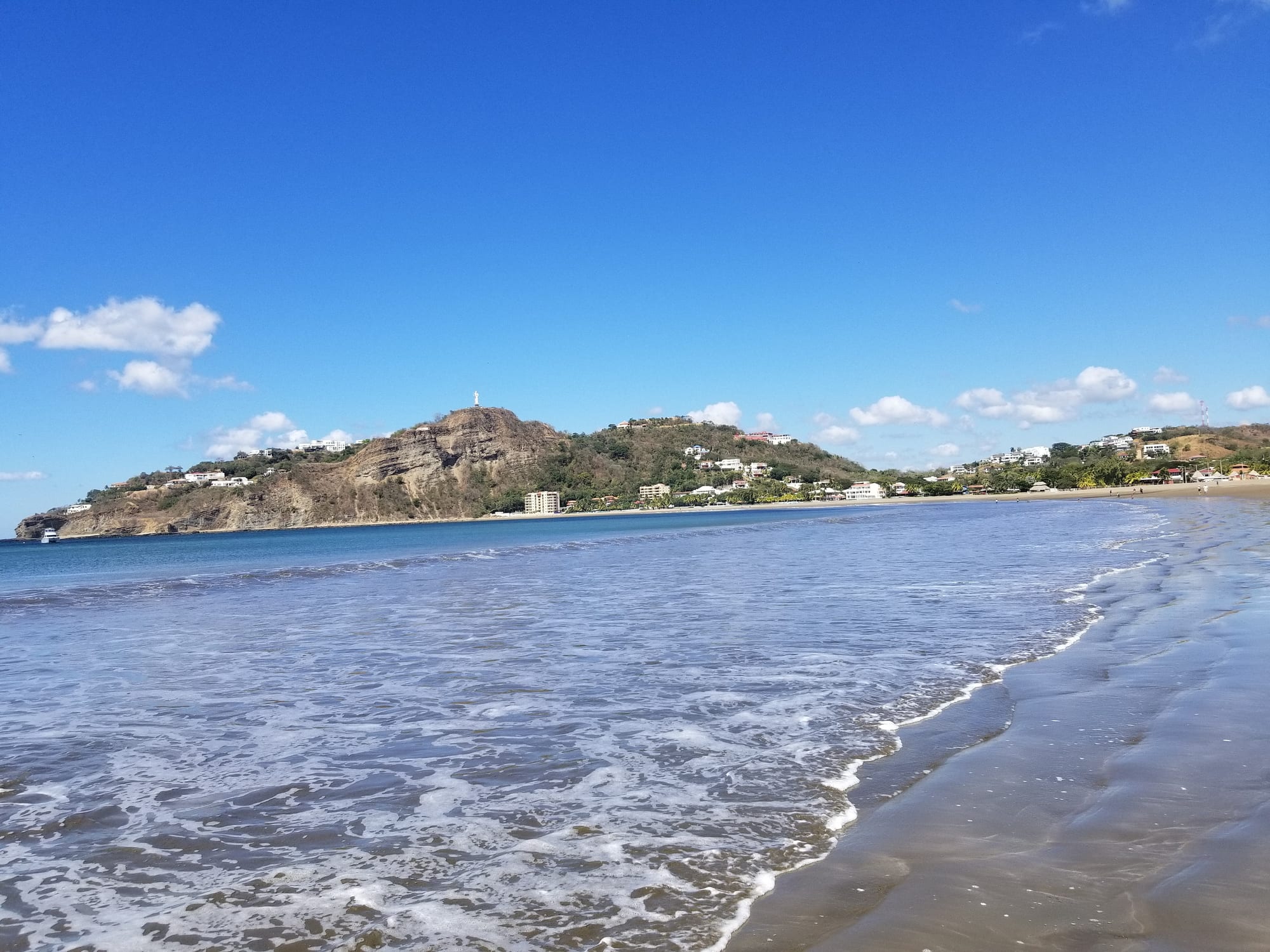
Waves running up a wide sandy beach, with a rocky headland topped by a white statue and houses on the hills across the bay

Granada, León & the Pacific, Nicaragua

San Juan del Sur

The bay of San Juan del Sur, with the Christ of the Mercy on the headland at its northern end. (Lubi nuñez / Wikimedia Commons · CC BY-SA 4.0)

A fishing port on a crescent-shaped Pacific bay in Rivas department, about 140 km south of Managua, that was a stop for gold-rush travellers to California in the 1850s. Rebuilt after a tsunami in 1992, it has turned from fishing and shipping to tourism, and is now a surf, beach and nightlife town with foreign residents and holiday homes.

Neighbourhoods

  • The town and the bay
    • First-time visitors
    • Nightlife
    • Beaches

    The small town behind its beach, where nowhere is more than about 500 metres from the sand. The beachfront road holds restaurants and bars, the market and the parish church are in the streets behind, and the town is busiest at weekends and in Holy Week.

    Open in Maps
  • The hills above the bay
    • Quiet and residential
    • Views

    Villas, condominiums and holiday homes climb the slopes around the bay, with views over the harbour; the Christ of the Mercy stands on the northern headland.

    Open in Maps
  • The northern beaches
    • Surfing
    • Beaches

    Playa Maderas and other surf beaches lie north of town along rough side roads, reached by shuttle, taxi or water taxi. Surfers and visitors who want to stay by the waves base themselves here.

    Open in Maps
  • The southern beaches
    • Beaches
    • Quiet and rural

    Playa El Coco and other beaches lie south of town, harder to reach than the northern beaches but more private.

    Open in Maps

Things to do

The town and the bay

  • Christ of the Mercyviewpoint

    A large statue of Christ built in 2008 above the northernmost seawall of the bay, about 134 metres above sea level, with a small chapel at its foot and wide views over the harbour.

    Open in Maps
  • San Juan del Sur beachbeach

    The town's own crescent of sand on a sheltered bay, good for swimming and the centre of town life.

    Open in Maps
  • Parish church of San Juan Bautistalandmark

    The town's parish church, with a front of stone and cement, dedicated to Saint John the Baptist, the town's namesake.

    Open in Maps

Beaches north and south of town

  • Playa Maderasbeach

    A surf beach north of town, reached by water taxi or along a steep, rough road.

    Open in Maps
  • Playa El Cocobeach

    A beach about half an hour south of town, less accessible than the northern beaches but more private.

    Open in Maps

Other surf beaches nearby

  • Playa Marsellabeach

    One of the beaches near the town listed among the area's surf spots.

    Open in Maps
  • Playa Majagualbeach

    Another of the nearby beaches suited to surfing.

    Open in Maps
  • Playa Hermosabeach

    A beach near the town, also listed among the area's surf spots.

    Open in Maps

Seasonal events

  • Holy WeekMarch or April

    The busiest week of the year, when Nicaraguan families fill the town and its beaches and room prices rise steeply.

  • Fiesta of San Juan Bautista24 June

    The feast of the town's patron saint, Saint John the Baptist.

  • Fiesta of the Virgen del Carmen16 July

    Celebrations in honour of the Virgin of Carmen, held every year.

Eat and drink

Long-standing places and food districts in San Juan del Sur. Hours, ratings and directions come from your maps app, always current.

San Juan del Sur classics

  • Beachfront restaurantsneighborhood

    Restaurants and bars along the bay serve fresh fish and seafood.

    Open in Maps
  • Market sodasmarket

    A row of small eateries, called sodas, in the municipal market, serving local breakfasts and simple Nicaraguan meals.

    Open in Maps

Experience San Juan del Sur

History

San Juan del Sur was a quiet fishing village until the California gold rush put it on an international route. From the late 1840s Cornelius Vanderbilt's transit company carried passengers from New York by ship to the Caribbean coast, up the San Juan River and across Lake Nicaragua, then overland to this bay to board steamers for San Francisco. The company operated for sixteen years, and the town became a resting place for prospectors heading west.

During the National War, in June 1855, a filibuster force of more than 150 men landed at the beach now called Gigante to attack Rivas. Because it sits on the narrow isthmus of Rivas between the Pacific and Lake Nicaragua, the port has been at the centre of many Nicaragua Canal proposals, historic and modern. On 7 March 1984, during the Contra war, US-backed forces fought in the town. In October 2002, marking its 150th anniversary, it was formally designated the Port of San Juan del Sur and a Tourism City of Nicaragua.

In September 1992 an offshore earthquake sent a tsunami about 5 metres high into the bay. It destroyed an estimated 60 per cent of the town's homes, displaced about 800 residents and badly damaged the waterfront. The town recovered and rebuilt, and over the following decades its economy turned from fishing and shipping towards tourism.

Culture & Customs

San Juan del Sur has two identities. It is a working Catholic fishing town, whose parish church is dedicated to its patron, Saint John the Baptist, honoured each 24 June, and which celebrates the Virgen del Carmen every 16 July. It is also a popular surf and party town on Nicaragua's Pacific coast, drawing backpackers, surfers and foreign visitors, and its waves have made it a venue for international surfing competitions.

The town became familiar to a wider audience through four seasons of the American television show Survivor, filmed nearby and aired between 2010 and 2015. Foreigners from the United States, Canada and Europe have settled in the town, and the town is also a long-standing holiday spot for Nicaraguan families, who crowd the beach in Holy Week.

The Christ of the Mercy, a 24-metre statue and pedestal raised in 2008 on the northern headland, has become the town's emblem. Local life still turns on the sea: fishing boats work out of the port, and international sport fishing has grown in recent years.

Daily Life

About 15,500 people live in San Juan del Sur, most of them in families who work in fishing, tourism, or food and drink, alongside a community of foreigners. Fishing and shipping were the base of the economy for many years; over the past two decades tourism has taken over, and green tourism has grown around the municipality's many beaches.

Fishing remains important. More than 80 boats work from the port, using both small-scale and industrial methods, and much of the catch is exported or sold to the town's restaurants. Tourism, from restaurants and lodging to surf schools, shuttles and water taxis, employs many more.

The town's rhythm follows the visitors. Weekends and holidays fill the bay and the bars, while weekdays are quieter. Many families have relatives working abroad, as across Nicaragua. Prices in shops and on the market are increasingly set for foreign buyers, and Holy Week brings the year's biggest crowds.

Food

Seafood is what San Juan del Sur does best. Fishing and shellfish gathering are among the town's main trades, and part of the catch is sold to the restaurants along the beachfront, where fresh fish and seafood are eaten looking out over the bay.

For everyday Nicaraguan food, the small sodas in the municipal market serve local breakfasts of gallo pinto, rice and beans fried together, with eggs, fresh cheese and tortillas, alongside simple set meals. The national staples, built on maize, beans, rice and plantain, fill the menus of the town's cheaper eateries.

The tourist trade has added much more, from fresh-baked bread, handmade pastries and desserts to pizza, sushi and other international dishes, aimed at visitors and foreign residents. In the bars, Toña and Victoria beers and Flor de Caña rum are the standard drinks, and fresh fruit frescos, sweet fruit drinks, are sold everywhere in the heat.

Planning tools

Budget

San Juan del Sur is one of the more expensive places in Nicaragua, with shops and restaurants priced increasingly for foreign visitors. Hostels and market food keep costs down; surf lessons, board rental, beach shuttles and water taxis add up. Room rates rise sharply in Holy Week and over Christmas and New Year.

Daily Budget Midrange
USD 70–140 (guesthouse or beach hotel, seafood dinners, surf lessons or board rental, shuttles and water taxis)
Daily Budget Shoestring
USD 30–50 (hostel dorm, market sodas, shared beach shuttles)

Book well ahead for Holy Week, when rates rise steeply and rooms sell out.

Best Time to Visit

The dry season, from about December to May, brings sunshine and easy roads to the beaches. The rains of June to November make the dirt roads muddy, but the surf on the southern coast is biggest from about April to October. Holy Week is the most crowded time of the year.

Suggested Number of Days

Two or three days are enough for the town and a couple of nearby beaches. Surfers often stay a week or more. Allow four to six days to reach the more remote beaches north and south, which take time to get to on rough roads.

First Visit
2–3 days
With Surroundings
4–6 days

Transportation

The town itself is walkable. Beaches north and south are reached by shuttles run by hotels and surf shops, by taxi, or by water taxi, and some are accessible only by boat. Motorbikes and bicycles can be rented, but side roads to the beaches are unpaved, steep and can flood.

Use shuttles or taxis arranged through a surf shop or hotel, and check the return time before leaving for a remote beach.

Airport & Station Connections

Augusto C. Sandino International Airport in Managua is about three hours' drive north; the international airport at Liberia in Costa Rica is about two and a half hours south, crossing the border at Peñas Blancas. Frequent buses and colectivo taxis run from Rivas, about an hour away; from Managua, Granada or Costa Rica travellers take a bus to Rivas first. Tourist shuttles also connect the town with Granada and León.

Walkability

The town is small, and every restaurant and hotel can be reached on foot; the beach is never more than about 500 metres away. The walk up to the hilltop statue is short but steep. The surrounding beaches are too far to walk to.

Safety

Nicaragua has historically had lower violent crime than its northern neighbours, but the political situation is now the dominant concern. The cities of this region were the centre of the 2018 protests and the crackdown that followed. In San Juan del Sur robberies have occurred on isolated beaches around the town, and rip currents on the open Pacific beaches are strong. The bay itself is sheltered and calm.

Visit remote beaches in company and by day, swim only where locals do, take a taxi back at night, and avoid demonstrations and political conversations. Check current official travel advice before travelling.

Climate

A tropical savanna climate, very warm and steady all year, with about 1,710 mm of rain. The dry season runs from December to May and the rainy season, with heavy downpours, through the rest of the year. Across the Pacific lowlands days are commonly 30–35°C.

Summer
rainy season June–November, around 27–33°C in the Pacific lowlands, with heavy afternoon storms
Winter
dry season December–May, around 30–36°C in the Pacific lowlands, sunny and windy

Local Customs

The town mixes a Nicaraguan fishing community with surfers, backpackers and foreign residents, and the party reputation sits beside a Catholic town with its own patron-saint fiestas. Swimwear belongs on the beach; in town, shops and the church, people dress more fully.

Cover up away from the beach, ask before photographing people, never photograph police, and keep away from any protest.

Common Payment Methods

The currency is the córdoba (NIO), and US dollars are widely used for lodging, surf lessons and shuttles, often with change in córdobas. Cards work in many hotels and restaurants, but market stalls, buses, colectivos and water taxis take cash.