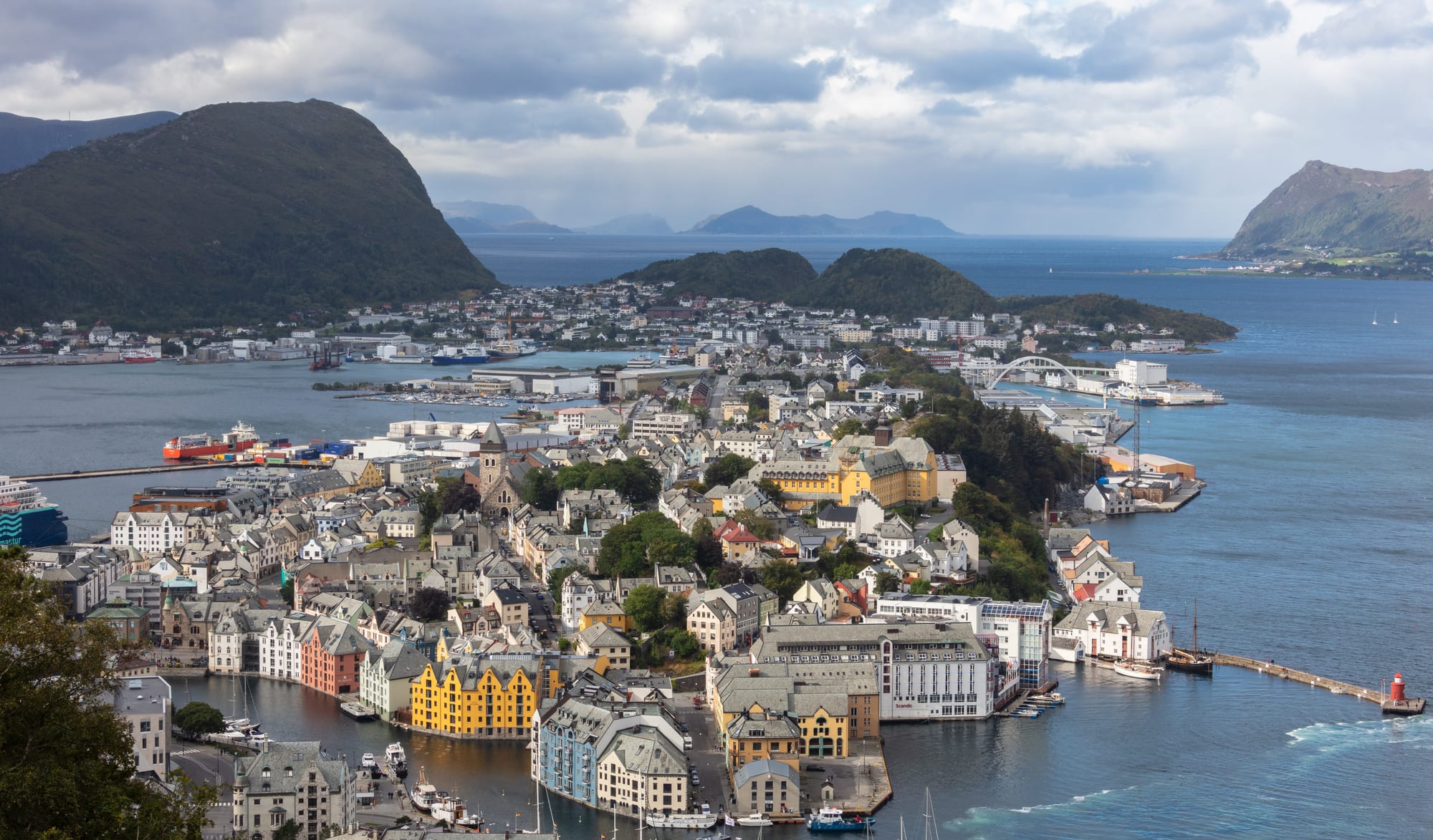
The pastel stone buildings of central Ålesund spread over narrow islands and harbours, with green hills and the open sea beyond

Fjord Norway, Norway

Ålesund

Central Ålesund on its islands, seen from the Aksla viewpoint. (Diego Delso / Wikimedia Commons · CC BY-SA 4.0)

A fishing and shipping town on a chain of islands at the outer edge of Sunnmøre, gateway to the Hjørundfjord and the Geirangerfjord. After fire destroyed its wooden centre in 1904 it was rebuilt within a few years in stone and brick in the Art Nouveau style, which still gives the harbour streets below the Aksla viewpoint their unusually uniform look.

Neighbourhoods

  • Aspøya and Nørvøya — the Art Nouveau centre
    • First-time visitors
    • Historic district
    • Close to public transport

    The two central islands, divided by the narrow harbour channel of Brosundet and joined by bridges. Most of the buildings here date from the rebuilding of 1904–1907, with turrets, carved stone and bright facades along the quays. The church, the Art Nouveau Centre, the shops, the cruise quay and the bus terminal are all within a short walk.

    Open in Maps
  • Aksla and the town park
    • Views
    • Walks
    • Quiet and residential

    The hill rising directly behind the centre, with the town park at its foot and a long stairway up to the Fjellstua viewpoint. Residential streets climb its lower slopes, and paths on top lead through woodland with views over the islands and the Sunnmøre Alps.

    Open in Maps
  • Hessa and Tueneset
    • Families
    • Coast walks

    The westernmost island of the town, about 3 kilometres from the centre, where the Atlantic Sea-Park aquarium sits in the Tueneset conservation area facing the open ocean. Green walkways and the remains of German wartime bunkers lie along the shore.

    Open in Maps
  • Borgund and Moa
    • Local life
    • Shopping
    • Museums

    The eastern, inland side of the municipality: Borgund, with its medieval church and the open-air Sunnmøre Museum on the site of the old trading place, and Moa, a newer commercial centre of shopping malls about 10 kilometres east of the old town.

    Open in Maps

Things to do

Art Nouveau town

  • Jugendstilsenteretmuseum

    The Norwegian Centre of Art Nouveau Architecture, in the old Swan Pharmacy of 1905–1907, which keeps the town's best-preserved Art Nouveau interior and tells the story of the fire and the rebuilding; its ticket also covers the KUBE art museum.

    Open in Maps
  • Ålesund Churchlandmark

    A large stone church on Aspøya completed in 1909 in the Art Nouveau style, built after the fire with stone from Eide in Nordmøre and a marble façade.

    Open in Maps
  • Brosundetattraction

    The narrow harbour channel separating the central islands of Aspøya and Nørvøya, crossed by the Hellebroa bridge, with one of the classic views of the rebuilt town.

    Open in Maps
  • Aalesunds Museummuseum

    The Aalesund Museum and Fisheries Museum on Rasmus Rønnebergs gate, one of the twelve museums of the Sunnmøre Museum Foundation.

    Open in Maps

Views and the shore

  • Aksla and Fjellstuaviewpoint

    The town hill, climbed from the park by 418 steps to the Fjellstua viewpoint, where a café opened in 1903 looks out over the islands, the fjords and the mountains.

    Open in Maps
  • Atlantic Sea-Parkattraction

    One of Scandinavia's largest saltwater aquariums, founded in 1951 and opened in its present building in 1998, set into the shoreline at Tueneset with walking paths along the ocean edge.

    Open in Maps

Museums east of the centre

  • Sunnmøre Museummuseum

    An open-air folk museum founded in 1931 on 120 hectares, with more than 55 old houses moved from around the district, replicas of Viking ships and a medieval museum of finds from the old Borgund trading place.

    Open in Maps
  • Borgund Churchlandmark

    A white stone church built around 1300 just east of the town, for centuries the seat of the large parish that once included all of Ålesund.

    Open in Maps

Short trips from the town

  • Alnes Lighthouselandmark

    A lighthouse of 1852 on the north side of the island of Godøya, built to guide fishing boats into the small harbour at Alnes.

    Open in Maps
  • Hjørundfjordenattraction

    A 20-kilometre arm of the Storfjorden walled by the Sunnmøre Alps, with peaks rising about 1,700 metres straight from the water.

    Open in Maps
  • Rundeattraction

    A small island famous for its seabirds, with several hundred thousand nesting on its cliffs.

    Open in Maps
  • Geirangerfjordattraction

    The World Heritage fjord at the inner end of the Storfjorden system, with the Seven Sisters waterfall and the village of Geiranger at its head.

    Open in Maps

Seasonal events

  • Norwegian Food Festivalevery year

    An annual food festival held in the town, which until 2020 was the setting for the national cooking championship.

Eat and drink

Long-standing places and food districts in Ålesund. Hours, ratings and directions come from your maps app, always current.

Ålesund classics

  • Bacalao restaurantsrestaurant

    Klippfisk, the salted and dried cod on which the town grew rich, is the local speciality, and a dish known here simply as bacalao is a favourite on town menus.

    Open in Maps
  • Fjellstuacafe

    The café at the top of Aksla, founded in 1903 and the oldest place serving food and drink in the town, with the famous view from its terrace.

    Open in Maps

Food districts

  • Restaurants around Brosundet and Apotekergataneighborhood

    The harbour quays and the streets of the Art Nouveau centre hold most of the town's restaurants, from seafood places to pizza and burger bars around the town square.

    Open in Maps

Experience Ålesund

History

The district was settled long before the town. Legend makes Rollo, the founder of the line of the dukes of Normandy, a native of the island of Giske to the north-west, and his statue stands in the town park. In the Middle Ages the local market town was Borgund, a trading place a little to the east around the stone church built around 1300; it declined in the 14th and 15th centuries and probably lay deserted by the 1500s. The modern town grew from a small trading post on the islands, gaining limited trading rights in 1793 and the status of a market town in 1848. It lived from the fish trade, and its population rose from 482 in 1835 to 11,777 by 1900.

On the night of 23 January 1904 fire, driven by a gale, destroyed almost the whole wooden centre. Only one person died, but more than 10,000 were left homeless. Kaiser Wilhelm II, who had often holidayed in Sunnmøre, sent four warships with materials for shelters. The town was rebuilt in stone, brick and mortar in the Art Nouveau style of the day, designed by around 20 master builders and 30 Norwegian architects, most of the work finished between 1904 and 1907.

During the German occupation Ålesund was known as "Little London" for its resistance work and its part in the escape boats to Scotland and England. In 1968 the town merged with the surrounding Borgund Municipality, more than doubling its population, and the island of Sula was separated again in 1977, although the town's built-up area still spills onto it.

Culture & Customs

The rebuilt town is Ålesund's identity. Its unusually uniform Art Nouveau architecture, almost all of it from the years just after the fire, is studied at the national Art Nouveau Centre in the old Swan Pharmacy, and the town belongs to a European network for the study and protection of Art Nouveau founded in 1999. The gratitude to the German emperor who helped after the fire is still visible: one of the busiest streets bears his name, honouring Kaiser Wilhelm II.

The coast shapes the rest. The Sunnmøre Museum, founded in 1931, is devoted to the coastal culture and way of life, with a large boat collection and more than 55 old houses, and the Atlantic Sea-Park shows the sea life of the waters just offshore. The local newspaper, Sunnmørsposten, has been published since 1882, and the town hosts a branch of the Norwegian University of Science and Technology with about 1,800 students.

Football is the town's great shared passion. Aalesunds FK, founded in 1914, reached the top division for the first time in 2003 and won the Norwegian Cup in 2009 and 2011; its supporters' club is called Stormen.

Daily Life

The town had about 55,700 people in 2024, about 46,500 of them in Ålesund Municipality and the rest across the boundary in Sula Municipality; it is the ninth-largest town in Norway and the regional centre of Sunnmøre. Its old core is squeezed onto a few islands, and newer housing and a second commercial centre around the shopping malls at Moa have grown on the mainland to the east.

The economy rests on the sea. Ålesund is one of Norway's major fishing ports, it ranks third among Norwegian cities for registered shipping fleets, after Oslo and Bergen, and maritime industries remain very important. The Norwegian Coastal Administration has its headquarters here, and cruise ships and the coastal ferry bring visitors to the quays all summer; since 2022 shore-power connections have let ships switch off their engines in port.

Life follows the weather and the water. Townspeople walk up Aksla and along the shore at Tueneset, ferries and undersea tunnels link the islands, and the long, dark winters are mild and wet rather than snowy, with skiing in the mountains inland.

Food

Ålesund grew rich on klippfisk, literally "cliff-fish": cod that is salted and then dried, once spread out on bare coastal rocks and today usually dried indoors, and sold mainly to the markets of southern Europe. Klippfisk is still the local speciality, and a dish made from it that is known in the town simply as bacalao is a local favourite that is not easy to find in other parts of the world.

Fresh fish and shellfish fill the rest of the menu. The town's restaurants range from seafood places on the harbour, where the fish of the day comes from local boats, to cheap pizza, kebab and burger bars around the town square. The café at Fjellstua on top of Aksla, founded in 1903, is the oldest place serving food in the town. The town also hosts the annual Norwegian Food Festival.

From the wider region come sveler, thick griddle cakes folded with butter and sugar or brown cheese, sold on Møre og Romsdal's ferries since 1971, and raspeball or komle, potato dumplings served with salted meat that appear on Thursday menus across western Norway.

Planning tools

Budget

Ålesund is expensive in the Norwegian way, and seafood dinners and drinks out are the main costs; a pint of beer and a bottle of wine in a restaurant are especially dear. Many of the best things — the walk up Aksla, the Art Nouveau streets and the shore at Tueneset — cost nothing, and pizza and kebab shops keep cheap meals possible.

Daily Budget Midrange
USD 270–450 (central hotel, seafood dinners, museum and aquarium tickets, a fjord cruise or a hire car)
Daily Budget Shoestring
USD 95–150 (hostel or campsite, supermarket food, local buses)

Rooms in the centre fill on days when cruise ships are in port in summer; book ahead for July and August.

Best Time to Visit

June to August brings the longest days, the sightseeing buses and boat trips to Geiranger, and the cruise ships. May and September are quieter. Winters are windy, wet and mild, with skiing in the mountains inland.

Suggested Number of Days

Two days are enough for the town itself. Four or five allow time for the islands, the bird cliffs and the fjords of Sunnmøre, which take a day each by road and ferry. Ålesund sits at the edge of the region, so trips inland take longer than the map suggests.

First Visit
2 days
With Surroundings
4–5 days

Transportation

The centre is easily covered on foot. City and express buses, run by FRAM and Skyss, link the islands, Moa and the airport, and in summer a hop-on hop-off bus and a small road train serve the main sights when cruise ships are in port. Undersea tunnels connect the airport island, and buses and ferries reach the fjord villages. A car gives the most freedom for the countryside.

Bars close by 03:00 and taxi queues build up at closing time, so book a taxi well before then.

Airport & Station Connections

Ålesund Airport, Vigra, is on the island of Vigra in neighbouring Giske Municipality, linked to the town by undersea tunnels; airport buses take around 25 minutes to the centre. Flights serve Oslo, Bergen, Trondheim and Copenhagen, and international services are flown by several airlines. The coastal ferry calls twice a day, and cruise ships, passenger and freight vessels use the port.

Walkability

The Art Nouveau centre is compact and flat along the quays, and the central islands are joined by short bridges. The climb up Aksla is steep, by 418 steps, but a road also reaches the top. Hessa and the aquarium are about 3 kilometres from the centre, a pleasant walk or a short bus ride.

Safety

Norway has among the lowest crime rates in the world. In Ålesund the main risks are wet, slippery steps and quays, strong wind on the exposed islands and changeable weather on mountain walks and boat trips. The centre can be rowdy around closing time on weekend nights.

Keep well back from quay edges in wind and darkness, and take warm, waterproof layers on hikes and fjord trips. Check current official travel advice before travelling.

Climate

A temperate oceanic climate shaped by the Norwegian Sea: windy, wet and mild in winter, with little difference between day and night and a long seasonal lag, so autumn stays mild and spring comes late. The island town is a little drier in winter than places nearby on the mainland such as Sykkylven, where the mountains wring more rain from the air.

Summer
mild and changeable — on the coast the warmest month averages only 10–15°C more than the coldest, so summers stay cool
Winter
windy, wet and mild — at the Svinøy lighthouse off the Sunnmøre coast the coldest month averages 3.7°C

Local Customs

Ålesund is proud of its Art Nouveau town and of its gratitude to Kaiser Wilhelm II, who sent help after the fire: one of the main streets is named after him. Norwegian manners lean egalitarian and understated, and first names are used for everyone. Bars aimed at young people are often close to empty before midnight.

Beer is sold in supermarkets only until 20:00 on weekdays and 18:00 on Saturdays; anything stronger than 4.75 per cent comes only from the state Vinmonopolet shops, and alcohol is not sold in shops on major Christian holidays.

Common Payment Methods

The currency is the Norwegian krone (NOK). Norway is close to cashless: cards, contactless payment and the Vipps app are used for almost everything; Vipps is Norway's largest payment application.