💰 Budget
Bergen is expensive in the national sense. Central hotels are dearest in summer, when cruise ships bring large crowds, and fjord cruises, the Flåm Railway and guided trips add up. The funicular and cable car, the museums and seafood at the harbour are the main city costs, while the mountain trails, the harbour and the old streets are free.
- Daily Budget Midrange
- USD 270–480 (central hotel, seafood dinners, museum tickets and the funicular, a fjord cruise)
- Daily Budget Shoestring
- USD 95–150 (hostel or campsite, supermarket food, fish cakes and buns, the light rail and buses)
Rain gear matters more than any other packing choice; beer under 4.75 per cent is sold in supermarkets but not on Sundays, and wine and spirits only from the state Vinmonopolet shops.
📅 Best Time to Visit
May to September. May and June bring the Bergen International Festival, Nattjazz and the national-day parades; July and August are the warmest months and the busiest with cruise passengers; September is quieter. Winters are mild for the latitude but wet and dark, with few crowds.
⏳ Suggested Number of Days
Two or three days cover the centre, the museums and a mountain or two. Allow four or five to add a day trip into the fjords by boat, rail and bus. Rain can slow outdoor plans, so a spare day helps.
- First Visit
- 2–3 days
- With Surroundings
- 4–5 days
🚆 Transportation
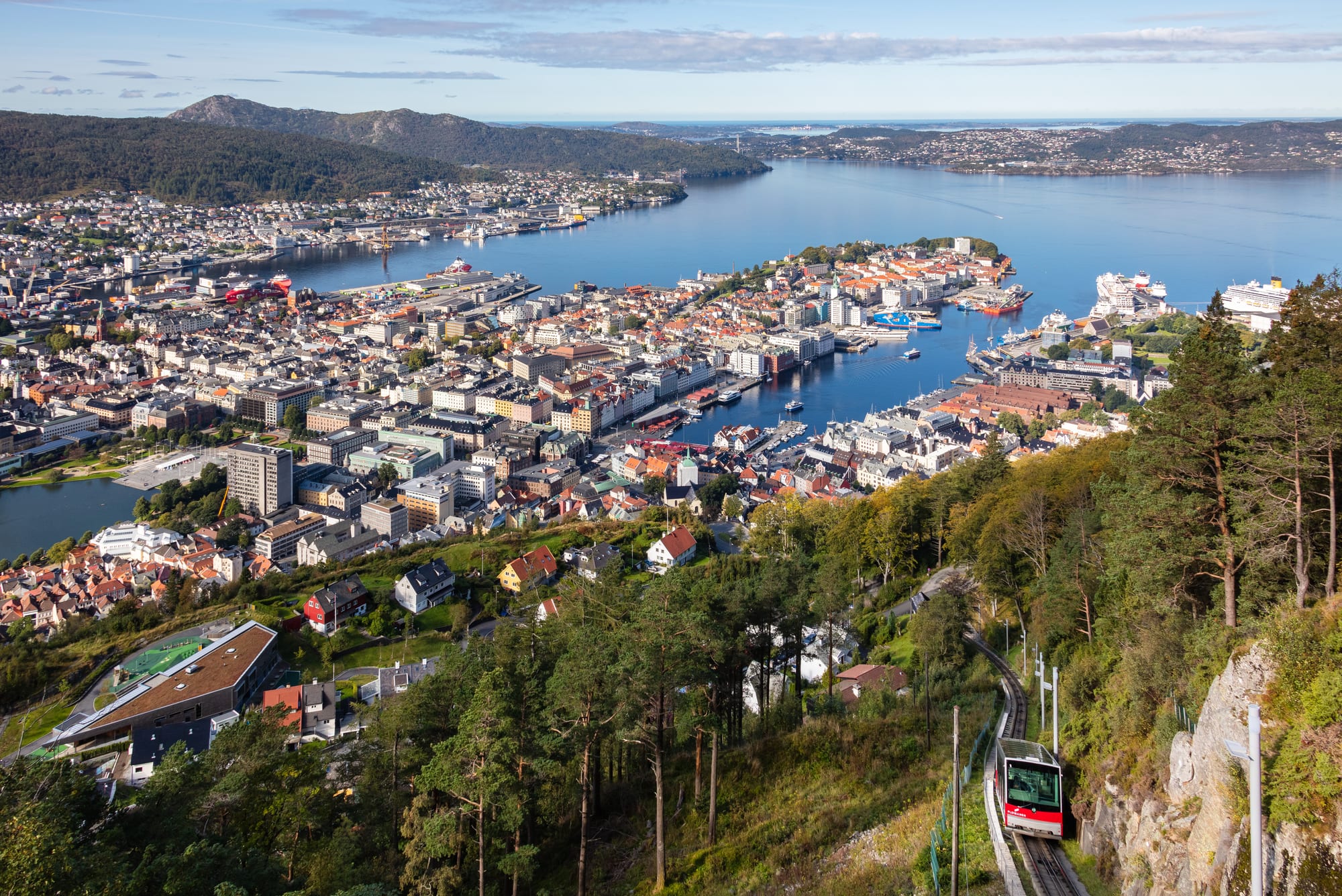
The centre is walkable. Bybanen, the light rail, runs from the city centre south through Nesttun to the airport at Flesland, and buses cover the rest of the city. Fløibanen climbs Mount Fløyen from the centre and Ulriksbanen lifts visitors to Ulriken. Commuter trains run to Arna through the Ulriken Tunnel in about eight minutes, much faster than the road around the mountains. Boats from the terminal beyond the fish market link the city with the Sognefjord.
The centre is ringed by an automatic toll system (Autopass), and street parking downtown is mostly paid parking.
🛬 Airport & Station Connections
Bergen Airport, Flesland, is 18 km from the centre, a hub with direct flights to Norwegian and European cities, reached by the light rail or the Flybussen airport bus. The Bergen Line ends here after crossing the mountains from Oslo, a trip of about seven hours. Fjord Line sails to Hirtshals in Denmark, the coastal ferry begins its voyage north from Bergen, and the city is one of Europe's largest cruise ports.
🚶 Walkability
Central Bergen is compact: Bryggen, the fish market, Torgallmenningen, Nordnes and the museums are all within easy walking distance, although the streets climb steeply up the hillsides. The Fjellveien road on the slopes of Fløyen is a largely level pedestrian route with views over the city. Wet stone can be slippery in rain.
🛡️ Safety
Norway has among the lowest crime rates in the world. In Bergen the main urban concern is pickpocketing, a growing problem in the summer season. On the city mountains, fog and rain can come in fast, and trails get slippery.
Watch bags in summer crowds, carry warm, waterproof layers on mountain walks, and turn back if fog closes in. Check current official travel advice before travelling.
🌦️ Climate
Mild for its latitude but famously wet. Moist Atlantic air rising over the mountains brings rain in every season — around 200 days a year with more than a millimetre — and in January 2007 a record of 85 rainy days in a row was set. Winters are mild, with snow that often melts quickly; by annual mean temperature, Bergen is the warmest city in Norway.
- Summer
- mild — July averages about 14°C and days sometimes reach the upper 20s; the record is 33.4°C, set in July 2019
- Winter
- mild and wet — January averages above 0°C, with frost and snow from December to February but temperatures below −10°C very rare
🤝 Local Customs
Tipping is not expected — restaurant staff are well paid — but leaving something for good service is never offensive, and rounding up a taxi fare is common. Bergensere speak their own dialect, Bergensk, and the buekorps youth brigades are a tradition unique to the city. Drinking alcohol in public places is prohibited, though licensed terraces are fine.
The age limit is 18 for beer and wine and 20 for spirits; there is no takeaway alcohol on Sundays.
💳 Common Payment Methods
The currency is the Norwegian krone (NOK). Cards, contactless payment and the Vipps app are used almost everywhere, and a contactless Visa or Mastercard works throughout; cash has been a legally required means of payment since 1 October 2024, so a little cash is useful but rarely needed.