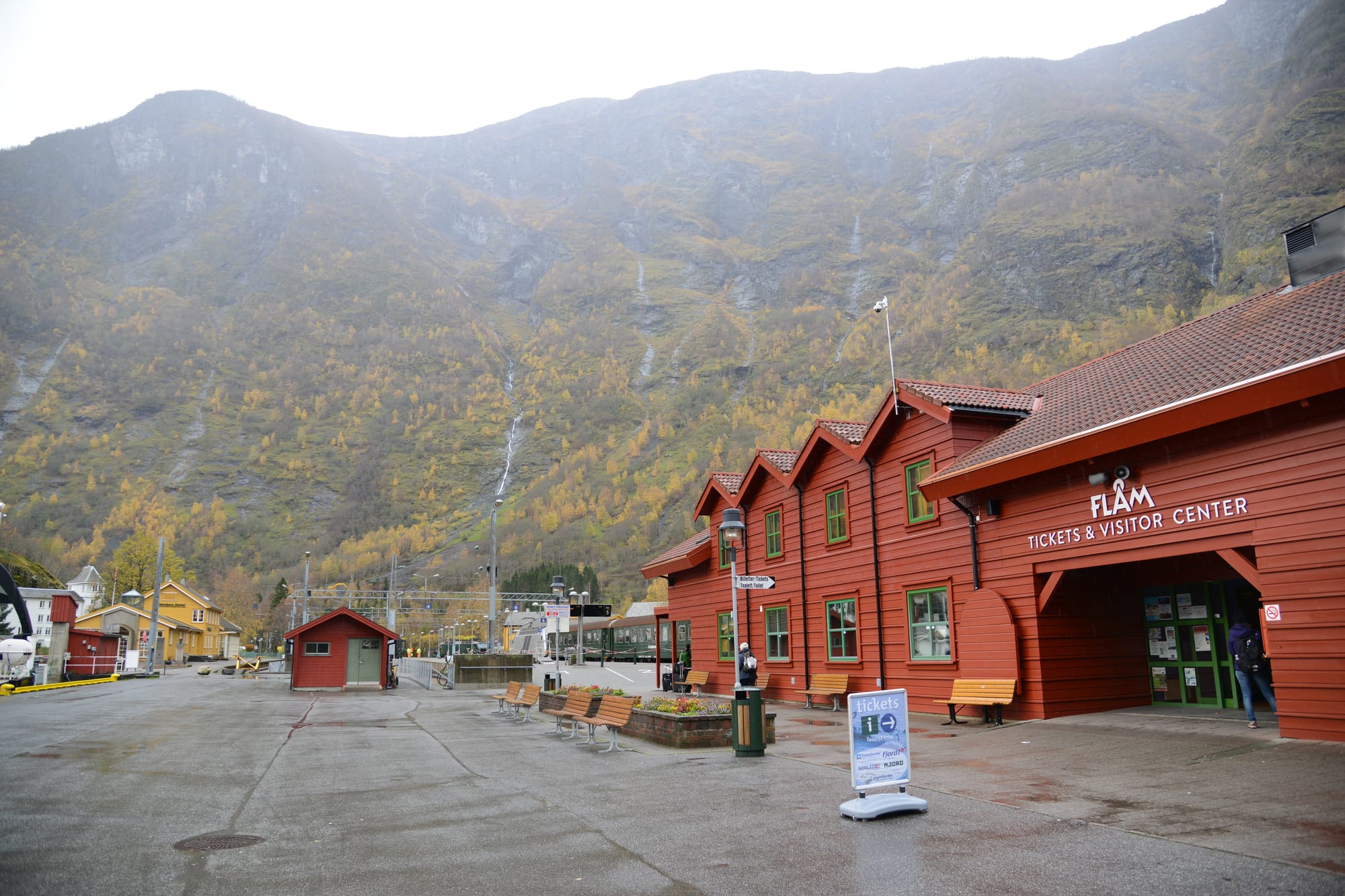
A red wooden station building with a tickets and visitor centre sign, below a steep mountainside with thin waterfalls and autumn trees

Fjord Norway, Norway

Flåm

The station and visitor centre at Flåm, at the foot of the mountains of the Flåmsdalen valley. (Jorge Láscar from Melbourne, Australia / Wikimedia Commons · CC BY 2.0)

A village of fewer than 300 people at the head of the Aurlandsfjord, an arm of the Sognefjord, where the steep Flåm Line comes down from the mountains to the sea. A tourist destination since the late 19th century, it now receives hundreds of thousands of visitors a year by rail, road, sightseeing boat and cruise ship, and is the starting point for trips into the Nærøyfjord.

Neighbourhoods

  • The harbour and station
    • First-time visitors
    • Close to public transport
    • Best for food

    The compact cluster at the head of the fjord, where the Flåm Line terminates beside the quay. The station and visitor centre, the railway museum, the cruise pier, the boat departures for the Nærøyfjord and most of the cafés and shops are all within a few minutes' walk.

    Open in Maps
  • Flåmsdalen valley
    • Quiet and rural
    • Walks and cycling

    The valley runs up from the fjord towards Myrdal, its floor flat and barely above sea level as far as the old wooden church, with farms and scattered houses along the river and the railway. The local road is a dead end with little traffic, so it suits walking and cycling.

    Open in Maps
  • Aurlandsvangen
    • Quiet and residential
    • Close to the fjord

    The municipal centre of Aurland, about 7 km along the fjord, with around 800 people, the medieval Vangen Church and the road up to the Stegastein viewpoint. It is a quieter alternative base.

    Open in Maps

Things to do

The railway

  • Flåm Lineattraction

    The 20 km railway from the fjord up to Myrdal on the Bergen Line, climbing 866 metres through twenty tunnels at gradients up to 1 in 18 — one of the steepest ordinary railways in the world.

    Open in Maps
  • Flåm Railway Museummuseum

    A museum in a former station building on the line's construction and history, with an El 9 electric locomotive among its exhibits.

    Open in Maps
  • Kjosfossenviewpoint

    A waterfall with a total fall of around 225 metres near Myrdal, where the trains stop in front of the falls; a small power station on it powers the line.

    Open in Maps
  • Rallarvegentrail

    The navvies' construction road of the Bergen Line, now a popular cycling route that runs from Myrdal north through Flåmsdalen to the fjord.

    Open in Maps

The village

  • Flåm Churchlandmark

    A brown wooden church of 1670 up the valley, seating about 160, which replaced an older stave church.

    Open in Maps
  • Fretheim Cultural Parkpark

    A park in the village with viewpoints, art installations and walking trails up the hill, and views of the fjord and mountains.

    Open in Maps

Fjords and viewpoints

  • Nærøyfjordviewpoint

    A 17 km arm of the Aurlandsfjord, only about 250 metres wide at its narrowest between mountains of up to 1,761 metres, part of a UNESCO World Heritage Site since 2005 and reached by sightseeing boat from Flåm to Gudvangen.

    Open in Maps
  • Stegasteinviewpoint

    A 30-metre platform of steel and laminated pine projecting from the road above Aurlandsvangen, overlooking the Aurlandsfjord.

    Open in Maps
  • Undredalneighborhood

    A small fjord village known for its goats and goat cheese, with the smallest stave church still in use in Scandinavia, built around 1147 and seating 40.

    Open in Maps
  • Otterneslandmark

    A historic farm cluster of 27 buildings on the hillside midway between Flåm and Aurlandsvangen.

    Open in Maps

Eat and drink

Long-standing places and food districts in Flåm. Hours, ratings and directions come from your maps app, always current.

Eating in Flåm

  • The harbour cafésneighborhood

    The village's places to eat and drink, including cafés near the station and a craft brewery.

    Open in Maps
  • Undredal goat cheesemarket

    Geitost, the goat's-milk cheese of Undredal, is considered a delicacy and is the local food to take home.

    Open in Maps

Experience Flåm

History

The name Flåm appears as Flaam as early as 1340. It comes from the Old Norse flá, "plain, flat piece of land", after the flat ground at the bottom of a valley that runs between steep mountains to the fjord. For centuries this was a farming community at the inner end of the Aurlandsfjord; in 1670 a wooden church replaced its older stave church, and Flåm has drawn tourists since the late 19th century.

The railway changed everything. Parliament approved the Flåm Line in 1908, but the money came only in 1923; work began in 1924 and the line opened in 1940 — regular freight from 1 August 1940, passenger trains from 10 February 1941 — linking the Sogn district with Bergen and Oslo through Myrdal on the Bergen Line. It was electrified in 1944. Until 1991 the trains connected with a ferry to Gudvangen, and freight ended in 1992, when low fares and high costs left the line close to closure. Instead it became a tourist railway.

By the 1960s cruise ships were anchoring in the fjord and sending passengers ashore in small boats, and from the 1980s the Norway in a Nutshell tour — the Flåm Line and a fjord boat in one day — brought growing numbers. A new pier built in 2000 allowed large cruise ships to dock directly, and tourism grew sharply. Today the village receives almost 450,000 visitors a year, and in May 2025 a contractor was named to build a shore power connection so that ships can switch off their engines in port.

Culture & Customs

Flåm's culture is that of the inner Sognefjord: small farms on steep slopes and an old wooden church at the heart of the parish. The poet Per Sivle was born here. The neighbouring village of Undredal, home to about 100 people and 500 goats, keeps a stave church built around 1147 that seats only 40, the smallest still in use in Scandinavia, and is famous for its brown goat cheese, still produced the traditional way.

The railway is the village's identity. Its engineering — twenty tunnels, a gradient of 1 in 18 and spirals in the mountainside — is the reason most people come, and a museum in the old station building tells how it was built. The navvies' construction road, Rallarvegen, is now a popular cycle route, with over 20,000 cyclists a year in the short season from July to September. At Kjosfossen, near Myrdal, an actress in costume as the huldra, a seductive forest creature of Scandinavian folklore, dances in front of the waterfall as the trains stop in summer.

Visitors are welcome, but the scale of tourism has been debated for years. Residents and commentators have complained about cruise-ship pollution and crowds, and a 2009 report warned that Flåm and Geiranger were nearing a limit in capacity.

Daily Life

Flåm itself has about 290 people (2025) and lies in Aurland Municipality, whose centre, Aurlandsvangen, is about 7 km away; the goat-farming village of Undredal is about 12 km to the north. Life for most residents is tied to tourism — the railway, the boats, the shops, cafés and accommodation.

The year has two very different halves. In the cruise season the port can take up to three cruise ships a day and receives some 160 a year, with trains, boats and coaches arriving through the day; a limit of 5,000 passengers may leave a ship at a time. Air pollution in Flåm during the cruise season has been reported to be similar to that of a big city.

Outside the cruise season the village is far quieter. The E16 between Oslo and Bergen runs through Flåm, and the Gudvanga Tunnel links it with Gudvangen, 15 km away, while the railway keeps it connected to the Bergen Line all year.

Food

Flåm eats the food of western Norway. Lamb and mutton are popular in autumn, and brunost, the sweet brown cheese of caramelised lactose from goat's milk or a mix of goat's and cow's milk, is popular with bread. Geitost, goat's-milk cheese, from Undredal across the fjord is considered a delicacy, and the village has its own craft brewery.

The west keeps older dishes too. At Christmas many families eat pinnekjøtt, cured and sometimes smoked mutton ribs steamed on a bed of birch sticks and served with puréed swede and potatoes, beer and akevitt. Raspeballer or komle, dumplings of grated potato often served with salted meat, are traditionally eaten on Thursdays in the west, and smalahove, a sheep's head salted, sometimes smoked, and dried, was originally eaten before Christmas; Voss, further along the road to Bergen, draws visitors who want to try it.

Fish is part of the western table, and gravlaks, salmon traditionally cured for 24 hours in sugar, salt and dill, is a common dish. Places to eat in the village include cafés near the station, and many visitors self-cater in cabins and campsites.

Planning tools

Budget

Flåm is one of the costliest stops in an expensive country: summer hotels, the Flåm Line, fjord boats and guided trips all carry a premium, and campsites and cabins are the cheaper options. Walking and cycling in the valley cost nothing, and staying in Aurlandsvangen can spread the cost.

Daily Budget Midrange
USD 270–480 (fjord hotel, a Flåm Line ticket, a Nærøyfjord boat trip, restaurant dinners)
Daily Budget Shoestring
USD 95–150 (campsite or cabin, supermarket food, walking and cycling)

Book the Flåm Line, the fjord boats and summer rooms well ahead; Norway in a Nutshell combines train, boat and bus in one ticket.

Best Time to Visit

May to September, when the Flåm Line runs nine or ten trains each way a day; the Rallarvegen cycle route has a short season from July to September. July and August are the busiest, with cruise ships in port on most days; May, June and September are quieter. In winter the railway still runs and the village is calm, but some mountain roads close in bad weather.

Suggested Number of Days

Many visitors pass through in a day on a tour. An overnight stay allows the railway and the fjord without the midday crowds; two or three days leave time for walking, cycling and the nearby villages.

First Visit
1–2 days
With Surroundings
2–3 days

Transportation

The village by the fjord is compact and easily covered on foot. The Flåm Line and bicycles are the best ways up the valley, since the upper part of Flåmsdalen and Myrdal cannot be reached by car. Sightseeing boats and a car ferry run to Gudvangen, and buses link Flåm with Bergen, Sogndal and Lærdal.

Bicycles can be hired to ride down from Myrdal to the fjord on the old navvies' road.

Airport & Station Connections

Most arrive by rail, changing at Myrdal on the Bergen Line for the Flåm Line down to the fjord. The E16 between Oslo and Bergen runs through the village, about 2 hours 45 minutes' drive from Bergen and 5 hours 30 from Oslo. The closest airport is Sogndal Airport, Haukåsen, about 70 km away, and Bergen Airport is the nearest international one. A catamaran route links Flåm with Bergen and villages along the Sognefjord.

Walkability

The harbour area is small and flat, with the station, quay and cafés a few minutes apart, and the valley floor stays flat up to the church. Stegastein is a long, steep walk uphill; most people go by road.

Safety

Norway has among the lowest crime rates in the world. In Flåm the risks are in the landscape: sudden fog and rain, rockfall and landslides on fjord roads, and cold, fast rivers swollen by snowmelt.

Keep behind barriers at waterfalls and viewpoints, carry warm, waterproof clothing on walks, and take care on the steep ride down the unpaved navvies' road. Check current official travel advice before travelling.

Climate

Inner Aurland has a typical inland climate, with mild winters at the lower levels, early springs and warm summers. It is one of the driest areas in Norway, with about 470 mm of precipitation a year against about 2,250 mm in Bergen.

Summer
warm and fairly dry; in nearby Lærdal the record high is 33.4°C, reached in July 2018 and July 2019
Winter
mild at the lower levels; nearby Lærdal's record low is −21.8°C, from January 1942

Local Customs

Tipping is not expected — restaurant staff are well paid — but leaving something for good service is never offensive. The village is small and lives with very large numbers of visitors; using the public toilets at the station and keeping to paths and roads past farmland is part of being a considerate guest. Drinking alcohol in public places is prohibited.

The age limit is 18 for beer and wine and 20 for spirits; there is no takeaway alcohol on Sundays.

Common Payment Methods

The currency is the Norwegian krone (NOK). Cards, contactless payment and the Vipps app are used almost everywhere, and a contactless Visa or Mastercard works throughout; cash has been a legally required means of payment since 1 October 2024, so a little cash is useful but rarely needed.