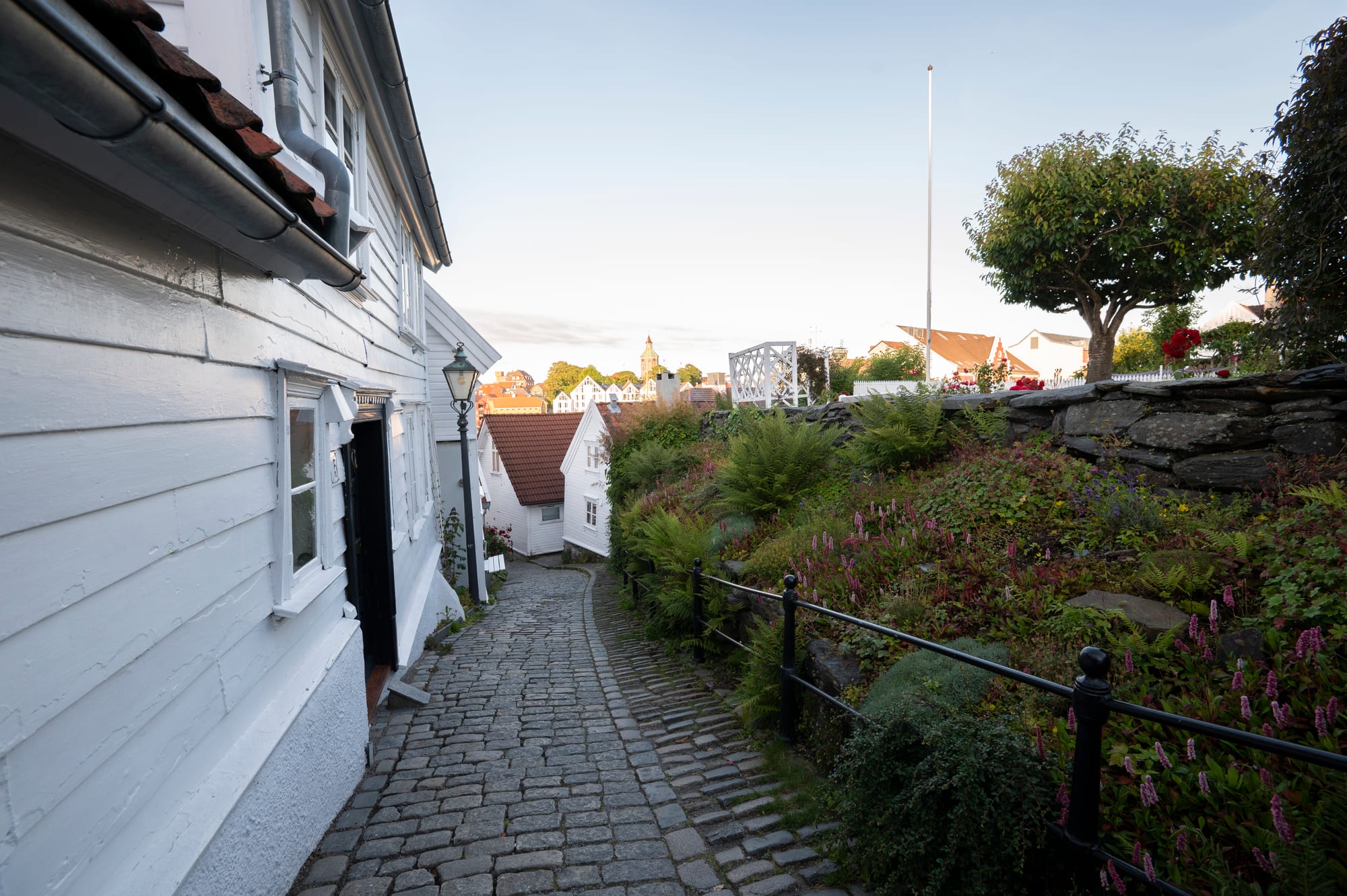
A narrow cobbled lane between white wooden houses in Old Stavanger, with flowering garden walls and a church tower in the distance

Fjord Norway, Norway

Stavanger

A cobbled lane between the white wooden houses of Gamle Stavanger on a summer evening. (Maarten Heerlien from Voorschoten, The Netherlands / Wikimedia Commons · CC BY 2.0)

Rogaland's county capital on Norway's south-west coast, a medieval cathedral town that lived from herring, shipping and fish canning before the North Sea oil finds of 1969 made it the country's oil capital. Today it is an international, expensive city of white wooden houses around the Vågen harbour, and the base for the Lysefjord and Preikestolen.

Neighbourhoods

  • Sentrum and Vågen
    • First-time visitors
    • Nightlife
    • Close to public transport

    The small centre around Vågen, the inner harbour where cruise ships tie up a short walk from the shops. The cathedral, the town lake of Breiavatnet, the railway station and the bus terminal are all here, and bars line the waterfront, with the eastern quay catching the afternoon sun.

    Open in Maps
  • Gamle Stavanger
    • Historic district
    • Quiet and residential
    • Photography

    More than 250 restored white wooden houses from the 18th and early 19th centuries on the western side of Vågen, saved from demolition by a council vote in 1956. Most are private homes on cobbled lanes, a few minutes' walk from the harbour.

    Open in Maps
  • Storhaug and Pedersgata
    • Best for food
    • Street art
    • Local life

    The borough east of the centre, once the home of the working class and now a dense, gentrified district popular with artists. Pedersgata, running east from St. Petri Church, is known for its range of international restaurants.

    Open in Maps
  • Eiganes and Våland
    • Quiet and residential
    • Historic homes
    • Parks

    The districts west of the centre where ship owners and factory owners built stately houses with large gardens, especially along Eiganesveien. The royal residence of Ledaal stands here, and the lake Mosvatnet and its walking path lie on the southern edge.

    Open in Maps

Things to do

Famous landmarks

  • Stavanger Cathedrallandmark

    Norway's oldest cathedral, a grey stone church built around 1125 and given a Gothic choir in the late 13th century.

    Open in Maps
  • Gamle Stavangerneighborhood

    The preserved old town of white wooden houses on cobbled lanes above the western side of the harbour.

    Open in Maps
  • Ledaallandmark

    A manor house that serves as the King of Norway's official residence in Stavanger, looked after by the city museum.

    Open in Maps
  • Fargegatenattraction

    Øvre Holmegate, the 'coloured street' east of the harbour, where brightly painted houses hold some of the city's cafés and small shops.

    Open in Maps
  • Valbergtårnetviewpoint

    A lookout tower on the hill of Valberget, built in 1850–1853 for the town's fire watchmen, on the eastern side of the harbour, with a small watchmen's museum.

    Open in Maps

Museums

  • Norwegian Petroleum Museummuseum

    A museum opened in 1999 by the harbour, built to look like a small oil platform from the sea, telling the story of Norway's offshore oil and gas industry.

    Open in Maps
  • Stavanger Museummuseum

    A museum of natural and cultural history founded in 1877, whose departments include the maritime museum, the canning museum, the printing museum and the children's museum.

    Open in Maps

Lakes, parks and the shore

  • Breiavatnetpark

    The shallow town lake between the cathedral and the railway station, with a fountain since 1924 and the city park on its northern shore.

    Open in Maps
  • Mosvatnetpark

    A lake just west of the centre, once the city's water supply and now its most used recreation area, with a path of about 3.2 kilometres around it.

    Open in Maps
  • Sverd i fjelllandmark

    A monument of swords set in rock beside the Hafrsfjord in Madla, commemorating the battle traditionally held to have united Norway.

    Open in Maps
  • Solastrandabeach

    A 2.3-kilometre sandy beach near the airport, about 15 kilometres from the city, used for swimming in summer and surfing and windsurfing all year, with traces of German wartime defences.

    Open in Maps

Music and sport

  • Stavanger Concert Hallattraction

    The city's concert hall, opened by Crown Prince Haakon in 2012 at Bjergsted, a park north of the old town that also hosts outdoor concerts and festivals.

    Open in Maps

Short trips from the city

  • Lysefjordattraction

    A 42-kilometre fjord about 25 kilometres east of the city, named for the light-coloured granite of its walls.

    Open in Maps
  • Preikestolentrail

    The Pulpit Rock, a flat-topped cliff 604 metres above the Lysefjord, reached by a hike of about 3.8 kilometres each way; it had some 300,000 visitors in 2024.

    Open in Maps
  • Kjeragboltentrail

    A boulder wedged in a crevice high on the mountain Kjerag above the Lysefjord, over a drop of almost 1,000 metres, reached on foot without climbing gear.

    Open in Maps

Seasonal events

  • MaiJazzMay

    The Stavanger International Jazz Festival, held since 1989, with around forty concerts at venues across the city.

  • GladmatJuly

    One of Scandinavia's leading food festivals, held in the city each year in late July.

  • International Chamber Music FestivalAugust

    A festival of chamber music held in the city every summer.

  • NuArt FestivalSeptember

    A street-art festival held since 2001, whose permanent and legal works now cover walls across the city.

Eat and drink

Long-standing places and food districts in Stavanger. Hours, ratings and directions come from your maps app, always current.

Food districts

  • Pedersgataneighborhood

    The street running east from St. Petri Church through Storhaug, known for its range of international cuisine.

    Open in Maps
  • Øvre Holmegateneighborhood

    The coloured street just east of the harbour, with some of Stavanger's best-known cafés among its painted houses.

    Open in Maps

Cafés and bars

  • Vågen waterfrontneighborhood

    The bars and restaurants around the inner harbour, the centre of the city's nightlife, where the eastern quay gets the afternoon sun for an outdoor drink.

    Open in Maps

Experience Stavanger

History

The flat land of North Jæren around Stavanger was an economic and military centre by the 9th and 10th centuries, and the Battle of Hafrsfjord, fought around 872 on the bay just west of today's city, is traditionally held to have united Norway. The town itself grew around the church: Bishop Reinald, who may have come from Winchester, began the cathedral around 1100, and the city counts 1125, the year it was finished, as its founding date. A great fire in 1272 left much of the medieval church town in ruins.

The Reformation of 1536 ended its role as a religious centre and in the 17th century the bishopric moved to the new town of Kristiansand. Rich herring fisheries revived Stavanger in the 19th century, followed by shipping, shipbuilding and canning: by the 1950s there were more than fifty canneries, and the city was known as Norway's canning capital. On 9 April 1940 German paratroopers seized Sola airport in only the second wartime parachute assault ever made, and the city was taken without a fight.

The city's history has alternated between booms and recessions. The discovery of the Ekofisk field in 1969 began a new boom and made Stavanger known as Norway's oil capital: the state company Statoil, now Equinor, founded in 1972, is based here, and giant concrete Condeep platforms were built at Jåttåvågen. Gamle Stavanger survived only because the city architect Einar Hedén opposed a post-war plan to clear the old wooden houses, and the council voted to conserve them in 1956. In 2008 Stavanger was a European Capital of Culture with Liverpool; in 2020 the island municipalities of Finnøy and Rennesøy merged into it.

Culture & Customs

The year as European Capital of Culture in 2008, under the theme "Open Port", sums up how the city sees itself: open to the world, with oil workers, engineers and students from many countries. Street art is a particular strength. The NuArt Festival, held each September since 2001, is one of the oldest official street-art festivals in the world, and its permanent works have turned walls across the centre into an open gallery.

Music runs from the Stavanger Symphony Orchestra and the concert hall at Bjergsted, opened in 2012, to MaiJazz in May and an international chamber music festival in August. The city also has a reputation in heavy music, as the home of gothic metal bands such as Theatre of Tragedy and Tristania and of the rock band Kvelertak, and the singer Aurora was born here. The television drama Lykkeland (State of Happiness) retold the discovery of oil and the growth of the petroleum industry in the city from 1969, and won awards at home and in Cannes.

Sport is followed closely. Viking FK, founded in 1899, has won nine Norwegian league titles and has spent more seasons in the top division than almost any other club, and the Stavanger Oilers have won nine national ice hockey championships, the first in 2010, and are the only western team in the top league.

Daily Life

The continuous urban area of Stavanger and Sandnes, which spreads over four municipalities, had about 244,000 people in 2026, making it Norway's third-largest. The protected wooden houses of the centre give the inner city a small-town feel, with an unusually high share of detached houses, and much of the population growth has spread to the suburbs. About 22 per cent of the city's people have an immigrant background.

Oil and gas shape the economy. Equinor has its headquarters at Forus, on the border with Sandnes and Sola, along with the state company Petoro and the offshore regulators, and international oil firms and service companies have followed. NATO's Joint Warfare Centre is here, the University of Stavanger has about 9,000 students, and a shipyard on the island of Hundvåg remains a major employer. Unemployment has stayed well below the European average since the early 2000s, but living costs are among the highest anywhere.

Away from work, life turns outdoors. The path around Mosvatnet is much used by joggers and cyclists, locals swim and barbecue on the islands reached by ferry from the harbour, and the beaches of Sola draw surfers. Big projects keep reshaping the region: the Ryfast tunnels already run under the fjord to Strand, and the undersea Rogfast tunnel towards Haugesund is being built.

Food

Stavanger likes to call itself a food city, and the region is often described as Norway's answer to Lyon. A culinary institute at Ullandhaug once focused attention on the region's food, and each July the city holds the Gladmat festival, considered one of Scandinavia's leading food festivals. The farmland of Jæren to the south supplies produce and meat, some of it processed in one of the country's largest slaughterhouses.

Fish built the city. In the first half of the 20th century Stavanger was known for canning, and among the canners was Christian Bjelland, founder of Chr Bjelland & Co.; the last factories closed in 2002, and the city museum's canning museum tells their story. Traditional western food remains part of local life: raspeball or komle, dumplings of grated potato and flour served with salted meat, melted butter or mashed swede, are a Thursday dish in many homes and cafés across Vestlandet. In early autumn many Norwegians eat fårikål, mutton stewed for hours with cabbage and whole peppercorns, the national dish.

Eating out is expensive, and the cheaper choices include take-away Asian food. Pedersgata, in Storhaug, has the widest spread of international food, the coloured houses of Øvre Holmegate hold cafés, and the bars and restaurants around Vågen are where the city goes out, with an outdoor drink on the eastern quay when the weather allows.

Planning tools

Budget

Stavanger has been ranked among the most expensive cities in the world, and its oil economy keeps prices high. Take-away Asian food, supermarkets and the free walks around the lakes, the old town and the shore keep costs down.

Daily Budget Midrange
USD 270–480 (central hotel, restaurant dinners, museum tickets, a Lysefjord cruise or a hire car)
Daily Budget Shoestring
USD 95–150 (hostel or campsite, supermarket food, buses and local ferries)

Book rooms early in the weeks of the Offshore Northern Seas conference, held every other year at the end of August.

Best Time to Visit

May to September. Spring and early summer are the driest time of year, summer is the main season for the Preikestolen and Kjerag hikes, and the festivals run from MaiJazz in May to NuArt in September. Late autumn and winter bring the heaviest rain and short days, but the city is quiet and mild for its latitude.

Suggested Number of Days

Two or three days cover the city itself at an easy pace. Four or five allow for the long hikes and boat trips on the fjords to the east, and bad weather can push a mountain hike back by a day, so a spare day helps.

First Visit
2–3 days
With Surroundings
4–5 days

Transportation

The centre is compact enough to walk. Kolumbus city buses cover the wider city and Sandnes, and a busway network is being built across the Stavanger–Sandnes area. Local trains on the Jæren Line run south across the farmland, ferries from the harbour serve the nearby islands, and passenger boats link Stavanger with villages and islands in Ryfylke. The Ryfast undersea tunnels carry road traffic towards Preikestolen.

In summer, seasonal buses run from the city to the start of the Preikestolen and Kjerag hikes; check the times of the last bus back, as a taxi is expensive.

Airport & Station Connections

Stavanger Airport, Sola, Norway's third-busiest airport, lies about 11 kilometres south-west of the centre, with airport buses into town and flights to Oslo, Bergen and many European cities. Trains on the Sørlandet Line reach Oslo in about eight hours, express buses run to Bergen and Kristiansand, and ferries to Hirtshals in Denmark sail from a port outside the city. Cruise ships dock in the centre.

Walkability

Very good in the centre: the harbour, the cathedral, the old town, the museums and the town lake all lie close together. The city sits on both sides of a hollow, so some streets climb steeply, and the lake paths and the coastal trail between the Rosenli and Godalen beaches are popular on foot.

Safety

Norway has among the lowest crime rates in the world. In Stavanger the main risks lie outside the city: the hikes to Preikestolen and Kjerag are steep and exposed, people are rescued from them every year and there have been deaths, and weather in the mountains turns quickly.

Start long hikes early with proper footwear, warm layers, food and water, turn back in fog or rain, and keep away from cliff edges. Check current official travel advice before travelling.

Climate

A temperate oceanic climate, shaped by the North Sea and by Atlantic lows bringing mild westerlies even in winter. Stavanger has the highest average annual temperature of any city in Norway. Rain is common, especially in late autumn and winter, while spring and early summer are the driest season.

Summer
mild — five months of the year have a mean temperature above 10°C; heat waves are rare and seldom long, though the city has recorded 34.4°C, in July 2018
Winter
mild and wet — winter usually stays above freezing, with more rain than snow; the coldest temperature recorded is −19.8°C, in January 1987

Local Customs

Stavanger is unusually international for Norway: more than a fifth of its people have an immigrant background. Norwegian manners lean egalitarian and understated, and first names are used for everyone. Most of the old town is private homes, so visitors keep their voices down and stay off doorsteps.

Drinks stronger than 4.75 per cent alcohol are sold only by the state retailer Vinmonopolet; football matches of Viking FK are a social occasion in the city.

Common Payment Methods

The currency is the Norwegian krone (NOK). Norway is close to cashless: cards, contactless payment and the Vipps app are used for almost everything; Vipps is Norway's largest payment application.