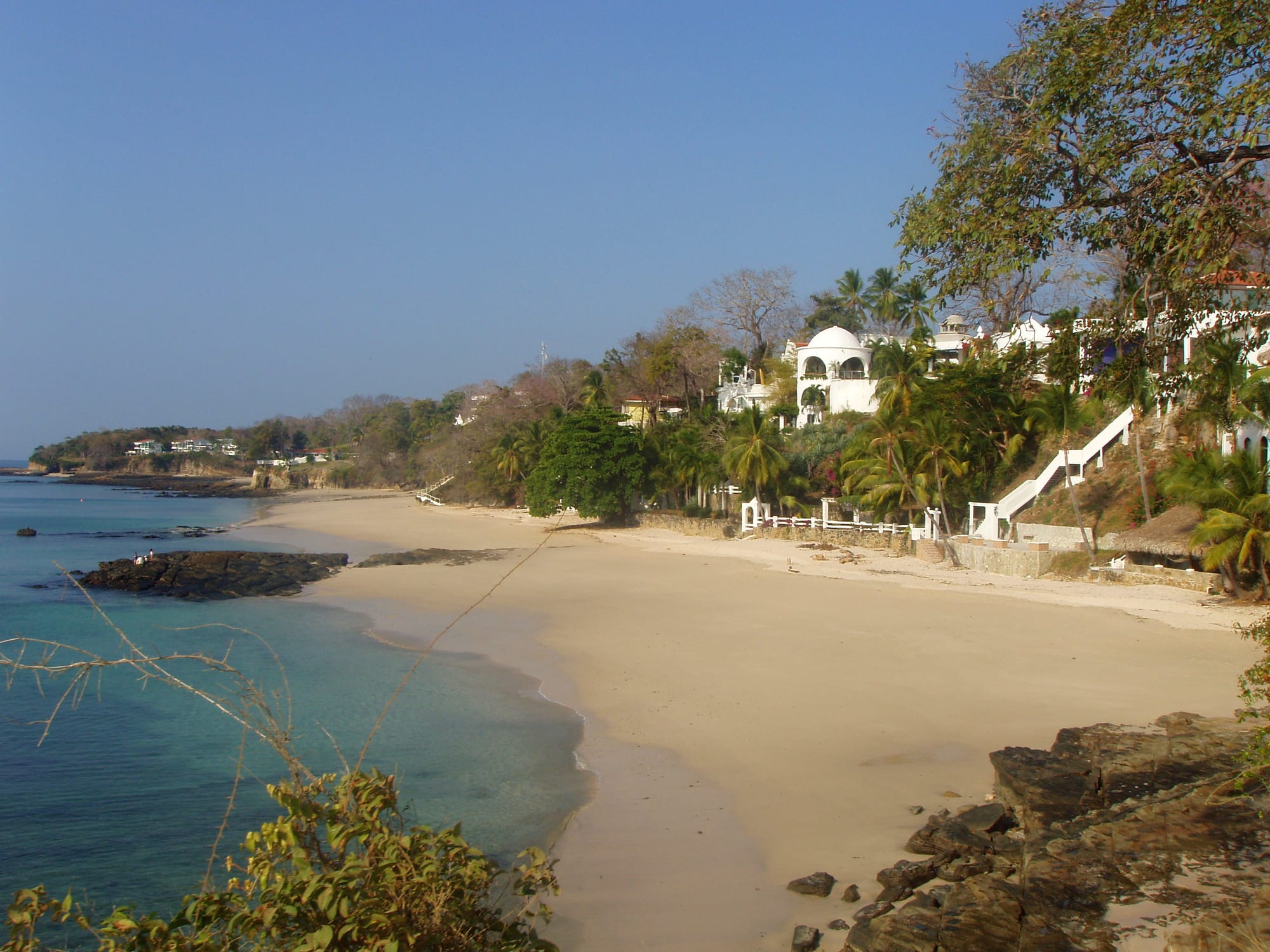
A curving pale sand beach with clear turquoise water and dark rocks, below white villas among palms and dry trees

Panama City & the Canal, Panama

Contadora Island

A beach lined with villas on Contadora Island in the Pearl Islands. (Katarzyna Sierocińska / Wikimedia Commons · FAL)

A small island in the Pearl Islands of the Gulf of Panama, named for the Spanish counting of pearls harvested from the surrounding waters. Once the brief refuge of the exiled Shah of Iran and the meeting place that gave the Contadora Group its name, it is now a quiet resort island of holiday villas, white-sand beaches and boat trips to snorkel and watch whales.

Neighbourhoods

  • Around the airstrip
    • First-time visitors
    • Close to arrivals

    The island's small domestic airport has a runway that crosses the width of the island. Beside it, on the main boulevard of the north-east side, are tourist shops and a visitor centre that rents golf carts.

    Open in Maps
  • The north-east villas
    • Quiet and private
    • Beaches

    Most visitors stay in rented villas on the north-east side of the island, chosen for their privacy and their access to quiet beaches.

    Open in Maps

Things to do

Beaches

  • Playa Largabeach

    One of the two beaches where day passes to the island can be booked.

    Open in Maps
  • Playa Caciquebeach

    The other beach where day passes to the island can be booked.

    Open in Maps
  • Playa de las Suecasbeach

    One of the island's several beaches, alongside Playa Galeón, Playa Canoa, Playa Caracol and others.

    Open in Maps

On and under the water

  • Snorkelling around the islandattraction

    Rock and coral formations around the island are home to many kinds of fish, and snorkelling tours also visit neighbouring islands.

    Open in Maps
  • Whale watchingattraction

    Whales come to the Pearl Islands from June to October, and whale-watching tours leave from Contadora as well as from Panama City.

    Open in Maps

Short trips around the archipelago

  • Isla Sabogaattraction

    A neighbouring island, home to many of the resort workers, served by the same ferry and with places to stay.

    Open in Maps

Seasonal events

  • Whale seasonJune to October

    The months when whales come to the Pearl Islands and boats take visitors out to see them.

Eat and drink

Long-standing places and food districts in Contadora Island. Hours, ratings and directions come from your maps app, always current.

Contadora classics

  • Island restaurantsneighborhood

    The island's hotels and a few small restaurants serve fish and seafood from the surrounding waters alongside Panamanian staples.

    Open in Maps
  • Fresh catchrestaurant

    The waters around the archipelago yield red snapper, wahoo, grouper and mahi-mahi, which turn up as ceviche or fried with patacones.

    Open in Maps

Experience Contadora Island

History

The Pearl Islands were home to Indigenous peoples before the Spanish arrived. Vasco Núñez de Balboa named the archipelago for its pearls on his discovery of it in 1513, and within two years the islands' original inhabitants, led by their chief Terarequí, had been wiped out. Contadora, "the one that counts" in Spanish, became the island where the pearls harvested across the archipelago were counted and sold to the Spaniards. In the years that followed, the islands were frequently used by pirates. Early in the 20th century an epidemic among the pearl oysters killed most of them, and the pearl trade dwindled.

The island's modern history began as a holiday retreat. In 1979 the exiled Shah of Iran, Mohammad Reza Pahlavi, briefly lived on Contadora, having spent much of his fortune on property there. In 1983 the foreign ministers of Colombia, Mexico, Panama and Venezuela first met on the island to launch a peace initiative for the wars in Central America, which took the island's name as the Contadora Group. Its work led to a Document of Objectives in 1983 and the Contadora Act on Peace and Co-operation in 1984.

Later decades brought tourism and television: the archipelago was the setting for three seasons of the American edition of Survivor, and many of the crew stayed on Contadora during filming. A ferry from Panama City began in 2010.

Culture & Customs

Contadora has little of the folk culture of the mainland's villages; it is above all a holiday island, shaped by its villas, its hotels and the visitors who come for its beaches and its waters. Its identity rests on its name and its past — the pearl counting of the Spanish era, the pirates of the archipelago, the Shah's exile and the peace initiative that carried the island's name around the world in the 1980s.

The archipelago is a world-renowned fishing destination, and sport fishing is a large part of the island's appeal, with catches including sailfish, blue marlin, wahoo, mahi-mahi, grouper, amberjack and roosterfish. Snorkelling over the rock and coral formations and watching the whales that arrive from June to October are the other draws.

Many of the people who work on Contadora live on neighbouring Saboga, and the rhythms of the island follow the ferry, the weekend arrivals from the capital and the seasons of fishing and whales.

Daily Life

Contadora is one of the most populated of the Pearl Islands despite its small size: it covers about 1.39 square kilometres, the eleventh largest island of the archipelago, but its population of 253 at the 2000 census placed it third. It is the archipelago's best-known island, a resort island with an airstrip, hotels and many homes owned by wealthy Panamanians.

Tourism is the island's economy, through its hotels, rented villas, boat trips and fishing, and most resort workers live on nearby Isla Saboga. A daily ferry links the island with Panama City and with Saboga, while private yacht charters come and go from the mainland.

Life on Contadora is quiet outside the busy weekends and holidays. The airstrip's runway crosses the whole width of the island, and the beaches — Playa Larga, Playa Galeón, Playa Canoa, Playa Caracol, Playa Cacique, Playa de las Suecas and others — are all within a short distance of one another. One large hotel on the north side has closed, a reminder that the island's fortunes depend on the flow of visitors.

Food

Food on Contadora comes largely from the sea around it. The waters of the Pearl Islands yield red snapper, mahi-mahi, wahoo, grouper and roosterfish, and the island's restaurants serve fish fried with patacones, twice-fried green plantain, or as ceviche, prepared in Panama with lemon juice, chopped onion, celery and cilantro.

Beyond seafood, menus follow the Panamanian staples: arroz con pollo, rice with coconut, stewed beans and sancocho, the chicken soup thickened with ñame and flavoured with culantro that is the national dish. Breakfast may be hojaldras, a fry-bread, or carimañolas, cassava fritters stuffed with beef.

Sweet things and drinks are the same as on the mainland: raspao, shaved ice, and chicheme, a drink made from pounded maize, are Panamanian favourites, the local lagers are Balboa, Atlas and Panamá, and seco is the national spirit. Panama also grows some of the world's most prized coffee, the Geisha variety from the Chiriquí highlands around Boquete, whose beans set auction records.

Planning tools

Budget

Contadora is one of the costlier parts of the region. Accommodation is mostly in hotels and rented villas priced for foreign visitors and well-off Panamanians, the boat or flight from the capital adds to the bill.

Daily Budget Midrange
USD 150–300 (hotel or shared villa, restaurant meals, a snorkelling or whale-watching trip)
Daily Budget Shoestring
USD 70–110 (day trip by ferry from Panama City, a beach day pass, simple meals)

Bring enough cash from the mainland, and book the ferry and accommodation ahead for weekends and the dry season.

Best Time to Visit

The dry season, from about mid-December to April, brings the sunniest beach weather. Whales are in the Pearl Islands from June to October, during the wet season, when afternoon rain is common but the island is quieter.

Suggested Number of Days

A day trip by ferry is possible, but the island suits a night or two. Three or four days allow time for boat trips around the wider archipelago, and the season changes what is on offer at sea.

First Visit
1–2 days
With Surroundings
3–4 days

Transportation

The island covers only about 1.4 square kilometres, so walking covers most of it. Boats take visitors to snorkelling spots and the neighbouring islands.

Agree routes and prices with boat operators before setting off, and check sea conditions.

Airport & Station Connections

A ferry runs daily from Panama City to Contadora and on to Saboga, and private charter boats also make the crossing; the Pearl Islands lie about 48 km off the Pacific coast. The island has a small domestic airport whose runway crosses the island.

Walkability

The island is small enough to walk from end to end, and most beaches are a short walk from the centre around the airstrip. Heat is the main obstacle in the middle of the day.

Safety

Panama is one of the safer countries in Central America, and the main tourist areas are generally fine with normal precautions. Contadora is a small, quiet resort island; the main risks are the sun, the sea and rip currents, which affect some Pacific beaches.

Heed beach flags, snorkel with a companion, keep to marked routes near the runway and check the return times of boats. Check current official travel advice before travelling.

Climate

Hot and humid all year, with a dry season from December to April and a rainy season, usually May to November.

Summer
the wet season, May to November: hot and humid, with frequent rain; Panama City, on the mainland, averages around 27°C all year
Winter
the dry season, December to April: a typical day in Panama City, on the mainland, runs from 24°C to 29°C, the sunniest weather of the year

Local Customs

Contadora is a small holiday island where many houses are private homes, and resort workers often commute from neighbouring Saboga. Spanish is the everyday language.

Respect private property around the villas, cover up away from the beach, and ask before photographing local residents.

Common Payment Methods

Panama uses US dollar notes and its own balboa coins of the same value. Card acceptance is limited on a small island, so bring cash from the mainland.