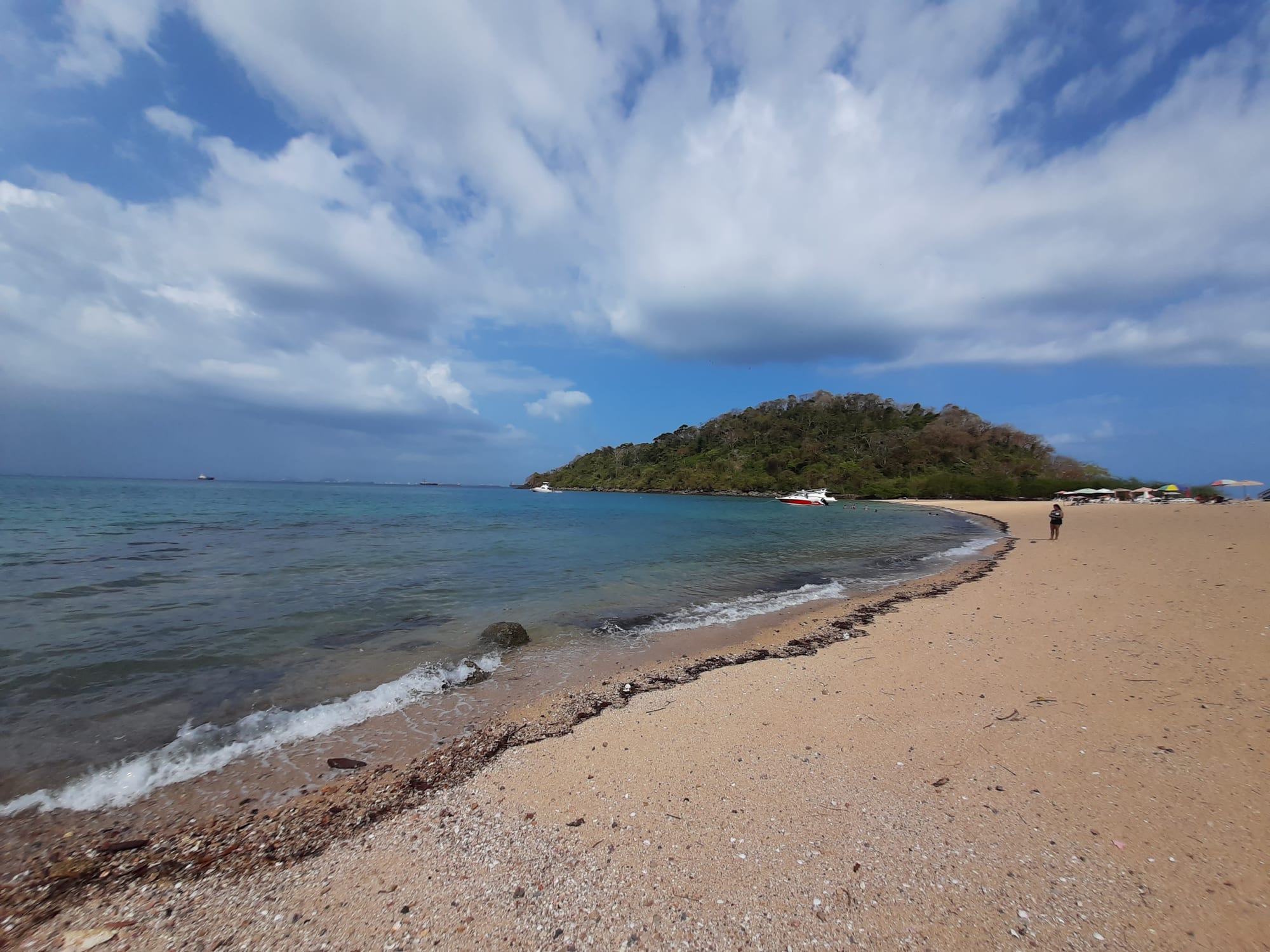
A sandy beach curving round to a small forested islet, with gentle waves, a moored boat and a wide cloudy sky

Panama City & the Canal, Panama

Taboga Island

A beach on Taboga Island in the Gulf of Panama. (Astrid Vergara / Wikimedia Commons · CC BY-SA 4.0)

A small volcanic island in the Gulf of Panama, about 20 km from Panama City, known as the Island of Flowers. Settled by the Spanish in the 1520s and later a resting point for ships and travellers, it now has a village of narrow lanes around an old church, a beach linked at low tide to a small islet, and hill trails with views back to the capital.

Neighbourhoods

  • The village
    • First-time visitors
    • Historic sites
    • Quiet stays

    The island's only settlement, a few narrow streets climbing from the pier around the whitewashed Church of San Pedro, with several small restaurants and places to stay and views across the water to Panama City.

    Open in Maps
  • Playa Restinga and El Morro
    • Beaches
    • Day trips

    The main beach, close to the village pier, faces the small islet of El Morro, which joins it at low tide. Day visitors from the city gather here, and snack vendors work the sand.

    Open in Maps

Things to do

The village

  • Church of San Pedrolandmark

    The whitewashed church around which the village grew, dedicated to the island's patron saint and claimed to be the second-oldest church in the hemisphere.

    Open in Maps

Beaches

  • Playa Restingabeach

    Taboga's main beach and its most popular spot, near the village pier, where Paul Gauguin's stay on the island is marked by an engraved plaque.

    Open in Maps
  • El Morrobeach

    A tiny islet joined to Playa Restinga at low tide, once the site of a Spanish fort, a shipyard and a cemetery for travellers who died on the island.

    Open in Maps

Walks, viewpoints and wildlife

  • Cerro de la Cruztrail

    A hill south of the village topped by a huge cross, reached on a hiking trail.

    Open in Maps
  • Cerro Vigíaviewpoint

    One of the hills reached by the island's hiking trails; from Taboga's highest point, at roughly 300 metres, the view stretches back to Panama City.

    Open in Maps
  • Pelican coloniespark

    The far side of the island is a refuge for brown pelicans; together with neighbouring islets, Taboga is an Important Bird Area for their breeding colonies, and local boatmen offer trips around it.

    Open in Maps

Seasonal events

  • CarnivalFebruary or March

    One of the religious and popular festivals the islanders celebrate through the year.

  • The Passion of ChristHoly Week, March or April

    Holy Week, when the islanders celebrate the Passion of Christ, also brings families over from the city.

Eat and drink

Long-standing places and food districts in Taboga Island. Hours, ratings and directions come from your maps app, always current.

Taboga classics

  • Village restaurantsneighborhood

    A handful of small restaurants in the village lanes serve fried fish, patacones and other Panamanian staples.

    Open in Maps
  • Beach vendors on Playa Restingamarket

    Snack vendors on the main beach sell drinks and simple food to day visitors.

    Open in Maps

Experience Taboga Island

History

Vasco Núñez de Balboa is credited with reaching Taboga and its islet El Morro in 1513. The island was first named San Pedro, and its present name is said to come from an Indigenous word, aboga, meaning abundant fish. In 1524 the Spanish priest Hernando de Luque founded a small village by the shore, San Pedro de Taboga, and with the settlers built the church, claimed to be the second oldest in the hemisphere. Fresh water and a sheltered anchorage made the island a useful stop for ships bound for Panama City.

When Henry Morgan sent troops to the island in 1671 to plunder it, they are said to have drunk all its wine and done little other damage. In 1819, during the wars of independence, the royalist island was attacked by the privateer corvette Rosa de los Andes, which destroyed the village and the church founded by Luque. In the 19th century Taboga and El Morro became a resting point for travellers heading for the west coasts of North and South America, with a fort, a 100-metre shipyard and services run mainly by British companies; the population reached 1,568 in 1870 and 3,130 by 1896.

In 1887 the French painter Paul Gauguin, who had worked on the French canal and fallen ill, was sent to Taboga for treatment before moving on to Martinique and, later, Tahiti. Today the island lives mainly from visitors drawn by its beaches so close to the capital.

Culture & Customs

Taboga is known as the Island of Flowers, and its village keeps the feel of a small, devout seaside community. Life revolves around the Church of San Pedro, and the islanders, known as Taboganos, celebrate numerous religious festivals through the year, among them San Pedro, the patron saint, the Virgen del Carmen, the Passion of Christ in Holy Week, and Carnival.

The island's place in the country's imagination comes from its closeness to the capital. For residents of Panama City it is one of the favourite escapes, a place for the beach, walks, fishing and boat trips, and the plaque on the main beach recalling Gauguin's stay links it to a wider story of the French canal and the travellers who passed this way. The view from the island's highest point, back across the water to Panama City, is part of its appeal. Tradition holds that Isabel Flores de Oliva, later Saint Rose of Lima, was born on the island in 1586, and in Panama she is known as Santa Rosa de Lima, la Tabogana.

Daily Life

Taboga has a small population of about 1,600 people, most of them in its single village. The island lies about 20 km from the capital, and its daily rhythm follows the boats that link it to the Amador Causeway, busiest when the day visitors are on the island.

Tourism is the main source of work, through the small restaurants, the guesthouses and small hotels, the beach vendors and the boatmen who take visitors around the island and to the pelican refuge. Fishing and boat charters also draw city residents, and local guides arrange whale-watching and fishing trips by boat. With about 1,600 residents, the island is far quieter than at its 19th-century peak, when it counted more than 3,000 people and supplied passing ships with stores, workshops, bakeries and lodgings.

The island's nature is part of its life. The Taboga group, including the neighbouring islands of Urabá, Taboguilla and Chamá, is an Important Bird Area because of its breeding colonies of brown pelicans, and the far side of the island is a refuge for them.

Food

Taboga's eating is simple and centred on the sea. Most of the island's restaurants are in its small hotels, with a couple more on the main street. The village's small restaurants serve the Panamanian seaside staples: fried whole fish with patacones, twice-fried green plantain, and ceviche, commonly made from corvina and prepared with lemon juice, chopped onion, celery and cilantro. Rice comes with almost every meal, often arroz con coco, cooked with coconut milk, or arroz con pollo.

On the beach, vendors sell drinks and snacks to day visitors. Sancocho, the chicken soup thickened with ñame and flavoured with culantro, is the national dish, and breakfast may be hojaldras, a fry-bread, or carimañolas, cassava fritters stuffed with beef.

The island's name, said to mean abundant fish, still suits it: fishing remains one of the reasons people come. Street and festival treats include raspao, shaved ice, and chicheme, a drink made from pounded maize, and the usual drinks are local lagers and seco, Panama's national spirit.

Planning tools

Budget

Most visitors come on a day trip from Panama City, so the main costs are the return boat from the Amador Causeway and lunch. Overnight stays are in a small number of guesthouses and small hotels, priced a little below the capital's.

Daily Budget Midrange
USD 100–200 (small island hotel, restaurant meals, a boat tour around the island)
Daily Budget Shoestring
USD 40–70 (return launch, beach lunch, a guesthouse room in the city or on the island)

Bring water, sun protection and cash from the city, as the island's shops and restaurants are few.

Best Time to Visit

The dry season, from about mid-December to April, brings the sunniest weather and the busiest beach, especially at weekends and in Holy Week, when city families come over. Weekdays and the wet season are quieter.

Suggested Number of Days

Most visitors come for a single day from Panama City. A night on the island gives time for the hill walks and a quieter evening after the day boats have left.

First Visit
1 day
With Surroundings
2 days

Transportation

Taboga is mainly a walking island, with only a couple of pickup-truck taxis; trails lead up the hills. Local boatmen take visitors around the island and to the pelican refuge on the far side.

Agree the route and price with a boatman before setting off around the island.

Airport & Station Connections

Boats leave from the Amador Causeway in Panama City, about 20 km away, and the crossing takes under an hour, across the Pacific approach to the canal. Several launches and ferries make the trip.

Walkability

The village is compact and walkable, with steep lanes in places. The hill trails to the cross and the higher points are hot, exposed climbs best started early in the day.

Safety

Panama is one of the safer countries in Central America, and the main tourist areas are generally fine with normal precautions. Taboga is a small, quiet island community; the practical risks are the sun, the heat on the hill trails and rip currents, which affect some Pacific beaches.

Heed beach flags, watch the tide when crossing to El Morro, carry water on the trails, and check the time of the last boat back. Check current official travel advice before travelling.

Climate

Hot and humid all year, with a dry season from December to April and a rainy season, usually May to November.

Summer
the wet season, May to November: hot and humid, with frequent rain; nearby Panama City averages around 27°C all year
Winter
the dry season, December to April: a typical day in nearby Panama City runs from 24°C to 29°C, the sunniest weather of the year

Local Customs

Taboga is a small, religious community whose year is marked by its saints' festivals, including San Pedro, the patron saint, and the Virgen del Carmen. The church opens to visitors at weekends; on weekdays the caretaker may open it on request.

Cover up when leaving the beach for the village and the church, and leave a small donation if the caretaker opens the church.

Common Payment Methods

Panama uses US dollar notes and its own balboa coins of the same value. The island has few places that take cards, so bring enough cash from the city for the boat, food and drinks.