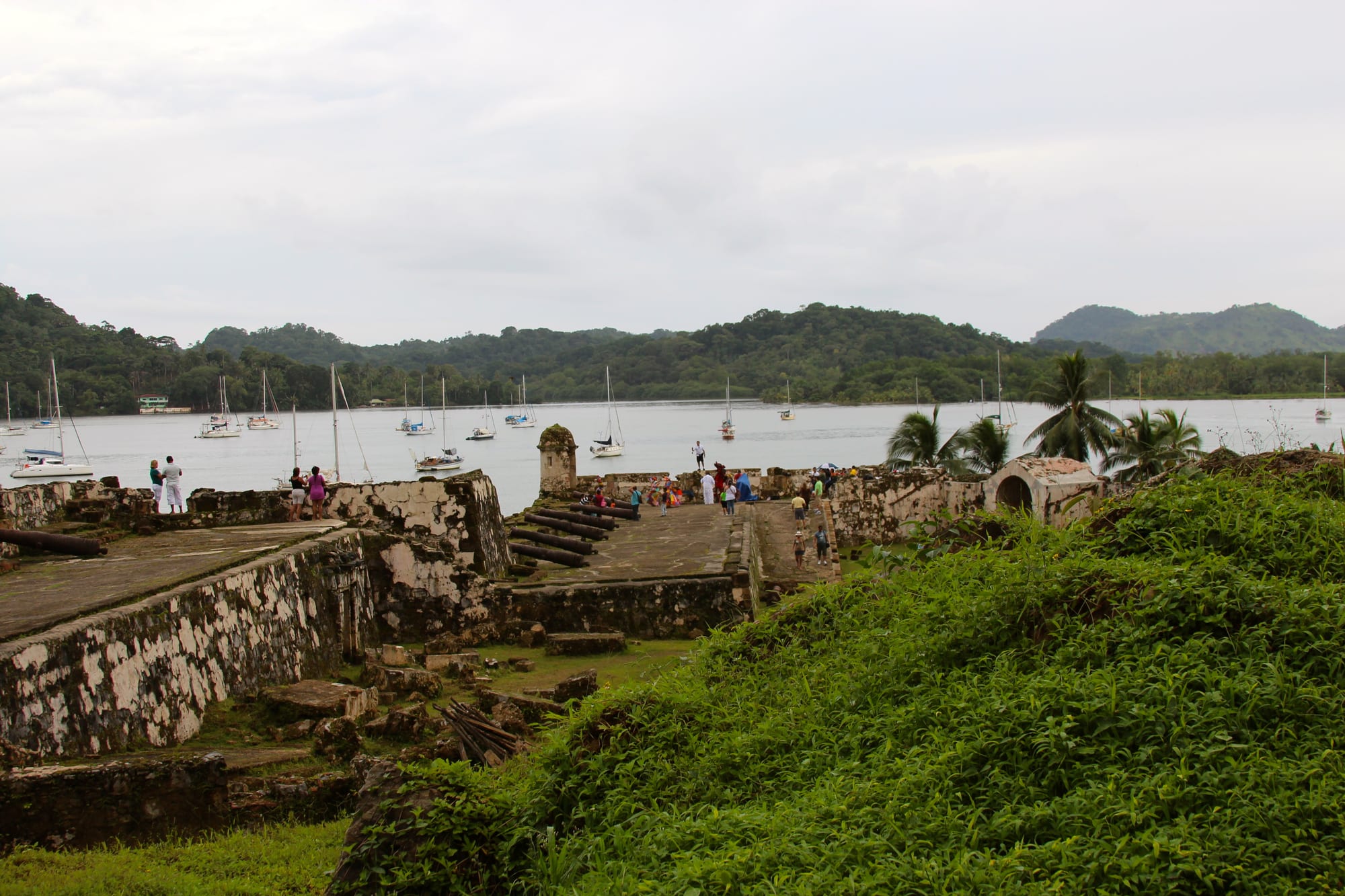
Stone ramparts with rusting cannons and a small watchtower beside a bay full of moored sailing boats and forested hills

Panama City & the Canal, Panama

Portobelo

The ruins of Fort Santiago de la Gloria above Portobelo Bay. (Daniestrada01 / Wikimedia Commons · CC BY-SA 3.0)

A small town on a deep Caribbean bay in Colón province, founded in 1597 as the port where Peruvian silver met the Spanish treasure fleets. Ruined forts, a customs house and a church holding the venerated Black Christ survive from those centuries, and the town is a centre of the Congo tradition of dance and drumming.

Neighbourhoods

  • The town centre
    • First-time visitors
    • Historic district

    The small grid of streets around the Church of San Felipe and the ruined customs house, where the old Spanish town stood. Buses from Colón stop here.

    Open in Maps
  • The bayfront and the forts
    • Historic sites
    • Views

    The shore of the bay is lined with the remains of the Spanish batteries — Santiago at the entrance to town on the western side, San Jerónimo on the eastern side — with sailing boats anchored in the harbour beyond their walls.

    Open in Maps

Things to do

Forts and colonial ruins

  • Fort Santiago de la Glorialandmark

    The castle and batteries on the western side of the bay, with walls, a watchtower and old cannons; part of the fortifications named a UNESCO World Heritage Site in 1980.

    Open in Maps
  • San Jerónimo Batterylandmark

    The battery fort on the eastern side of the bay, one of the Spanish defences rebuilt with neoclassical features in the mid-18th century.

    Open in Maps
  • The Customs Housemuseum

    The ruins of the colonial customs house, one of the most important buildings of the trading era, badly damaged in an attack in 1744 and now home to a museum on the town's history and its Congo culture.

    Open in Maps

Churches

  • Church of San Felipelandmark

    The church built in 1814 that houses the Black Christ, a life-size wooden statue of Jesus found on the shore of the harbour and venerated throughout the year.

    Open in Maps

Beaches, islands and the bay

  • Drake Islandattraction

    The islet at the mouth of the harbour named after Francis Drake, who died in 1596 and was buried at sea in a lead coffin off Portobelo.

    Open in Maps
  • Playa Blancabeach

    One of the beaches around the bay reached by launch from the town.

    Open in Maps
  • Portobelo National Parkpark

    A national park created in 1976 around the bay and its forts, about a quarter of it marine, with reefs used by the town's dive centres.

    Open in Maps
  • Isla Grandeattraction

    A small island off the coast in Portobelo District, named by Columbus in 1502, with surfing in the channel to the mainland at the right times of year.

    Open in Maps

Seasonal events

  • Festival of Devils and CongosCarnival season, February or March

    Dances, drumming and masked devils re-enact episodes of slavery and the rebellions of enslaved people, many of whom escaped to found free settlements.

  • Festival of the Black Christ21 October

    Pilgrims come to venerate the Black Christ, whose robe is changed for the festival; some walk from the capital and some crawl the final stretch.

Eat and drink

Long-standing places and food districts in Portobelo. Hours, ratings and directions come from your maps app, always current.

Portobelo classics

  • Seafood on the bayneighborhood

    Simple restaurants in the town serve fried fish with patacones and Caribbean dishes cooked in coconut.

    Open in Maps
  • Coconut cookingrestaurant

    The coast's kitchen of arroz con coco, fish stewed in coconut milk and rondón, a West Indian seafood and root-vegetable stew.

    Open in Maps

Experience Portobelo

History

Portobelo was founded in 1597 by Francisco Velarde y Mercado for its deep natural harbour, and it quickly replaced Nombre de Dios as the Caribbean port for Peruvian silver, carried across the isthmus from Panama City and shipped on to Spain. A year earlier, the English privateer Francis Drake had died of dysentery and been buried at sea in a lead coffin off its shore, remembered by Drake Island at the mouth of the harbour.

The wealth of the trade fairs drew attackers. Henry Morgan took the town in 1668 with 450 privateers, overcoming its fortifications. In 1726 and 1727 a British fleet blockaded the port, and thousands of its sailors died of disease while anchored off Isla Grande. In 1739, during the War of Jenkins' Ear, a Royal Navy siege captured the town. The Spanish built and rebuilt the forts from 1600 until the last works at Santiago and San Fernando in 1753, and an attack in 1744 badly damaged the customs house.

The town's economy received a major boost in the late 19th century during the construction of the canal. In 1980 UNESCO inscribed the Fortifications on the Caribbean Side of Panama: Portobelo-San Lorenzo, including the ruins around the bay and Fort San Lorenzo near the mouth of the Chagres, as a World Heritage Site. In 2012 the site was placed on the List of World Heritage in Danger, citing environmental factors, lack of maintenance and uncontrolled urban development.

Culture & Customs

Portobelo is a centre of the Congo tradition, kept alive by the descendants of enslaved Africans brought to the isthmus in colonial times. The dance of the Congos, which goes back to the enslaved people of that era, survives here: in the Carnival season, dances, drumming and masked devils re-enact episodes of slavery and the rebellions of enslaved people, many of whom escaped to found free settlements. A museum in the old customs house tells the story of the Congo people and of the town's devotion to a dark image of Christ.

That devotion centres on the Black Christ, a life-size wooden statue in the Church of San Felipe, built in 1814. It was found on the shores of the harbour. Its robe is changed twice a year, for Holy Week and for the Festival of the Black Christ on 21 October, when pilgrims arrive from across the country, some walking from the capital and some crawling the final stretch to the church.

Daily Life

Portobelo is small: the town had about 1,300 inhabitants in 2023, and it serves as the seat of Portobelo District in Colón province, which had 10,320 inhabitants in 2023.

Daily life depends on the sea and on visitors. Two dive centres take visitors to the reefs, launches carry day-trippers to the beaches, and the harbour is a meeting point for sailing boats, some of which offer passages to Colombia. Buses run along the coast road to Sabanitas and Colón from early morning into the evening, connecting the town with jobs and shops on the canal side of the isthmus.

The forts and the customs house are part of the townscape, with houses standing close to walls built around three centuries ago. Its placing on UNESCO's danger list in 2012, citing environmental factors, lack of maintenance and uncontrolled urban development, drew attention to how the ruins are protected. The Festival of the Black Christ, the biggest religious and cultural celebration in Portobelo, brings pilgrims from across the country each October.

Food

The cooking of the Caribbean coast makes much use of coconut. Arroz con coco is rice cooked in coconut milk, and fish is stewed in coconut milk or fried whole and served with patacones, twice-fried green plantain. Rondón, a West Indian stew of seafood, plantain and yam in coconut milk, is typical of Colón province.

The town's restaurants are simple places, and alongside the coastal dishes they serve the everyday Panamanian staples of rice, beans and stewed meat. Sancocho, the chicken, yam and culantro soup, is the national dish, and arroz con pollo is part of the traditional Christmas meal across the country. Breakfast can be hojaldras, a fry-bread, or carimañolas, cassava fritters stuffed with beef.

West Indian influence, carried by the Afro-Antillean communities of Colón province, shows in dishes such as rondón. Street and festival food includes raspao, shaved ice, and chicheme, a drink made from pounded maize, while the usual drinks are local lagers such as Balboa and Atlas and seco, the national spirit.

Planning tools

Budget

Portobelo costs less than the capital. Most visitors come on a day trip from Panama City, by bus or with a driver; staying over means simple guesthouses. Diving, snorkelling and boat trips to the beaches are the main added costs.

Daily Budget Midrange
USD 100–200 (comfortable guesthouse, restaurant meals, a boat trip or a dive, a driver from the capital)
Daily Budget Shoestring
USD 40–70 (guesthouse room, local meals, buses via Sabanitas)

Take a launch to the nearby beaches rather than walking the coast road, and travel between Colón and Portobelo in daylight.

Best Time to Visit

The drier months from December to April bring the most settled weather, though rain is generally much heavier on the Caribbean coast than on the Pacific side. Carnival brings the Congo dances, and 21 October brings the pilgrims of the Black Christ festival.

Suggested Number of Days

The town's historic sights fit into a single day, and many visitors come on a day trip from Panama City. Two or three days allow time for the beaches, diving and the islands along the coast.

First Visit
1 day
With Surroundings
2–3 days

Transportation

The town is small enough to cover on foot. Buses run along the coast road to Sabanitas and on to Colón through the day, and boat launches carry visitors to the beaches and islands of the bay.

Agree the price and the return time with a boatman before setting off.

Airport & Station Connections

Portobelo lies about 105 km by road from Panama City, around an hour and a half by car along the highway across the isthmus to Sabanitas and then the coast road. By bus, the usual route is an express from the Albrook terminal to Sabanitas, then a local bus to Portobelo. Boats also sail from here to Colombia, varying widely in safety and comfort.

Walkability

The town centre, the church, the customs house and the nearest forts are all within a short walk of each other; the sights can be seen in a couple of hours. Heat, humidity and sudden rain are the main obstacles.

Safety

Panama is one of the safer countries in Central America, and the main tourist areas are generally fine with normal precautions. Portobelo itself is small and quiet, but Colón city, on the way, has high crime and is best passed through with a driver and by day.

Travel between Colón and Portobelo in daylight, check the condition of any boat before boarding, and heed beach flags. Check current official travel advice before travelling.

Climate

Hot and humid all year. Rain is generally much heavier on the Caribbean coast around Portobelo than on the Pacific side; most of it falls in the rainy season, usually May to November, and December to April is drier.

Summer
the wet season, May to November: around Portobelo hot and humid, with heavy rain; Panama City averages around 27°C all year
Winter
the drier season, December to April: a typical day in Panama City runs from 24°C to 29°C, and the Caribbean side is somewhat warmer

Local Customs

Portobelo is a small town where the church and its Black Christ are objects of deep devotion, and the Congo dances are a living tradition rather than a show. Spanish is the language of daily life.

Dress modestly in the Church of San Felipe, keep quiet during services, and ask before photographing pilgrims or dancers.

Common Payment Methods

Panama uses US dollar notes and its own balboa coins of the same value. Card payment is less common here than in the capital, so carry cash in small notes for buses, boats and meals.