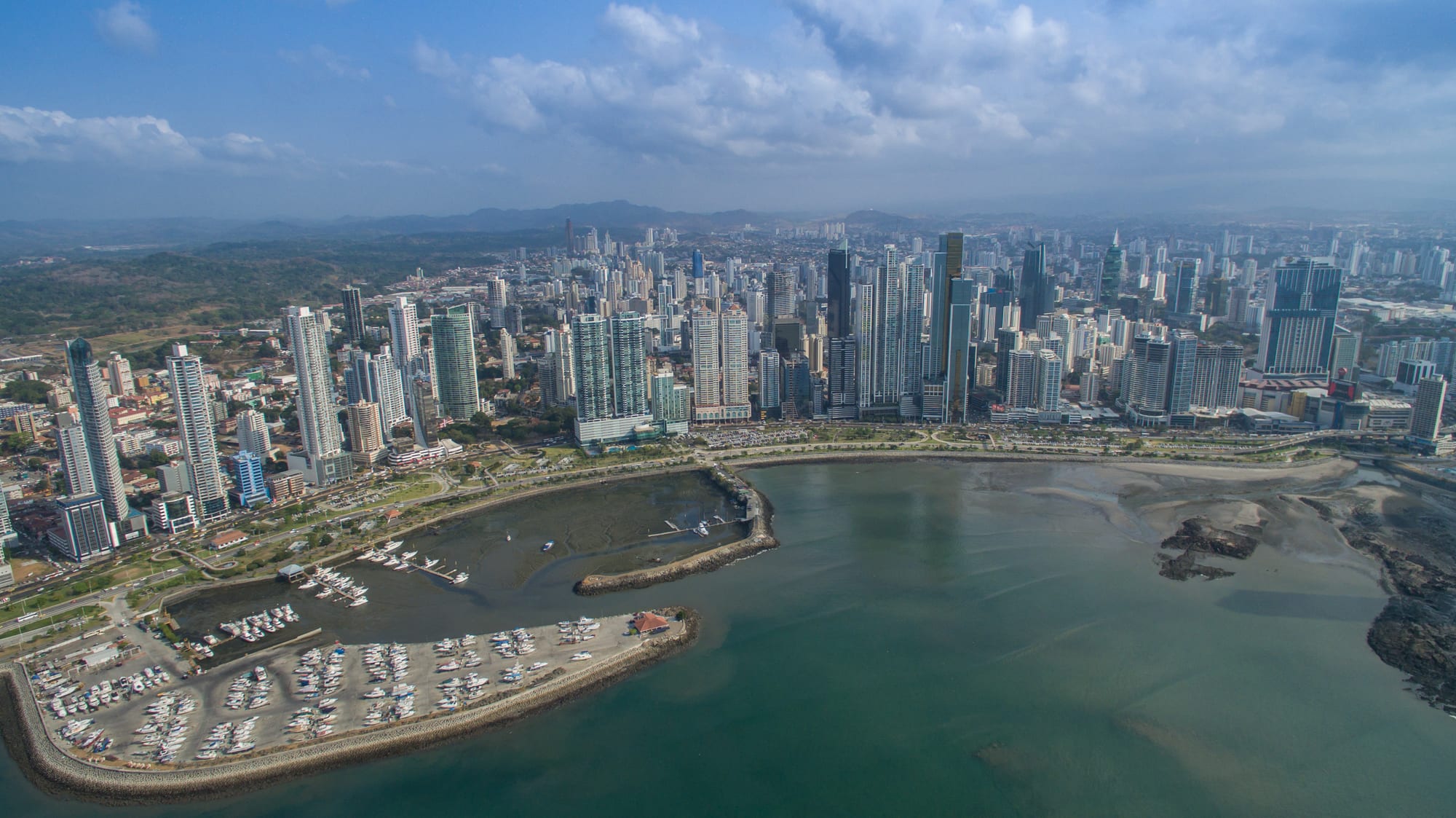
Aerial view of Panama City's dense cluster of high-rise towers behind a curving bayfront road and a marina full of boats

Panama City & the Canal, Panama

Panama City

The towers of Panama City's financial district rising behind the Cinta Costera and Panama Bay. (Dronepicr / Wikimedia Commons · CC BY 3.0)

Panama's capital, on the Pacific at the southern entrance of the canal. Founded in 1519 as the Spanish transit point for Peruvian silver, burned in 1671 and rebuilt on a walled peninsula, it is now a banking and shipping centre whose glass towers rise along the bay beside the restored old quarter of Casco Viejo and the ruins of Panamá Viejo.

Neighbourhoods

  • Casco Viejo
    • First-time visitors
    • Historic district
    • Best for food

    The walled quarter built on a peninsula after 1673, also called Casco Antiguo or San Felipe. Restored plazas, churches, the presidential palace and balconied houses share narrow streets with restaurants, rooftop bars and small hotels, and the Cinta Costera viaduct curves around its sea side.

    Open in Maps
  • Bella Vista and Calle Uruguay
    • Nightlife
    • Close to public transport

    A central district of apartment towers, offices and hotels along the bay, close to the Cinta Costera and the metro. Calle Uruguay is a street of bars and clubs popular with well-off Panamanians and foreigners.

    Open in Maps
  • El Cangrejo
    • Best for food
    • Close to public transport

    A compact, walkable district of apartment blocks, hotels, language schools and small restaurants, among the central neighbourhoods usually considered safest.

    Open in Maps
  • Obarrio and the banking area
    • Business travellers
    • Quiet and residential

    The banking area of glass office towers and business hotels, busy on weekdays and calmer in the evenings.

    Open in Maps
  • Amador
    • Waterfront walks
    • Cycling
    • Museums

    The causeway built from canal spoil that runs out to four small islands at the Pacific entrance of the canal, with the Biomuseo at its foot, marinas and restaurants along the way, and a path for walking and cycling with views back to the skyline.

    Open in Maps

Things to do

The old town and the first city

  • Panamá Viejolandmark

    The ruins of the original city, founded in 1519 and destroyed in 1671 when Henry Morgan sacked it, now in the suburbs of the modern city; together with the historic district it has been a UNESCO World Heritage Site since 1997.

    Open in Maps
  • Metropolitan Cathedrallandmark

    The cathedral basilica of Santa María la Antigua on the main plaza of Casco Viejo, begun in 1688 and consecrated in 1796.

    Open in Maps
  • Panama Canal Museummuseum

    A museum of the French and American canal projects and the handover to Panama, in the former Grand Hotel of the 1870s that became the French canal company's headquarters.

    Open in Maps
  • Palacio de las Garzaslandmark

    The president's office and residence on the waterfront of Casco Viejo, named after the herons that have lived in its courtyard since 1922.

    Open in Maps

The canal

  • Miraflores Locksattraction

    The Pacific-side locks nearest the city, where ships are raised or lowered 16.5 metres in two stages; a visitor centre has viewing terraces over the chambers.

    Open in Maps
  • Bridge of the Americaslandmark

    The road bridge completed in 1962 across the Pacific entrance of the canal, under which ships pass on their way to and from the port of Balboa.

    Open in Maps

Museums

  • Biomuseomuseum

    Frank Gehry's first design for Latin America, opened in 2014 at the start of the Amador Causeway, telling how the rise of the isthmus changed the natural world.

    Open in Maps

Parks and the waterfront

  • Amador Causewaytrail

    A causeway of rock dug out during the canal's construction, linking Naos, Culebra, Perico and Flamenco islands to the mainland, with a cycling and jogging path beside the road.

    Open in Maps
  • Cinta Costerapark

    The reclaimed bayfront completed in 2009, running from Paitilla to El Chorrillo, with a marine viaduct opened in 2014 that loops around Casco Viejo.

    Open in Maps
  • Ancón Hillviewpoint

    The 199-metre forested hill that once held the Canal Zone's administration, now a reserve with sloths and coatis, reached by a walk of about half an hour to views over the city and the canal.

    Open in Maps
  • Metropolitan Natural Parkpark

    A protected area of tropical forest inside the city, inaugurated in 1988, with nature trails and a panoramic view of the city.

    Open in Maps

Markets

  • Avenida Centralmarket

    A pedestrian shopping street leading towards the old town, lined with shops and markets.

    Open in Maps
  • San Felipe Neri Public Marketmarket

    A public market reached from Avenida Central near the Cinco de Mayo metro station.

    Open in Maps

Short trips from the city

  • Soberanía National Parkpark

    A rainforest national park beside the canal, established in 1980, crossed by the Chagres River and by the 16th-century Camino de Cruces, the stone trail used by the Spanish to carry gold.

    Open in Maps
  • Taboga Islandattraction

    An island in the Gulf of Panama reached by ferry from the city, with a small village and beaches.

    Open in Maps

Seasonal events

  • Carnivalthe four days before Ash Wednesday, February or March

    Parades and music fill the city, with processions along the Cinta Costera.

  • Fiestas PatriasNovember

    The national holidays of November, beginning with Separation Day on 3 November, which marks the break from Colombia in 1903.

Eat and drink

Long-standing places and food districts in Panama City. Hours, ratings and directions come from your maps app, always current.

Panama City classics

  • Fish market by Casco Viejomarket

    The city's main fish market, at the entrance to Casco Viejo, and a cheap place to eat seafood.

    Open in Maps
  • Fondasrestaurant

    Small, cheap local eateries serving a quick lunch of rice, beans, meat or fried fish, salad and patacones.

    Open in Maps

Food districts

  • Casco Viejoneighborhood

    The old town is one of the city's main areas for restaurants, rooftop bars and nightlife.

    Open in Maps
  • Calle Uruguayneighborhood

    A street of bars and clubs in Bella Vista, busiest late in the evening.

    Open in Maps

Experience Panama City

History

Panama City was founded on 15 August 1519 by the Spanish conquistador Pedro Arias Dávila, as the first permanent European city on the Pacific coast of the Americas. It was the starting point for the expeditions that conquered the Inca Empire, and the Pacific end of the route across the isthmus that carried most of Spain's American gold and silver to the fairs of Nombre de Dios and Portobelo. By 1670 it had about 15,000 inhabitants. On 28 January 1671 the privateer Henry Morgan sacked the city and it was destroyed by fire.

The city was formally re-established on 21 January 1673 on a defensible peninsula 8 km from the original settlement — today's Casco Viejo — and the ruins of the first site became Panamá Viejo. Fortunes revived with the California Gold Rush: the Panama Railroad, opened across the isthmus in 1855, brought a flow of travellers, and the French canal company of Ferdinand de Lesseps made its headquarters in a hotel on the main plaza in the 1880s. After independence from Colombia in 1903, the American-built canal and the Canal Zone along its banks shaped the city's growth for most of the 20th century.

In December 1989, during the US invasion to remove Manuel Noriega, fire destroyed part of the El Chorrillo neighbourhood, a district of old wooden buildings beside the old town. The canal and the former Zone passed to Panama by 1999, and in 1997 Panamá Viejo and the historic district were together named a UNESCO World Heritage Site. Since then a banking and construction boom has filled the bayfront with towers, the Cinta Costera has been built out over the sea, and the city opened its first metro line in 2014.

Culture & Customs

The capital is a city of great cultural diversity. Mestizo Panamanians live alongside Afro-Antillean families descended from the West Indian labourers who built the railway and the canal, with Chinese, Arab and Jewish communities and newer arrivals from Venezuela, Colombia and North America. The former Canal Zone left its mark on Balboa, once its administrative centre, and English is still widely spoken in the city.

The city's sound is loud and varied, from reggae en español, Spanish-language reggae that originated in Panama in the late 1980s, to the music of Carnival, whose stages and night parades fill the Cinta Costera. November brings the Fiestas Patrias, the national holidays that begin with Separation Day on 3 November. Baseball and football are the city's favourite sports, and the national football team reached its first World Cup in 2018.

Casco Viejo is both the city's showpiece and a living district, where restored mansions, churches and rooftop bars share the streets with residents. Herons have strutted in the courtyard of the presidential palace since 1922, when President Belisario Porras brought them there on the suggestion of the poet Ricardo Miró. Catholicism remains the main faith, and the cathedral on the main plaza is the seat of the archdiocese.

Daily Life

The 2023 census counted 410,354 people in the city itself and 1,086,990 in the wider Panamá District. The old central districts lost population between the 2010 and 2023 censuses, while the rest of the district grew by about half.

Banking, commerce, shipping and tourism drive the economy, and the city is the political and administrative centre of the country. Traffic congestion is a constant problem that spills over into neighbouring Panamá Oeste and Colón; the metro, with two lines and a monorail under construction to the west, was built to ease it. Uber has been controversial, with many taxi drivers demanding that it stop operating.

Water is a recurring worry. The canal depends on the fresh water of Gatún Lake, and in early December 2023 low water levels cut canal transits from the normal 36 ships a day to 22, leaving ships backed up waiting to cross. In 2025 the canal authorities began plans for a new dam to feed Gatún Lake, and from 3 September 2026 the canal allowed 34 ships a day instead of 36.

Food

Ceviche, commonly made from corvina and prepared with lemon juice, chopped onion, celery and cilantro, is a city favourite, and the main fish market at the entrance to Casco Viejo is a cheap place to eat seafood. Fried fish with patacones, twice-fried green plantain, is a common plate. Sancocho, a chicken soup thickened with ñame and flavoured with culantro, is the national dish, and arroz con pollo is part of the traditional Christmas meal.

Breakfast often means fried foods such as hojaldras, a fry-bread, or carimañolas, cassava fritters stuffed with beef. Fondas, small local eateries, serve a quick, cheap lunch of rice, beans, meat or fried fish, salad and patacones. Afro-Antillean cooking is one of the influences on the national cuisine, and the city's restaurants range from Chinese and Arab to Colombian, Peruvian and Venezuelan.

Panamanian treats include chicheme, a drink made from pounded maize, and raspao, shaved ice topped with condensed milk and fruit flavours. Nightlife centres on Casco Viejo and Calle Uruguay, where the bars serve local lagers such as Balboa and Atlas and seco, the national spirit. Panama also grows some of the world's most prized coffee, the Geisha variety from Boquete in the western highlands.

Planning tools

Budget

The capital is the most expensive part of Panama, and Casco Viejo's boutique hotels, rooftop bars and canal transit tours are priced for foreign visitors. Fondas, the metro and city buses remain cheap, and the US dollar is the currency, so prices feel familiar to American visitors.

Daily Budget Midrange
USD 110–230 (Casco Viejo or Obarrio hotel, restaurant dinners, a partial canal transit or Taboga ferry, Uber)
Daily Budget Shoestring
USD 45–75 (hostel dorm, fonda lunches, metro and buses, the Miraflores visitor centre)

Eat lunch at fondas, use the metro and Uber rather than street taxis, and compare partial-transit canal tours before booking.

Best Time to Visit

The dry season, from December to April, brings the sunniest weather and the most visitors. The wet season, from May to November, brings afternoon showers, greener surroundings and fewer tourists. The canal works all year, so the locks can be seen in any season.

Suggested Number of Days

Two or three days cover the old town, the canal and the waterfront. Allow four to six to add the rainforest beside the canal and an island in the bay. Traffic is heavy, so time spent between districts adds up.

First Visit
2–3 days
With Surroundings
4–6 days

Transportation

The metro has two lines: Line 1, opened in 2014, runs 18.1 km north from the Albrook bus terminal, and Line 2, opened in 2019, runs 24 km east, with a branch to Tocumen airport since 2023. Line 3, a monorail west across the canal to Arraiján, is under construction. Metrobus services reach Miraflores and the Amador Causeway from Albrook, and Uber and taxis are widely used.

Buy a rechargeable card for the metro and Metrobus, and allow extra time at rush hour, when traffic is heavy.

Airport & Station Connections

Tocumen International Airport, the hub of Copa Airlines, lies east of the city, with its own metro station since 2023; taxis and Uber also make the run. Long-distance buses use the Albrook terminal beside the mall, and cruise ships usually dock on the Amador Causeway.

Walkability

Casco Viejo is compact and best on foot, and the Cinta Costera and the Amador Causeway are long, flat promenades. Elsewhere the city is spread out along busy roads, the heat and humidity make long walks tiring, and most people use the metro or a ride between districts.

Safety

Panama is one of the safer countries in Central America, and the main tourist areas are generally fine with normal precautions. Casco Viejo, the banking districts, the Amador Causeway and the canal visitor centres are generally safe and well policed. Neighbouring districts such as El Chorrillo and parts of Curundú and San Miguelito see street crime and gang activity, and armed robbery and express kidnapping are reported in the city.

Keep to well-lit streets after dark, use Uber or registered taxis, do not wander from Casco Viejo into neighbouring districts, and keep valuables out of sight. Check current official travel advice before travelling.

Climate

Tropical and humid, with temperatures that barely change through the year, averaging around 27°C. The wet season runs from May to November and the dry season from December to April; even in the dry months the sky is often hazy or cloudy.

Summer
the wet season, May to November: in Panama City around 27°C on average, with afternoon showers and high humidity
Winter
the dry season, December to April: in Panama City around 27°C on average, with the sunniest weather of the year

Local Customs

Spanish is the language of daily life, though English is widely spoken in business and tourism. Catholicism is the main faith, and the old town's churches are places of worship as well as sights. Beachwear belongs on the beach and the causeway rather than in churches or offices.

Check whether service is already included before tipping, dress modestly in churches, and ask before photographing people, especially in the poorer districts.

Common Payment Methods

Panama uses US dollar notes alongside its own balboa coins, which match US coins in size and value. Cards are widely accepted in the city, and ATMs are common. Carry small notes for buses, fondas, markets and the islands.