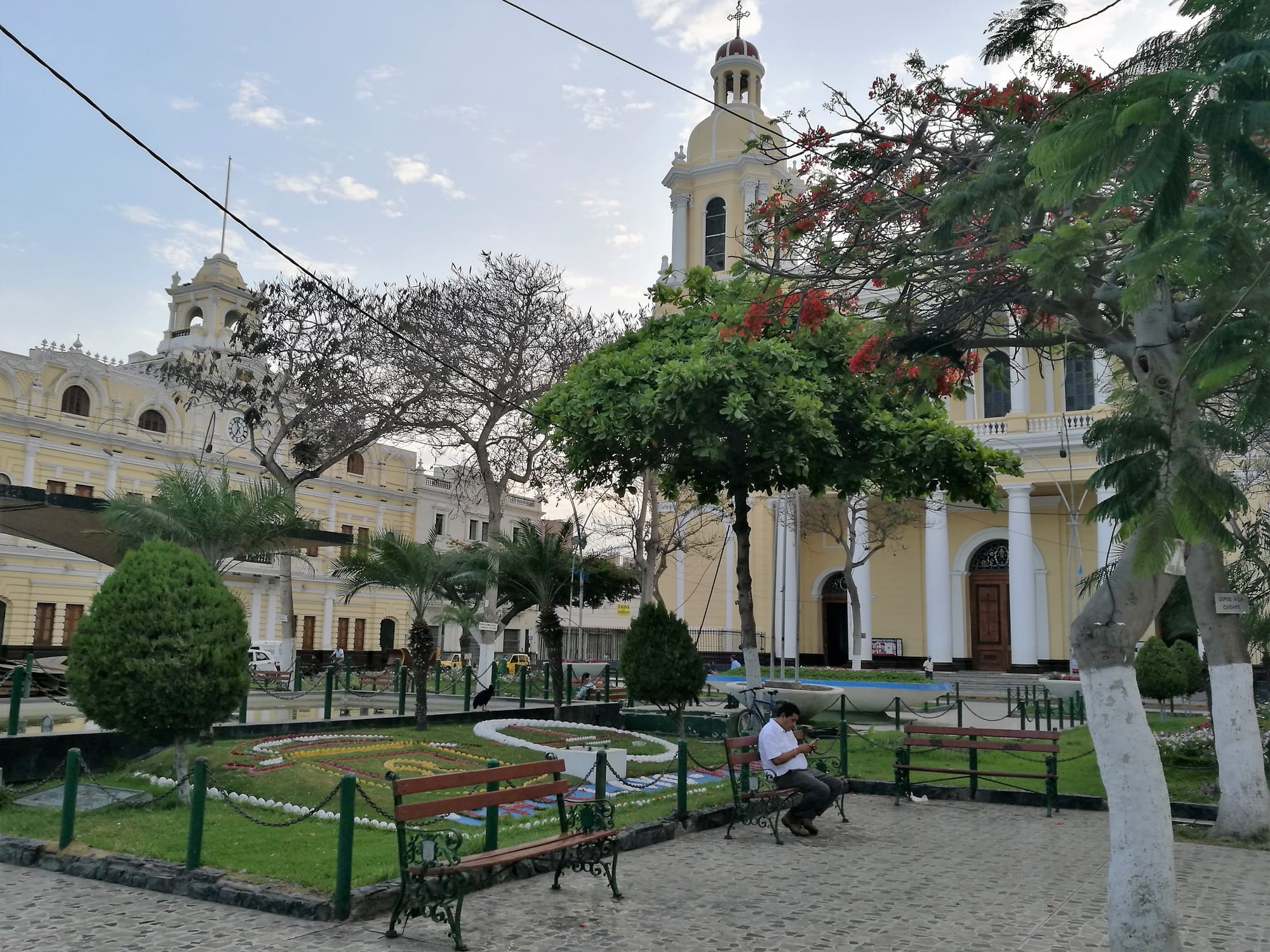
Gardens and benches in Chiclayo's main square, with the yellow cathedral tower and the municipal palace behind flowering trees

Trujillo, Chiclayo & the North Coast, Peru

Chiclayo

The gardens of the Plaza de Armas in Chiclayo, with the cathedral and the municipal palace. (Pitxiquin / Wikimedia Commons · CC BY-SA 4.0)

The capital of the Lambayeque region, 13 km inland from the Pacific on Peru's north coast. Founded by Franciscan friars in the 16th century as a modest stopping place, it grew into a busy commercial city and one of Peru's largest, and it is the base for the Moche royal tombs of Sipán, the pyramids of Túcume and the museums of nearby Lambayeque.

Neighbourhoods

  • Central Chiclayo
    • First-time visitors
    • Close to buses
    • Shopping

    The commercial heart around the main square, the Parque Principal, with the cathedral, the municipal palace, banks, shops and many of the hotels. Busy streets of shops lead off it, and squares such as the Plazuela Elías Aguirre stay lively after dark.

    Open in Maps
  • La Victoria
    • Quiet and residential
    • Local life

    One of the three districts that make up central Chiclayo, on flat ground south of the centre and away from the tourist sights.

    Open in Maps
  • José Leonardo Ortiz
    • Local life
    • Markets

    One of the three districts of central Chiclayo, to the north of the centre, named after the creole patriot who oversaw Chiclayo's support for the independence army. It is well off the tourist track.

    Open in Maps
  • Pimentel
    • Beaches
    • Seafood

    The beach district south-west of the city, where Chiclayo goes in summer. Its beach and its reed fishing boats, the caballitos de totora, are its best-known sights, and the seafront has seafood restaurants.

    Open in Maps
  • Lambayeque
    • Museums
    • Historic district

    The provincial capital a few kilometres from the city, part of the Chiclayo metropolitan area. It is a cultural and educational centre with two of Peru's most important archaeological museums.

    Open in Maps

Things to do

The city centre

  • Chiclayo Cathedrallandmark

    The neoclassical cathedral on the main square, begun in 1869 to designs commissioned from Gustave Eiffel and finished in 1939; Robert Prevost, later Pope Leo XIV, celebrated mass here as Bishop of Chiclayo.

    Open in Maps
  • Estadio Elías Aguirreattraction

    The city's main stadium, built in 1970 and home to the football club Juan Aurich, Peru's champions in 2011.

    Open in Maps

Museums of Lambayeque

  • Royal Tombs of Sipán Museummuseum

    Opened in 2002 and built to resemble a Moche tomb, it holds the gold, silver and turquoise found with the Lord of Sipán and the Old Lord of Sipán at Huaca Rajada.

    Open in Maps
  • Brüning Museummuseum

    A regional archaeological museum opened in 1966, built on a German researcher's collection, with Lambayeque, Moche, Chimú and Vicús ceramics, textiles and gold.

    Open in Maps

The coast and nearby towns

  • Pimentel beachbeach

    Chiclayo's most popular beach, with surfing waves and caballitos de totora drawn up on the sand.

    Open in Maps
  • Monsefúattraction

    A town about 12 km south-east of the city, known for its food and handicrafts and as the birthplace of a number of cumbia groups.

    Open in Maps

Short trips from the city

  • Huaca Rajada (Sipán)landmark

    The Moche site where Walter Alva and Susana Meneses began excavating the tomb of the Lord of Sipán in 1987, considered a very important archaeological discovery.

    Open in Maps
  • Túcumelandmark

    A plain of 26 major adobe pyramids and mounds around La Raya hill, a centre of the Lambayeque, Chimú and Inca periods, still invoked by local healers.

    Open in Maps
  • Sicán National Museummuseum

    A museum in Ferreñafe, opened in 2004, devoted to the Sicán culture and its metalwork.

    Open in Maps
  • Bosque de Pómac Historic Sanctuarypark

    A protected dry forest dominated by Prosopis trees, containing pyramids of the Batán Grande complex.

    Open in Maps
  • Zañaattraction

    A colonial town founded in 1563, whose Afro-Peruvian Museum was recognised by UNESCO in 2017 as a site of memory of slavery and African heritage.

    Open in Maps

Eat and drink

Long-standing places and food districts in Chiclayo. Hours, ratings and directions come from your maps app, always current.

Chiclayo classics

  • Restaurants of the city centreneighborhood

    The centre's restaurants serve the Lambayeque classics — arroz con pato, rice cooked green with coriander and served with duck, and cabrito a la norteña.

    Open in Maps

Food districts and markets

  • Mercado Modelomarket

    A very large central market where it is possible to buy almost anything, including the ingredients of the northern kitchen.

    Open in Maps
  • Pimentel's seafrontneighborhood

    Seafood restaurants by the beach, where Chiclayo eats ceviche in summer.

    Open in Maps
  • Monsefúneighborhood

    A town in the metropolitan area, south-east of the city, known for its gastronomy.

    Open in Maps

Experience Chiclayo

History

The Lambayeque valley, the largest on Peru's north coast, was one of the great centres of ancient Peru. The Moche irrigated it with canals between roughly AD 100 and 800, and their rulers were buried at Sipán with treasures of gold, silver and turquoise. The Sicán or Lambayeque culture followed, raising the pyramids of Batán Grande and Túcume and working gold with great skill, until drought and El Niño disasters weakened it; the Chimú then absorbed its lands and its goldsmiths, and the Inca took the valley in turn.

The Spanish town began in the 16th century, when Franciscan friars founded Santa María de los Valles de Chiclayo as a small place of passage and rest for travellers. Unlike Lima, Trujillo or Piura, it was inhabited mainly by Indigenous people rather than Spanish settlers. During the War of Independence Chiclayo supplied José de San Martín's army with soldiers, weapons and horses, and on 15 April 1835 President Felipe Santiago Salaverry raised it to the rank of city and named it the Heroic City, a title it still holds.

The city grew into a commercial crossroads of the north, and its cathedral was built to designs commissioned from Gustave Eiffel. In 1987 the discovery of the tomb of the Lord of Sipán nearby put the region on the world's archaeological map. On 8 May 2025 Robert Francis Prevost, Bishop of Chiclayo from 2015 to 2023 and a naturalised Peruvian since 2015, was elected Pope Leo XIV, bringing the city international attention.

Culture & Customs

Chiclayo's nicknames — the Capital of Friendship and the Pearl of the North — reflect the pride its people take in their hospitality. The city's identity leans heavily on its ancient past: the Lord of Sipán is a regional emblem, and its museums, above all the Royal Tombs of Sipán Museum at Lambayeque, are among the best in Peru.

Older traditions live on in the surrounding towns. Monsefú is known for its crafts and its food, and is the birthplace of a number of cumbia groups; the fishermen of Pimentel still use caballitos de totora; and local healers, curanderos, invoke the power of Túcume and its sacred hill in their rituals. At Zaña, a colonial town where enslaved Africans once made up much of the population, the Afro-Peruvian Museum recalls that history.

Catholicism is strong, and the election of the city's former bishop as pope has added to the cathedral's importance. Football is followed passionately, and the city's club Juan Aurich, which plays at the Elías Aguirre stadium, won the national championship in 2011.

Daily Life

Chiclayo is Peru's fourth-largest city, with a population of about 738,000 in 2011, and the wider metropolitan area, which includes Lambayeque, Monsefú and other nearby towns, is one of the most populous in the country. Central Chiclayo is made up of three districts — Chiclayo, José Leonardo Ortiz and La Victoria — with Pimentel, Pomalca and Reque on the periphery.

The city is above all a place of trade, serving the farming valleys of Lambayeque, with the provincial capital and smaller towns around it serving as bedroom communities and suppliers. Large supermarkets, banks, warehouses, hospitals and clinics have spread in recent decades, and a long list of universities, from the Catholic University of Santo Toribio de Mogrovejo to the Señor de Sipán University, draws students from across the north. Much of the population works in commerce and services, many of them informally.

Days begin early, and the centre's streets and markets are busiest in the morning. Summer weekends are spent at the beaches of Pimentel and Puerto Eten, and the squares fill in the evenings. The city has a reputation in Peru as one of the friendliest in the country.

Food

Chiclayo is one of the capitals of northern Peruvian cooking. Its signature is arroz con pato, duck marinated in garlic, vinegar and chilli and cooked with rice turned green with coriander. Cabrito a la norteña, kid goat stewed with chicha de jora, coriander and chilli, is served with yuca, rice and beans; in Piura the same dish comes with tamales instead.

The sea is close, and ceviche and other seafood are eaten in the city and on the seafront at Pimentel. Monsefú, part of the metropolitan area south-east of the city, is known for its gastronomy, and the very large Mercado Modelo, where almost anything can be bought, supplies the ingredients of the northern kitchen.

The best-known sweet of the region is the King Kong of Lambayeque, a giant biscuit sandwich filled with manjar blanco, a milk caramel, and fruit paste, sold across the north and taken home as a gift. The drink of the countryside is chicha de jora, the fermented maize beer.

Planning tools

Budget

Chiclayo is good value. Hotels in the centre are cheaper than in Lima, set lunches and market food are inexpensive, and the museums charge modest entry fees. The main cost is getting to the sites, which are spread over the valley: a tour or a hired taxi saves a great deal of time.

Daily Budget Midrange
USD 75–150 (mid-range hotel, restaurant meals, guided site visits and taxis between ruins)
Daily Budget Shoestring
USD 25–50 (hostel or budget hotel, menú lunches, combis to the sites)

Combine Sipán's site and the Lambayeque museums in one outing; Túcume and Ferreñafe make another.

Best Time to Visit

The museums and sites can be visited all year. July to September is mild, sunny and almost free of the coastal drizzle; December to May is hot, when Chiclayo heads to the beaches of Pimentel and Puerto Eten. El Niño years can bring heavy rain in summer.

Suggested Number of Days

Two or three days are enough for the city and the main museums and archaeological sites around it. Allow more for the dry forests and outlying sites of the valley, or for time at the beach.

First Visit
2–3 days
With Surroundings
3–5 days

Transportation

Taxis and mototaxis are cheap and the usual way around the city. Combis leave from city terminals for Lambayeque, Ferreñafe, Sipán, Túcume and Pimentel, and are slow but very cheap; many visitors prefer a tour or a taxi hired for the day. Long-distance coaches use the bus companies' own terminals.

Use app-based or hotel taxis, never hail one on the street or at the airport.

Airport & Station Connections

Capitán FAP José A. Quiñones González International Airport, the main airport of the Lambayeque region, is at the eastern edge of the city, with flights to Lima. Chiclayo is 770 km from Lima and 208 km from Trujillo; coaches take about three hours from Trujillo, longer from Lima, often overnight.

Walkability

The centre around the main square is flat and walkable, though the streets are crowded and noisy with traffic. The museums, sites and the beach are all outside the city and need transport.

Safety

The standard tourist circuit — Lima's Miraflores and Barranco, Cusco, the Sacred Valley, Arequipa, Puno — is generally safe with urban precautions, but crime has risen. In Chiclayo, theft, bag-snatching and robbery in street-hailed taxis occur, and markets and crowded streets call for care with belongings.

Use app-based or hotel taxis, keep valuables out of sight in markets, and visit the archaeological sites in daylight. Check current official travel advice before travelling.

Climate

Hot and dry but tempered by strong winds for much of the year, with very little rain. Every few years El Niño brings intense heat and heavy rain, as in 1998.

Summer
December to May is hot, with days of about 27–30°C, peaking at 31–33°C in February and March
Winter
July to September is mild and sunny, with days of about 21–24°C and windy nights

Local Customs

Chiclayo calls itself the Capital of Friendship, and its people are known for their warmth. The city is strongly Catholic and has followed closely the election of its former bishop as pope. Traditional healers remain part of local life around the valley. A tip of around 10 per cent is usual in sit-down restaurants.

Dress modestly in churches, ask before photographing people in markets, and do not climb on the adobe pyramids.

Common Payment Methods

The currency is the sol (PEN). Cards are accepted in hotels, larger restaurants and malls; cash is needed for markets, combis, mototaxis and small eateries. ATMs are common in the centre and charge fees, and US dollars are easily exchanged.