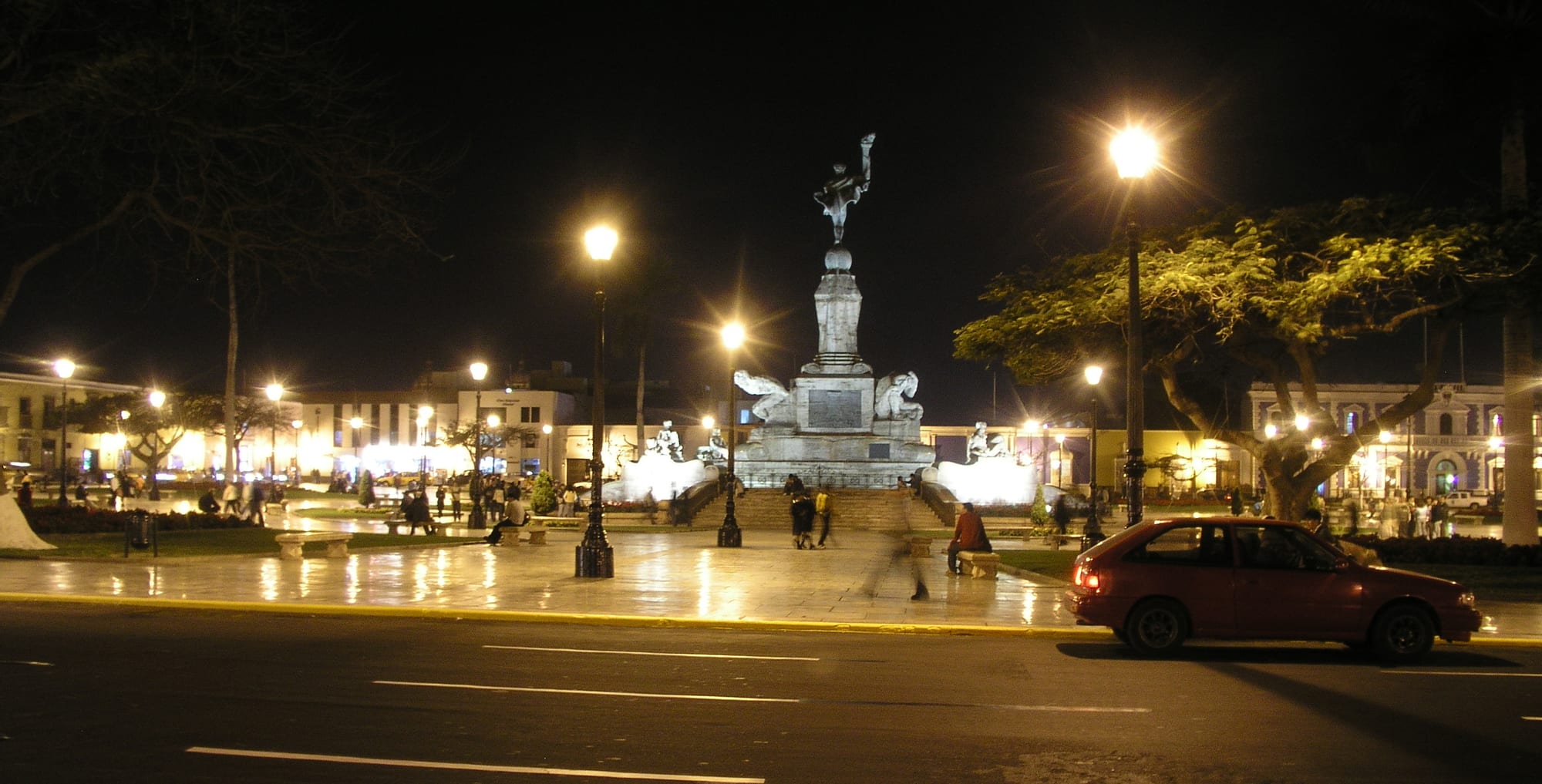
The Plaza de Armas of Trujillo at night, its tall monument lit by street lamps and colonial facades around the square

Trujillo, Chiclayo & the North Coast, Peru

Trujillo

The Plaza de Armas, the main square of Trujillo's historic centre, at night. (JYB Devot / Wikimedia Commons · CC BY-SA 4.0)

The capital of La Libertad on Peru's north coast, near the mouth of the Moche River — a Spanish city founded in 1534 among the lands of the Moche and Chimú. Its walled colonial centre of painted mansions sits a few kilometres from the adobe ruins of Chan Chan and the Moche temples, and it is now the heart of Peru's third-largest metropolitan area.

Neighbourhoods

  • Historic Centre
    • First-time visitors
    • Historic district
    • Architecture

    The old walled city, now ringed by Avenida España, which follows the line of the colonial wall. Its grid of streets around the Plaza de Armas holds the cathedral, colonial and republican mansions with barred windows and some ten colonial churches, as well as most of the city's museums, hotels and restaurants.

    Open in Maps
  • Víctor Larco Herrera
    • Quiet and residential
    • Shopping
    • Near the sea

    A district on the plain between the centre and the Pacific, joined to the city in one built-up area. It is mainly commercial and residential, with green spaces, shopping streets such as Larco and Fátima avenues and a seafront walk.

    Open in Maps
  • Huanchaco
    • Beaches
    • Surfing
    • Best for food

    The seaside resort north-west of the city, close to Chan Chan, where fishermen still use the reed boats called caballitos de totora. It is known for its surf breaks and its ceviche, and many travellers stay here rather than in the centre.

    Open in Maps
  • Moche
    • Archaeology
    • Countryside

    A town in the irrigated Moche Valley south of the city, part of the wider Trujillo area. The Moche temples of the Sun and the Moon stand in its farmland below Cerro Blanco, and the beach of Las Delicias is in the same district.

    Open in Maps

Things to do

The colonial centre

  • Plaza de Armaslandmark

    The square where the Spanish city was founded and where independence was proclaimed in December 1820, framed by the cathedral and the municipal palace, with the Freedom Monument at its centre.

    Open in Maps
  • Trujillo Cathedrallandmark

    The cathedral on the Plaza de Armas, built between 1647 and 1666, with baroque and rococo altars, paintings of the Cusco and Quito schools and a museum of colonial religious silver and gold.

    Open in Maps
  • Historic Centre of Trujilloneighborhood

    Seventy-two blocks of colonial and republican houses and churches inside Avenida España, declared a monumental zone, for walking between painted facades and courtyards.

    Open in Maps

Chimú and Moche sites

  • Chan Chanlandmark

    The Chimú capital, the largest city of pre-Columbian South America, whose adobe walled compounds spread over some 20 square kilometres west of the city; a UNESCO World Heritage Site since 1986.

    Open in Maps
  • Huaca de la Lunalandmark

    A Moche adobe temple near Cerro Blanco, inhabited from the 1st to the 9th century, better preserved than its neighbour and known for its painted reliefs.

    Open in Maps
  • Huaca del Sollandmark

    Once the largest adobe structure of the pre-Columbian Americas, built from over 130 million bricks; about two-thirds has been lost to erosion and looting, after colonists redirected the river past its base to loot it.

    Open in Maps
  • Huaca del Dragónlandmark

    Also called the Huaca Arco Iris, an adobe ceremonial centre near Chan Chan with relief friezes of human figures and a rainbow.

    Open in Maps
  • Huaca Esmeraldalandmark

    A Chimú adobe platform inside the city, built in an early stage of the culture in close connection with Chan Chan.

    Open in Maps

Beaches and the coast

  • Huanchaco beachbeach

    The town beach and surf breaks of Huanchaco, just north of the city, a World Surfing Reserve since 2012, where caballitos de totora are made.

    Open in Maps
  • Swamps of Huanchacopark

    A wetland reserve at Huanchaco where the reeds for the caballitos de totora have been cut since ancient times.

    Open in Maps
  • Las Deliciasbeach

    A coastal settlement and beach in Moche district, south of the city between Buenos Aires and Salaverry.

    Open in Maps

Short trips from the city

  • El Brujolandmark

    An archaeological complex in the Chicama valley occupied from preceramic times, with Huaca Prieta as its oldest part and large Moche temples.

    Open in Maps

Seasonal events

  • Marinera FestivalJanuary

    A national contest of the marinera, the handkerchief courtship dance, with parades and displays of Peruvian paso horses.

  • Carnival of Huanchacosouthern summer

    A beach-town carnival held since the early 20th century, with parades and dancing in Huanchaco.

  • Trujillo Spring Festivallate September to early October

    The festival of the 'city of everlasting spring', with beauty queens and a spring parade judged on its decoration.

  • Paso horse competitionSeptember–October, during the Spring Festival

    A contest of Peruvian paso horses and their riders, the chalanes, organised by the La Libertad breeders' association.

Eat and drink

Long-standing places and food districts in Trujillo. Hours, ratings and directions come from your maps app, always current.

Trujillo classics

  • Restaurants of the historic centreneighborhood

    Restaurants in and around the old centre serve the city's regional dishes — shámbar on Mondays, cabrito and sopa teóloga.

    Open in Maps

Food districts

  • Huanchaco's seafood restaurantsneighborhood

    The beach town is known above all for its ceviche, served in restaurants along the seafront.

    Open in Maps
  • Víctor Larco's avenuesneighborhood

    The restaurants and cafés of the residential district between the centre and the sea.

    Open in Maps

Experience Trujillo

History

The Moche Valley was home to two of ancient Peru's great coastal societies. The Moche, between roughly the 1st and 9th centuries AD, built the adobe temples of the Sun and the Moon below Cerro Blanco; later the Chimú made Chan Chan, at the mouth of the valley, the capital of the kingdom of Chimor from about 900 until the Inca conquered it around 1470. In 2018 archaeologists working at Trujillo uncovered the world's largest known site of child sacrifice from the Chimú era.

The Spanish city was founded in 1534 by Diego de Almagro, named after Trujillo, Francisco Pizarro's home town in Spain, and placed among four Chimú settlements. By 1544 it had some 300 houses and an economy built on sugar cane, wheat and livestock. An earthquake in February 1619 almost destroyed it and killed around 400 people; the cathedral that stands today was built between 1647 and 1666, and a wall was raised around the town against pirates. When the wall came down, Avenida España was laid along its line under a master plan of 1942.

On 29 December 1820 Trujillo proclaimed its independence from Spain in the Plaza de Armas, and in 1824 Simón Bolívar made it the provisional capital of Peru while he campaigned against the royalists. The city was the birthplace of Peru's judiciary and of Víctor Raúl Haya de la Torre, founder of the APRA movement, and in 1932 it was the scene of a military revolt. Migration from the Andean provinces pushed the population past 400,000 by 1981, and the city spread into a metropolis of several districts.

Culture & Customs

Trujillo presents itself as Peru's capital of culture. It calls itself the capital of the marinera, the coastal courtship dance performed with handkerchiefs, which has been declared national cultural heritage, and it holds a national marinera contest every January. It is also called the cradle of the Peruvian paso horse, a breed with a smooth gait shown by riders called chalanes in competitions during the Spring Festival, when the city lives up to its nickname of the city of everlasting spring.

The poet César Vallejo and Haya de la Torre are among the prominent writers associated with the city, and Trujillo has a lively arts scene, a school of arts and a book festival. Religious life is Catholic, with some ten colonial churches inside the old wall and others in Huanchaco, Huamán and Moche.

At Huanchaco, fishermen still make and ride the caballitos de totora, narrow reed boats used on this coast since Moche and Chimú times, and competitions in them are held alongside surfing contests, including a longboard world championship held since 2010. The people of the north coast think of themselves as warm and outgoing, and Trujillanos are proud of their food, their dance and their part in independence.

Daily Life

Trujillo is Peru's third most populous city and the centre of its third-largest metropolitan area; the national statistics office put the metropolitan population at about 935,000 in 2014. The metropolis joins the old city to districts such as Víctor Larco Herrera, La Esperanza, El Porvenir, Florencia de Mora and the beach town of Huanchaco, and much of its recent growth has come from migrants from the highland provinces of La Libertad and from Cajamarca and Áncash.

The economy rests on commerce, services and manufacturing. Leather and footwear are made in a cluster of more than a thousand small and medium firms, shopping malls and supermarkets have spread on the main roads, and the irrigated valleys around the city grow sugar cane and export crops on a large scale. The universities draw students from across the north.

Life begins early, and the centre is busiest in the morning and evening, when families gather in the Plaza de Armas. Public concern is dominated by crime: extortion of bus lines and businesses by criminal gangs has made Trujillo a focus of national emergency measures.

Food

Trujillo cooks in the confident style of the north coast. Its best-known local dish is shámbar, a soup of beans with smoked ham, mostly served on Mondays. Sopa teóloga, traditionally made in Moche, is a turkey or chicken broth with soaked bread, potatoes, milk and cheese, and cabrito, stewed kid goat, is served across the region.

Seafood comes from the coast just outside the city. Huanchaco is famous for its ceviche, raw fish cured in lime with onion and chilli, and its seafront restaurants are the place where many Trujillanos eat it at lunchtime. Fish and shellfish dishes appear on menus across the city.

For sweets, Trujillo is known for its alfajores, biscuits sandwiched with filling, which visitors carry home as the classic sweet souvenir of the city of everlasting spring. Bakeries and sweet shops in the centre sell them by the box. Among the region's typical drinks are the chichas of Moche and of Magdalena de Cao, made with jora.

Planning tools

Budget

Trujillo is good value compared with Lima or Cusco. Hotels in the centre and in Huanchaco cover a wide range, set lunches are cheap and the archaeological sites charge modest entry fees. Taxis or a guided tour add to the cost, because the ruins are spread around the city.

Daily Budget Midrange
USD 75–150 (mid-range hotel, restaurant meals, guided site visits and taxis between ruins)
Daily Budget Shoestring
USD 25–50 (hostel in Huanchaco or the centre, menú lunches, combis and colectivos)

A combined day by taxi or tour is the easy way to see Chan Chan and the Moche temples, which lie on opposite sides of the city.

Best Time to Visit

The city can be visited all year: it has a desert climate and is known as the 'city of everlasting spring' for its mild, sunny weather. January brings the Marinera Festival and late September to early October the Spring Festival, when hotels are busier. The southern summer is the beach season in Huanchaco.

Suggested Number of Days

Two or three days cover the colonial centre and the main ruins around the city. Add a day or more for a longer stay at the beach or for the sites of the Chicama valley to the north.

First Visit
2–3 days
With Surroundings
3–4 days

Transportation

Taxis are cheap and the usual way to reach the ruins; agree the fare or use an app. Combis and buses run from the centre, many from around Avenida España, to Huanchaco, Chan Chan and the Moche valley. Long-distance coaches arrive at the bus companies' own terminals, a short taxi ride from the centre.

Use app-based or hotel taxis, never hail one on the street or at the airport.

Airport & Station Connections

Capitán FAP Carlos Martínez de Pinillos International Airport, the main air hub of northern Peru, is in Huanchaco, about 10.5 km north-west of the centre, with flights to Lima. Long-distance coaches up the Pan-American Highway take roughly nine hours from Lima, often overnight.

Walkability

The historic centre inside Avenida España is flat, compact and easy to cover on foot. Everything else — Chan Chan, the Moche temples and Huanchaco — needs a taxi or bus, and the roads to the sites are not pleasant to walk in the heat.

Safety

The standard tourist circuit — Lima's Miraflores and Barranco, Cusco, the Sacred Valley, Arequipa, Puno — is generally safe with urban precautions, but crime has risen. Extortion and gang violence have surged in Lima and Trujillo, prompting repeated states of emergency. Visitors are rarely targeted directly, but theft, bag-snatching and robbery in street-hailed taxis occur.

Use app-based or hotel taxis, visit the ruins in daylight and keep valuables out of sight. Check current official travel advice before travelling.

Climate

A desert climate: dry, mild and sunny for most of the year, with very little rain and less of Lima's winter fog. El Niño years can bring heavy rain and floods to the coast.

Summer
December to February is the warm, sunny season, with summer highs around 28°C, and the beach season at Huanchaco
Winter
June to August is mild and mostly dry, with temperatures falling to around 17°C and morning haze near the sea

Local Customs

Trujillo calls itself the capital of the marinera and the cradle of the Peruvian paso horse, and both are matters of local pride. The city is mostly Catholic, and churches are working places of worship. A tip of around 10 per cent is usual in sit-down restaurants.

Dress modestly in churches, ask before photographing people, and do not climb on the adobe walls at the archaeological sites, which are fragile.

Common Payment Methods

The currency is the sol (PEN). Cards are accepted in hotels, larger restaurants and the shopping malls; cash is needed for markets, combis, taxis and small eateries. ATMs are common in the centre and charge fees, and US dollars are easily exchanged.