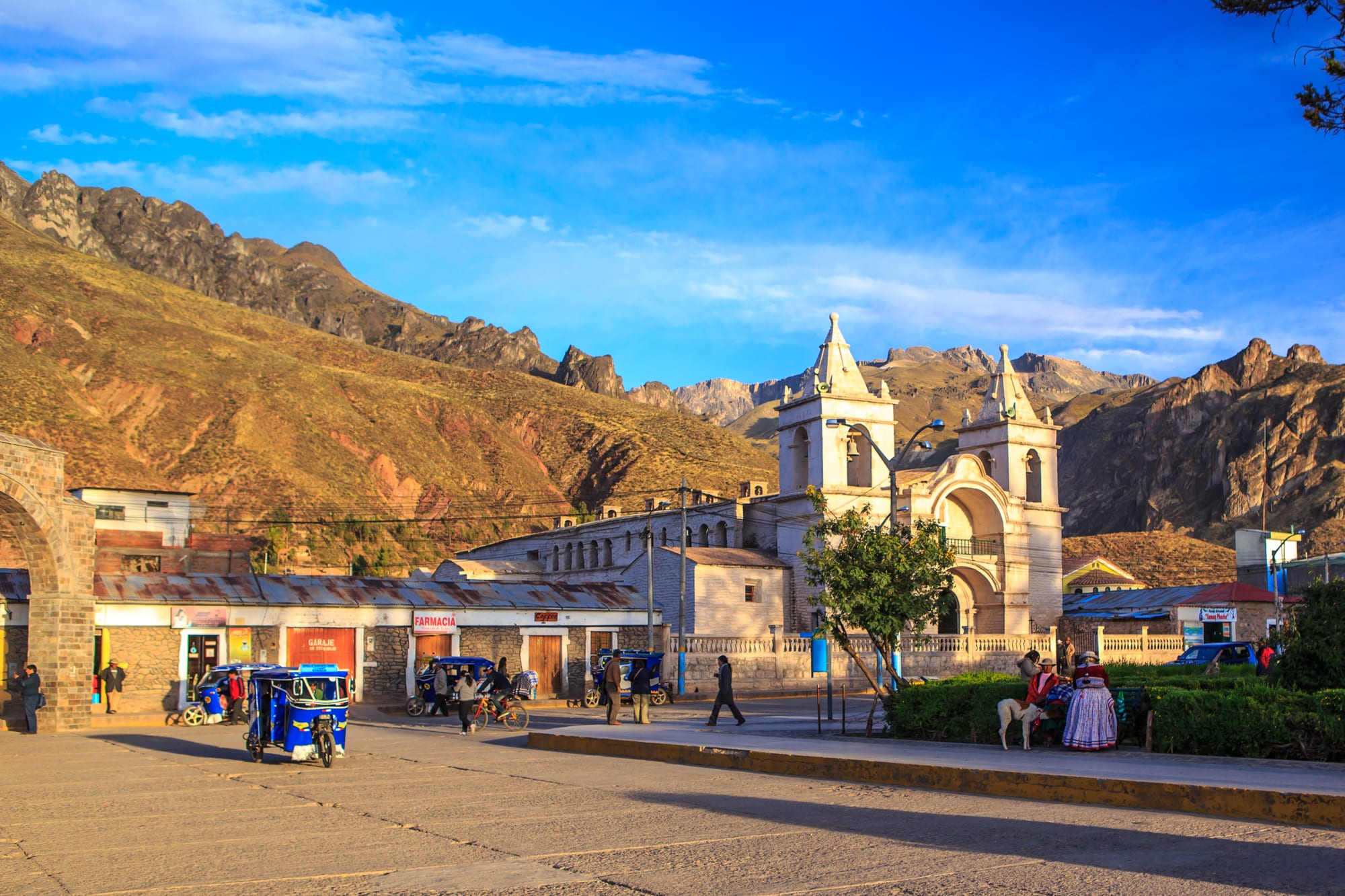
A wide square in Chivay with motor taxis and a white twin-towered church below dry, rocky mountains in evening light

Arequipa, Colca & the South, Peru

Chivay

The main square and church of Chivay, below the mountains of the Colca valley. (Murray Foubister / Wikimedia Commons · CC BY-SA 2.0)

The capital of Caylloma province, at about 3,600 metres in the Colca valley of southern Peru, upstream of the Colca Canyon. Founded as a Spanish reduction town in the 16th century among pre-Inca farming terraces, it became the hub of the valley once roads and tourism arrived, and is now the market town and base for visits to the canyon and its condors.

Neighbourhoods

  • Town centre
    • First-time visitors
    • Close to public transport
    • Markets

    The old reduction-town grid around the Plaza de Armas, with the church on one side and the market a short walk away. Buses from Arequipa arrive here, colectivos to the hot springs leave from the square, and most of the town's hotels, hostels and restaurants are within a few blocks.

    Open in Maps
  • Yanque and the valley villages
    • Quiet and residential
    • Terraces and countryside

    Villages a short drive down the valley along the road to Cabanaconde, among the terraced fields that run for many kilometres below Chivay. Yanque has a plaza, a colonial church and a small museum, and several country lodges stand along the river.

    Open in Maps

Things to do

In the town

  • Plaza de Armas and the churchlandmark

    The central square laid out in the Spanish period, faced by the town's main church, with the town hall opposite.

    Open in Maps
  • Chivay marketmarket

    The town's active market, selling the valley's produce; Chivay is also the place to find the hand-knitted alpaca goods and machine-embroidered hats, belts and purses for which the Colca is known.

    Open in Maps
  • La Calera hot springsattraction

    Natural thermal springs about 3 km from the town, where heated pools have been built beside the river.

    Open in Maps
  • The Inca bridgelandmark

    A stone bridge, known locally as the Inca bridge, crossing the ravine of the Colca River just north of the town.

    Open in Maps

The Colca valley

  • Yanqueneighborhood

    A village down the valley with a small museum by its plaza, run by the Catholic University of Santa María, on the valley's history and culture.

    Open in Maps
  • Uyu Uyulandmark

    An archaeological site on the right bank of the Colca River in Yanque District, whose Aymara name means ‘a complex of yards’.

    Open in Maps

Short trips from the town

  • Colca Canyonviewpoint

    One of the deepest canyons in the world, about 3,270 metres deep, lined with pre-Inca terraces and colonial villages.

    Open in Maps
  • Cruz del Cóndorviewpoint

    The viewpoint on the canyon where Andean condors can be seen riding the morning thermals past the canyon walls, the most popular spot for viewing them.

    Open in Maps
  • Cabanacondeneighborhood

    The village at the end of the bus route down the valley, about 56 km from Chivay, and the starting point for treks down to the Sangalle oasis.

    Open in Maps

Eat and drink

Long-standing places and food districts in Chivay. Hours, ratings and directions come from your maps app, always current.

Food in Chivay

  • Chivay marketmarket

    The town market, with local potatoes, maize, quinoa, broad beans and cheese, and simple cooked meals at its stalls.

    Open in Maps
  • Restaurants around the Plaza de Armasneighborhood

    Most of the town's restaurants are within a few blocks of the square, many serving set lunch menus.

    Open in Maps

Experience Chivay

History

The Colca valley was first used by hunters and gatherers some 6,000 years ago, but settled farming came about a thousand years ago with two peoples: the Cabanas, Quechua speakers descended from the Wari culture, and the Collaguas, Aymara speakers from the Lake Titicaca region. They built the vast terraces and irrigation channels that still cover the slopes, and stone and mud granaries called qolqas, which give the valley its name. In the 14th century the Inca brought the valley into their empire, largely through intermarriage, and improved its terraces and canals.

Chivay itself is a Spanish creation. Under the reforms of the Viceroy Francisco de Toledo, the scattered population of the valley was concentrated into a few reduction towns, where people could be evangelised in the Catholic faith, and Chivay was laid out on a Spanish grid with its main church facing the town council across the square. Most of the valley's churches were built between the 16th and 19th centuries.

For centuries the valley was isolated: no passable road linked Arequipa and Chivay until the 1940s, when one was built to serve the silver and copper mines. In the 1980s the Majes project, a 100 km canal taking water from the Colca to irrigate the desert, brought hundreds of workers. In 1981 a Polish rafting expedition made the first descent of the canyon and suggested it might be the deepest in the world, and the publicity that followed turned Chivay into the base for a new tourist trade.

Culture & Customs

Chivay is the capital of Caylloma province and the cultural centre of the valley's communities, who keep traditions inherited from the Collaguas and Cabanas. The best known is the Wititi, a courtship dance of the valley; the Wititi festival in Chivay has been named part of Peru's cultural heritage, and the dance is recognised by UNESCO as intangible heritage.

Dress is a marker of identity. Women wear polleras, full skirts covered in dense, colourful machine embroidery, and decorated hats. The same embroidery adorns vests, belts and purses, and goods knitted from baby alpaca fibre are the other famous craft of the valley; both are sold in the town.

Catholic life and Andean custom are intertwined, as across the southern highlands, and the church on the plaza is the centre of the town's religious life. The valley's way of life is closely tied to the land, and visitors are expected to treat fields, terraces and irrigation channels with care.

Daily Life

Chivay sits at about 3,600 metres at the midpoint of the Colca valley, where the farming country below meets the herding country above. Above the town, agriculture gives way to raising alpacas and llamas, with some sheep and dairy cattle; below it, the terraced fields grow maize, quinoa, barley, broad beans and many varieties of potato.

As provincial capital, Chivay has the valley's offices, schools and market, and people come in from the surrounding villages to trade, shop and catch buses to Arequipa. Tourism has become a second pillar of the economy since a boom that began in the early 1990s, filling the town with hostels, restaurants and craft stalls, and most visitors to the Colca pass through.

Days start early and end early. Mornings are bright and cold, the strong sun warms the square by midday, and once the sun goes behind the mountains the temperature drops fast; in the dry-season months the nights fall below freezing. Water from the river and the irrigation channels decides what can be grown, and the shared work of maintaining the canals remains part of community life.

Food

Chivay eats what the valley produces. Potatoes in many varieties, maize, quinoa, broad beans and barley come from the terraces, and the herds of the high country supply meat and fibre from alpacas and llamas. Cheese and dairy come from the cattle above the town.

Chivay lies in the Arequipa region, whose cooking includes rocoto relleno, the stuffed hot pepper baked under cheese, and hearty soups, and the town has plenty of simple restaurants around the plaza. Quinoa turns up in soups, and coca tea is drunk throughout the day, not least by visitors adjusting to the altitude.

The market is the best place to see the valley's produce, from sacks of dried maize and potatoes to fresh cheese, and to eat a cheap cooked meal among local shoppers. Its stalls are also where the valley's dried maize and potatoes are traded, alongside fresh produce brought down from the terraces and up from the herding villages above the town.

Planning tools

Budget

Chivay is inexpensive, with plenty of cheap hostels and simple restaurants, and most visitors come on low-cost group tours from Arequipa. Every visitor must buy the Boleto Turístico, the tourist ticket for the Colca circuit, which covers the viewpoints, the canyon and the villages. Country lodges along the river and private tours cost considerably more.

Daily Budget Midrange
USD 75–160 (comfortable hotel or country lodge, restaurant meals, a private tour or driver)
Daily Budget Shoestring
USD 25–50 (hostel bed, market and menú meals, local buses and colectivos, the hot springs)

Carry the tourist ticket at all times in the valley, as it is checked at the viewpoints and on the road.

Best Time to Visit

The dry season from May to November brings clear skies, sunny days and cold, often freezing nights; condors can be seen at the Cruz del Cóndor on most days throughout the year. The wet season, from December to March, brings most of the year's rain but milder nights, and the valley is at its greenest in April and May, when the fields are green and the mountains snow-capped.

Suggested Number of Days

Most visitors stay one or two nights, usually on a tour from Arequipa. Three or four days allow a slower look at the valley villages or a trek into the canyon; arriving straight from sea level, the altitude makes a slower pace sensible.

First Visit
1–2 days
With Surroundings
3–4 days

Transportation

The town is small enough to walk. Colectivos to the hot springs leave from the main square when full, and taxis and trucks can be hired. Public buses run the length of the valley to Cabanaconde about every hour and a half, stopping at the villages on the way, and the journey takes two to two and a half hours.

Carry warm layers and water on any trip down the valley, as conditions change quickly with altitude and time of day.

Airport & Station Connections

There is no airport or railway; the nearest airport is at Arequipa. Buses run frequently from Arequipa's Terminal Terrestre and take about three and a half to four hours on a road that crosses the high plateau and a pass at about 4,800 metres, where altitude and cold need care. Most visitors arrive on a group or private tour from Arequipa.

Walkability

The centre is compact and easy on foot, and the hot springs and the bridge are within walking distance. At about 3,600 metres even a gentle walk is tiring in the first days, the sun is strong and evenings turn cold quickly.

Safety

The standard tourist circuit — Lima's Miraflores and Barranco, Cusco, the Sacred Valley, Arequipa, Puno — is generally safe with urban precautions, but crime has risen. Chivay itself is a small, quiet town, and the main risks are altitude, cold, the strong sun and steep trails in the canyon. The volcano Sabancaya, not far from the valley, has been active in recent decades.

Spend a few days in Arequipa before coming up to adjust to the altitude, drink plenty of water, and carry warm clothes for the nights. Check current official travel advice before travelling.

Climate

A highland climate with mild days and cold nights. Average daytime highs are close to 20°C in every month; the difference is at night, when the dry season brings average lows below freezing from May to August. About 450 mm of rain falls a year, most of it from December to March.

Summer
December–February is the wet season, with most of the year's rain, days close to 20°C and nights averaging above 4°C
Winter
June–August is dry and sunny, with days close to 20°C and average lows below freezing

Local Customs

The people of the valley descend from the Collagua and Cabana peoples and keep their own dress, including richly embroidered skirts and hats. The Wititi courtship dance of the valley is recognised as cultural heritage. Coca tea is widely drunk and is offered for the altitude.

Ask before photographing people in traditional dress, and dress modestly in the churches.

Common Payment Methods

The currency is the sol (PEN). Carry cash: cards are accepted only in some hotels and larger restaurants, and markets, buses, colectivos and the hot springs expect soles. Bring enough cash from Arequipa, where ATMs are common.