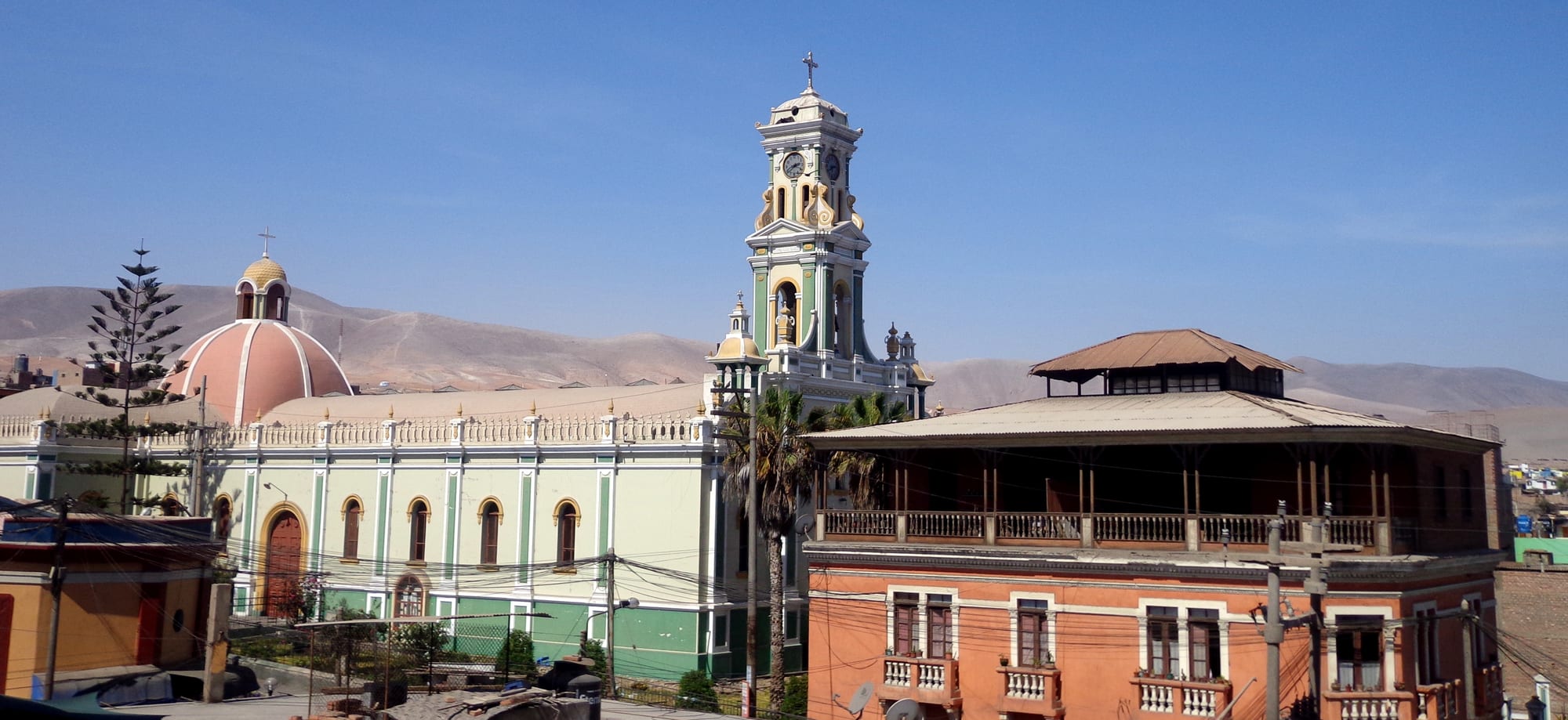
A pale green church with a domed roof and tall clock tower beside an old house with a wooden upper gallery, below bare desert hills

Arequipa, Colca & the South, Peru

Mollendo

The old quarter of Mollendo, with its church and an old house with a wooden gallery. (Leoncit / Wikimedia Commons · CC0)

A Pacific port town in southern Peru, capital of Islay province in the Arequipa region. It grew as the terminus of the Southern Railway from 1871 and was the main port of the south until Matarani took over its shipping in the mid-20th century. Today it is Arequipa's summer seaside resort, with long beaches, old wooden houses and the Mejía lagoons nearby.

Neighbourhoods

  • Town centre
    • First-time visitors
    • Beaches
    • Historic district

    The old core above the sea, with the Plaza de Armas, the cathedral, the markets, the banks and the obelisk, and the first and second beaches just below. Many of the late 19th-century wooden houses stand here, and most hotels and restaurants are within walking distance.

    Open in Maps
  • Zona Norte
    • Quiet and residential
    • Close to public transport

    The northern districts of Villa Lourdes and La Florida, where the bus terminal is. Catarindo, a narrow cove of calm water, lies just beyond.

    Open in Maps
  • Mejía
    • Beaches
    • Summer holidays

    A separate district along the coast to the south-east, a popular summer destination for holidaymakers from Arequipa, with its own beaches and the bird sanctuary of the Mejía lagoons beyond.

    Open in Maps

Things to do

Beaches

  • Playa Unobeach

    The first beach, closest to the town, with fine grey sand, moderate waves, a water park and a beach club with a pool, one of the busiest in summer.

    Open in Maps
  • Playa Dosbeach

    The second beach, below the Castillo Forga, with seafood restaurants and open-air weekend concerts known as 'Playazos Musicales'.

    Open in Maps
  • Playa Tresbeach

    A beach of about a kilometre at the southern end of town, where in summer the bathers' tents and awnings stand in colourful rows.

    Open in Maps
  • Catarindobeach

    A narrow cove of calm water about 2 km north of the town, busy in summer and popular for fishing.

    Open in Maps

Landmarks and museums

  • Castillo Forgalandmark

    A yellow castle-like house on a rock above the second beach, built between 1908 and 1910 for the Arequipa merchant José Miguel Forga in a mix of neo-Gothic and other styles, and a national historic monument.

    Open in Maps
  • Museo Municipalmuseum

    The museum created by the provincial municipality to study the Chiribaya culture, which once lived along this coast.

    Open in Maps

Short trips from the town

  • Lagunas de Mejía National Sanctuarypark

    Lagoons, marshes and the mouth of the Tambo River protected as a bird sanctuary, a Ramsar site since 1992 and a rare wetland stop on this desert coast for migratory birds from North America.

    Open in Maps
  • Mejíaneighborhood

    The neighbouring beach district, a summer resort for families from Arequipa.

    Open in Maps
  • Mataranitransit hub

    The port about 12 km north of the town, now the main port of southern Peru, which took over Mollendo's commercial shipping in the mid-20th century.

    Open in Maps

Eat and drink

Long-standing places and food districts in Mollendo. Hours, ratings and directions come from your maps app, always current.

Mollendo classics

  • Seafood restaurants at Playa Dosneighborhood

    Restaurants by the second beach serving Peruvian dishes made with seafood from the local coast.

    Open in Maps
  • Mollendo marketmarket

    The town-centre markets, where fish and shellfish from the local catch are sold alongside produce from the Tambo valley.

    Open in Maps

Experience Mollendo

History

Long before the port, this stretch of coast was home to fishing and farming peoples. The Chiribaya culture lived here and along the coast to the south, and later groups known as the Changos occupied the shore between Aranta and Islay. Names ending in -endo and -indo, such as Mollendo, Catarindo and Cachendo, are thought to come from the Puquina and Kauiqui languages.

In the early republic the main port of the area was Islay, a short way up the coast. In 1860 Congress authorised a railway from Islay to Arequipa, but the American contractor Henry Meiggs and his engineers chose Mollendo instead, and the opening of the Southern Railway on 6 January 1871 is taken as the town's founding date. From about 1830 to 1880 the coast was a key port for the guano trade. During the War of the Pacific, in March 1880, a Chilean expedition landed, the customs house was looted and the town was sacked and burned.

Mollendo recovered as the second port of the republic. Merchants of many nationalities settled, and in the late 19th century families built large houses of Oregon pine brought from the United States; the railway station was built in the same style. By the 1930s the town had only about 7,500 inhabitants but a prosperous trade, including tourists from transatlantic liners. The development of the new port of Matarani from the 1940s took away the commercial shipping, and the old port fell into ruin.

Culture & Customs

Mollendo's identity is that of a port town turned holiday resort. For generations Arequipa families have spent their summers here, and from December to April the beaches fill with tents and umbrellas, weekend concerts are held by the second beach, and visitors arrive from across the south. The rest of the year the town returns to a slower rhythm.

The port years left a cosmopolitan streak: merchants and workers of several nationalities settled here and brought their customs, and the timber houses and railway buildings of the late 19th century are still part of the townscape. The Castillo Forga, built for an Arequipa merchant family whose summer train is said to have stopped right in front of it, is a national historic monument.

Catholic life centres on the cathedral and on local traditions such as the iron cross on the highest point of the town, raised on 1 January 1900 to welcome the new century. The villages of the Tambo valley hold patron saints' festivals, and the Mejía lagoons, with their migratory birds, are a point of local pride.

Daily Life

Mollendo had about 22,400 inhabitants in 2015, making it the third town in population in the Arequipa region. It is the capital of Islay province, with the provincial offices, schools and services, and the town is divided between the old centre above the first and second beaches and residential districts to the north and south.

The economy rests on commerce, agriculture, fishing and tourism. The port of Matarani, a short way north, is the main port of southern Peru, and part of the province's catch goes to the fish-canning industry. Artisanal fishermen land fish and shellfish sold in the town and in Arequipa. The irrigated Tambo valley grows rice, potatoes, garlic, sweet potatoes, onions, maize, olives and sugar cane, with cattle raising in Mejía, Deán Valdivia and Punta de Bombón.

Water and mining are the big local questions. The Tía María copper project in the Tambo valley has faced repeated, sometimes deadly, protests from farmers who fear for their water. In summer the town's life turns towards the beach, and weekends are busy with visitors from Arequipa; in winter, fog rolls in off the cold sea.

Food

Mollendo's cooking is built on the sea, and its seafood dishes are among the favourites of the Arequipa region. Ceviche de muy muy, made with a small sand crustacean of the beaches, is a local speciality, and torrejitas de pejerrey are fritters of silverside, a small coastal fish. The local catch also includes cojinova, bonito, lorna and sole, served as ceviche, fried or in stews in the restaurants near the beaches.

The Tambo valley supplies rice, potatoes, garlic, onions, olives and sweet potatoes, and the coastal rivers supply the freshwater prawns of Arequipa's chupe de camarones, the rich prawn soup of the region's picanterías. Visitors from Arequipa bring their own food culture with them, so rocoto relleno and other Arequipa dishes are easy to find in summer.

The markets in the town centre are the place to see the morning's catch and the valley's produce side by side, and the restaurants by the second beach serve the classic coastal dishes through the summer season.

Planning tools

Budget

Mollendo is inexpensive outside the summer season. From December to April, and above all at weekends, visitors from Arequipa and the south fill the town and rooms cost more; out of season the town is quiet and cheap.

Daily Budget Midrange
USD 75–150 (comfortable hotel, seafood restaurants, taxis, a trip to the Mejía lagoons)
Daily Budget Shoestring
USD 25–50 (simple guesthouse, market and menú meals, local buses)

Visit midweek in summer, or in spring and autumn, to avoid the weekend crowds from Arequipa.

Best Time to Visit

Summer, from December to April, is the beach season, with clear skies and strong sun, when the town is at its busiest. In winter the coast is often grey, with fog and drizzle, and the town is quiet. The cold Humboldt Current keeps the sea cool even in summer.

Suggested Number of Days

One or two days are enough for the town and its beaches. Two or three allow time for the lagoons and the neighbouring coast as well; many Arequipa families come for a weekend or a longer summer stay.

First Visit
1–2 days
With Surroundings
2–3 days

Transportation

The town is small and walkable, and the main beaches are close to the centre. Taxis and local buses link it with Mejía and the coast to the south-east, and with Matarani to the north.

Agree taxi fares before setting off, as cars are not metered.

Airport & Station Connections

Most people arrive by road from Arequipa, the nearest city with a major airport, on a highway linked to the Pan-American Highway; buses arrive at the terminal in the north of town. The town is the starting point of the Southern Railway to Arequipa, Cusco and Puno, which once carried passengers, and has a small civilian airport.

Walkability

The centre is compact, and the first and second beaches are reached on foot down from the town. Streets climb from the shore, so walks back up from the beach are steep in places.

Safety

The standard tourist circuit — Lima's Miraflores and Barranco, Cusco, the Sacred Valley, Arequipa, Puno — is generally safe with urban precautions, but crime has risen. Mollendo is a small, quiet town, with petty theft on crowded summer beaches the main risk. Mining protests have occasionally closed roads in Islay province, and the coast is highly seismic.

Watch belongings on the beach, swim only where others do and heed lifeguards where present, and check for road closures before travelling. Check current official travel advice before travelling.

Climate

A dry coastal desert climate tempered by the cold Humboldt Current, with mean annual temperatures of about 17–18°C across Islay province. Summer is clear and sunny; winter brings fog and drizzle.

Summer
December–February is clear and sunny with strong sun, the warmest part of the year; the province's annual mean is about 17–18°C
Winter
June–August is grey, with fog and drizzle, and cooler than the rest of the year; the province's annual mean is about 17–18°C

Local Customs

Mollendo is above all Arequipa's beach, and in summer it fills with families from the city; out of season it is a quiet provincial town of fishermen, farmers and port workers. Beachwear belongs on the beach, and modest dress is expected in town and in the cathedral.

Ask before photographing fishermen and market vendors, and leave the beaches as clean as they were found.

Common Payment Methods

The currency is the sol (PEN). Cards are accepted in some hotels and restaurants, but cash is needed for markets, beach stalls, buses and taxis. There are banks with ATMs in the centre, which charge fees.