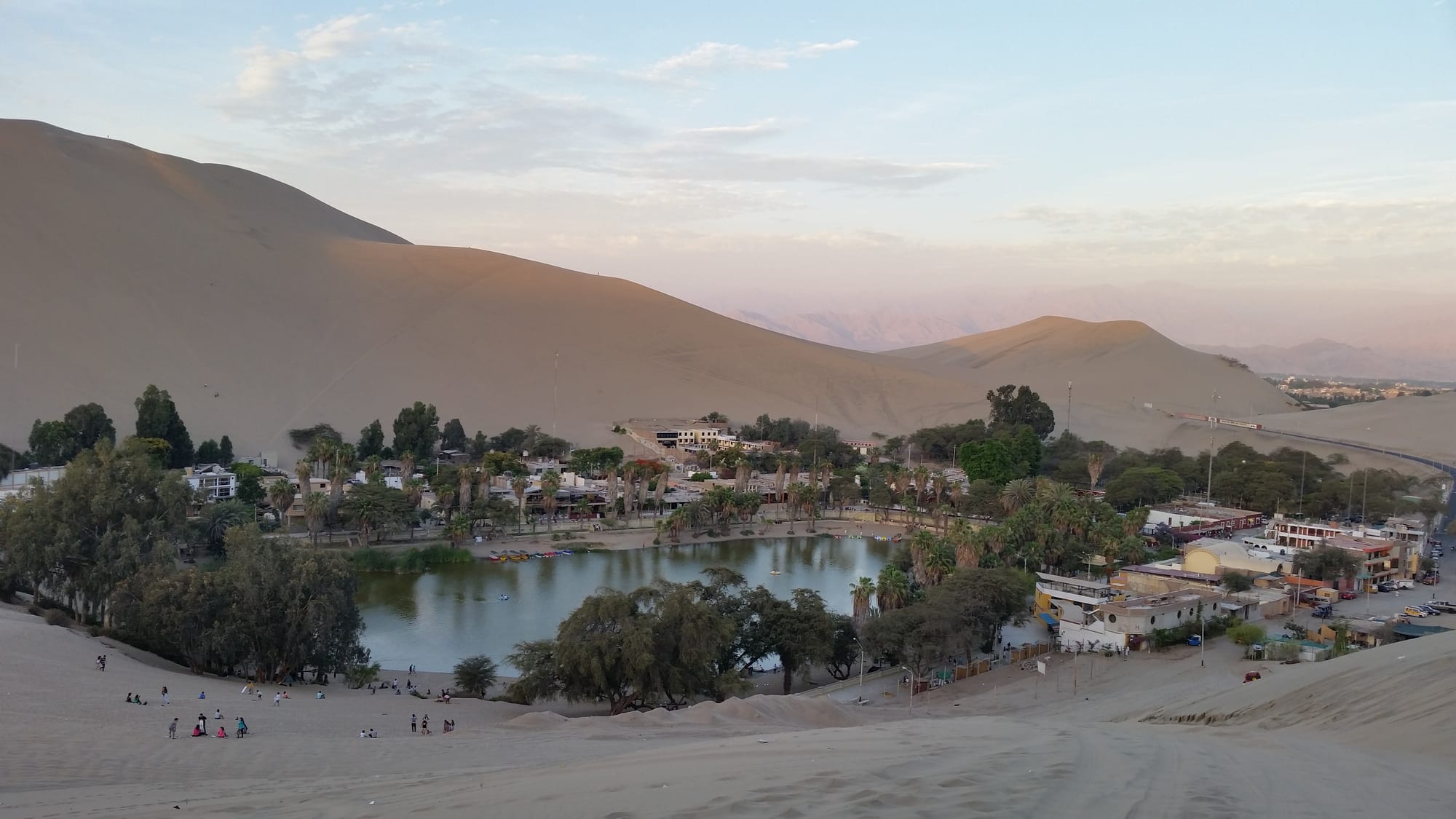
A small green lagoon edged by palms and low buildings, seen from a sand dune, with larger dunes rising behind in evening light

Lima & the Central Coast, Peru

Huacachina

The lagoon and village of Huacachina from the surrounding dunes. (Heiner Amado Cadillo / Wikimedia Commons · CC BY-SA 3.0)

A village built around a small natural lagoon in the desert about five kilometres from the city of Ica, on Peru's southern coast. Ringed by palms and by sand dunes up to 500 metres high, the oasis has been a resort for Ica families for decades and now draws travellers for sandboarding and dune-buggy rides; about 100 people live here permanently.

Neighbourhoods

  • The lagoon
    • First-time visitors
    • Best for food
    • Nightlife

    The village itself is a ring of hotels, hostels, restaurants and shops around the lagoon, with a promenade under the palms. Paddle boats and rowing boats are hired at the water's edge, and buggy tours start from the hotels.

    Open in Maps
  • The dunes
    • Adventure
    • Viewpoints

    Giant sand dunes rise directly behind the village on every side. A climb to the rim takes up to an hour, depending on fitness and the dune chosen, and gives views over the lagoon and the rolling desert, especially at sunset.

    Open in Maps
  • Ica
    • Local life
    • Museums
    • Close to public transport

    The regional capital, about five kilometres away, a city of about 280,000 people with the bus terminals, banks, markets and the regional museum, and the pisco bodegas in the surrounding valley.

    Open in Maps

Things to do

The oasis and the dunes

  • Huacachina lagoonpark

    The small natural desert lake at the heart of the village, called the oasis of America, where paddle boats and rowing boats can be hired; it appeared on the back of the 50-sol note in 1991.

    Open in Maps
  • Sandboardingattraction

    Riding boards down the dunes, the desert's answer to snowboarding; most non-athletic visitors end up riding the board like a sled, lying face-down, which makes for a very rapid, sometimes dangerous, descent.

    Open in Maps
  • Dune buggy ridesattraction

    Rides in four-wheel-drive buggies, known locally as areneros, that run up and down the dunes at high speed; most tours last about two hours and include sandboarding on the steeper slopes.

    Open in Maps
  • Sunset from the dunesviewpoint

    The walk up to the rim of the dunes for the view over the lagoon, the village and the desert, particularly beautiful at sunset; a tourist fee is charged for climbing the dunes.

    Open in Maps

Short trips to Ica

  • Icaattraction

    The regional capital, founded by the Spanish in 1563 as Villa de Valverde and badly damaged in the 2007 earthquake, the traditional home of pisco brandy.

    Open in Maps
  • Regional Museum of Icamuseum

    An archaeological museum in Ica with exhibits from prehistoric times to the colonial era, including Paracas and Nazca material and skulls showing evidence of trepanning.

    Open in Maps
  • Pisco bodegasattraction

    The bodegas around Ica, from small family-run artisanal producers to large industrial wineries, which make pisco and sweet red wine and offer tours and tastings.

    Open in Maps
  • Cachicheattraction

    A community about four kilometres from Ica known for its traditions of witchcraft.

    Open in Maps

Eat and drink

Long-standing places and food districts in Huacachina. Hours, ratings and directions come from your maps app, always current.

Huacachina and Ica classics

  • Restaurants around the lagoonneighborhood

    Cafés, restaurants and bars around the lagoon serve travellers and the Ica families who come out to the oasis at weekends.

    Open in Maps
  • Ica's bodegasneighborhood

    Producers of pisco and sweet wine in the valley around Ica, some of them small family-run artisanal bodegas.

    Open in Maps
  • Local jams and liqueursmarket

    Stalls and shops sell jams made from local fruit such as mango, fig and soursop, along with Ica's pisco and wine.

    Open in Maps

Experience Huacachina

History

The lagoon formed by natural seepage from underground aquifers, a rare pool of water among the dunes of one of the driest deserts on earth. Its name comes from the Quechua wakachina, meaning to guard or conceal, possibly short for "hidden lagoon". Legend says the lagoon was made by a native princess who fled when a hunter surprised her bathing; the pool, or her mirror, became the lake, the folds of her mantle became the dunes, and she is said to live on in the water as a mermaid.

The nearby city of Ica was founded by the Spanish on 17 June 1563 as Villa de Valverde, in a valley long inhabited by earlier cultures, and became the traditional heart of pisco production. Huacachina became a resort for Ica families, and in the 1960s it was a popular summer resort for tourists from around the world. The oasis was honoured on the back of the 50-sol note in 1991.

From the early 2000s the increase in well-drilling in the Ica valley began to threaten the aquifers that feed the lagoon. In 2015 local business groups began pumping water into the lake to preserve it. A restoration project led by the Peruvian scientist Marino Morikawa was announced in 2016. The 2007 earthquake caused extensive damage and loss of life in Ica.

Culture & Customs

Huacachina's culture is a meeting of two worlds. For decades it has been a favourite family destination for the people of Ica, who come to the lagoon to walk, row and bathe; according to local legend the water and mud are therapeutic, and some still cover themselves in the mud hoping to ease arthritis, rheumatism or asthma. It is increasingly an attraction for travellers from further afield too, drawn by the dunes, with hostels, bars and tour desks around the water.

The dunes give the place its identity. Sandboarding and rides in the areneros, the local dune buggies, are the reasons most visitors come, and many visitors climb to the rim of the dunes to watch the sunset over the desert.

Ica's wider culture surrounds the village: the pisco bodegas of the valley, the regional museum's collection of Paracas and Nazca artefacts, and the community of Cachiche, known for its traditions of witchcraft. The legend of the mermaid of the lagoon, said to take one man each year, is told to every visitor.

Daily Life

Only about 100 people live in Huacachina permanently, outnumbered by the tourists who stay each year. Daily life revolves around hospitality: hostels and hotels, restaurants, buggy drivers and the shops selling jams and liqueurs. The resort is geared to local families from Ica as well as to foreign travellers, and the lagoon promenade is where both meet. Paddle boats and rowing boats on the water, dune tours leaving in the afternoon and the crowd on the dunes at sunset set the rhythm of the day.

Most residents' links are with Ica, a city of over 280,000 people at the 2017 census, a few kilometres away, where the schools, hospitals, banks and markets are. The Ica valley grows cotton, grapes, asparagus, avocados, mangoes and olives, and pisco and wine production are long-standing industries.

The future of the lagoon is the village's central concern. The water that once seeped naturally from the aquifers is now topped up by pumping, as farms and wells draw down the water table in one of the driest places on earth.

Food

The food of Huacachina is the food of Ica and the south coast. Restaurants around the lagoon serve travellers and visiting families, and Ica itself has the markets and local restaurants where the valley's produce is cooked.

Ica is the heart of pisco country. The clear grape brandy is distilled in the bodegas of the valley, from small family-run artisanal producers to large industrial wineries that supply the whole country and export abroad, and many of them also make sweet red wine. The pisco sour is the classic drink.

The valley's fruit turns up in jams sold around the lagoon — mango, fig and guanábana, or soursop — together with liqueurs. Ica's traditional sweets are tejas, filled with manjar blanco, a milk caramel, and coated in fondant, or in chocolate as chocotejas.

The wider south coast supplies the rest of the menu: seafood from the Pacific, cured in lime as ceviche, and the criollo dishes of the coast, such as causa, chilled layers of seasoned yellow potato, and ají de gallina, chicken in a creamy yellow-chilli sauce. Purple-corn chicha morada and Inca Kola are the everyday soft drinks.

Planning tools

Budget

Huacachina is a backpacker favourite, with hostels and hotels for most budgets, though prices are higher than in Ica. The buggy and sandboarding tour is the main cost; a tourist fee is charged for the lagoon and for walking up the dunes, and bodega tours from Ica add more.

Daily Budget Midrange
USD 90–180 (hotel by the lagoon, restaurant meals, buggy tour and a bodega visit)
Daily Budget Shoestring
USD 35–55 (hostel bed, simple meals, a buggy and sandboarding tour)

Check how many slopes of sandboarding a buggy tour includes before booking, and compare a few operators.

Best Time to Visit

The desert around Ica is sunny and dry nearly all year, with only around a centimetre of rain annually. Summer, from December to March, is hot; winter, from June to September, is warm by day with cooler nights. The late afternoon is the favourite time on the dunes, when the light is softer.

Suggested Number of Days

A night or two is enough for most visitors, and up to three nights for those who want more time in the surrounding valley. Many travellers combine the oasis with other stops along the south coast.

First Visit
1–2 days
With Surroundings
2–3 days

Transportation

The village is tiny and walkable. Taxis link Huacachina with Ica, a few kilometres away, and within Ica moto-taxis are a cheap way to reach places too far to walk. The dunes are explored on foot or in the tour buggies.

Use registered licensed taxis in Ica, with an official roof sign and the driver's documents on the dashboard.

Airport & Station Connections

Coaches run from Lima down the Pan-American Highway to Ica in about five hours, and buses also link Ica with Nazca and the south. From Ica a local taxi covers the five kilometres to the oasis. The nearest major international airport is Lima's.

Walkability

The whole village can be walked round in a few minutes. Climbing the dunes on foot is hard work in loose sand, and the windswept rim calls for water, sun protection and something to shield eyes and cameras from the sand.

Safety

The standard tourist circuit — Lima's Miraflores and Barranco, Cusco, the Sacred Valley, Arequipa, Puno — is generally safe with urban precautions, but crime has risen. Buggies run up and down the dunes at break-neck speed, and sandboarding face-down gives a very rapid, sometimes dangerous, descent. Drownings in the lagoon have been reported over the years.

Choose an established buggy operator, and take care swimming in the lagoon. Check current official travel advice before travelling.

Climate

One of the driest climates in the world, on the edge of the Atacama Desert, with around a centimetre of rain a year. In the city of Ica the mean temperature is about 27°C in summer and 18°C in winter.

Summer
December–March, hot; in Ica the summer mean is about 27°C and highs usually pass 30°C
Winter
June–September, warm; in Ica the winter mean is about 18°C and the minimum rarely falls below 8°C

Local Customs

The oasis is a family resort for people from Ica as well as a traveller hangout, and some locals bathe in the water or cover themselves in its mud, believed in local legend to be therapeutic. The lagoon's legend of a princess who still lives there as a mermaid is part of local lore.

Tipping is not practised in taxis. Keep noise down late at night in a village where people live beside the hostels.

Common Payment Methods

The currency is the sol (PEN). Hotels and tour operators in the village may take cards, but cash is needed for tourist fees, boat hire, small shops and taxis. The village has very few ATMs; Ica has a number of ATMs and money-changers.