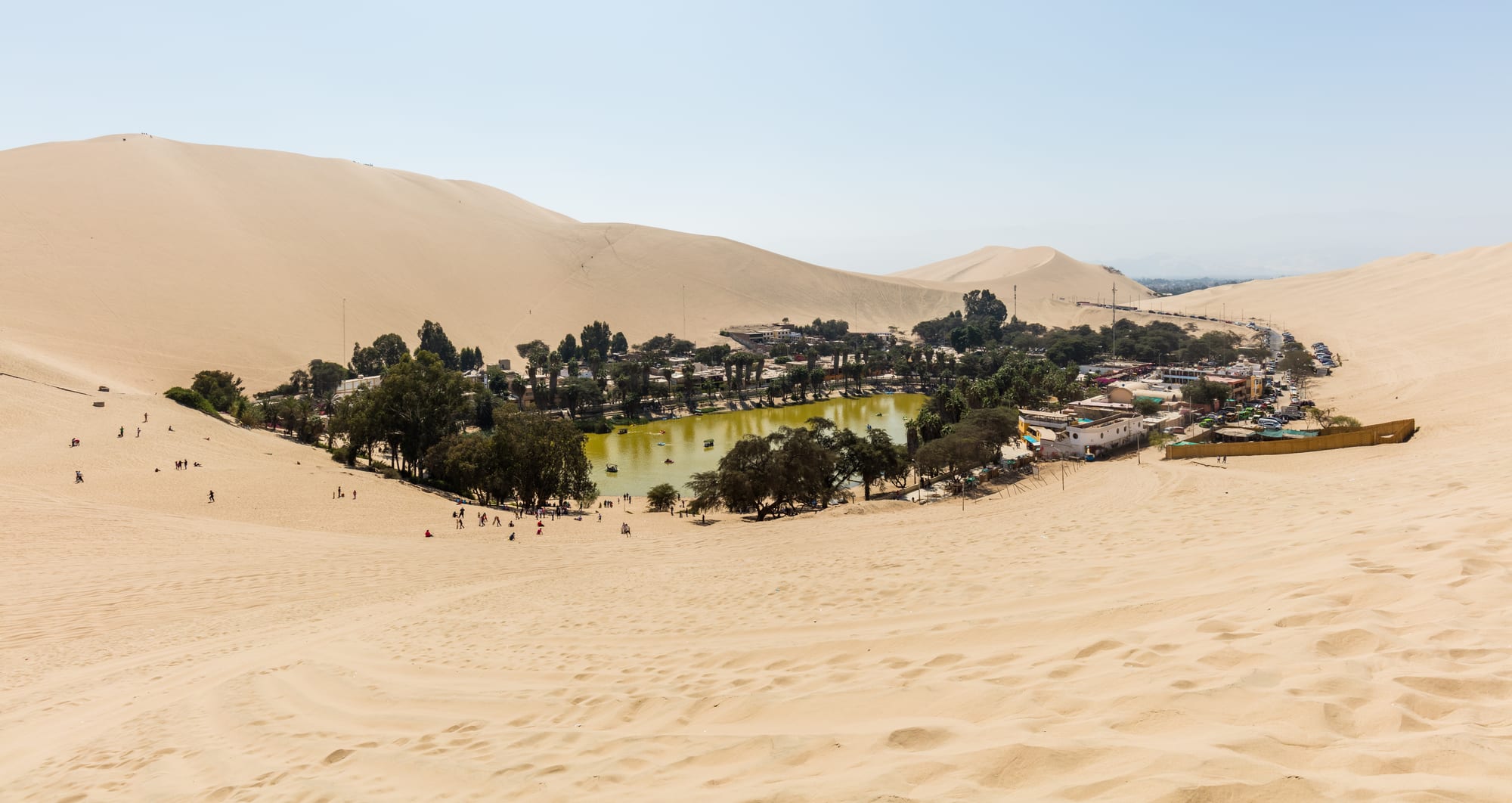
A small green lagoon ringed by trees and low buildings, surrounded by huge pale sand dunes under a hazy blue sky

Peru

Lima & the Central Coast

The oasis of Huacachina among the sand dunes outside Ica, on Peru's southern desert coast. (Diego Delso / Wikimedia Commons · CC BY-SA 4.0)

The desert coast of central Peru, from the capital Lima and its port of Callao south through Ica's vineyards, dunes and the Nazca lines, and north-east into the high Andes of Ancash — a region that holds much of the country's population, some of the Americas' oldest cities and Peru's highest mountain.

Explore Lima & the Central Coast

History

This stretch of coast holds some of the oldest urban history in the Americas. Caral, in the Supe valley north of Lima, was a city of platform pyramids nearly 5,000 years ago, and in the Ancash highlands the temple of Chavín de Huántar became, from about 900 BC, the centre of a religious culture whose style spread across the Andes. In the south, the Paracas people buried their dead wrapped in some of the finest ancient textiles known, and their successors the Nazca scratched giant lines and animal figures into the desert between about 500 BC and AD 500. On Lima's own site the Lima culture built adobe temples such as Huaca Pucllana, and the oracle of Pachacamac drew pilgrims for centuries before the Inca absorbed it.

Francisco Pizarro founded Lima in 1535 as the City of the Kings, and it became the capital of the Viceroyalty of Peru and the seat of Spanish power in South America, with Callao as its fortified port. The earthquake and tsunami of 1746 destroyed Callao and much of Lima. José de San Martín declared independence in Lima in 1821, and during the War of the Pacific Chilean forces occupied the capital from 1881 to 1883.

The 20th century brought mass migration from the Andes that turned Lima into a city of millions. In 1970 an earthquake set off an avalanche from Huascarán that buried the town of Yungay. During the Shining Path conflict the capital suffered car bombs, including the Tarata Street attack in Miraflores in 1992, the year the group's leader Abimael Guzmán was captured in Lima. In 2007 an earthquake devastated Pisco and much of Ica.

Culture & Customs

Lima is where Peru's mixture is most visible: criollo Spanish-descended traditions, Andean migrants and their children, Afro-Peruvian communities, and the Chinese and Japanese families whose cooking reshaped the national table. The city's great religious event is the Señor de los Milagros each October, when hundreds of thousands of people in purple follow a painting of Christ, first painted on a wall by an Angolan slave in the 17th century, through the streets. Criollo waltzes, the música criolla of the peñas, and the marinera are still danced at Barranco's clubs.

South of the capital, Chincha and the village of El Carmen are the heartland of Afro-Peruvian music and dance, from the festejo to the zapateo, with the cajón, the box drum now recognised as national heritage, at its core. Ica celebrates its grape harvest with the Festival de la Vendimia.

In Ancash, Quechua remains widely spoken in the villages of the Callejón de Huaylas, and communities keep patron-saint festivals with dancers in masks and brass bands. Everywhere, the rivalry between Lima and the rest of the country — the capital seen as privileged and centralising — is a constant theme.

Daily Life

Greater Lima and Callao together hold more than 10 million people, spread along the desert coast and up into the dry hills. The old centre and the wealthier seaside districts of Miraflores, San Isidro and Barranco are a small part of a city whose majority lives in the "cones" to the north, east and south, built by migrants who arrived with nothing and slowly turned shacks into brick houses. Much of the work is informal, from street trade to the vast Gamarra clothing district, and the daily commute across the city can take hours.

Callao is the country's main port, handling most of its sea trade. To the south, Ica has become an agro-export region of asparagus, grapes and avocados, while Pisco and Chincha live from fishing, farming and pisco. Chimbote, on the Ancash coast, is the centre of the fishmeal industry, and the giant Antamina copper and zinc mine in the Ancash highlands is one of Peru's largest. Huaraz, rebuilt after 1970, has around 120,000 people and lives from commerce and mountain tourism.

Crime and extortion dominate public debate in Lima, alongside the chronic shortage of water in a desert city of this size.

Food

Lima is the capital of Peru's cooking and its seafood above all. Cebicherías serve ceviche with leche de tigre, the spicy citrus marinade, drunk as a pick-me-up; tiradito, jalea (a platter of fried seafood) and arroz con mariscos follow. The criollo kitchen gives causa limeña, chilled layers of seasoned yellow potato with a chicken or tuna filling, ají de gallina, chicken in a creamy yellow-chilli sauce, anticuchos of beef heart grilled on street corners, and pan con chicharrón, a fried-pork sandwich eaten for weekend breakfast. The Chinese quarter around Calle Capón is the home of chifa.

Afro-Peruvian cooking from Lima and Chincha adds tacu tacu, fried rice and beans, and carapulcra, a stew of dried potato and pork, often eaten with sopa seca, spiced noodles. Sweets include picarones, doughnut rings of squash and sweet potato in syrup; suspiro a la limeña, a caramel custard topped with meringue; and Ica's tejas, sweets filled with manjar blanco and coated in sugar or chocolate.

Ica is the heart of pisco country, and the bodegas around the city and Pisco distil the grape brandy in traditional clay jars and copper stills. In Ancash the food turns Andean: roast cuy, pachamanca and trout from mountain streams.

Attractions & Natural Wonders

Lima's historic centre, a UNESCO World Heritage Site, has the Plaza Mayor with the cathedral and Government Palace, colonial balconies, and the monastery of San Francisco with its library and catacombs. The Museo Larco holds a great collection of pre-Columbian ceramics, Huaca Pucllana rises among the flats of Miraflores, and Barranco has cliff-top walks and the Bridge of Sighs. South of the city lie the temples and pyramids of Pachacamac; to the north, Caral, a UNESCO site.

Down the coast, the Paracas peninsula is a national reserve of desert cliffs and red and yellow beaches, and boats from Paracas pass the Candelabro geoglyph on the way to the Ballestas Islands and their sea lions, penguins and seabirds. Huacachina, a lagoon among giant dunes a few kilometres from Ica, is the place for sandboarding and dune buggies, and Ica's bodegas offer pisco tastings. The Nazca lines, a UNESCO World Heritage Site, include the hummingbird, the monkey and the spider; they are seen from overflights, and nearby are the Cantalloc underground aqueducts and the Chauchilla cemetery.

Inland, Huaraz is the base for Huascarán National Park in the Cordillera Blanca, with Huascarán, Peru's highest mountain at about 6,770 metres, the Llanganuco lakes, the day hike to Laguna 69, and the multi-day Santa Cruz trek. Chavín de Huántar lies over the range to the east, and the jagged Cordillera Huayhuash rises to the south.

Cities in Lima & the Central Coast

Planning basics

Budget

Lima is Peru's most expensive city for rooms, and its famous restaurants can cost as much as anywhere in the world, but the everyday menú lunch, markets and buses keep the capital manageable. Ica, Paracas and Huaraz are cheaper, though Nazca overflights, Ballestas boat trips, dune-buggy tours and guided Cordillera Blanca treks are the costs that add up.

Daily Budget Midrange
USD 90–190 (mid-range hotel in Miraflores or Barranco, restaurant dinners, tours and a guided trek)
Daily Budget Shoestring
USD 35–60 (hostel, menú lunches, city buses and long-distance coaches)

Eat the set menú at lunchtime and save the tasting-menu restaurants for one night; book Nazca flights and Huaraz treks through established operators.

Safety

Miraflores, Barranco and San Isidro are the usual bases and are generally safe with ordinary precautions, but theft is common in central Lima, on buses and around the bus terminals, and extortion by criminal gangs of bus companies and small businesses has led to strikes and states of emergency. Nazca overflights are made in small light aircraft. In Ancash the risks are altitude, glacier hazards and remote trails; the whole coast is seismic.

Use app-based taxis, keep phones out of sight on the street, fly with an established Nazca operator, and acclimatise in Huaraz before trekking. Check current official travel advice before travelling.

Climate

Lima and the coast are desert that barely sees rain, but from about May to November a low grey cloud and fine drizzle, the garúa, hang over the capital and keep it cool and damp. Ica and Nazca, further from the sea fog, are sunny and dry nearly all year and hot in summer. Huaraz sits at about 3,000 metres, with a dry season from May to September and rains from December to March.

Summer
sunny and humid in Lima, 25–30°C; hot in Ica and Nazca; rainy afternoons in the Ancash highlands
Winter
grey and cool in Lima, about 14–19°C; still sunny inland at Ica; dry, clear and cold at night in Huaraz

Transportation

Lima's airport, in Callao, is the national hub. Comfortable coaches run down the Pan-American Highway to Paracas in about four hours, Ica in about five and Nazca in about seven, and up into the Andes to Huaraz in about eight. Within Lima, the Metropolitano bus lanes and the elevated Line 1 of the metro help, but traffic is heavy at most hours. Tours from Huaraz reach the trailheads and lakes by minibus.

Take app-based or hotel taxis in Lima, and allow extra time for the capital's traffic when heading to the airport.

Best Time to Visit

December to April brings Lima's sunny beach season and warm weather along the whole coast. May to September is the time for Huaraz and the Cordillera Blanca, when the trails are dry and the peaks clear. Lima's great purple procession of the Señor de los Milagros fills the streets in October. The southern desert can be visited year-round.