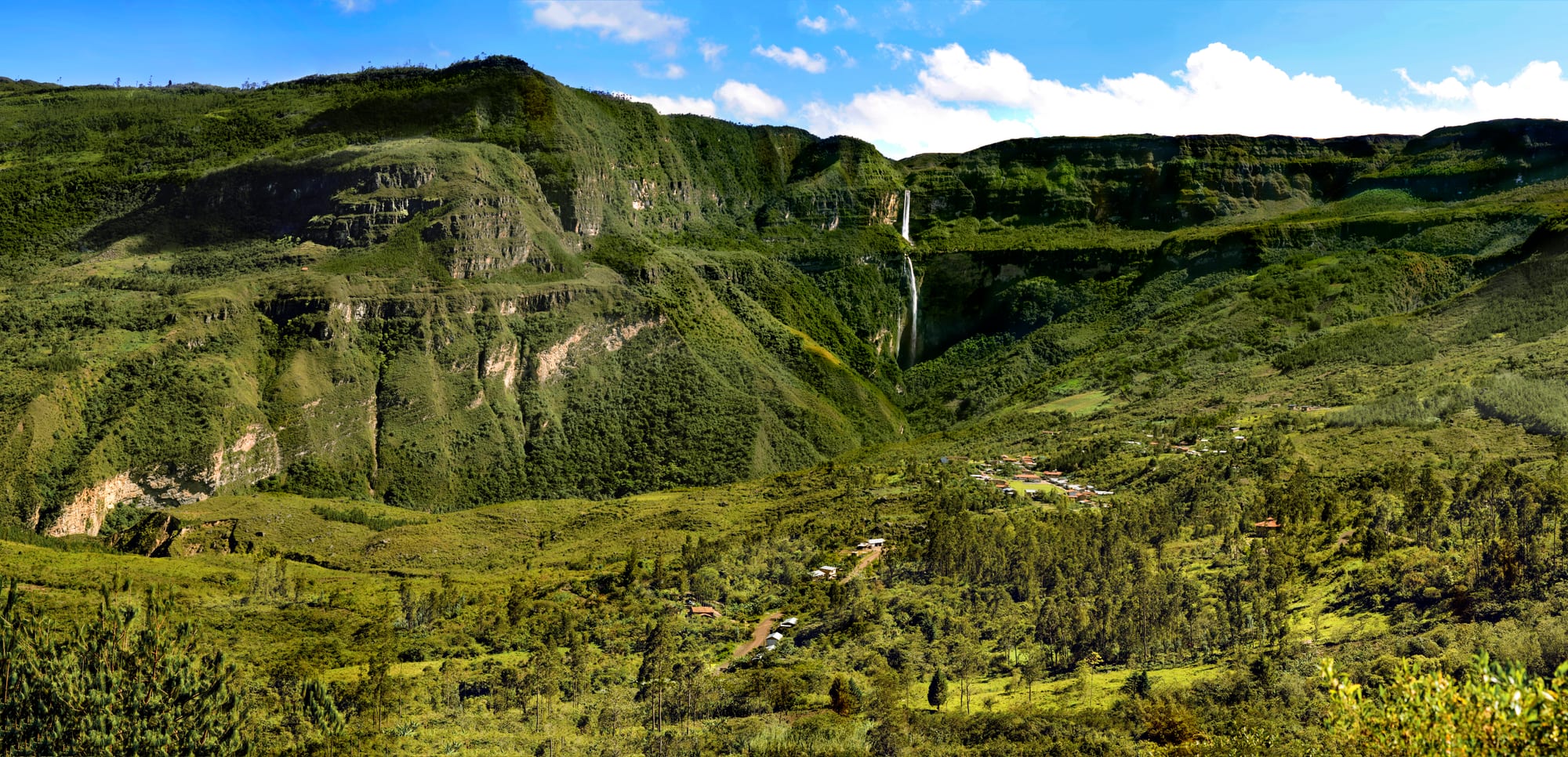
A long thin waterfall dropping in two tiers down a green cliff above a forested valley with a small village

Peru

Chachapoyas, Iquitos & the Northern Amazon

The two-tiered Gocta waterfall above a cloud-forest valley near Chachapoyas, in the Amazonas region. (Srooose / Wikimedia Commons · CC BY-SA 4.0)

Peru's green north-east, dropping from the highland valley of Cajamarca and the cloud forests of Chachapoyas through the lowlands of San Martín to the Amazon river ports of Iquitos and Pucallpa — a vast, thinly peopled region of pre-Inca fortresses, waterfalls, rainforest reserves and river life.

Explore Chachapoyas, Iquitos & the Northern Amazon

History

The north-eastern Andes were the home of the Chachapoya, a cloud-forest people who from around the 9th century built walled towns of round stone houses and buried their dead in cliff-face tombs and upright clay sarcophagi. Their greatest site, Kuélap, commands a ridge above the Utcubamba. The Inca conquered them in the later 15th century, and Chachapoya resentment led some to side with the Spanish. Cajamarca, in its fertile highland valley, was a regional centre that the Inca turned into an important town, and in November 1532 it was here that Francisco Pizarro ambushed and captured the Inca emperor Atahualpa, who paid a room of gold and silver for a ransom and was executed the following year.

Spanish missionaries and explorers pushed into the lowlands from towns such as Moyobamba, but the Amazon stayed on the edge of the state until the rubber boom of the late 19th and early 20th centuries made Iquitos a wealthy port, linked to Europe by steamers down the Amazon, and brought forced labour and violence to Indigenous peoples. Loreto was also at the centre of border disputes with Colombia and Ecuador.

In the 1980s and 1990s the Huallaga valley in San Martín and Huánuco was a centre of coca growing, and the Shining Path and the MRTA were both active there. Oil extraction in Loreto, the Yanacocha gold mine near Cajamarca and a deadly clash between police and Awajún and Wampís protesters at Bagua in 2009 have made the region central to Peru's debates over land and resources.

Culture & Customs

The highlands and the lowlands are two different worlds. Cajamarca is mestizo and Catholic, with a strong dairy and farming tradition, and its carnival, with water fights, paint, competing troupes and satirical songs, is among the best known in the country. In Chachapoyas, the whitewashed colonial town keeps a quiet, provincial pace, and villages such as Leymebamba preserve Chachapoya heritage in their museums.

The Amazon is home to dozens of Indigenous peoples, among them the Awajún and Wampís in the north, the Shipibo-Konibo along the Ucayali, and the Kichwa-speaking people of Lamas near Tarapoto. Shipibo-Konibo women paint and embroider kené, the maze-like geometric designs that decorate their textiles and pottery and are recognised as national cultural heritage. Riverside mestizo culture, known in Peru as ribereño, mixes Indigenous knowledge with Spanish Catholicism and the legacy of the rubber era.

The great festival of the lowlands is San Juan on 24 June, when families eat juane and bathe in the rivers. Traditional healing with medicinal plants, including ayahuasca, is part of local life around Iquitos and Pucallpa and has also grown into an industry of retreats for foreigners.

Daily Life

Iquitos, with more than 400,000 people, is the largest city in the Peruvian Amazon and among the largest in the world that cannot be reached by road; almost everything arrives by river or by air, and the streets are full of mototaxis. Pucallpa, on the Ucayali, is the other big river city and the end of the road from Lima, handling timber and trade. Cajamarca and Tarapoto are growing regional centres, while Chachapoyas remains a small highland town.

The economy follows the land. Cajamarca lives from dairy farming and from gold mining, which has brought jobs and money as well as repeated protests over water. San Martín, once a coca-growing area, now produces coffee, cacao and rice. Loreto depends on oil, fishing, timber and public employment, and its northern pipeline has suffered repeated spills. Illegal logging, gold mining and drug trafficking are persistent problems in remote areas.

Days in the lowlands start early to avoid the heat, with markets busiest at dawn. In the rainy season the rivers rise into the lower neighbourhoods of Iquitos, and life in Belén shifts to canoes.

Food

The Amazon kitchen is built on plantain, cassava and river fish. Juane, rice seasoned with turmeric and filled with chicken, egg and olive, is wrapped in bijao leaves and boiled, and is the dish of San Juan. Tacacho con cecina pairs balls of mashed fried green plantain with smoked pork, and inchicapi is a chicken soup thickened with peanuts and maize. Fish such as paiche, one of the largest freshwater fish in the world, and doncella are grilled or cooked in leaves as patarashca.

Markets such as Belén sell tropical fruits little known outside the region: camu camu, rich in vitamin C, the orange palm fruit aguaje, and cocona, used in juices and sauces. Iquitos bars serve liquors steeped with bark and roots, while masato, fermented cassava drink, is shared in Indigenous communities.

In the highlands the food changes completely. Cajamarca is known for its dairy — queso mantecoso, a soft buttery cheese, and manjar blanco — and for caldo verde, a potato soup green with herbs. San Martín's cacao is made into chocolate in Tarapoto.

Attractions & Natural Wonders

In the Amazonas region, Kuélap rises above the Utcubamba valley, reached by road or by cable car from Nuevo Tingo; a section of its perimeter wall collapsed in April 2022, and emergency conservation work has followed. Gocta falls, among the world's tallest, is a half-day walk through cloud forest from Cocachimba or San Pablo. The sarcophagi of Karajía, the cliff tombs of Revash and the Leymebamba museum, with mummies from the Laguna de los Cóndores, complete the Chachapoya circuit.

Cajamarca has the Ransom Room, the baroque church of San Francisco and the cathedral, the hot springs of the Baños del Inca, the carved pre-Inca water channel of Cumbe Mayo and the burial niches of the Ventanillas de Otuzco.

In San Martín, Tarapoto is the base for waterfalls such as Ahuashiyacu, the Laguna Azul at Sauce and the town of Lamas, and Moyobamba for orchid gardens. From Iquitos, boats run to lodges along the Amazon and its tributaries and to the Pacaya-Samiria reserve, and in town the Belén market, rubber-era mansions and the Malecón look over the river. Pucallpa's lake of Yarinacocha is lined with Shipibo-Konibo villages.

Cities in Chachapoyas, Iquitos & the Northern Amazon

Planning basics

Budget

Day-to-day costs are low in Cajamarca, Chachapoyas, Tarapoto and Pucallpa, with cheap hostels, menú lunches and colectivos. The big expense is the Amazon: most visitors fly to Iquitos, and all-inclusive jungle lodges and cruises on the Amazon are priced per night and can be costly. Riverboat travel in a hammock is the cheapest way to move, if also the slowest.

Daily Budget Midrange
USD 75–180 (mid-range hotel, day tours to Kuélap and Gocta, domestic flights; Amazon lodges extra)
Daily Budget Shoestring
USD 25–45 (hostel, menú lunches, colectivos and hammock riverboats)

Compare several Iquitos lodges directly rather than buying from touts at the airport or in the street, and check what transfers and excursions are included.

Safety

Cajamarca, Chachapoyas, Tarapoto and Iquitos are generally calm, with petty theft the usual risk. Drug trafficking persists in parts of the Huallaga valley and along the Putumayo and Colombian border in Loreto, which are best avoided. Health matters more than crime: malaria and dengue occur in the lowlands, and ayahuasca retreats around Iquitos vary widely in how safely they are run, with deaths and assaults reported.

Get advice on yellow fever vaccination and malaria before visiting the Amazon, use recommended lodges and guides, and avoid the Colombian border areas. Check current official travel advice before travelling.

Climate

Three climates in one region. Cajamarca, at about 2,700 metres, and Chachapoyas, at about 2,500, are temperate, with sunny dry seasons from about May to September and rain the rest of the year. Tarapoto and the San Martín lowlands are warm and humid, and Iquitos and Pucallpa are hot and rainy all year. On the Amazon rivers the water rises from about December to May and falls from June to November.

Summer
Andean wet season with afternoon rain in Cajamarca and Chachapoyas; heavy rain and high water in the Amazon
Winter
dry, sunny days and cool nights in the highlands; slightly drier in the lowlands, with falling rivers

Transportation

Flights from Lima reach Cajamarca, Tarapoto, Pucallpa and Iquitos; Jaén and Chachapoyas have smaller airports. Chachapoyas is about nine or ten hours by bus from Chiclayo and around seven from Tarapoto, and minibuses and a cable car serve Kuélap. Iquitos has no road link to the rest of Peru: the choice is to fly or to take a cargo riverboat of several days from Yurimaguas or Pucallpa. Motorcycle rickshaws, the mototaxis, are the standard town transport in the lowlands.

Allow spare days around any riverboat journey, which runs to no fixed schedule, and carry a hammock, water and insect repellent.

Best Time to Visit

May to September suits Kuélap, Gocta and the Chachapoyas trails, when paths are drier and the falls still full. The Amazon can be visited all year: high water lets boats reach deeper into the flooded forest, while low water exposes beaches and trails. Cajamarca's carnival, before Lent, is one of the liveliest in Peru, and the Amazon towns celebrate San Juan on 24 June.