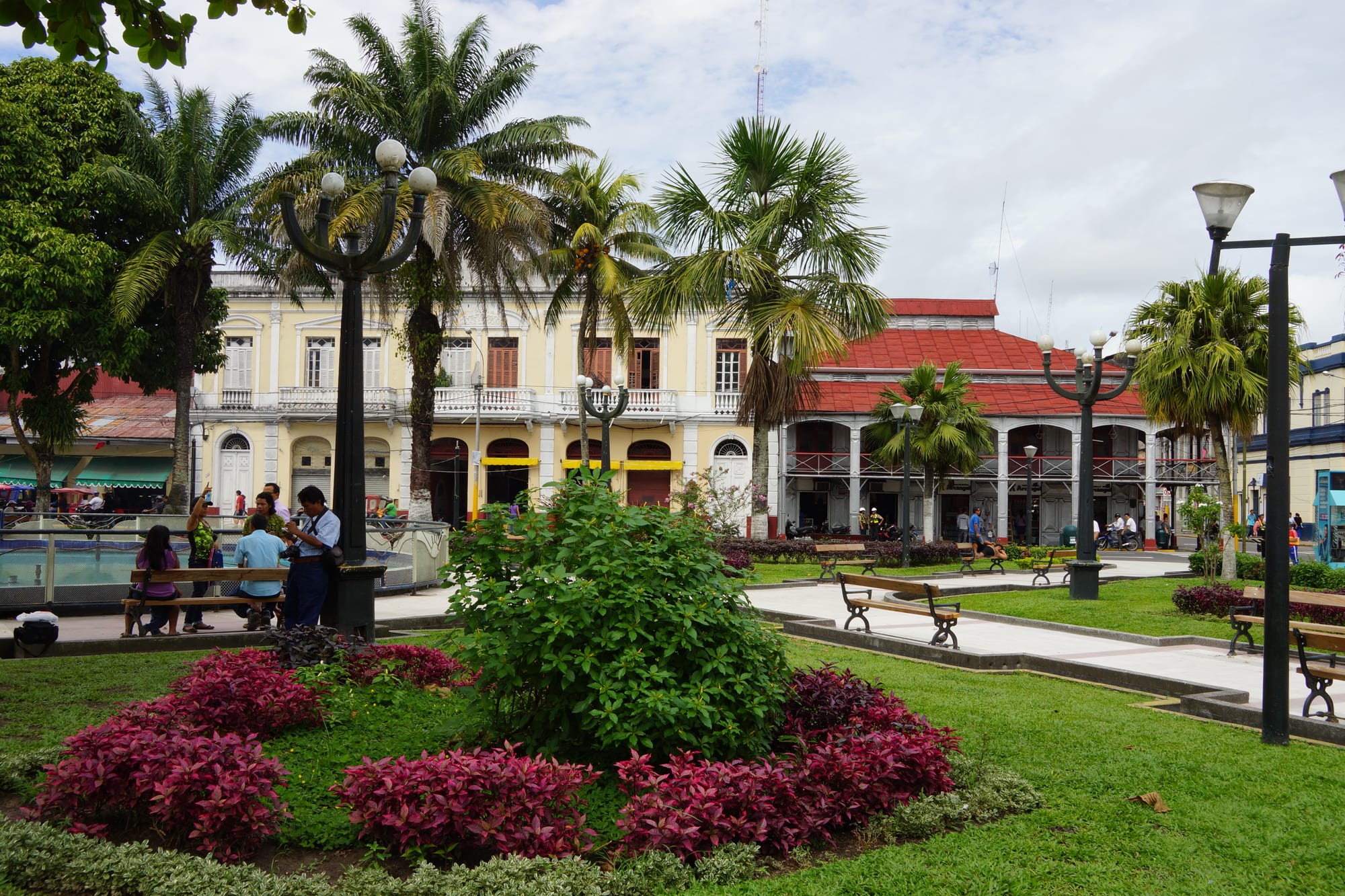
Palm trees, flower beds and lamp posts in a square, with two-storey colonnaded rubber-era buildings behind

Chachapoyas, Iquitos & the Northern Amazon, Peru

Iquitos

The Plaza de Armas of Iquitos, surrounded by buildings from the rubber boom. (Maurice Chédel / Wikimedia Commons · CC BY 3.0)

The capital of Loreto and the largest city in the Peruvian Amazon, on the Amazon, Nanay and Itaya rivers and reachable only by river or air. A Jesuit mission turned rubber-boom port, it keeps tiled mansions from its years of wealth beside the stilt and floating houses of Belén, and is the starting point for boat trips into the rainforest.

Neighbourhoods

  • Historic centre
    • First-time visitors
    • Historic district
    • Nightlife

    The grid around the Plaza de Armas, where most visitors stay. The Iron House, the cathedral and rubber-era mansions faced with tiles stand within a few blocks, and the Malecón Tarapacá riverwalk runs along the river.

    Open in Maps
  • Belén
    • Markets
    • Local life
    • River culture

    A poor riverside district on the floodplain of the Itaya, with a huge open-air market uphill and, below it, houses that float or stand on stilts as the river rises five or six metres each year. Travel books call it the Venice of Latin America, and goods reach its waterfront mostly by canoe.

    Open in Maps
  • Punchana
    • River port
    • Local life

    The northern district of the city, known for its port activity. The Bellavista-Nanay landing, where boats leave for villages, the butterfly farm and the river, is the reason most visitors go there.

    Open in Maps
  • San Juan Bautista
    • Crafts
    • Quiet and residential

    The largest district, spreading south along the road to Nauta as new families arrive. It holds the San Juan craft market, river beaches and the Quistococha tourist complex.

    Open in Maps

Things to do

The rubber-boom centre

  • Plaza de Armaslandmark

    The main square and the starting point for most visitors, surrounded by the cathedral, the Iron House and buildings from the rubber era.

    Open in Maps
  • Casa de Fierrolandmark

    The Iron House, a building covered in iron sheets from the rubber boom, said to be the first prefabricated house in the Americas; it is popularly credited to Gustave Eiffel, though there is no evidence that he designed it.

    Open in Maps
  • Iquitos Cathedrallandmark

    The neo-Gothic Cathedral of St John the Baptist on the Plaza de Armas, built from 1911 and inaugurated in 1919, with a crypt.

    Open in Maps
  • Old Hotel Palacelandmark

    A hotel of 1908–1912 on the Malecón, built with materials shipped across the Atlantic, its tiles from Málaga and its balconies of wrought iron in plant shapes.

    Open in Maps
  • Malecón Tarapacáviewpoint

    The riverwalk of the historic centre, lined with rubber-era buildings such as the former Hotel Palace.

    Open in Maps

Markets and river life

  • Belénneighborhood

    The district of floating and stilt houses on the floodplain of the Itaya, where goods arrive mostly by canoe.

    Open in Maps
  • Mercado Belénmarket

    A large open-air market selling produce, fish, meat, spices, flowers, folk medicines and prepared foods, along with manufactured goods.

    Open in Maps
  • San Juan craft marketmarket

    The crafts market in San Juan Bautista district, one of the city's listed tourist sights.

    Open in Maps

Nature around the city

  • Quistocochapark

    A tourist complex about 12 km south of the main square on the Iquitos–Nauta road, with natural forest, a small zoo, a serpentarium, an aquarium and a nursery.

    Open in Maps
  • Pilpintuwasiattraction

    A butterfly farm and animal orphanage near the village of Padre Cocha on the Nanay, reached by boat from Bellavista-Nanay, showing more than 40 species.

    Open in Maps
  • Allpahuayo-Mishana National Reservepark

    A reserve on the Iquitos–Nauta road, established in 2004 to protect rainforest on white sandy soils and the streams that supply the city's drinking water.

    Open in Maps

Short trips from the city

  • Nautaattraction

    A river town on the Marañón near its meeting with the Ucayali, the staging point for boats to the Pacaya-Samiria reserve.

    Open in Maps

Seasonal events

  • Fiesta de San Juan24 June

    The feast of St John the Baptist, patron saint of the Peruvian Amazon, when families eat juane and dances such as the shunto are performed.

Eat and drink

Long-standing places and food districts in Iquitos. Hours, ratings and directions come from your maps app, always current.

Iquitos classics

  • Restaurants of the historic centreneighborhood

    Restaurants around the main square and the Malecón serve Amazonian dishes — juane, tacacho and grilled river fish.

    Open in Maps

Markets

  • Mercado Belénmarket

    The city's great market, with prepared foods, river fish and Amazonian fruits such as aguaje and camu camu.

    Open in Maps

Experience Iquitos

History

The rivers around Iquitos were long home to Indigenous peoples, among them the Iquito, who had moved to the Nanay, Amazon and Itaya from other rivers. Between 1638 and 1769 Jesuit missionaries from Quito gathered the peoples of the region into missions, and according to Spanish records the settlement that became Iquitos was founded around 1757 on the Nanay as San Pablo de Napeanos. In 1861 President Ramón Castilla created the department of Loreto and ordered a river port built on the Amazon, and Iquitos grew so quickly that it became Loreto's capital in 1897.

The rubber boom of about 1880 to 1914 transformed it. Rubber houses multiplied, immigrants arrived from around the world, and the city's merchants built the rubber-era mansions that still stand around the Plaza de Armas and the Malecón. The wealth rested on terrible abuse: rubber companies, above all Julio César Arana's Peruvian Amazon Company, held Indigenous workers in near-slavery, and slave raids killed many people, until reports by Roger Casement and others exposed the crimes on the Putumayo. After rubber seeds were smuggled out to plantations in British colonies in Asia and Africa, prices collapsed and many merchants and workers left.

Iquitos later found new income in timber, fishing, oil and minerals. It remains reachable only by river and air, and floods are its main hazard: those of 2012 were the worst in its history, and in 2021 a large solar power plant was announced to replace much of the diesel that generates its electricity.

Culture & Customs

Iquitos calls itself the capital of the Peruvian Amazon, and its culture mixes the riverside mestizo life known in Peru as ribereño with Indigenous traditions, Catholic festivals and the memory of the rubber era. Local Spanish has its own features, and the city's mood is relaxed, warm and loud. Mario Vargas Llosa's comic novel Captain Pantoja and the Special Service even tells its own story of how the Iron House came to the city.

The great festival is San Juan on 24 June, honouring John the Baptist, patron of the Peruvian Amazon: families eat juane, the dish named after the saint, and dances such as the shunto are performed. Many Indigenous peoples live along the rivers, and their crafts are sold in the city's markets.

Traditional healing with plants, including ayahuasca, a powerful psychedelic brew that is legal in Peru, is part of local life and has grown into an industry of retreats for foreigners; Iquitos is a major centre of ayahuasca tourism. The practice carries real dangers.

Daily Life

Iquitos is the ninth most populous city in Peru, and the 2007 census counted about 406,000 people; the metropolitan area of four districts — Iquitos, Punchana, Belén and San Juan Bautista — was projected at about 472,000 for 2015. San Juan is the largest district and keeps spreading south along the Nauta road.

The city lives from commerce, transport, public services and tourism, with industries in timber, oil and gas, flour milling, rum and camu camu. Almost everything arrives by river or by air. Belén shows the other side of the city: some 65,000 people, many in extreme poverty, live there without clean water or proper sanitation, in houses that float or stand on stilts as the river rises from February to July.

The streets belong to more than 25,000 motokars. Days start early to beat the heat, markets are busiest at dawn, and in the evening people gather on the Plaza de Armas and the Malecón above the river.

Food

The Amazon kitchen is built on plantain, cassava and river fish. Juane, rice seasoned with turmeric and filled with chicken, egg and olive, wrapped in bijao leaves and boiled, is the dish of San Juan and one of the main dishes of the Peruvian jungle. Tacacho is made from fried plantain mashed with chicharrones, often served with cecina, smoked pork, and inchicapi is a chicken soup thickened with peanuts and maize.

River fish are central: paiche, one of the largest freshwater fish in the world, and other river fish are roasted wrapped in leaves as patarashca. Mercado Belén is the place to see the ingredients, from fish and spices to fruits little known outside the region — camu camu, rich in vitamin C, aguaje, the fruit of the moriche palm, resold in small quantities by the women of Belén, and cocona, used in juices.

Masato, a fermented cassava drink, is still prepared in the traditional way by Indigenous groups.

Planning tools

Budget

Day-to-day costs in Iquitos are modest: guesthouses, set lunches and motokar rides are cheap. The big expense is the jungle — lodges and river cruises are priced per night and can be costly — and flights in and out, since there is no road.

Daily Budget Midrange
USD 75–180 (mid-range hotel, restaurant meals, guided boat trips; jungle lodges extra)
Daily Budget Shoestring
USD 25–45 (hostel, menú lunches, motokars and local boats)

Compare lodges and tours directly rather than buying from touts at the airport or in the street, and check what transfers and excursions are included.

Best Time to Visit

Iquitos can be visited all year. The river rises from about February to July, lifting the floating houses of Belén and reaching its lower streets; in the low-water season it retreats. San Juan, on 24 June, is the city's great festival.

Suggested Number of Days

Two or three days cover the city, its market and short boat trips. Most visitors also spend several nights at a lodge or on a river cruise, and the length of that stay sets the total.

First Visit
2–3 days
With Surroundings
5–7 days

Transportation

More than 25,000 motokars — three-wheeled motorcycle taxis — dominate the streets and are the normal way to get around; agree the fare first. Buses run along the main avenues and the road to Nauta. Boats leave from Bellavista-Nanay and other landings for villages and lodges.

Hire boats through established operators or the boat owners' association, and be wary of drivers who take visitors to places that pay them commission.

Airport & Station Connections

Iquitos has no road link to the rest of Peru. Coronel FAP Francisco Secada Vignetta International Airport is 7 km south-east of the centre, with flights to Lima and other Peruvian cities. The alternative is a cargo riverboat: about two days from Yurimaguas or about four from Pucallpa, sleeping in a hammock.

Walkability

The historic centre, the Plaza de Armas and the Malecón are compact and easy on foot, though the heat and humidity make walking slow. Traffic from motokars is constant and noisy. Belén's lower streets flood at high water, and everything beyond the centre needs a motokar or a boat.

Safety

The standard tourist circuit — Lima's Miraflores and Barranco, Cusco, the Sacred Valley, Arequipa, Puno — is generally safe with urban precautions, but crime has risen. Iquitos is generally calm, with petty theft the usual risk. Health matters more than crime: malaria and dengue occur in the lowlands, and ayahuasca retreats around the city vary widely in how safely they are run, with deaths and assaults reported.

Get advice on yellow fever vaccination and malaria before visiting, use recommended lodges and guides, and avoid the Colombian border areas. Check current official travel advice before travelling.

Climate

A tropical rainforest climate, hot and humid all year with rain in every month and no distinct dry season, though summer is wetter. The main natural hazard is flooding: in 2012 the rivers rose to the worst floods in the city's history.

Summer
the wetter season, hot and humid throughout, with temperatures across the year ranging from about 21 to 33°C
Winter
a little less wet; on clear, less humid days heat waves can bring temperatures over 37°C and a heat index of 45°C

Local Customs

Iquitos is informal and relaxed, and its Amazonian Spanish has its own turns of phrase. Light clothing is normal everywhere, though churches expect covered shoulders. Indigenous communities near the city should be visited with a guide and with their consent. A tip of around 10 per cent is usual in sit-down restaurants, and tips for boat guides are appreciated.

Ask before photographing people in Belén and in villages, never buy products made from wild animals, and treat ayahuasca as a serious medical risk rather than an attraction.

Common Payment Methods

The currency is the sol (PEN). Hotels, lodges and larger restaurants take cards; cash is needed for markets, motokars and boats, and is essential before heading upriver, where there are no ATMs. ATMs in the centre charge fees, and US dollars are easily exchanged.