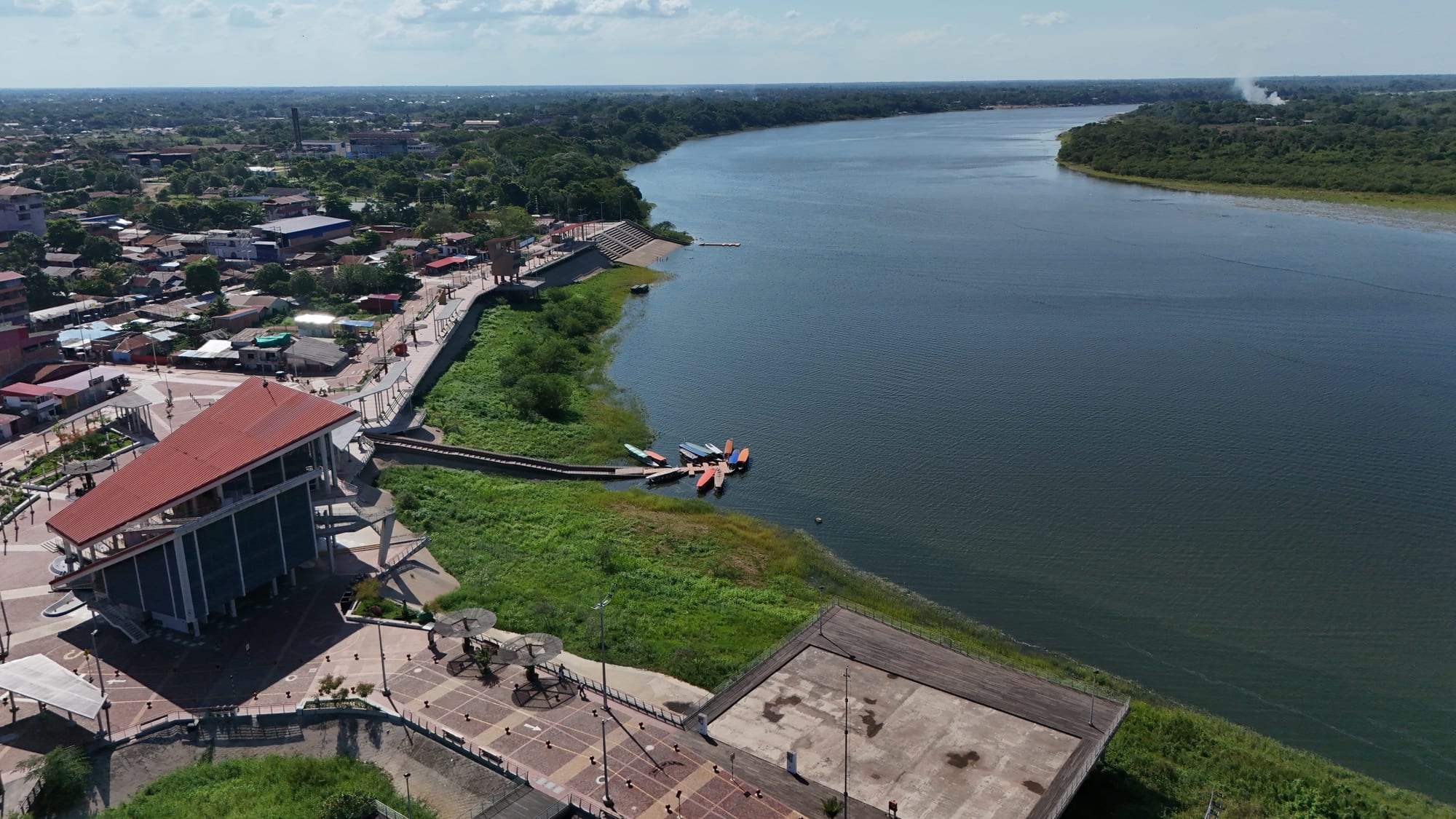
Aerial view of a wide calm lagoon beside a lakeside promenade with a red-roofed pavilion, moored boats and low town buildings among trees

Chachapoyas, Iquitos & the Northern Amazon, Peru

Pucallpa

The Yarinacocha lagoon at low water, on the edge of Pucallpa. (Txolo / Wikimedia Commons · CC BY-SA 4.0)

The capital of Peru's Ucayali region, on the banks of the Ucayali river, a main headstream of the Amazon. A small mission and rubber-era settlement until a highway from Lima arrived in 1945, it grew into the second city of the Peruvian Amazon — a hot, busy river port of timber yards, mototaxis and markets, beside the Yarinacocha lagoon and its Indigenous villages.

Neighbourhoods

  • Callería and the city centre
    • First-time visitors
    • Close to the river
    • Markets

    The original city, around the Plaza de Armas and its cathedral, close to the Ucayali. Most hotels, banks and restaurants are within a few blocks, and the markets and ports run along the Ucayali bank.

    Open in Maps
  • Yarinacocha and Puerto Callao
    • Lakeside
    • Shipibo-Konibo crafts
    • Quiet and residential

    The district whose capital, Puerto Callao, sits on the shore of the Yarinacocha lagoon. Boats leave from its waterfront for the lake's villages, and it has its own market and lakeside restaurants.

    Open in Maps
  • Manantay
    • Local life
    • Quiet and residential

    The part of the conurbation around the old town of San Fernando, made a district of its own in 2000. It is a working, largely residential area with a municipal market and few visitors.

    Open in Maps

Things to do

In the city

  • Plaza de Armas and the Cathedrallandmark

    The main square, home to the Cathedral of the Immaculate Conception, the only cathedral in the Ucayali region.

    Open in Maps
  • Plaza Grau and the Public Clocklandmark

    A square marked by an eight-storey clock tower decorated with images on each side, an early landmark of the city's modern architecture.

    Open in Maps
  • Pablo Amaringo's house and painting schoolmuseum

    The house of the painter Pablo Amaringo, in the south of the city, which keeps a collection of his works and serves as a painting workshop.

    Open in Maps

Parks

  • Parque Naturalpark

    The city's zoo and park, with Amazonian animals at close quarters and a historical section.

    Open in Maps

The Yarinacocha lagoon

  • Yarinacochapark

    A lagoon formed from an old meander of the Ucayali, with which it joins in the rainy season, and the most visited sight around Pucallpa; boat trips run from Puerto Callao.

    Open in Maps
  • San Francisco de Yarinacochaattraction

    One of the two Indigenous communities on the shore of the lagoon.

    Open in Maps
  • Santa Claraattraction

    The second Indigenous community on the shore of the lagoon.

    Open in Maps
  • Isla del Amorbeach

    An island in the middle of the lagoon.

    Open in Maps

Seasonal events

  • Fiesta de San JuanJune

    The city's greatest festival, celebrated above all at Yarinacocha, when families eat juane and tacacho con cecina and the lagoon fills with visitors.

  • CarnivalFebruary

    The region's carnival, which includes the felling of the humisha, a tree hung with gifts.

  • Semana JubilarOctober

    The city's anniversary week, held around the traditional founding date of 13 October 1888.

Eat and drink

Long-standing places and food districts in Pucallpa. Hours, ratings and directions come from your maps app, always current.

Pucallpa classics

  • Restaurants around the Plaza de Armasneighborhood

    The centre's restaurants and juice bars serve the Amazon staples — juane, tacacho con cecina and grilled river fish — alongside rotisserie chicken and fruit juices.

    Open in Maps
  • Lakeside restaurants at Puerto Callaoneighborhood

    Eating places on the Yarinacocha waterfront, including a restaurant floating on the lagoon, known for local fish.

    Open in Maps

Food districts and markets

  • Mercado N.º 1market

    The municipal market on the bank of the Ucayali, selling river fish, fruit and produce.

    Open in Maps
  • Mercado N.º 2market

    The central market, two blocks south of the municipal building.

    Open in Maps
  • Mercado La Hoyadamarket

    An informal riverside market on Avenida Sáenz Peña, next to one of the floating ports used at high water.

    Open in Maps

Experience Pucallpa

History

The Ucayali valley was home to Pano-speaking peoples long before Europeans arrived, among them the ancestors of today's Shipibo-Konibo, who lived along the river and its tributaries and on the shores of lakes such as Yarinacocha. Franciscan missionaries founded villages along the Ucayali from the colonial era, and Pucallpa itself began in the 1840s as a small settlement where the missionaries settled Shipibo-Konibo families and newcomers gradually arrived.

There is no single founding act. Tradition dates the city's founding to 13 October 1888, the date still celebrated in its anniversary week, during the rubber era, and the honour of being its founder is disputed between Eduardo del Águila Tello and the Brazilians Agustín Cáuper Videira and Antonio Maya de Brito. A municipal council was formed in 1901. For decades Pucallpa stayed small, cut off from the rest of Peru by forest and mountains, while railway plans to connect it with the Central Railway were started and abandoned repeatedly from the 1880s to the 1920s.

Its isolation ended in 1945, when a highway through Tingo María reached Lima, opening the way for timber, farm produce and migrants. Pucallpa became the river port linking Lima's road with the Amazon, and in the 1980s it merged with Puerto Callao and San Fernando into one conurbation, today divided between the districts of Callería, Yarinacocha and Manantay.

Culture & Customs

Pucallpa's identity is shaped by the river and by the Shipibo-Konibo, who give the city its own name, May Ushin. Shipibo-Konibo women paint and embroider kené, the maze-like geometric designs that decorate their textiles and pottery and are recognised as national cultural heritage, and their work is sold in the city's markets and in the communities around Yarinacocha. The city also draws visitors interested in shamanism.

Painting has a following here too. The house of the painter Pablo Amaringo, in the south of the city, keeps a collection of his works and serves as a painting workshop, and Shipibo-Konibo artists sell their textiles and ceramics in the city.

The biggest festival is San Juan, on 24 June, celebrated above all at Yarinacocha, when families eat juane and tacacho and the lagoon fills with visitors from across Peru. Carnival in February includes felling the humisha, a tree hung with gifts, and October brings the city's anniversary week. Football is the most followed sport, and Christianity is the main religion, with Catholic, Adventist and other Protestant congregations.

Daily Life

Peru's statistics institute ranks Pucallpa as the country's tenth-largest city. The three districts that make up the city, Callería, Yarinacocha and Manantay, had about 341,000 people in 2017, according to the same institute, and about a third of those living in the region come from other parts of Peru.

The economy rests on trade, timber, fishing, farming and livestock, with tourism growing. The river port is the second most important in the Peruvian Amazon after Iquitos, and the highway to Lima is vital for moving raw materials and manufactured products. The San Juan brewery has operated in the city since 1970, and a small oil refinery and a gas plant in the region supply fuel.

Life follows the heat and the river. Mototaxis fill the streets from early morning, nine municipal markets and several informal ones supply the city, and in the high water season floating ports are used along the bank. Power cuts have long been a complaint, and pollution of the Yarinacocha lagoon by the city's drainage is a serious environmental problem.

Food

Pucallpa eats like the rest of the Peruvian Amazon, from rivers and forest. Paiche, one of the largest freshwater fish in the world, stands out among the river fish and is prepared in many ways. Juane — rice seasoned and filled with chicken, egg and olive, wrapped in bijao leaves and boiled — is the dish of San Juan, and tacacho, plantain mashed with lard and pieces of pork rind, is eaten with cecina. Inchicapi, a chicken soup thickened with peanuts and maize, and patarashca, fish wrapped in leaves and grilled, are common across the region.

Eating wild meats from the forest, such as peccary, tapir, armadillo and large rodents, is a long tradition in the region. Across the Peruvian Amazon, markets sell tropical fruits little known elsewhere — aguaje, cocona and camu camu among them — which are pressed into juices, and the city's markets by the Ucayali are the place for river fish and produce.

To drink there is masato, a fermented drink made from cassava, fruit juices of every kind, and beer from the San Juan brewery, opened in the city in 1970.

Planning tools

Budget

Pucallpa is inexpensive. Simple hotels around the Plaza de Armas, menú lunches, collectivos and mototaxis cost little; air-conditioned rooms, flights and boat trips on the lagoon are the main extras. Long river journeys by cargo boat are cheap but slow.

Daily Budget Midrange
USD 60–130 (air-conditioned hotel, restaurant meals, a boat trip on Yarinacocha)
Daily Budget Shoestring
USD 20–40 (simple hotel or hostel, market meals, mototaxis and collectivos)

Air conditioning makes a large difference to comfort and to the price of a room; agree mototaxi fares before setting off.

Best Time to Visit

Pucallpa is hot all year. January to March is the wettest period, which eases river transport, and in the rainy season the lagoon joins the Ucayali; June to September brings warmer, drier and sunnier days. June also brings the San Juan festival, the busiest time of year at Yarinacocha.

Suggested Number of Days

Two or three days are enough for the city and the lagoon. Allow longer for visits to communities further away or for a river journey, which runs to no fixed timetable and can take several days.

First Visit
2–3 days
With Surroundings
3–5 days

Transportation

Mototaxis are the standard way to get around, and collectivos — shared cars on set routes — are cheaper and run between the centre and Yarinacocha. The centre is small enough to walk. Boats for the lagoon leave from Puerto Callao, and cargo boats on the Ucayali leave from the city's river ports.

Allow spare days around any riverboat journey and carry water, a hammock and insect repellent.

Airport & Station Connections

FAP Captain David Abensur Rengifo International Airport, the main airport of the Ucayali region, lies on the north-western side of the city, with daily flights from Lima and some to Iquitos and Tarapoto. Pucallpa is linked to the national road network: the Federico Basadre highway runs by way of Aguaytía and Tingo María to Huánuco and Lima, about 18 hours or more by bus. Cargo boats run down the Ucayali to Iquitos.

Walkability

The centre around the Plaza de Armas and the river is compact and walkable, but the heat and sun make long walks tiring, and the conurbation is spread out, so mototaxis are used for anything beyond a few blocks.

Safety

Cajamarca, Chachapoyas, Tarapoto and Iquitos are generally calm, with petty theft the usual risk. In Pucallpa, robberies are reported to be more common around Christmas, and the road between Tingo María and Pucallpa is known for robberies of buses. Malaria and dengue occur in the lowlands.

Avoid the Tingo María road around Christmas and special events, keep valuables out of sight, and get advice on yellow fever and malaria before visiting the Amazon. Check current official travel advice before travelling.

Climate

A hot tropical climate with an average temperature of about 26°C and peaks of around 34°C on the hottest days, with strong sun and high humidity. Rain falls throughout the year, about 1,570 mm in total, and the river levels rise and fall with the seasons.

Summer
December–February is hot and wet, with heavy rain and rising rivers, and temperatures in the high 20s to low 30s °C
Winter
June to August is somewhat drier, with falling rivers and hot days, averaging around 26°C

Local Customs

Pucallpa is informal and relaxed, with a mixed population of Amazonian, Andean migrant and Indigenous origins. In the Shipibo-Konibo communities, visitors are guests: buying crafts directly from the women who make them is welcome, but photographs of people and homes should be asked for first. Light clothing is normal, with modest dress in churches.

Ask before photographing people, especially in Indigenous communities, and approach ayahuasca retreats with great caution.

Common Payment Methods

The currency is the Peruvian sol. Cards are taken in larger hotels, supermarkets and some restaurants; mototaxis, collectivos, markets, boat trips and crafts are paid in cash, so small notes are useful.