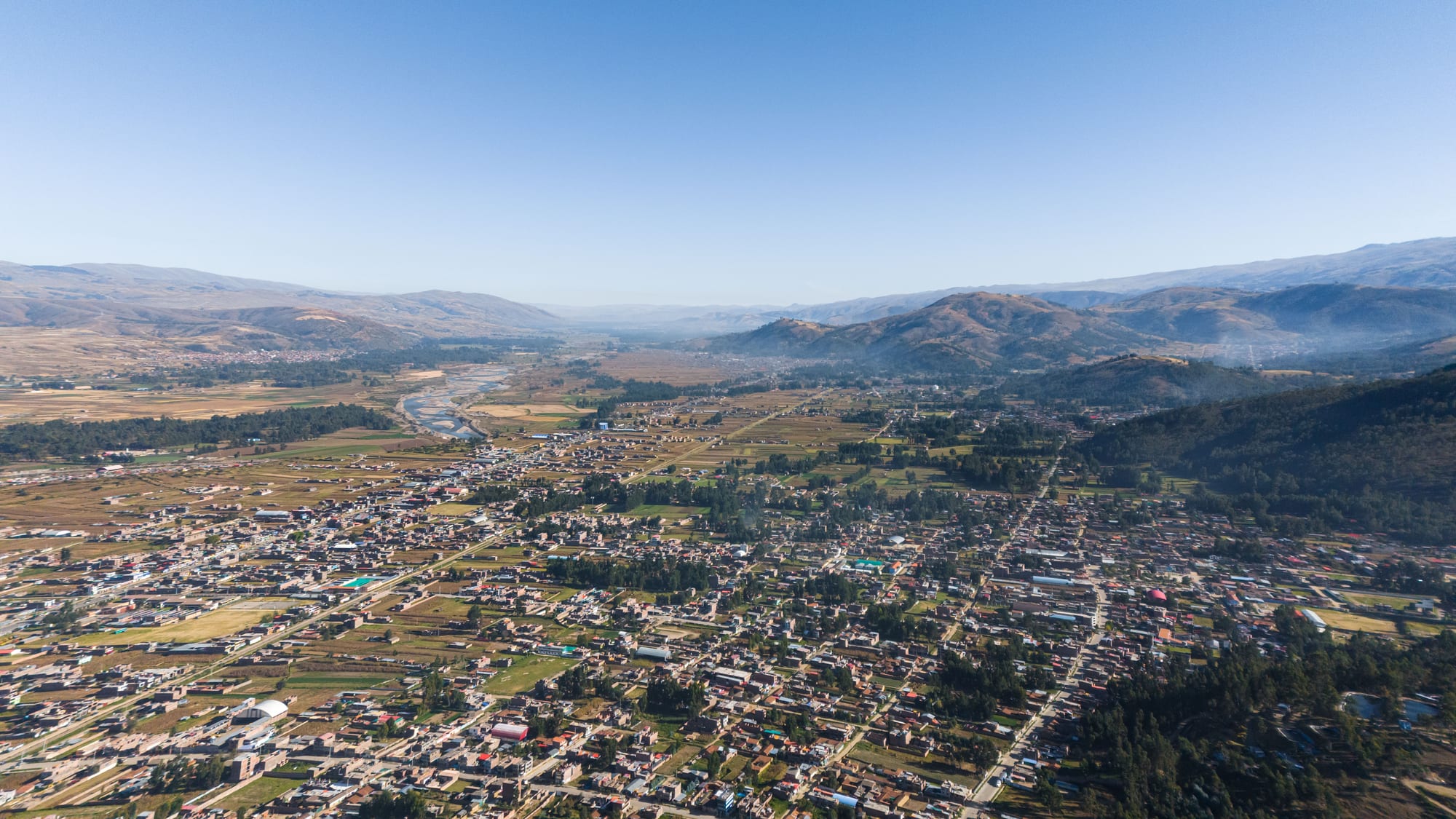
Aerial view of a town spread across a broad farmed valley floor, with a river and dry brown hills beyond

Peru

The Central Highlands

The Mantaro valley seen from above Concepción, in the Junín region. (Guillermo Carlos Gómez / Wikimedia Commons · CC BY-SA 4.0)

The Andes east of Lima, from the mining towns of Pasco and the farming valley of the Mantaro around Huancayo south to colonial Ayacucho and Huancavelica, and down to the jungle edge at Tingo María — a Quechua-speaking heartland of crafts and festivals that bore the worst of the Shining Path conflict.

Explore The Central Highlands

History

The central Andes have been farmed and fought over for thousands of years. Kotosh, near Huánuco, was a temple site some four thousand years ago, and around Ayacucho the Wari built, from about AD 600, the first great Andean empire, with a capital of walled compounds and roads and administrative centres across much of Peru. The Huanca people of the Mantaro valley were later conquered by the Inca and, in revenge, sided with the Spanish, and Jauja briefly served as Pizarro's first capital before Lima was founded.

Colonial wealth came from the mines. Huancavelica's mercury, essential for refining the silver of Potosí, was dug by forced mita labour in notoriously deadly conditions, and Cerro de Pasco's silver drew miners from the 17th century. Huamanga, today's Ayacucho, grew into a city of churches and mansions on the road between Lima and Cusco. In 1824 the patriot armies won at Junín in August and at the Pampa de Ayacucho in December, the battle that ended Spanish rule in South America.

The 20th century brought the Central Railway and a copper smelter at La Oroya, and in 1980 the Shining Path, founded by Abimael Guzmán, a professor at Ayacucho's university, began its war by burning ballot boxes at Chuschi. Ayacucho became the epicentre of the conflict: the Truth and Reconciliation Commission found that the region suffered the largest share of deaths, from massacres committed both by the Shining Path and by the armed forces, and tens of thousands of people fled to the cities.

Culture & Customs

This is a Quechua-speaking heartland, and in the villages of Ayacucho and Huancavelica Quechua is still many people's first language. The region is known throughout Peru for its music, from the huayno sung by Ayacucho's guitarists to the brass bands of the Mantaro valley, and for the danza de tijeras, the scissors dance of Ayacucho, Huancavelica and Apurímac, in which dancers clash iron blades in contests of skill; it is recognised by UNESCO as intangible heritage.

The crafts are among the finest in the Andes. Ayacucho is known for retablos, painted wooden boxes filled with small scenes of saints, markets and village life, as well as for its weaving, stone carving and the pottery of Quinua. In the Mantaro valley, Cochas is known for mates burilados, gourds carved with fine scenes, Hualhuas for weaving, and San Jerónimo de Tunán for silver filigree.

Religious life is intense. Ayacucho's Holy Week, with its many processions, draws pilgrims from across the country. Mantaro towns celebrate with dances such as the huaylarsh and Jauja's Tunantada, in which masked dancers parody colonial society.

Daily Life

Huancayo, the commercial capital of the central Andes, has around half a million people and a huge Sunday market along one of its main avenues. Ayacucho and Huánuco are university and trading cities of a few hundred thousand, while Huancavelica and Cerro de Pasco are smaller and, at their altitude, among the poorest and coldest urban places in Peru.

The Mantaro valley is one of Peru's most productive farming areas, supplying Lima with potatoes, maize, vegetables, trout and dairy. Mining dominates Pasco and parts of Junín and Huancavelica: Cerro de Pasco has a vast open-pit mine at its centre, and pollution from it and from the La Oroya smelter has become a long-running health issue. East of the Andes, Chanchamayo and Satipo grow coffee and fruit, and the Huallaga valley near Tingo María has moved from coca towards cacao and coffee.

The legacy of the conflict is still felt in Ayacucho, where families continue to search for the disappeared and exhumations of mass graves continue. Young people leave for Lima, and many villages are ageing.

Food

The central highlands claim some of Peru's best-known dishes. Papa a la huancaína, boiled potatoes in a creamy sauce of yellow chilli and fresh cheese, takes its name from Huancayo. Pachamanca, meats and potatoes cooked on hot stones in an earth oven, is a Sunday and festival meal across Junín, and cuy colorado, guinea pig fried and served in a red chilli sauce, is a festival dish in Junín and Ayacucho. Trout from highland streams and lakes appears everywhere.

Ayacucho has puca picante, a stew of potatoes and ground peanuts coloured red with beetroot, often served with rice and fried pork, and qapchi, a dish of fresh cheese, broad beans, potatoes and herbs. Andean bakers make wawas, sweet bread figures, for All Souls' Day on 2 November.

Maca, a root grown on the high plateau around Junín and Pasco, is eaten in porridges and sold as a supplement. Chicha de jora is drunk at festivals, and the lowlands around Tingo María and Chanchamayo add tropical fruit, coffee and juane to the table.

Attractions & Natural Wonders

Huancayo is the base for the Mantaro valley: the Sunday market, the craft villages of Cochas, Hualhuas and San Jerónimo de Tunán, colonial Jauja and the Convento de Santa Rosa de Ocopa, a Franciscan mission house with a library. To the north lies Lake Junín, a high plateau lake with its own endangered grebe, and beyond, the Austro-German colonial town of Pozuzo and the coffee country of Oxapampa.

Ayacucho's historic centre has more than thirty colonial churches, including the cathedral, Santo Domingo and La Compañía, and the market and craft workshops of the Santa Ana district. Nearby are the ruins of Wari, the craft town of Quinua and the Pampa de Ayacucho with its obelisk, and, further south, the Inca temple and platform of Vilcashuamán and the turquoise pools of Millpu. Huancavelica has colonial churches and the Santa Bárbara mine, and Huaytará an Inca temple beneath its church.

Huánuco has the Kotosh temple outside town and, higher up, the Inca administrative city of Huánuco Pampa. Tingo María National Park protects the Bella Durmiente ridge and the Cueva de las Lechuzas, where oilbirds nest in the dark.

Cities in The Central Highlands

Planning basics

Budget

One of the cheapest parts of Peru. Hotels, menú lunches and buses in Huancayo, Ayacucho and Huánuco cost well below Cusco or Lima, and entry fees to most sites are low. The main extras are a flight to Ayacucho and a seat on the Lima–Huancayo train, which runs only on occasional departures and costs far more than the bus.

Daily Budget Midrange
USD 60–120 (comfortable hotel, restaurants, guided day trips and a domestic flight)
Daily Budget Shoestring
USD 20–40 (guesthouse, menú lunches, colectivos and buses)

Ayacucho's hotels fill and raise prices around Holy Week, so book well ahead or visit at another time.

Safety

Huancayo, Ayacucho and Huánuco are generally calm. The exception is the VRAEM, the valleys of the Apurímac, Ene and Mantaro rivers on the eastern edge of Ayacucho, Junín and Huancavelica, where a remnant of the Shining Path and drug traffickers still operate and ambushes on security forces occur. Altitude sickness is a real risk in Huancavelica and Cerro de Pasco, and mountain roads see frequent bus accidents.

Avoid the VRAEM, travel by day, and acclimatise before going above 3,500 metres. Check current official travel advice before travelling.

Climate

Highland climate with a dry season from about May to September — sunny days, cold nights and frost in the high towns — and rains from about November to March. Ayacucho, at about 2,750 metres, is mild and sunny; Huancayo, at about 3,250 metres, is cooler; Huancavelica and Cerro de Pasco, far higher, are cold all year. Tingo María, on the jungle edge, is hot, humid and wet.

Summer
rainy season, with afternoon storms and muddy roads; warm and very wet at Tingo María
Winter
dry and sunny by day, near or below freezing at night in Huancavelica and Pasco

Transportation

Buses run from Lima to Huancayo in about seven hours over the Ticlio pass, and to Ayacucho in about nine by way of the coast at Pisco. Ayacucho, Jauja (for Huancayo) and Huánuco have flights from Lima. The Central Railway from Lima to Huancayo, one of the highest in the world, carries passengers only on scheduled tourist departures. Roads between the highland towns are slow and winding, and Tingo María is a few hours from Huánuco.

Take daytime buses from established companies on the mountain roads, and carry warm clothes for the passes.

Best Time to Visit

May to September for dry roads and clear skies. Ayacucho's Holy Week, in March or April, is one of the great religious events of the Andes, and the anniversary of the battle is marked at Quinua each December. The Mantaro valley has festivals through the year, with the Tunantada of Jauja in January.