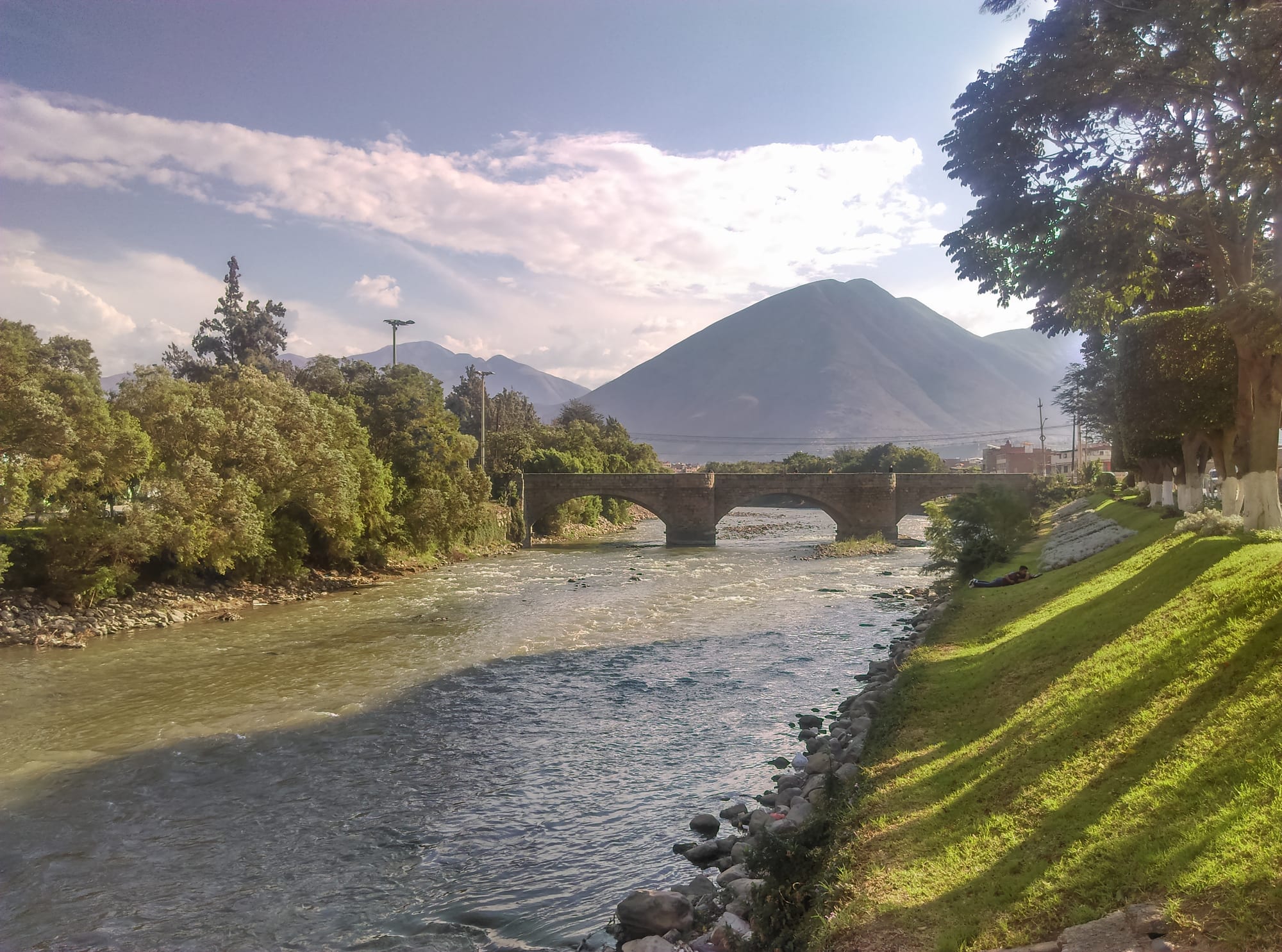
A stone arched bridge over a fast, clear river, with a grassy tree-lined bank and a pointed mountain behind

The Central Highlands, Peru

Huánuco

The stone Calicanto bridge in Huánuco. (Templariocristiano / Wikimedia Commons · CC BY-SA 4.0)

The capital of the Huánuco Region, at about 1,900 metres where the Higueras river meets the Huallaga on the eastern slopes of the Andes. Founded by the Spanish in 1539, it stands near Kotosh, a temple site of the Andean preceramic period, and today is a mild, sunny trading and university city on the highway from Lima to the Amazon.

Neighbourhoods

  • The centre and Plaza de Armas
    • First-time visitors
    • Close to public transport

    The compact old grid around the Plaza de Armas and the modern cathedral, with banks, shops, hotels, the tour agencies on Jirón General Prado and the offices of several bus companies. It is small enough to cover on foot.

    Open in Maps
  • Amarilis
    • Quiet and residential
    • Students

    The district on the right bank of the Huallaga, one of the three that make up the city, with an estimated population of over 67,000.

    Open in Maps
  • Pillco Marca
    • Quiet and residential

    The third of the city's three districts, alongside Huánuco itself and Amarilis.

    Open in Maps

Things to do

Archaeology

  • Kotoshattraction

    An archaeological site about 5 kilometres from the city with six periods of occupation, best known for the Temple of the Crossed Hands, whose mud reliefs of crossed arms date to around 1800 BC; the original relief is in Lima and a replica remains on site.

    Open in Maps

In the city

  • Huánuco Cathedrallandmark

    The Cathedral of the Lord of Burgos, seat of a diocese created in 1865; the original church of 1618 was demolished in 1965 and replaced by a modern building.

    Open in Maps
  • Estadio Heraclio Tapiaattraction

    The city's 25,000-seat stadium, built in 1972 and renovated in 2010, home to Alianza Universidad and León de Huánuco, whose matches make up the Huánuco Classic.

    Open in Maps

Short trips from the city

  • Tomayquichuaattraction

    A village about 19 kilometres from Huánuco, near Ambo, known as the birthplace of the colonial actress Micaela Villegas, La Perricholi, whose house is its main sight.

    Open in Maps
  • Tingo María National Parkpark

    The park on the jungle edge to the north-east, protecting the Bella Durmiente ridge and the Cueva de las Lechuzas, a cave inhabited by oilbirds.

    Open in Maps
  • Huánuco Pampaattraction

    The ruins of one of the Inca empire's great administrative centres on a high plateau near La Unión, where the Spanish first founded Huánuco in 1539.

    Open in Maps

Eat and drink

Long-standing places and food districts in Huánuco. Hours, ratings and directions come from your maps app, always current.

Huánuco classics

  • Menú lunchesrestaurant

    The everyday set lunch of soup, main course and a drink, served in small restaurants around the centre.

    Open in Maps
  • Valley fruitmarket

    The warm valleys around the city grow avocado, mango, papaya, oranges, lúcuma, custard apple and guava, sold in the city's markets.

    Open in Maps

Food districts

  • Jirón General Pradoneighborhood

    A central street a block from the Plaza de Armas with restaurants among its shops and agencies, including a vegetarian set-meal restaurant.

    Open in Maps

Experience Huánuco

History

People have lived in the Huallaga valley for thousands of years. At Kotosh, just outside today's city, a sequence of temples was built and rebuilt over six periods of occupation; the oldest, of the Mito phase, include the Temple of the Crossed Hands, named after two mud reliefs of crossed arms dating to around 1800 BC. The site gave its name to the Kotosh Religious Tradition, an early form of Andean temple worship. Under the Inca the valley, then known as Pillco, sent young women to serve as acllas in Cusco, and the region was administered from Huánuco Pampa, high in the mountains to the west.

The Spanish conquistador Gómez de Alvarado founded Huánuco on 15 August 1539 at the old Inca centre, but the town was soon moved; by 1541 it stood in its present place in the warm Pillco valley, where the Higueras meets the Huallaga. In 1543 Charles V granted it a coat of arms and the title of "Very Noble and Very Loyal". The colonial town became a farming and trading centre on the eastern edge of the Andes.

Huánuco played its part in the War of Independence and again in the War of the Pacific, when guerrilla units raised here, the most prominent led by Colonel Leoncio Prado, fought the Chilean occupation in the Breña campaign, and the city suffered a massacre during the occupation of 1881–1883. The highway from Lima to Pucallpa made it a staging post between the coast and the Amazon, and in recent years growth in mining has added to its economy.

Culture & Customs

Huánuco's culture blends the highlands and the jungle edge. Its best-known son in music is Daniel Alomía Robles, the composer and ethnologist born here in 1871, who wrote El Cóndor Pasa. Other notable natives include President Mariano Ignacio Prado, born in 1825, and Colonel Leoncio Prado, who fought in Cuba and led the resistance to Chile and whose name a city school bears.

Catholic life centres on the cathedral, dedicated to the Lord of Burgos and the seat of a diocese since 1865, and on older churches such as San Cristóbal, built in 1560, whose tower collapsed in 2014.

Football is the main passion. Alianza Universidad, which plays in the national first division, and León de Huánuco, historically the city's biggest club and founded in 1946, meet in the Huánuco Classic at the 25,000-seat Estadio Heraclio Tapia, one of the highest-altitude stadiums in South America. Futsal, volleyball, handball and basketball are also widely played, and a newer 11,000-seat stadium forms part of a sports complex.

Daily Life

The city had about 197,000 people in 2017, spread over its three districts: Huánuco itself, Amarilis and Pillco Marca. As capital of the Huánuco Region it is the seat of the regional government, and the national university, Hermilio Valdizán, and the private University of Huánuco are both based here.

Agriculture is the main economic sector. The surrounding valleys produce vegetables, potatoes and cassava as well as a long list of fruit — avocado, mango, bananas, papaya, oranges, lúcuma, custard apple and guava — and the warmer lands grow coffee, pineapple, sugarcane and coca. The timber industry is important in the region, commerce supports much of the population, and mining grew sharply in 2023.

Daily life follows the rhythm of a provincial capital: offices and schools in the morning, a long lunch break, busy streets of taxis and mototaxis around the centre, and evenings in the plaza. The mild, dry and sunny climate is often described as good for people with asthma.

Food

Huánuco's food draws on both sides of its position between the Andes and the jungle. From the highlands come potatoes, maize and hearty soups; from the warm valleys and the lowlands to the north-east come tropical fruit, cassava, coffee and juane, rice and chicken wrapped and cooked in leaves, the classic dish of the Peruvian Amazon.

Fruit is the region's great strength, and markets sell avocados, mangoes, papayas, oranges and guavas grown nearby, along with lúcuma and custard apple; the warm valleys also grow pineapple, sugarcane and coffee, and in livestock farming crossbreeding zebu cattle with native cows has given good results.

For everyday eating, small restaurants around the Plaza de Armas and Jirón General Prado serve the menú, the set lunch of soup, a main course and a drink that most working people eat at midday, and one restaurant a block from the plaza serves vegetarian set meals. Highland and jungle produce meet on the same market stalls, which is the clearest picture of where the city stands.

Planning tools

Budget

Huánuco is inexpensive. Hotels, set lunches, taxis and mototaxis cost well below Lima or Cusco, and the trip to Kotosh is a short, cheap ride. The main costs are a flight from Lima or a guided day tour to Tingo María.

Daily Budget Midrange
USD 55–100 (comfortable hotel, restaurants, taxis and a guided day tour)
Daily Budget Shoestring
USD 20–35 (guesthouse, menú lunches, mototaxis and colectivos)

Agencies near the Plaza de Armas sell tours of the city, Kotosh and Tingo María; a taxi with a short wait is the simple way to see Kotosh.

Best Time to Visit

The climate is mild, dry and sunny for much of the year, so any season works. July and August are the coolest months and November and December the hottest. The wider Andes have their rainy season from about November to March, which affects mountain roads and the trip down to Tingo María.

Suggested Number of Days

One or two days are enough for the city and its nearby archaeology. Allow three or four to add the jungle-edge country to the north-east or the high Inca ruins to the west, which involve long road journeys.

First Visit
1–2 days
With Surroundings
3–4 days

Transportation

Taxis and mototaxis are plentiful and cheap for getting around the city and out to its edges. Colectivos and buses run north-east to Tingo María in about two to three hours, south to Cerro de Pasco and Huancayo, and west towards La Unión and on to Huaraz.

Travel the highways by day, especially the long road on from Tingo María to Pucallpa.

Airport & Station Connections

Alférez FAP David Figueroa Fernandini Airport, in the Huallaga valley, has regular flights to Lima. Many bus companies run from Lima on one of the country's main highways, a journey of about eight hours, and buses from Huancayo take about seven.

Walkability

The centre is small and easy to walk, with most hotels, restaurants and bus offices within a few blocks of the Plaza de Armas. The riverbanks of the Huallaga make pleasant walks; Kotosh and the outer districts are a short taxi or mototaxi ride away.

Safety

The standard tourist circuit — Lima's Miraflores and Barranco, Cusco, the Sacred Valley, Arequipa, Puno — is generally safe with urban precautions, but crime has risen. The central highland cities, Huánuco among them, are generally calm, and ordinary care with bags and phones is enough in the centre. The risks the regional advice stresses are on the roads: mountain highways see frequent bus accidents, and night travel is best avoided.

Use registered taxis, take daytime buses from established companies, and keep valuables out of sight in crowded markets. Check current official travel advice before travelling.

Climate

A mild, semi-arid valley climate, dry and sunny for much of the year, with very warm days and comfortable nights at about 1,900 metres.

Summer
December–February is warm; the hottest months are November and December, with days of about 30°C
Winter
June–August is the coolest season, with July and August days around 21°C and nights around 17°C

Local Customs

Spanish is the everyday language. A handshake and a polite greeting open most conversations, and rounding up the bill or leaving around 10 per cent in sit-down restaurants is appreciated rather than expected. Modest dress is expected in churches.

Ask before photographing people, especially in markets and during religious processions.

Common Payment Methods

The currency is the sol (PEN). Larger hotels and some restaurants take cards, but taxis, mototaxis, colectivos, markets and small restaurants work in cash. ATMs are found around the centre and charge fees.