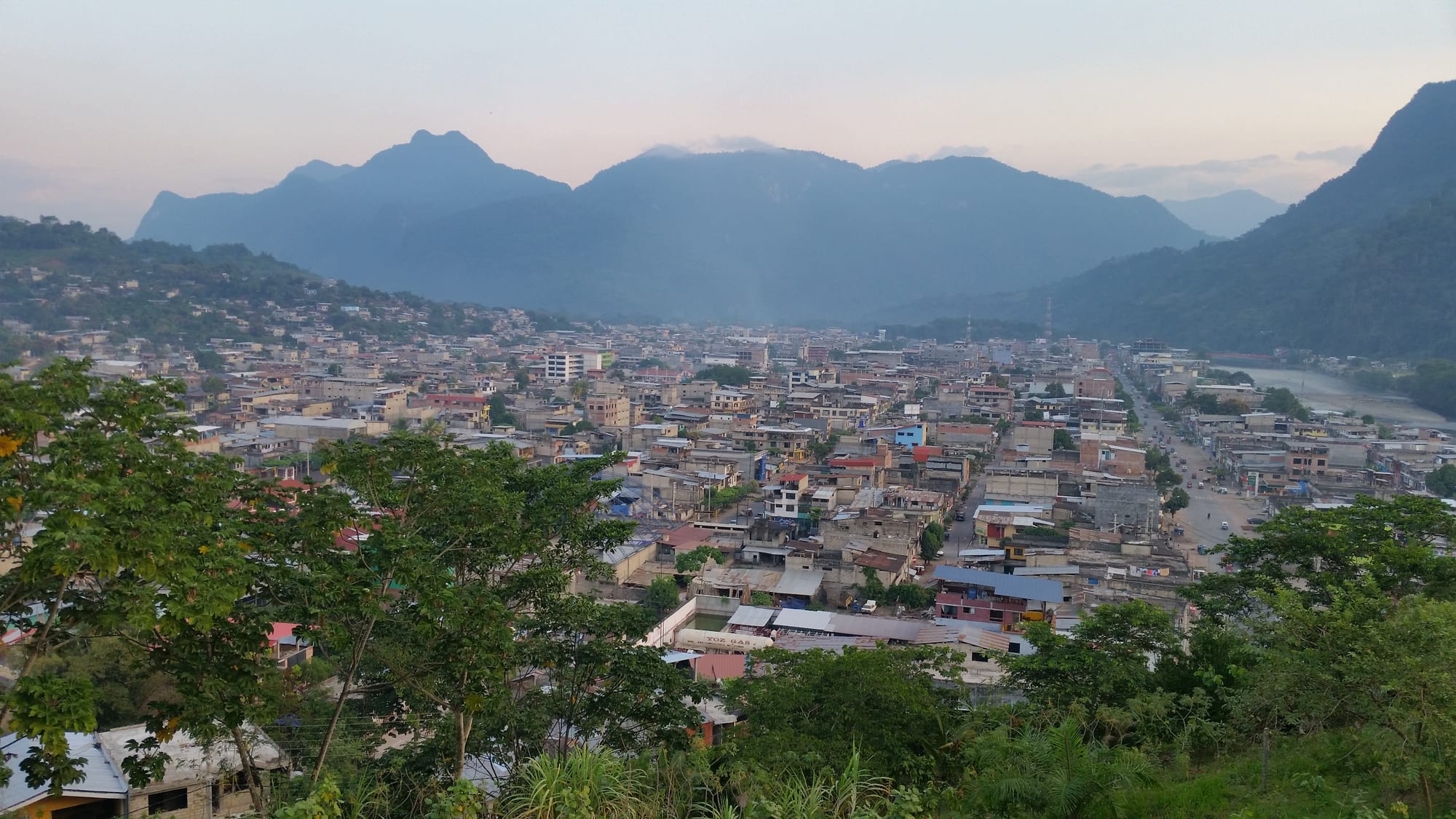
Rooftops of a low town spread across a valley floor, with steep forested mountains rising behind in the evening haze

The Central Highlands, Peru

Tingo María

Tingo María below the forested ridge of the Bella Durmiente. (Heiner Amado Cadillo / Wikimedia Commons · CC BY-SA 3.0)

A humid town on the edge of the Amazon where the Monzón meets the Huallaga, below the forested ridge called the Bella Durmiente, or Sleeping Beauty. Opened up by the road from Lima in 1936 and founded as a settlers' town in 1938, it lives from farming, coffee and cacao, a university and visitors to its national park and the Cave of the Owls.

Neighbourhoods

  • The centre and the Alameda Perú
    • First-time visitors
    • Close to public transport

    The grid around the Plaza de Armas and the Alameda Perú, a seven-block avenue of wide pavements and native trees with monuments to Leoncio Prado and the aviator José Abelardo Quiñones. Hotels, restaurants, banks and the transport offices are all here.

    Open in Maps
  • The university and the riverside
    • Quiet and residential
    • Nature

    The campus of the National University of the Forest, with its botanical park, and the banks of the Huallaga, where people head to the river beaches for the San Juan festival. Greener and quieter than the centre, with the Bella Durmiente in view.

    Open in Maps

Things to do

The national park

  • Tingo María National Parkpark

    A park of about 4,800 hectares created in 1965, protecting misty montane forest, steep limestone walls and wildlife from spider monkeys to cock-of-the-rock; birdwatching and hiking are the main activities.

    Open in Maps
  • La Bella Durmienteviewpoint

    The limestone ridge, also called Puma Rinri, whose outline seen from the town resembles a sleeping woman; it rises to about 1,805 metres and gives Tingo María its nickname.

    Open in Maps
  • Cueva de las Lechuzasattraction

    The park's best-known sight and one of the most accessible caves in Peru, about 15 minutes from the town, named the Cave of the Owls after the colony of nocturnal oilbirds that nests inside.

    Open in Maps

Rivers and pools

  • Cueva de las Pavaspark

    A spot on the banks of the Las Pavas river near the town, popular for bathing and picnics.

    Open in Maps
  • Aguas Saladaspark

    A natural pool near the town, valued locally as medicinal.

    Open in Maps

In the town

  • Plaza de Armas and Alameda Perúlandmark

    The main square and the tree-lined avenue that crosses the centre, the town's places for an evening walk, with monuments to local and national heroes.

    Open in Maps
  • Óvalo Leoncio Pradolandmark

    A roundabout with a statue of Colonel Leoncio Prado, the Huánuco-born hero of the War of the Pacific after whom the province is named.

    Open in Maps

Seasonal events

  • National park anniversaryMay

    The town marks the founding of its national park, created by law on 14 May 1965.

  • Fiesta de San Juan24 June

    The Amazonian feast of St John: dancing round bonfires on the eve, a yunza tree hung with gifts at dawn, and a day on the river beaches with dances, craft fairs and juane for everyone.

  • Fiestas Patrias28–29 July

    Peru's independence holidays, celebrated with parades and events in the town.

  • Anniversary of Tingo MaríaOctober

    The town celebrates its founding on 15 October 1938.

Eat and drink

Long-standing places and food districts in Tingo María. Hours, ratings and directions come from your maps app, always current.

Tingo María classics

  • Juanerestaurant

    A large tamale of rice, chicken, olives and egg wrapped in a bijao leaf, the traditional dish of the San Juan festival.

    Open in Maps
  • Tacacho con cecinarestaurant

    Fried green plantain mashed with salt and pork lard, served with cecina, dried and smoked pork.

    Open in Maps
  • Patarashcarestaurant

    Local river fish seasoned and wrapped in banana or bijao leaves, then grilled, baked or boiled.

    Open in Maps

Drinks

  • Fruit drinkscafe

    Aguajina from the aguaje palm fruit, juice of the tart cocona, chapo of ripe plantain, and fruits such as caimito.

    Open in Maps

Experience Tingo María

History

Before the Spanish, the forests along the Monzón and the Huallaga were home to peoples such as the Panatahuas and the Tulumayos, and chroniclers record that some withdrew deeper into the forest when Inca armies pushed into the region. A stone road about 5 kilometres long between the provinces of Leoncio Prado and Pachitea survives from the Inca period, linking the high jungle with the sierra. The name comes from the Quechua tinku, a meeting of rivers — here the Monzón and the Huallaga — and, by one local tradition, from a woman called María who fed and sheltered travellers on the river.

A small settlement, Juana del Río, had begun to form by about 1830, and explorers passed through in the 19th century; in 1868 Leoncio Prado took part in a hydrographic expedition down the Huallaga. But Tingo María was considered almost unreachable until 1936, when the road from Lima arrived. On 15 October 1938 the land was expropriated in favour of the settlers living there, the act now celebrated as the town's founding.

The state set up an agricultural experimental station, and from 1942 the United States government helped fund it; by 1960 over 160 square kilometres were under cultivation along the level land of the valley, with coffee a particularly valuable crop. The national park followed in 1965. In 1966 the American actor Eric Fleming, star of Rawhide, drowned in the Huallaga while filming nearby. Today the town is a regional hub on the highway between Lima and Pucallpa.

Culture & Customs

Tingo María calls itself the "door of the Amazon", and its culture is a blend of highland settlers and Amazonian tradition. The Bella Durmiente, the ridge whose silhouette resembles a sleeping woman, is the town's emblem, explained by a local legend, and gives it its other name, the "city of the Sleeping Beauty".

The great festival is San Juan on 24 June, shared across the Peruvian Amazon. On the eve, Tulumayo groups dance around bonfires to local bands; at dawn comes the pandillada, when people dance around a yunza, a tree hung with gifts; and during the day families go to the river beaches for dances, craft fairs and juane. The town's own anniversary in October and the anniversary of the national park in May are also celebrated.

The patron saint is Santa Teresita, chosen at the founding for the settlers' Catholic devotion. Traditional medicine has a strong place: drinks made from plants such as cat's claw, chuchuhuasi, camu camu and sangre de grado are part of local tradition. The National University of the Forest gives the town a student population and a focus on agriculture, forestry and the environment.

Daily Life

Tingo María had about 46,000 people at the 2017 census, making it the second-largest city of the Huánuco Region. It is the capital of Leoncio Prado Province and of Rupa-Rupa district, and its position on the highway halfway between Lima and Pucallpa, near the junction with the road north along the Huallaga to Tarapoto, makes it a busy regional crossroads.

Farming is the base of the economy. Coffee has long been a valuable crop, and cacao is important too: the Naranjillo agro-industrial cooperative works with cacao and sells its products abroad. Timber is another important industry, and the university, with seven faculties and its own botanical park, is based in the town.

Life is lived outdoors and at a relaxed pace. Mototaxis fill the streets, the Alameda Perú and the plaza come alive in the cooler evenings, and at weekends and holidays families head to the rivers and bathing spots around the town.

Food

Tingo María eats like the Amazon. The emblem is juane, a large tamale of rice, chicken, olives and egg wrapped in a bijao leaf, eaten by everyone at San Juan. Tacacho con cecina pairs fried green plantain, mashed with salt and pork lard, with cecina, dried and smoked pork. Patarashca is any local fish seasoned and wrapped in banana or bijao leaves, then grilled, baked or boiled; pollo canga is chicken grilled with orange or lime; and inchicapi is a soup of ground peanuts, farm-raised chicken, cassava, maize and sacha culantro.

Drinks are made from the forest's fruit. Aguajina comes from the aguaje palm fruit, a refreshing drink is pressed from the tart cocona, and chapo is a sweet drink of ripe plantain. Masato, made by fermenting cassava in water for about a week, is the traditional drink of the forest. Fruits such as caimito are sold in the markets.

Coffee and cacao grow in the valley around the town. Medicinal drinks of cat's claw, chuchuhuasi, camu camu and the sap called sangre de grado appear alongside the food, as does siete raíces, a drink made from seven roots.

Planning tools

Budget

Tingo María is cheap. Guesthouses, set meals, mototaxis and colectivos cost little, and the main outlay is the park entrance, local guides and the journey in by bus or plane.

Daily Budget Midrange
USD 50–100 (comfortable hotel, restaurants, guided visits to the park and taxis)
Daily Budget Shoestring
USD 20–35 (guesthouse, set meals, mototaxis and colectivos)

Visit the national park in the drier months, as access is limited in the heavy rains.

Best Time to Visit

The drier months, from about May to September, are best for the park and the trails. The rains are heaviest from about November to March, when access to parts of the park is limited. The Fiesta de San Juan in June is the town's liveliest celebration.

Suggested Number of Days

Two or three days are enough for the town and its national park at an easy pace. Rain can wash out a day in the wet season, so allowing an extra day then makes sense.

First Visit
2–3 days
With Surroundings
3–4 days

Transportation

Mototaxis are the usual way around town and out to the park, the cave and the bathing spots, and taxis can be hired for longer trips. Colectivos and buses run along the highway south to Huánuco and east towards Pucallpa.

Agree the fare before getting into a mototaxi, and travel the highways by day.

Airport & Station Connections

Tingo María Airport, beside the Huallaga on the edge of town, has daily regional flights. The Federico Basadre highway between Lima and Pucallpa runs through the town: colectivos from Huánuco take about two hours and buses about three, and many buses continue east to Pucallpa.

Walkability

The centre is flat and easy to walk, and the Alameda Perú is the pleasant way across it. Heat and humidity make walking tiring at midday. The park, the cave and the river spots are reached by mototaxi.

Safety

The standard tourist circuit — Lima's Miraflores and Barranco, Cusco, the Sacred Valley, Arequipa, Puno — is generally safe with urban precautions, but crime has risen. In Tingo María ordinary care with valuables is enough in the centre. Travel guides advise making the journey on to Pucallpa by day, as attacks on buses are not unknown. The park's terrain is steep and mountainous, with landslides in places.

Travel by day, use registered transport, and keep to marked routes in the national park. Check current official travel advice before travelling.

Climate

A tropical rainforest climate, hot and humid all year, with abundant rain — about 3,000 millimetres a year — and the heaviest falls from November to March. Local showers can be very patchy.

Summer
December–February is the heart of the rainy season, hot and humid; across the year the average maximum is about 30°C
Winter
June–August is drier, still hot and humid, with the yearly average minimum about 19°C

Local Customs

Spanish is the everyday language. The town keeps the easy-going manners of the Amazon: greetings are friendly, dress is light and informal, and rounding up the bill is appreciated rather than expected. Medicinal plant drinks, from cat's claw to sangre de grado, are part of local tradition.

Dress modestly in churches, carry insect repellent, and ask before photographing people.

Common Payment Methods

The currency is the sol (PEN). A few hotels and restaurants take cards, but mototaxis, markets, park guides and small restaurants work in cash. There are ATMs in the centre; carrying small notes helps.