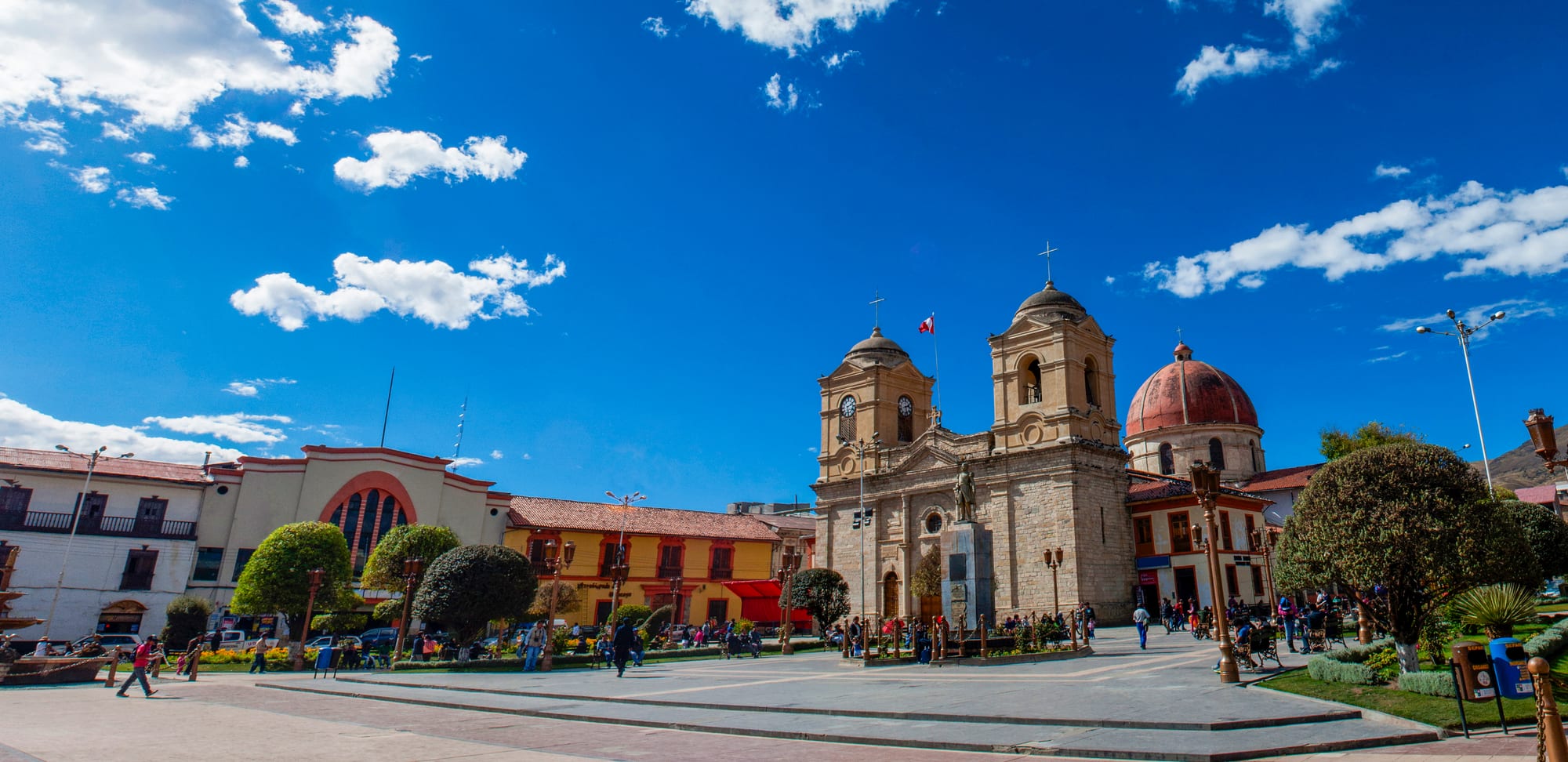
A wide paved square with clipped trees and a twin-towered stone cathedral with a red dome under a blue sky

The Central Highlands, Peru

Huancayo

Huancayo Cathedral on the Plaza de la Constitución, the main square of the city. (PoolPs / Wikimedia Commons · CC BY-SA 4.0)

The capital of the Junín Region, at about 3,250 metres at the southern end of the Mantaro Valley — a Huanca town on the Inca road, refounded by the Spanish in 1572, that grew with the railway from Lima into the commercial centre of the central Andes. Today it is a busy city of markets, universities and Sunday crafts.

Neighbourhoods

  • The centre and Plaza de la Constitución
    • First-time visitors
    • Close to public transport
    • Markets

    The old core around the main square, renamed in 1813 for the Spanish liberal constitution, with the cathedral on its west side. Calle Real, the line of the old Inca road, runs through it, and the Sunday fair, the craft market, banks, hotels and the agencies selling valley tours are all a short walk away.

    Open in Maps
  • Plaza Huamanmarca and the station quarter
    • Markets
    • Local life

    The blocks around Plaza Huamanmarca, where the city's name-giving stone is said to have stood, and the railway station to Lima. The busy market streets behind the station and the craft market behind the plaza give the area a working, trading feel.

    Open in Maps
  • El Tambo
    • Quiet and residential
    • Students

    The large district to the north, now home to much of the city's housing and many of its schools. The craft village of Cochas, known for carved gourds, belongs to it.

    Open in Maps
  • Chilca
    • Local life

    One of the three central districts of the urban area, mostly residential and commercial.

    Open in Maps

Things to do

Landmarks and views

  • Huancayo Cathedrallandmark

    The neoclassical cathedral on the Plaza de la Constitución, built between 1799 and 1831, with paintings of the Cusco School inside.

    Open in Maps
  • Cerrito de la Libertadviewpoint

    A hill on the east side of the city, now built over, where a battle of 1854 was fought; today it is a lookout over the city with a small zoo and restaurants.

    Open in Maps
  • Torre Torreviewpoint

    Clay pinnacles shaped by rain erosion, some more than 30 metres tall, about a kilometre beyond the Cerrito de la Libertad, with wider views over the city and valley.

    Open in Maps
  • Parque de la Identidad Huancapark

    A park built between 1992 and 1996 as a celebration of Huanca culture, with canals, stone portals and statues of the region's best-known folk singers and musicians.

    Open in Maps

Museums and archaeology

  • Warivilcaattraction

    The remains of a Wari-era temple in the village of Huari in Huancán district, just south of the city, with a small site museum on the plaza.

    Open in Maps
  • Museo Salesianomuseum

    The Vicente Rasetto Salesian Museum, a museum of natural history and minerals of the region and the country, on the upper floor of the Salesian school.

    Open in Maps

Markets and crafts

  • Feria Dominicalmarket

    The Sunday fair along Avenida Huancavelica, with a large section of craftspeople alongside food of every kind and everyday goods — the city's trade fair since the 19th century.

    Open in Maps
  • Hualhuasattraction

    A village about 7 kilometres north of the city where weaving of rugs and tapestries has long been the main trade.

    Open in Maps
  • San Jerónimo de Tunánattraction

    A valley town north of Huancayo known for its silver filigree jewellery, a usual stop on craft-village tours.

    Open in Maps

Sport and nights out

  • Estadio Huancayoattraction

    The 20,000-seat stadium of Sport Huancayo, the city's top-flight football club, which also hosts the yearly Marathon de los Andes.

    Open in Maps

Short trips from the city

  • The Mantaro Valleyattraction

    The broad, fertile valley of the Mantaro river, one of Peru's most productive farming areas, known for its many archaeological sites and craft villages.

    Open in Maps
  • Convent of Santa Rosa de Ocopalandmark

    A historic Franciscan monastery in a small valley town north of Huancayo, whose friars Bolívar expelled in 1824 as royalists.

    Open in Maps
  • Ingenio trout farmsattraction

    A valley district with trout farms where visitors can fish and eat the trout in local restaurants.

    Open in Maps
  • Huaytapallanatrail

    The highest peak of its range at about 5,557 metres, with a glacier reached on a full-day guided excursion; acclimatisation is needed first.

    Open in Maps
  • Jaujaattraction

    Pizarro's first capital of Spanish Peru, a laid-back town of narrow streets and blue-painted houses 45 kilometres up the valley.

    Open in Maps
  • Lake Pacapark

    A spring-fed lake 4 kilometres north of Jauja, with boat rides and lakeside restaurants.

    Open in Maps

Eat and drink

Long-standing places and food districts in Huancayo. Hours, ratings and directions come from your maps app, always current.

Huancayo classics

  • Papa a la huancaínarestaurant

    The city's most famous dish — potatoes under a creamy yellow chilli and fresh-cheese sauce, with egg and black olives — served in restaurants across the centre.

    Open in Maps
  • Trout and cuyrestaurant

    Trout ceviche, and guinea pig as picante de cuy or fried cuy chactado, are the dishes local restaurants are known for.

    Open in Maps

Food districts and markets

  • Feria Dominicalmarket

    The Sunday fair sells the farm produce of the valley alongside crafts and everyday goods.

    Open in Maps
  • Jirón Arequipaneighborhood

    A street in the centre with a cluster of vegetarian restaurants serving set menús of soup, main course and a drink.

    Open in Maps
  • Ingenio's trout restaurantsneighborhood

    Restaurants beside the trout farms of Ingenio, each with its own way of preparing the fish.

    Open in Maps

Experience Huancayo

History

The valley was home to the Huanca long before the Inca. Its central part fell within the Wari empire, which expanded north from Ayacucho from the sixth century and left the temple of Warivilca on the city's southern edge. Around 1460 the Inca ruler Pachacuti conquered the Huanca, who resisted repeatedly, and the valley became a granary of the empire and a stage on the Qhapaq Ñan, the royal road north to Cajamarca and Quito; its line through the city is still called Calle Real. When the Spanish arrived, the Huanca sided with them and fought alongside them at Cusco and against the Inca of Vilcabamba.

Huancayo was at first overshadowed by Jauja, Pizarro's provisional capital. In 1572 it was founded as a reduction, Santísima Trinidad de Huancayo, by Jerónimo de Silva. In 1813 the town celebrated the Constitution of Cádiz and renamed its market square the Plaza de la Constitución, and the cathedral was built on its west side between 1799 and 1831. Bolívar passed through in 1824, expelling the royalist friars of Ocopa, and in 1854 Ramón Castilla issued the decree abolishing slavery in Peru in a house on the square.

The railway from the coast reached the city in the early 20th century and turned it into the commercial centre of the central Andes. In the 1980s the Shining Path and the MRTA both operated in the city; the MRTA leader Víctor Polay was captured on Plaza Huamanmarca in 1988, and the Shining Path's last leader, Feliciano, at Cochas in 1999. People fleeing the violence swelled the population, and the city grew fast.

Culture & Customs

Huancayo is the cultural capital of the Mantaro Valley, and its identity is proudly Huanca, or Wanka. Music is at the centre of it: the huaylarsh, a dance that began as a farming rite and was given its modern form by the composer Zenobio Dagha and his orchestra, sits alongside the Santiago, the mulizas and huaynos. The Parque de la Identidad Huanca, completed in 1996, honours the folk singers who made the region's music known across Peru, among them La Chaparrita and Flor Pucarina, with statues among its canals and portals. Musicians, some playing cow-horn trumpets, wait outside the church of La Inmaculada to be hired for weddings and celebrations.

The surrounding villages keep the valley's craft traditions — weaving in Hualhuas, silver filigree in San Jerónimo de Tunán and the finely carved gourds of Cochas — and their festivals fill much of the year. The painter Josué Sánchez and the muralist and letterer Elliot Túpac are among the city's best-known artists, and an international book fair has been held every year since 2009.

Football, volleyball and long-distance running are the popular sports. Sport Huancayo plays in the national first division at the 20,000-seat Estadio Huancayo, which also hosts the yearly Marathon de los Andes, run at well over 3,000 metres.

Daily Life

The three central districts — Huancayo, El Tambo and Chilca — had about 400,000 people in 2020, and the wider urban area spreads into neighbouring districts along the highways. It is the economic and social centre of central Peru and, as capital of the Junín Region, the seat of the regional government, the regional ministries and the Superior Court of Junín.

Trade is the city's backbone. Farmers and traders from the valley and the jungle towns to the east bring produce, livestock and goods to its markets, and the Sunday fair along Avenida Huancavelica, held since the 19th century, is the weekly high point. Universities — the Universidad Nacional del Centro del Perú, the Universidad Peruana Los Andes and the Universidad Continental among them — give the city a large student population.

Much of the growth of recent decades came from people who sought refuge from the highlands and the Amazon lowlands during the internal conflict. The result is a busy city with crowded streets, colectivos and taxis, and the green valley and its villages a short ride away.

Food

Huancayo gave its name to papa a la huancaína, one of Peru's best-known dishes: boiled potatoes covered with a creamy sauce of yellow ají chilli and fresh cheese, garnished with hard-boiled egg and black olives.

Trout raised in the cold streams of the valley is the other staple. The farms at Ingenio are the classic place to eat it, and every restaurant there has its own recipes; ceviche de trucha, the fish cured in lime with onion and chilli, is a local favourite. Guinea pig, cuy, is served as picante de cuy, in a chilli sauce, or as cuy chactado, fried guinea pig, and pachamanca, meat and potatoes cooked on heated stones, is the meal for Sundays and celebrations.

The Sunday fair, with its farm produce, crafts and everyday goods, is a good place to see what the valley grows. Everyday lunch is the menú, a set meal of soup, main course and a drink, served cheaply in small restaurants across the centre.

Planning tools

Budget

Huancayo is one of the cheaper cities in Peru. Hotels, set lunches, city taxis and colectivos cost far less than in Cusco or Lima, and many of the sights — the Sunday fair, the plazas, the viewpoints — are free. Guided tours of the valley and the glacier, and above all a seat on the tourist train from Lima, are the larger costs.

Daily Budget Midrange
USD 60–110 (comfortable central hotel, restaurants, guided valley tours and taxis)
Daily Budget Shoestring
USD 20–40 (guesthouse, menú lunches, colectivos and city buses)

Valley craft-village tours and Huaytapallana trips are sold by agencies around the Plaza de la Constitución; compare a few before choosing.

Best Time to Visit

May to September, the dry season, brings sunny days, clear views of the mountains and cold nights. The rains run from November to March, when the valley turns green but roads and treks are muddier. Hotels fill during festivals in the surrounding towns.

Suggested Number of Days

Two or three days cover the city and a Sunday at the fair. Allow four to six to explore the wider valley and its villages, or for a high-altitude trek, which needs time to acclimatise first.

First Visit
2–3 days
With Surroundings
4–6 days

Transportation

City taxis are cheap and plentiful, and buses and colectivos follow the main streets, though routes can change, so asking locally helps. Colectivos run through the day to Jauja and other valley towns, and agencies run day tours of the craft villages. A separate railway, the Tren Macho, links Huancayo with Huancavelica.

At about 3,250 metres the city is high enough to cause altitude sickness, so arrival is best taken slowly.

Airport & Station Connections

Francisco Carle Airport at Jauja, about 45 minutes by car up the valley, has daily flights from Lima. Many bus companies run from Lima along the Carretera Central by way of La Oroya, a trip of seven to eight hours. The Lima–Huancayo railway, one of the highest in the world, has no regular passenger service, but runs several tourist trips a month on a published schedule.

Walkability

The centre is flat and compact, and the cathedral, the main plazas, the Sunday fair and the craft market are within easy walking distance. The Cerrito de la Libertad and Torre Torre are a taxi ride or an uphill walk away. The altitude makes walking more tiring than usual for new arrivals.

Safety

The standard tourist circuit — Lima's Miraflores and Barranco, Cusco, the Sacred Valley, Arequipa, Puno — is generally safe with urban precautions, but crime has risen. Huancayo itself is generally calm, though the usual city care with bags and phones applies in crowded markets. The VRAEM valleys on the eastern edge of Junín, where a Shining Path remnant and drug traffickers operate, are a separate matter and should be avoided.

Use app-based or registered taxis, take daytime buses from established companies on the mountain roads, and acclimatise before going higher. Check current official travel advice before travelling.

Climate

A subtropical highland climate with mild days and cold nights. Average highs stay close to 20°C all year. Most of the rain falls from November to March; June and July are the driest months.

Summer
December–February is the wet season, with frequent rain and milder nights, lows averaging above 6°C
Winter
June–August is dry and sunny by day, with nights regularly dropping to 0°C or below

Local Customs

Spanish is the everyday language, and Wanka Quechua is part of the region's heritage. A handshake and a polite greeting open any conversation. People in the valley villages dress for the cold and church services are frequent; photographing people, especially at markets and festivals, calls for asking first.

Dress modestly in churches, and ask before photographing craftspeople at work or animals and traders at the Sunday fair.

Common Payment Methods

The currency is the sol (PEN). Hotels, larger restaurants and shops in the centre accept cards, but the Sunday fair, colectivos, taxis and the craft villages work in cash. ATMs are common in the centre but charge fees, and small notes and coins are useful.