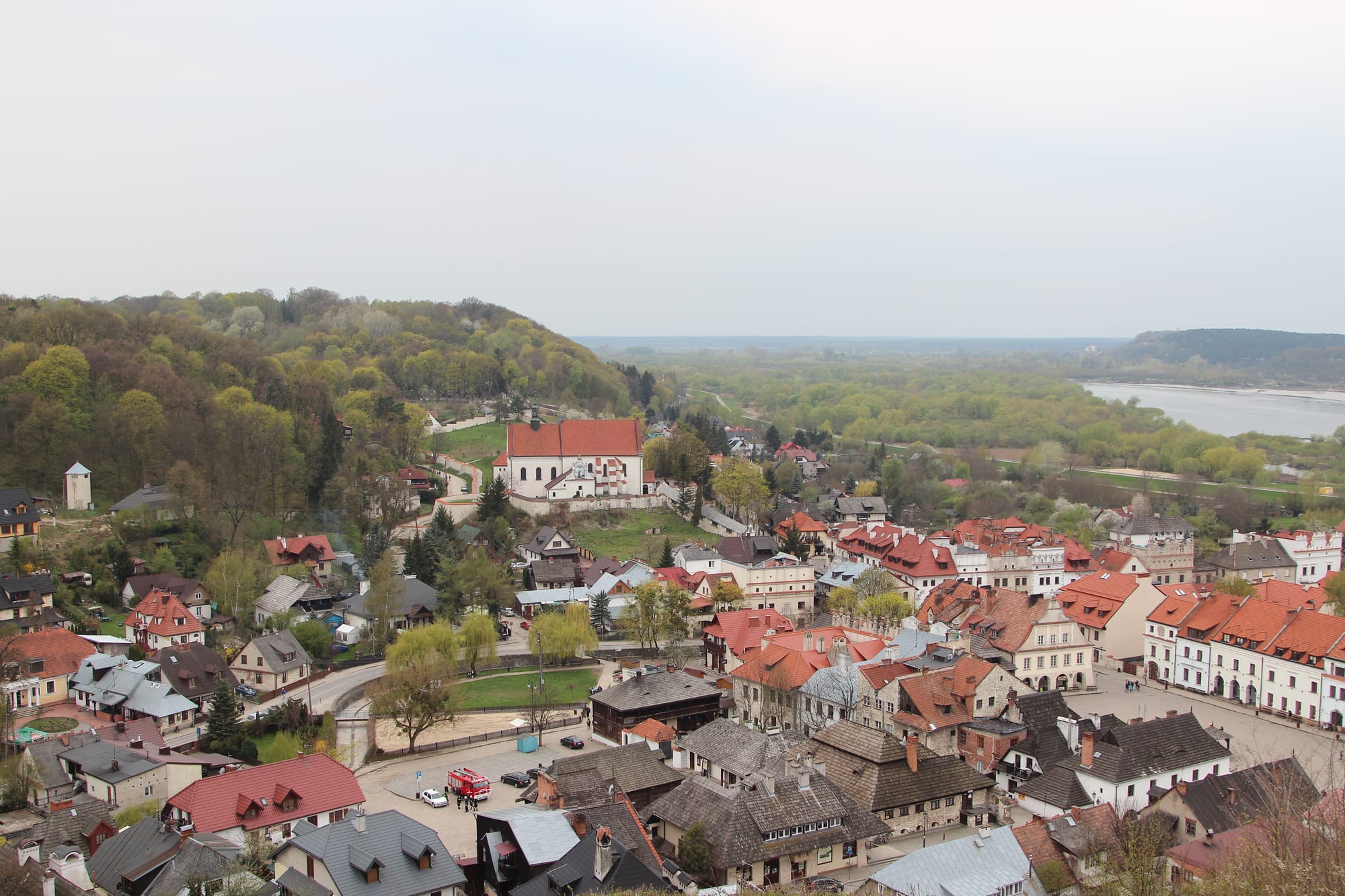
Red-roofed houses around a market square and a white church below wooded hills, with the wide Vistula river in the distance

Lublin, Zamość & the Southeast, Poland

Kazimierz Dolny

Kazimierz Dolny's market square and the Vistula seen from Three Crosses Hill. (Fallaner / Wikimedia Commons · CC BY-SA 4.0)

A small town on the eastern bank of the Vistula, about 50 km west of Lublin, that grew rich on the river grain trade in the 16th and early 17th centuries and then stood still, keeping its Renaissance square, granaries and ruined castle. Since the 19th century it has drawn painters and summer visitors, and galleries line almost every street.

Neighbourhoods

  • The Market Square and old town
    • First-time visitors
    • Historic district
    • Art galleries

    The square laid out under Władysław II Jagiełło, left open on its north side so as not to hide the parish church and the castle. Mannerist merchants' houses, galleries, bars and the main museum stand around it, with the castle ruins on the hill above.

    Open in Maps
  • The Vistula riverside and the granaries
    • Riverside walks
    • Architecture

    The road along the river towards Puławy is lined with the stone granaries of the 16th and 17th centuries that once stored grain for the boats to Gdańsk; one holds the natural history museum. Paths lead along the river and boats cross to Janowiec.

    Open in Maps
  • The gorges and hillside villas
    • Quiet and residential
    • Walking

    Deep loess gorges cut into the hills around the town, where villas and guesthouses for summer visitors from Lublin and Warsaw were built from the late 19th century. Quiet, green and a short walk from the square.

    Open in Maps

Things to do

The old town

  • Kazimierz Dolny Castlelandmark

    The ruins of a castle of the 13th and 14th centuries on the hill above the town, rebuilt by the Firlej family after fires in the 16th century.

    Open in Maps
  • Defensive towerviewpoint

    A defensive tower of the 13th or 14th century on the hill above the castle, with views over the town and the Vistula.

    Open in Maps
  • Parish church of St Bartholomew and St John the Baptistlandmark

    The parish church above the square, rebuilt in 1586–89, with an organ of 1620 and a pulpit of 1615.

    Open in Maps
  • Przybyła brothers' houseslandmark

    A pair of merchants' houses on the Market Square with Mannerist decoration of around 1615, built for the Przybyła brothers.

    Open in Maps

Museums and the Jewish town

  • Vistula Museummuseum

    The town museum, founded in 1963, with its main building on the Market Square and branches in the Celej House and the Kuncewicz House.

    Open in Maps
  • Natural History Museummuseum

    A collection of stuffed birds, insects and other animals of the region, housed in a restored 16th-century granary on the road to Puławy.

    Open in Maps
  • Jewish cemetery memoriallandmark

    About 2 km from the square on the road to Opole Lubelskie, a memorial wall built after the war from the surviving gravestones of the town's Jewish cemetery.

    Open in Maps

Gorges and the river

  • Korzeniowy Dółtrail

    The best known of the many loess gorges around the town, free to walk.

    Open in Maps
  • Kazimierz Landscape Parkpark

    A protected area established in 1979 around the town, covering about 137 square kilometres and including two nature reserves.

    Open in Maps

Short trips from the town

  • Janowiec Castlelandmark

    A Renaissance castle of 1508–26 on a steep hillside across the Vistula, reached by boat from Kazimierz.

    Open in Maps
  • Puławyattraction

    The nearest city and transport hub, home to Poland's first permanent museum, with a palace and park near its centre.

    Open in Maps

Seasonal events

  • Festival of Folk Bands and SingersJune

    A festival of folk bands and singers held since 1966, with a folk art fair alongside.

  • Klezmer festivalJuly

    A klezmer music festival, continuing since 2022 an earlier festival of klezmer music and tradition.

  • Two Riversides Film and Art FestivalAugust

    An international film and art festival held every August since 2007, which draws film lovers from around the world.

  • Wings over KazimierzSeptember

    An air show held every September since 2016.

Eat and drink

Long-standing places and food districts in Kazimierz Dolny. Hours, ratings and directions come from your maps app, always current.

Food and drink in town

  • Market Square bars and restaurantsneighborhood

    Most of the town's bars are on the Market Square, with restaurants ranging from simple to expensive on the square and in the streets towards the river.

    Open in Maps
  • Morning marketmarket

    A morning market on the Market Square on Sundays and some weekdays, with handmade baskets and trinkets on sale.

    Open in Maps

Experience Kazimierz Dolny

History

A Benedictine settlement called Wietrzna Góra stood on one of the local hills in the 11th century; in 1181 Prince Casimir II the Just gave it to Norbertine nuns from Kraków, who renamed it Kazimierz after him, and "Dolny" (Lower) was added later to tell it apart from Kazimierz near Kraków. King Casimir III the Great granted town rights in the first half of the 14th century, and Władysław II Jagiełło laid out its market square and streets.

The town's golden age came in the 16th and early 17th centuries with the Vistula grain trade. Under the Firlej family, who held it from 1501 to 1644, merchants built granaries and houses in local limestone after the fires of 1561 and 1585, and grain was shipped downriver to Gdańsk. Swedish troops burned and ransacked the town in February 1656. John III Sobieski invited Armenian, Greek and Jewish merchants to settle in 1677, but the river trade had come to an end, and after the partitions cut it off from Gdańsk the town sank into obscurity — which preserved its Renaissance plan and buildings.

From the late 19th century wealthy people from Lublin and Warsaw built villas in the gorges, and painters made it an art colony; it regained town status in 1927. Jews had lived here since the 14th century, and as Kuzmir the town gave its name to a Hasidic dynasty founded by Yehezkel Taub. On the eve of the war some 1,800 Jews lived here; the Germans set up a ghetto in 1940, and in 1942 its inmates were sent to their deaths, with fewer than twenty surviving. Partly destroyed in the war and rebuilt, the town was declared a national Historic Monument in 1994.

Culture & Customs

Kazimierz Dolny is above all an art town. Painters have come here since the 19th century to paint the square, the river and the hills and to sell their work, and galleries in almost every street offer paintings, sculpture, stained glass and folk art. The painter and sculptor Chaim Goldberg, one of its best-known Jewish residents, made depicting the town of the 1930s his life's mission and went on painting it from memory.

Its picturesque streets have long attracted film-makers: scenes for the Yiddish films Yiddle With His Fiddle of 1936 and The Dybbuk of 1937 were shot here, and several films since. The Two Riversides Film and Art Festival brings cinema to the town every August. Music has its own calendar: the Festival of Folk Bands and Singers, held since 1966, an organ festival in the parish church, a klezmer festival, the multi-genre Kazimiernikejszyn since 2014 and, since 2013, the Pardes Festival of Jewish culture.

The town is a favourite weekend escape for people from Warsaw and Lublin, part of a "tourist triangle" with Puławy and the spa town of Nałęczów. Local life follows the seasons: busy and festive in summer, quiet in winter, with the market and the parish church at the centre of the week.

Daily Life

Kazimierz Dolny had about 2,500 inhabitants at the end of 2019, a small community that swells many times over with visitors on summer weekends and festival days. Tourism is the town's economy: galleries, guesthouses, restaurants, bars and craft stalls, with summer homes in the surrounding hills.

The town is protected as a whole: its centre is a national Historic Monument, and the surrounding hills and gorges, where villas and guesthouses still stand among the trees, form the Kazimierz Landscape Park, established in 1979 and judged to have an unstable natural balance. There is no railway, so residents depend on minibuses and cars, and on nearby Puławy for rail connections and nightlife.

Life centres on the Market Square, with its morning market on Sundays and some weekdays and its bars where national football matches are shown. In 2024 an international travel magazine named the town among Europe's most beautiful small towns.

Food

Kazimierz Dolny has no single dish of its own, but its kitchens draw on the cooking of the Lublin region. Cebularz, the round wheat-dough pancake topped with diced onion and poppy seeds that is characteristic of Lublin cuisine and was first baked by Jewish bakers, is the regional snack, and pierogi are widely served.

The town's Jewish past is remembered above all in music, at the klezmer festival and the Pardes Festival of Jewish culture. Restaurants range from simple places to expensive ones, mostly on the Market Square and the streets leading down to the river, and bar prices are much the same across the town.

The morning market on the square sells handmade baskets and trinkets, and Nałęczów nearby bottles mineral water. Drinks from the regional capital are on hand too: Żołądkowa Gorzka, a herbal vodka in the tradition of the infused nalewka made by the Lublin distillery, and the Perła brewery's pilsner-type lager.

Planning tools

Budget

A popular weekend escape from Lublin and Warsaw, Kazimierz Dolny has restaurants from the simple to the expensive and prices that vary little from bar to bar. Many guesthouses stand in villas in the gorges, and summer and festival weekends are the busiest times.

Daily Budget Midrange
USD 110–200 (hotel or villa guesthouse, restaurant meals, museum entries, boat to Janowiec)
Daily Budget Shoestring
USD 45–80 (guesthouse room, simple meals, minibuses)

Walking the gorges, the riverside and the castle hill costs nothing; the tour buses from the square visit the Jewish cemetery and the largest gorge for anyone short of time.

Best Time to Visit

May to September, when the festivals run — folk music in June, klezmer in July, film in August — and the gorges and riverside are at their greenest. Autumn colours in the hills make October attractive. Winter is quiet and cold.

Suggested Number of Days

Most first visits last one or two days; three give time for the nearby spa and river towns as well. The number grows for walkers and gallery lovers, and festival weekends are crowded enough to warrant extra time.

First Visit
1–2 days
With Surroundings
3 days

Transportation

The town is small and compact and easily walked. There is a taxi stand on the Market Square, and bicycles and scooters can be hired near the river by the hour or the day. Tour buses from the square visit the Jewish cemetery and the largest gorge.

There is no railway: arrive by minibus or car, and walk once in town.

Airport & Station Connections

Kazimierz Dolny has no rail connection; the nearest station is in Puławy, about 10 km away. Minibuses run daily from Warsaw, Lublin and Puławy. Lublin, about 50 km to the east, is the regional capital, and Lublin Airport is the nearest airport.

Walkability

Very walkable: the square, the castle hill and the riverside are a few minutes apart. Streets are cobbled and the paths up to the castle and into the gorges are steep and can be muddy after rain. A walk of about 2.5 km along the Vistula leads to a large limestone quarry and the boats to Janowiec.

Safety

Poland is a safe country with low violent crime. Kazimierz Dolny is a small, quiet town, though crowded on summer weekends and during festivals. The gorge paths can be slippery, and ticks are common in the woods and meadows.

Wear sturdy shoes for the gorges and check for ticks after walks. Check current official travel advice before travelling.

Climate

A humid continental climate with warm summers and cold winters. In nearby Lublin the average yearly temperature is about 7–8°C.

Summer
warm — in nearby Lublin, July and August average about 19°C
Winter
cold — in nearby Lublin, January and February average about −5°C

Local Customs

A tip of around 10 per cent is usual in restaurants, though not everyone leaves one. A 'dzień dobry' (good day) is a common greeting. The town's churches are places of worship first, and the Jewish cemetery memorial is a place of mourning.

Men remove hats in churches; ask before photographing artists at work or their pieces in the galleries.

Common Payment Methods

The currency is the Polish złoty (PLN), not the euro. Cards and contactless payment are widely accepted in restaurants, hotels and galleries, but market stalls and small shops may prefer cash.