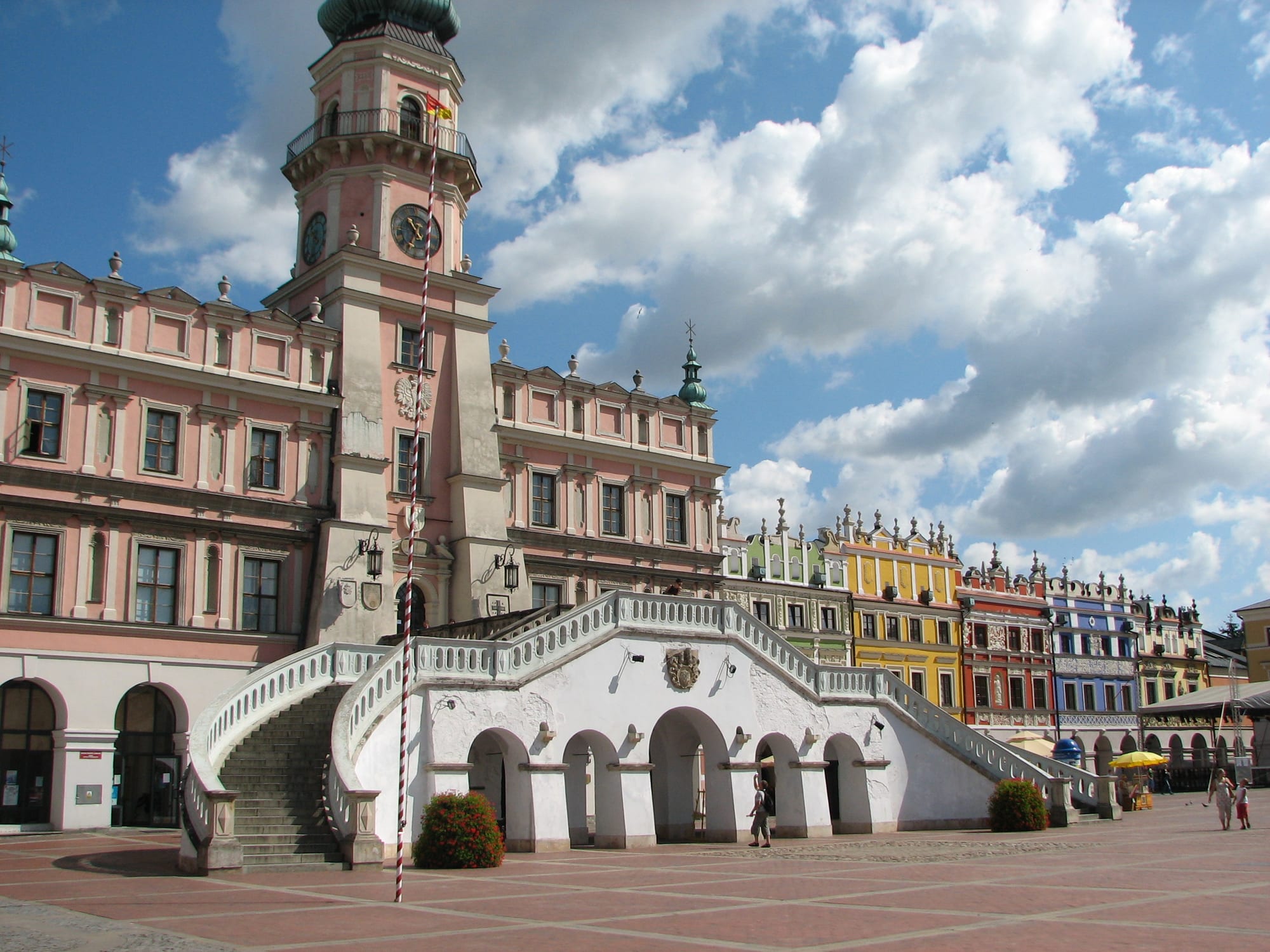
A pink town hall with a tall clock tower and a white curved double stairway, beside a row of brightly painted arcaded houses

Lublin, Zamość & the Southeast, Poland

Zamość

The town hall and the arcaded houses of the Great Market Square in Zamość. (Pryma / Wikimedia Commons · CC BY-SA 3.0)

A planned Renaissance town in south-eastern Poland, about 90 km from Lublin, founded in 1580 by Chancellor Jan Zamoyski as his ideal city and laid out by the Paduan architect Bernardo Morando. Its arcaded market square, town hall, churches and bastions survive almost intact and form a UNESCO World Heritage Site, with the forests of Roztocze close by.

Neighbourhoods

  • Old Town
    • First-time visitors
    • Historic district
    • Architecture

    Morando's planned town of the 1580s, still on its original grid: the 100-metre-square Great Market Square with the town hall and arcaded merchants' houses, the smaller Salt and Water squares, the cathedral, the synagogue and the bastions. Small enough to cross on foot in minutes.

    Open in Maps
  • The green ring around the Old Town
    • Parks
    • Quiet and residential

    The old town keeps its separate character thanks to the green belt that replaced much of the demolished fortress — the City Park with its pond to the north-west and squares to the south and west. The Rotunda memorial stands just outside, and the zoo and railway station are a short way off.

    Open in Maps
  • New Town
    • Local life
    • Quiet and residential

    The large south-eastern part of the city that locals call Nowe Miasto, a mainly residential area, once a separate settlement, with the New Market Square at its centre.

    Open in Maps

Things to do

The ideal town

  • Zamość Town Halllandmark

    The town hall on the north side of the Great Market Square, with a 52-metre clock tower and an 18th-century fan-shaped double stairway; it holds the tourist information centre.

    Open in Maps
  • Armenian houseslandmark

    The richly decorated 17th-century merchants' houses on the square's Armenian Street side, built by Armenian traders, with carved saints, lions and dragons on their façades.

    Open in Maps
  • Zamość Museummuseum

    The town museum, housed in the Armenian houses beside the town hall on the north side of the Great Market Square.

    Open in Maps
  • Apteka Rektorskaattraction

    A pharmacy on the Great Market Square that has been operating continuously since 1609, the oldest in Poland.

    Open in Maps
  • Zamoyski Academylandmark

    The building of the academy founded by Jan Zamoyski in 1594, the third institution of higher education in the Commonwealth.

    Open in Maps

Churches and the synagogue

  • Zamość Cathedrallandmark

    The Cathedral of the Resurrection and St Thomas the Apostle, built by Morando in 1587–98 on Italian models, with crypts of the Zamoyski family and a separate Baroque bell tower.

    Open in Maps
  • Zamość Synagoguemuseum

    A Renaissance synagogue completed in 1618, the clearest reminder of the town's Jewish past, restored from 2005 and now a museum.

    Open in Maps
  • Franciscan Churchlandmark

    The largest church in Zamość, a 17th-century Baroque church that lost its religious role after 1784, later housing a cinema and a school, and was returned to the Franciscans in 1993.

    Open in Maps

Fortress and memory

  • Zamość Fortresslandmark

    Bastions, gates and walls built between 1579 and 1618 that withstood the Cossacks and the Swedes; restored parts, including Bastion VII, can be visited.

    Open in Maps
  • Arsenal Museummuseum

    A military museum in the old fortress arsenal.

    Open in Maps
  • Zamość Rotundamuseum

    A 19th-century fortification where the Gestapo ran a camp and execution site during the Second World War, now a museum of the martyrdom of the Zamość region.

    Open in Maps

Parks and the zoo

  • Zamość Zoopark

    A zoo founded in 1918, covering about 13 hectares, the only one in the Lublin province.

    Open in Maps

Short trips from the town

  • Roztocze National Parkpark

    About 20 km away, a national park protecting the forests of the middle Roztocze hills, with its headquarters in Zwierzyniec.

    Open in Maps
  • Szczebrzeszynattraction

    A small town about 20 km west, often called the capital of the Polish language.

    Open in Maps
  • Krasnobródattraction

    A spa town on the Wieprz near the Roztocze National Park, with an old church and a former Dominican monastery.

    Open in Maps

Seasonal events

  • Zamość Summer Theatresummer

    Open-air performances held every summer since 1976, many of them on the Great Market Square.

Eat and drink

Long-standing places and food districts in Zamość. Hours, ratings and directions come from your maps app, always current.

Zamość classics

  • Biłgoraj pierógrestaurant

    A baked pie from the Biłgoraj Land south-west of Zamość, filled with potato, curd cheese and buckwheat groats with mint, served hot or cold with sour cream.

    Open in Maps

Food districts

  • Great Market Squareneighborhood

    Restaurants and cafés under the arcades of the merchants' houses, with tables on the square in summer, serving Polish traditional cooking.

    Open in Maps
  • Cafés of the Old Townneighborhood

    Cafés and bars in the cellars and streets around the three market squares.

    Open in Maps

Experience Zamość

History

Zamość was founded in 1580 by Jan Zamoyski, Chancellor and Hetman of the Polish–Lithuanian Commonwealth, on the trade route linking western and northern Europe with the Black Sea. Modelled on Italian trading cities, it was designed by the Paduan architect Bernardo Morando on an anthropomorphic plan: the Zamoyski Palace as the head, Grodzka Street as the backbone and the Salt and Water markets as the inner organs. Zamoyski invited settlers of many nations — Armenians, Greeks and Jews, the first of them Sephardi Jews from Italy, Spain, Portugal and Turkey — and in 1594 founded the Zamoyski Academy.

The fortress proved its worth: it held out against Bohdan Khmelnytsky's Cossacks in 1648 and the Swedes in 1656, and fell only during the Great Northern War. Annexed by Austria in 1772, it passed to the Duchy of Warsaw in 1809 and then to Russian-ruled Congress Poland; in the November Uprising of 1830–31 it was the last Polish stronghold to surrender. The demolition of the fortress in 1866 allowed the town to grow beyond its walls.

The Second World War was devastating. German bombing in September 1939 killed over 250 people, the Rotunda became a Gestapo execution site where more than 8,000 died, and the Nazis chose the fertile Zamość region for German colonisation, renaming the town Himmlerstadt and expelling tens of thousands of people, including thousands of children. The town's Jews, who made up 43 per cent of the population on the eve of the war, were deported to Bełżec and murdered. The Old Town itself survived, and in 1992 it was added to the UNESCO World Heritage List as a unique example of a Renaissance town in Central Europe.

Culture & Customs

Zamość is proud of its title "pearl of the Renaissance" and of being called "the new Padua". The Great Market Square, regarded as one of the most beautiful 16th-century squares in Europe, is the town's stage: the summer theatre season has put on performances there since 1976, and festivals of jazz, folk and religious film fill the year. The Karol Namysłowski Symphony Orchestra gives concerts in the town, and the Jazz na Kresach festival has run since 1982 to commemorate Mieczysław Kosz.

The town's past as a meeting place of nations is written on its buildings — the Armenian merchants' houses with their carved saints, lions and dragons, the former Orthodox church of St Nicholas with its Moldavian features, and the restored synagogue. The poet Solomon Ettinger and the writer Isaac Leib Peretz are among the prominent Jews who lived in the town.

Local folk culture of the Zamość region is kept alive by associations and fairs that also promote the regional kitchen. Memory of the war remains strong, centred on the Rotunda and on the children of the Zamość region taken by the Germans. Sport centres on the handball club Padwa Zamość and the football club Hetman Zamość.

Daily Life

Zamość had about 62,000 inhabitants in 2021, the second city of the Lublin province, though numbers have slipped since a peak of more than 68,000 in 1999 as families move to new houses in the surrounding villages. From 1975 to 1998 it was the capital of its own province, and it remains the centre of the Zamość region, with schools, colleges and offices serving a wide farming hinterland.

The economy rests on services and many small firms, alongside food factories that reflect the region's farming — grain milling, animal feed, frozen food and dairy — and makers of furniture, metal hardware and agricultural machinery. The town lies on the broad-gauge railway that runs from the former Soviet Union towards the Silesian mines, and less than 60 km from the crossings into Ukraine.

Most residents live in housing estates and suburbs outside the walls, above all in the south-eastern New Town, while the Old Town is the place for strolls, cafés and churchgoing. A municipal bus network, recently joined by electric buses, links the estates with the surrounding villages.

Food

The cooking of the Zamość region is rural and filling, and buckwheat groats run through many dishes of the Lublin region. The best-known local dish is the Biłgoraj pieróg, from the Biłgoraj Land to the south-west: a pie, baked with or without a yeast-dough crust, filled with cooked potatoes, curd cheese and buckwheat groats, with eggs, sour cream, fatback or lard and mint, and served hot or cold with sour cream, milk or butter. A bread roll filled with the same mixture is called kaszak.

Lublin's cebularz, a wheat-dough pancake topped with onion and poppy seeds, is sold across the region, and pierogi are widely served. Restaurants and cafés under the arcades of the Great Market Square serve Polish dishes at tables set out on the square in summer, and regional food is promoted at local fairs. The region's fertile black soil supports farming, and the town has a large grain company, a dairy and a frozen-food plant.

Planning tools

Budget

Zamość is one of the cheaper places to visit in Poland, with hotels and restaurants costing less than in Kraków or Warsaw. The Old Town is small, and the square, streets and bastions cost nothing to see.

Daily Budget Midrange
USD 100–190 (Old Town hotel, restaurant meals, museum entries, a hire car for Roztocze)
Daily Budget Shoestring
USD 40–70 (hostel or guesthouse, milk bars and bakeries, local buses)

Many museums close on Mondays, so plan sightseeing for the rest of the week; bicycles can be hired from the tourist information centre on the square.

Best Time to Visit

May to September, when café tables fill the Great Market Square and the summer theatre season brings performances to the square. Spring and autumn are quieter and good for walks in Roztocze. Winters are cold, and the town is very quiet.

Suggested Number of Days

One full day covers the Old Town and its fortifications, two allow the museums at an easy pace. Three or four days leave time for the forests and small towns of Roztocze, for which a car or bicycle makes the biggest difference.

First Visit
1–2 days
With Surroundings
3–4 days

Transportation

The Old Town is small and best seen on foot. A municipal bus network of some 28 routes links the city with its outer districts and surrounding villages, running from early morning to late evening on the busiest lines. A car or bicycle is the easiest way to reach Roztocze.

Buses to Lublin and nearby towns run more often than trains and leave from the bus station on the other side of the centre from the railway station.

Airport & Station Connections

The nearest airport is Lublin Airport, near Lublin; Rzeszów and Warsaw have larger airports. Regional trains to Lublin take about two hours, and one long-distance train a day runs via Kraków. Buses connect more often with Lublin and surrounding towns. By road the city lies on the main route from Lublin towards the Ukrainian border, less than 60 km away.

Walkability

Very easy: the Old Town is compact, its main axes crossing at the Great Market Square, and almost everything of interest lies inside it or along the parks at its edge. The railway station and the zoo are a longer walk away.

Safety

Poland is a safe country with low violent crime. Zamość is a quiet provincial town, and the main things to watch are bags in busy summer crowds on the square and ticks on forest walks in Roztocze. Since 2022 the border region has seen more military traffic and refugees from Ukraine, but daily life is normal.

Check for ticks after walks in Roztocze and stay on marked trails. Check current official travel advice before travelling.

Climate

A temperate climate with a strongly continental touch, typical of eastern Poland, and most rain falls between May and August.

Summer
warm — July averages about 17°C
Winter
cold — January averages about −4°C

Local Customs

A tip of around 10 per cent is usual in restaurants, though not everyone leaves one. A 'dzień dobry' (good day) is a common greeting, and the cathedral and churches are places of worship first.

Men remove hats in churches; dress modestly in churches and at the Rotunda memorial, which is a place of mourning.

Common Payment Methods

The currency is the Polish złoty (PLN), not the euro. Cards and contactless payment are widely accepted, but small bakeries, kiosks and markets may prefer cash. ATMs are easy to find around the Old Town.