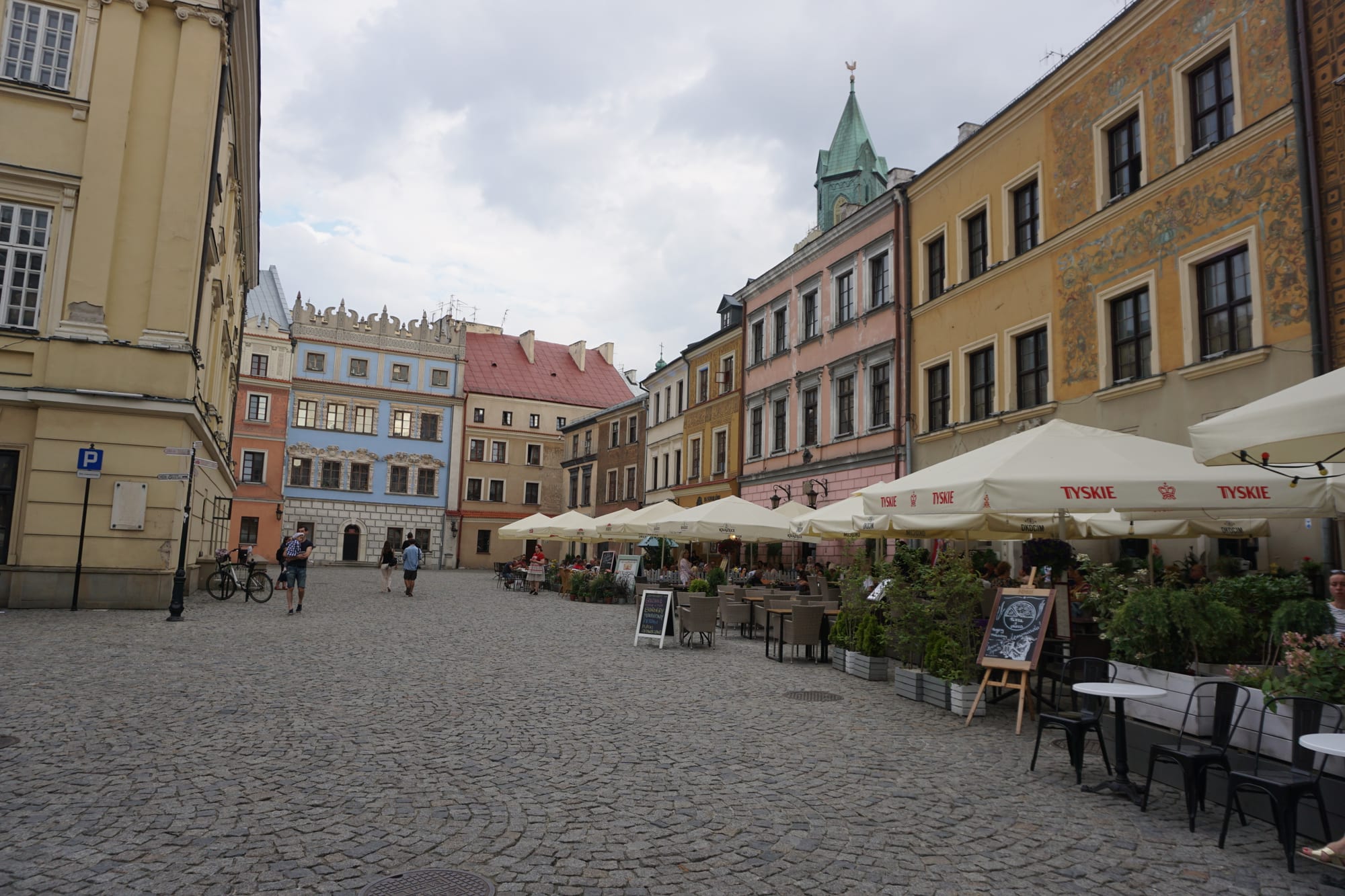
A cobbled square lined with pastel and painted townhouses, café umbrellas and a green church spire behind

Lublin, Zamość & the Southeast, Poland

Lublin

Café tables and painted townhouses on the Market Square of Lublin's Old Town. (Andrew Milligan sumo / Wikimedia Commons · CC BY 2.0)

The largest Polish city east of the Vistula, on the Lublin Upland about 150 km south-east of Warsaw. A royal trading city on the route between Kraków and Vilnius, it hosted the Union of Lublin in 1569 and was a great centre of Jewish learning. Today it is a university city of cobbled old streets, festivals and trolleybuses, chosen as European Capital of Culture for 2029.

Neighbourhoods

  • Old Town
    • First-time visitors
    • Historic district
    • Nightlife

    Cobbled, narrow streets running from the Kraków Gate to the castle around the Market Square and the Crown Tribunal. Restaurants and pubs fill the old cellars and townhouses, and the large student clientele keeps prices low.

    Open in Maps
  • Krakowskie Przedmieście and the city centre
    • Shopping
    • Cafés
    • Close to public transport

    The main street of Lublin, a pedestrian zone known locally as the Deptak, leads west from the Kraków Gate past Litewski Square. Shops, banks, cafés and restaurants line it and the side streets of Narutowicza, Okopowa and Chopina.

    Open in Maps
  • Below the castle
    • Jewish heritage
    • Transport links

    The low ground beneath the castle hill, once the heart of the Jewish town that the Grodzka Gate separated from the Christian Old Town. Today it holds the main bus terminal, and the Old Jewish Cemetery stands on a hill just beyond.

    Open in Maps
  • University quarter
    • Students and nightlife
    • Parks
    • Quiet and residential

    West of the centre around the Saxon Garden, one of the oldest city parks in Poland, with the campuses of Maria Curie-Skłodowska University and the Catholic University of Lublin close by. Students make up a large share of the city's population, and cafés and bars cluster on the way back towards the Old Town.

    Open in Maps

Things to do

Famous landmarks

  • Lublin Castlelandmark

    One of the oldest preserved royal residences in Poland, rebuilt in a white Gothic Revival style in the 19th century, with a 13th-century round keep in its courtyard and the National Museum inside.

    Open in Maps
  • Chapel of the Holy Trinitylandmark

    The Gothic castle chapel whose walls are covered in Byzantine-style frescoes completed in 1418, an unusual meeting of Catholic and Orthodox art.

    Open in Maps
  • Kraków Gatelandmark

    A 14th-century Gothic gate, one of the last parts of the city walls and a symbol of Lublin, where a trumpeter plays the hejnał bugle call at noon.

    Open in Maps
  • Crown Tribunallandmark

    The historic building on the Market Square that housed the Crown Tribunal, the highest appeal court, which sat in Lublin for the Lesser Poland province from 1578; with the Kraków Gate it is seen as a symbol of the city.

    Open in Maps
  • Lublin Cathedrallandmark

    One of the first Baroque churches in Poland, built between 1592 and 1617 for the Jesuits, with a panorama of the city from the neighbouring Trinity Tower.

    Open in Maps

Jewish Lublin and the war

  • Grodzka Gate – NN Theatremuseum

    The old Jewish Gate between the Christian and Jewish towns, now a cultural centre with an exhibition on the shared Polish-Jewish past of the city.

    Open in Maps
  • Old Jewish Cemeterylandmark

    A walled hilltop cemetery overlooking the Old Town, among the last physical traces of centuries of Jewish life in Lublin.

    Open in Maps
  • Chachmei Lublin Yeshivalandmark

    The building of a great Jewish academy that operated from 1930 to 1939 and was one of the largest yeshivas in the world in its day.

    Open in Maps
  • Majdanek State Museummuseum

    The preserved Nazi German concentration and extermination camp on the city's edge, liberated in July 1944 and now a memorial museum and education centre.

    Open in Maps

Museums and underground Lublin

  • Lublin Underground Routeattraction

    A guided route of about 250 metres through the cellars and corridors beneath the Old Town, dating from the 16th and 17th centuries.

    Open in Maps
  • Cellar Under Fortunamuseum

    Ten underground rooms beneath a Market Square house with multimedia history displays, including a former wine cellar with Renaissance wall paintings.

    Open in Maps
  • Lublin Open Air Village Museummuseum

    One of the largest open-air museums in Poland, with farmhouses, churches and other rural buildings brought from across the Lublin region.

    Open in Maps

Parks and the lake

  • Saxon Gardenpark

    A city park laid out in 1837 near the university campuses, one of the oldest public parks in Poland.

    Open in Maps
  • Zemborzyce Lakepark

    An artificial lake made by damming the Bystrzyca in the south of the city, where boats and water skis can be hired.

    Open in Maps

Sport and nights out

  • Arena Lublinattraction

    The football stadium of Motor Lublin, holding about 15,000 people.

    Open in Maps

Short trips from the city

  • Kozłówkaattraction

    A village north of Lublin known for the palace and park of the Zamoyski family.

    Open in Maps
  • Nałęczówattraction

    A small spa town on the Nałęczów Plateau west of Lublin, known for its mineral water.

    Open in Maps
  • Kazimierz Dolnyattraction

    A Renaissance town on the Vistula, with old granaries, a ruined castle and loess gorges, popular with artists.

    Open in Maps

Seasonal events

  • Night of CultureJune

    A single night, usually the first Saturday of June, when hundreds of free events fill the city.

  • Carnaval Sztukmistrzówlate July

    The largest new circus festival in Poland, named after Isaac Bashevis Singer's novel The Magician of Lublin, with street performers across the Old Town.

  • Urban Highline Festivallate July

    Hundreds of highliners from around the world walk lines strung high above the Old Town, the largest slackline gathering in Poland.

  • Jagiellonian Fairlate August

    A fair of artists, artisans and craftspeople from across Central and Eastern Europe.

  • Mikołajki Folkoweearly December

    The oldest folk music festival in Poland, held around St Nicholas Day.

Eat and drink

Long-standing places and food districts in Lublin. Hours, ratings and directions come from your maps app, always current.

Lublin classics

  • Cebularzcafe

    Lublin's best-known snack: a flat wheat-dough pancake topped with diced onion and poppy seeds, first baked by Jewish bakers in the Old Town and sold in the city's bakeries.

    Open in Maps
  • Pierogi po lubelskurestaurant

    The local style of pierogi, filled with curd cheese, buckwheat groats and mint.

    Open in Maps

Food districts

  • Old Town Market Squareneighborhood

    Regional, Polish, Jewish and Italian restaurants in the cellars and townhouses around the square, with tables outside in summer.

    Open in Maps
  • Krakowskie Przedmieścieneighborhood

    The pedestrian main street and its side streets, lined with cafés, restaurants and ice-cream shops.

    Open in Maps

Bars

  • Perłowa Pijalnia Piwarestaurant

    A beer hall on the edge of the Perła brewery, built around one big oval bar and serving the brewery's light and dark beers.

    Open in Maps

Experience Lublin

History

Settlements stood on the hills above the Bystrzyca valley from the sixth century, and a stronghold on Castle Hill was the seat of a castellan by the early 13th century. Lying on Poland's eastern edge, the town was repeatedly attacked by Mongols, Tatars, Ruthenians and Lithuanians, and received its town charter in 1317. Casimir III the Great built a masonry castle in 1341 and ringed the city with walls. Peace between Poland and Lithuania made it a trading centre between Kraków and Vilnius, and the largest trade fairs of the Commonwealth were held here.

On 26 June 1569 the Sejm meeting in Lublin proclaimed the Union of Lublin, joining Poland and Lithuania in a single Commonwealth, and from 1578 the city was a seat of the Crown Tribunal, the highest appeal court. Calvinists and the radical Polish Brethren found a home here, and one of Poland's most important Jewish communities built a yeshiva so respected that the city was called "the Jewish Oxford". Invasions in 1655 and 1656 began a long decline. After the partitions Lublin passed to Austria and then to Russian-ruled Congress Poland; a railway to Warsaw arrived in 1877, and in 1918 the first government of independent Poland briefly sat here.

German occupation from 1939 brought mass arrests of the city's educated class, the Lublin Ghetto and the Majdanek camp on the city's edge; Lublin was the headquarters of Operation Reinhard, and almost all of its Jews, more than a third of the pre-war population, were murdered. Taken by the Soviet Army in July 1944, it served for a few months as the seat of the communist-run provisional authorities. Under communism the population more than tripled, and in 2023 Ukraine honoured the city for its help to Ukraine's war refugees.

Culture & Customs

Lublin calls itself the Polish capital of festivals. The Carnaval Sztukmistrzów turns the Old Town into a stage for new circus at the end of July, named after Isaac Bashevis Singer's novel The Magician of Lublin, while highliners walk ropes strung between the rooftops at the same time. The Night of Culture opens hundreds of free events in June, the Jagiellonian Fair gathers craftspeople from across Central and Eastern Europe in late August, and Mikołajki Folkowe, the oldest folk music festival in Poland, closes the year in December. The city was European Youth Capital in 2023 and has been chosen as European Capital of Culture for 2029.

It is also a city of learning. Several universities, among them Maria Curie-Skłodowska University and the John Paul II Catholic University, long associated with Karol Wojtyła, later Pope John Paul II, give Lublin its young population, its cheap pubs and its music and club scene. The violinist Henryk Wieniawski, born in Lublin, gives his name to the city's philharmonic. The Grodzka Gate – NN Theatre centre keeps alive the memory of Jewish Lublin through exhibitions, oral history and a poetry festival.

The city likes to see itself as a meeting point of East and West, symbolised by the Byzantine frescoes of its castle chapel. Football support centres on Motor Lublin, promoted to the top division, the Ekstraklasa, in 2024. Catholic feast days are widely kept, and Ukrainian cultural events have a place in the calendar.

Daily Life

Lublin had about 328,000 inhabitants at the end of 2024, and is the largest Polish city east of the Vistula. Students make up around a third of the population, and the largest employer is Maria Curie-Skłodowska University. Eastern Poland gained less from the changes after 1989 than the west of the country, and the old car factory, FSC, collapsed after its Korean owner's troubles in the late 1990s; the economy has since turned towards services, IT companies and outsourcing, with a special economic zone and industry in neighbouring Świdnik.

Most people live in post-war housing estates that spread out from the centre as the city grew — the brutalist Słowacki estate designed by Oskar Hansen now holds a museum of housing estates — while the Old Town is the place for evenings out. The city has no trams; trolleybuses and buses carry commuters, and more than 80 km of cycle lanes and paths cross the city.

The war in neighbouring Ukraine is part of everyday life: Lublin has a Ukrainian consulate, took in many refugees and was named a "City-Rescuer" by President Zelensky in 2023. Expressways completed in recent years to Warsaw and Rzeszów have brought the city closer to the rest of the country.

Food

The cebularz is Lublin's own: a round wheat-dough pancake about 15–20 cm across, topped with diced onion and poppy seeds. It was first baked by Jewish bakers selling in the Old Town, was widely popular across the region before the Second World War, and since 2014 has had protected status in the European Union. It is bought in bakeries and eaten as a snack rather than in restaurants.

Pierogi are a regional pride. The Lublin style, pierogi po lubelsku, is filled with curd cheese, buckwheat groats and mint. Lublin's dining scene has grown more international with the large foreign student body of the Medical University, and kebab bars cluster near the Technical University on Nadbystrzycka Street.

The city also has a long history of drink. Żołądkowa Gorzka, a herbal vodka in the tradition of the infused nalewka, has been the leading brand of the Lublin distillery since 1950. Lublin has the oldest mead-making factory in Poland, and the Perła brewery makes the city's pilsner-type lager, served at its own beer hall beside the brewery.

Planning tools

Budget

Lublin is cheaper than Warsaw or Kraków. Its large student population keeps prices low in Old Town pubs, bakeries sell cebularz for very little, and buses and trolleybuses cover the city cheaply. Rooms in and near the Old Town are the main cost and fill up during the big summer festivals.

Daily Budget Midrange
USD 110–200 (Old Town hotel, restaurant meals, castle and museum entries, taxis)
Daily Budget Shoestring
USD 40–75 (hostel, bakeries and self-service canteens, buses and trolleybuses)

The Old Town streets, the Kraków Gate, the castle courtyard and the Old Jewish Cemetery's surroundings can all be seen without a ticket.

Best Time to Visit

May to September, when the Old Town fills with outdoor tables and the festival season peaks — the Night of Culture in June and the circus and highline festivals in late July. Late August brings the Jagiellonian Fair. Winters are cold, but December has a folk music festival and the museums are quiet.

Suggested Number of Days

Two days cover the Old Town, the castle and the memorial sites at the city's edge. Three or four allow trips to the palace and spa towns and the Vistula towns nearby. Festival weekends are busy and worth extra time.

First Visit
2 days
With Surroundings
3–4 days

Transportation

The centre and Old Town are easily covered on foot. Lublin is one of only three Polish cities with trolleybuses, and the largest without trams; about 50 bus lines and 8 trolleybus lines cover the rest, with night buses. Tickets are bought at kiosks or on board and validated immediately. There are over 80 km of cycle lanes and paths and a self-service bike hire scheme from spring to autumn.

Use taxis from official ranks or ordered by phone or app; unregulated drivers near the bus terminal and railway station overcharge.

Airport & Station Connections

Lublin Airport is about 10 km east of the centre beside the town of Świdnik, with a railway station inside the terminal and trains and buses to the city. Trains from Warsaw take about two hours to Lublin Główny station, and there are direct trains to Kraków and other cities. The S17 expressway links the city with Warsaw, and long-distance buses leave from the terminal beside the castle.

Walkability

Compact and easy on foot: the Old Town, the castle and Krakowskie Przedmieście are a few minutes apart, and the university quarter is a short walk west. The Old Town's streets are cobbled and in places steep. The main railway station is around half an hour's walk from the centre, so most arrivals take a bus or trolleybus in.

Safety

Poland is a safe country with low violent crime. Lublin is generally considered very safe by day and night, with frequent police patrols in the Old Town and student areas. Pickpockets work the bus and trolleybus routes to and from the railway station and the main bus terminal, and car theft has been a problem in the past. Since 2022 the city has received many refugees from Ukraine, but daily life is normal.

Watch bags on transport to and from the stations, take taxis only from ranks or by phone, and call 112 in an emergency. Check current official travel advice before travelling.

Climate

A humid continental climate, with warm summers and cold, damp winters. The average yearly temperature is about 7–8°C.

Summer
warm — July and August average about 19°C
Winter
cold and damp — January and February average about −5°C

Local Customs

A tip of around 10 per cent is usual in restaurants, though not everyone leaves one; a word of thanks while handing over money is taken to mean the change can be kept. A 'dzień dobry' (good day) is a common greeting, and churches are places of worship first.

Men remove hats in churches but cover their heads in synagogues; dress modestly in both, and respect the Majdanek memorial and the Jewish cemeteries as places of mourning.

Common Payment Methods

The currency is the Polish złoty (PLN), not the euro. Cards and contactless payment are widely accepted; a little cash is useful for small bakeries, kiosks and markets. ATMs are easy to find in the centre.