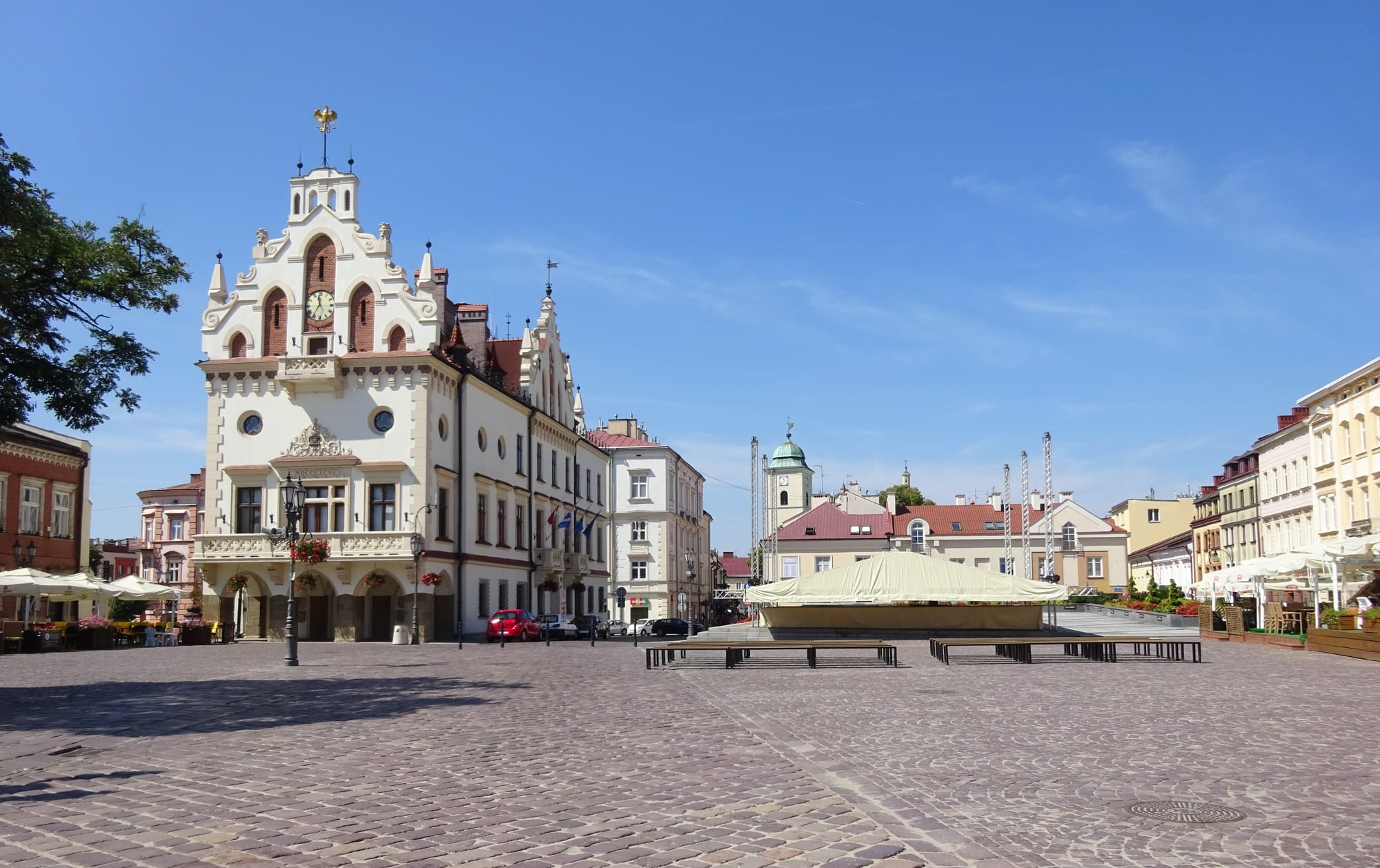
A white town hall with a clock gable and turrets on a wide cobbled market square under a clear blue sky

Lublin, Zamość & the Southeast, Poland

Rzeszów

The town hall on the Market Square in Rzeszów's Old Town. (Mach240390 / Wikimedia Commons · CC BY 4.0)

The largest city in south-eastern Poland and capital of the Subcarpathian province, on both banks of the Wisłok. A medieval trading town and for centuries a private town of the Lubomirski family, it keeps a compact old town with cellars beneath its market square, and has grown fast around aviation, IT and an airport that became a hub for aid to Ukraine.

Neighbourhoods

  • Old Town
    • First-time visitors
    • Historic district
    • Nightlife

    The small historic centre around the Market Square and the town hall, with the parish church, the two synagogues and the former Piarist monastery a few streets away. Pubs and restaurants line the square, and a route of old cellars runs beneath it.

    Open in Maps
  • Castle and the Lubomirski avenues
    • Architecture
    • Parks
    • Culture

    Close to the square, the castle with its bastions, the Lubomirski summer palace and the fountain on the avenue between them, close to the theatre and the Bernardine church on Sokoła Street.

    Open in Maps
  • Pedestrian streets of the centre
    • Shopping
    • Cafés
    • Close to public transport

    The pedestrianised 3 Maja and Grunwaldzka streets, the main shopping streets, link the square with the rest of the centre and are lined with cafés, cheap eateries and small shops.

    Open in Maps
  • The Wisłok riverside
    • Walks and cycling
    • Quiet and residential

    Paths and cycle routes follow the river through the city; upstream lies the Lisia Góra nature reserve, and on the river the Olszynki Park towers rise above the skyline.

    Open in Maps

Things to do

Famous landmarks

  • Market Square and Town Halllandmark

    The central square of the Old Town, with the town hall built in 1591 and later remodelled in Neo-Gothic and Renaissance Revival styles.

    Open in Maps
  • Rzeszów Castlelandmark

    Rebuilt in 1902–06 on the site of the Lubomirski castle, whose bastions and walls survive around it; it houses courts, so the walls are seen from outside.

    Open in Maps
  • Lubomirski Summer Palacelandmark

    A Rococo-style palace of the 17th and 18th centuries on Lubomirski Avenue, often called the finest aristocratic residence in the region, now used by the university.

    Open in Maps
  • Monument of the Revolutionary Deedlandmark

    A large communist-era monument of 1974 commemorating the struggles for freedom in the region.

    Open in Maps
  • Olszynki Parklandmark

    A mixed-use complex whose 220-metre residential tower is the third tallest building in Poland and the tallest residential building in the country.

    Open in Maps

Churches and synagogues

  • Church of Sts Stanislaus and Adalbertlandmark

    The Gothic parish church near the square, whose oldest parts probably date from the 15th century, on a site with a church recorded from 1363.

    Open in Maps
  • Bernardine Basilicalandmark

    The Baroque Basilica of the Assumption and Bernardine monastery of the 17th century, founded under Mikołaj Spytek Ligęza.

    Open in Maps
  • Old Town Synagoguelandmark

    A synagogue built in the early 17th century, now home to state archives.

    Open in Maps
  • New Town Synagoguelandmark

    A late-18th-century synagogue destroyed by the Nazis and restored in 1954–63, now an art exhibition gallery.

    Open in Maps

Museums and underground Rzeszów

  • Underground Tourist Routeattraction

    A 369-metre route through the old cellars beneath the Market Square and the houses around it, on three levels up to 10 metres below ground.

    Open in Maps
  • Rzeszów Regional Museummuseum

    Polish paintings from the 18th to 20th centuries and European art in the former Piarist monastery, under 17th-century frescoed vaults.

    Open in Maps
  • Ethnographic Museummuseum

    Traditional folk costumes and old woodcarvings from the region.

    Open in Maps
  • Museum of Bedtime Cartoonsmuseum

    Poland's only museum devoted to dobranocki, the animated films shown to children before bedtime.

    Open in Maps

Parks and the river

  • Lisia Góra nature reservepark

    A nature reserve upstream on the Wisłok, south of the centre, for an easy walk out of the city.

    Open in Maps
  • Żwirownia city beachbeach

    A free beach by the Żwirownia lake where residents cool off on hot summer days.

    Open in Maps

Short trips from the city

  • Łańcut Castlelandmark

    The residence of the Lubomirski and Potocki families, set in a park and protected as a national Historic Monument, and the setting for a chamber music festival each May.

    Open in Maps

Eat and drink

Long-standing places and food districts in Rzeszów. Hours, ratings and directions come from your maps app, always current.

Rzeszów classics

  • Proziakirestaurant

    The soda bread of the Subcarpathian foothills: small rolls of flour, soured milk and bicarbonate of soda, traditionally baked on a stovetop and eaten with fresh butter and salt, cottage cheese or jam.

    Open in Maps

Food districts

  • Market Squareneighborhood

    Pubs and restaurants around the square, from beer-and-snack places to fuller meals, with tables outside in summer.

    Open in Maps
  • 3 Maja and Grunwaldzka streetsneighborhood

    The pedestrian streets of the centre, with a pierogi house and other inexpensive places to eat.

    Open in Maps

Experience Rzeszów

History

Rzeszów was part of the emerging Polish state in the 10th century, fell to Ruthenian rulers and was recovered for Poland by Casimir III the Great, who granted it town rights in 1354. It prospered on the trade routes from Kraków to Lwów and from Lublin to Slovakia, despite a great fire in 1427 and Tatar raids in 1458 and 1502. In the 1580s Mikołaj Spytek Ligęza built a castle and a Bernardine church and monastery, and from 1638 the town belonged to the Lubomirski family, who made it the centre of their estates. The first Jews settled in the 15th century, and by the mid-18th century Poles and Jews lived here in almost equal numbers.

Swedish, Transylvanian and other armies sacked the town in the 17th and early 18th centuries, and from 1772 it spent 146 years under Austrian rule. The Galician railway arrived in 1858, and Rzeszów grew into a garrison town. After 1918 it became part of independent Poland, and the Central Industrial Region of the 1930s made it a centre of the defence industry, with the PZL aircraft-engine works opening in 1937.

German occupation from September 1939 renamed the town Reichshof. The intelligentsia were imprisoned and shot, and the Jews, more than a third of the population, were forced into a ghetto; some 20,000 Jews were murdered there or deported to Bełżec and Auschwitz, and only about 100 of the city's 14,000 pre-war Jews survived. The Home Army took the town in August 1944 before Soviet control was imposed. From 1945 Rzeszów was a provincial capital and grew quickly. In 1981 farmers' protests here led to the creation of Rural Solidarity, in 1999 it became capital of the Subcarpathian province, and since 2022 it has been a key hub for Western aid to Ukraine.

Culture & Customs

Rzeszów presents itself as a young, fast-developing city that has adapted to its heritage, and a full calendar of festivals backs the claim. The Carpathia Festival is an international music festival; the World Festival of Polish Diaspora Folk Ensembles brings folk groups of Polish emigrants from around the world; and Breakout Days, a blues and rock festival, honours Tadeusz Nalepa and his band Breakout. Other festivals celebrate optimistic films, the theatre artist Józef Szajna and the multicultural heritage of Galicia. The Artur Malawski Subcarpathian Philharmonic also runs the chamber music festival at Łańcut Castle each May.

The Wanda Siemaszkowa Theatre, opened in 1944 as the city's first professional theatre, and the Maska puppet theatre are the main stages, alongside a dance theatre and several galleries, one of them in the New Town Synagogue. The Ethnographic Museum keeps the folk costumes and woodcarving of the region.

Faith matters here: Pope John Paul II visited in 1991, when nearly a million people gathered, and the following year made Rzeszów the seat of a new diocese. Football support is split between two clubs, Stal and the multisport Resovia, which share the municipal stadium south of the centre. The city's long Jewish history is remembered in its two surviving synagogues and its cemeteries.

Daily Life

Rzeszów had about 199,000 inhabitants in January 2026, and unlike most Polish cities of its size its population is growing. Between 2017 and 2021 the city limits were extended to take in neighbouring villages, bringing its area to over 120 square kilometres, and the Olszynki Park tower, the tallest residential building in Poland, rises by the river.

The economy is built on aviation, IT and manufacturing. The old PZL works, now part of Pratt & Whitney, makes aircraft engines, the software group Asseco has its headquarters here, and pharmaceutical, food and household-appliance factories add to the mix. The city is home to several universities, and in 2011 Forbes ranked it among the most attractive mid-sized Polish cities for business.

The war in Ukraine has changed the city's role: its airport became the main transfer point for Western military supplies, and direct trains run to Lviv, Odesa and Kyiv. Day to day, residents shop in the malls of the New Town and the pedestrian streets of the centre, use a bus network of 49 lines, and the city is a gateway to the Bieszczady mountains, with many buses heading for Sanok.

Food

Subcarpathia's everyday bread is proziaki, a soda bread from the Carpathian foothills: small rolls of wheat or wheat-rye flour, soured milk, salt and bicarbonate of soda — proza in the local dialect — traditionally baked on clay, cast-iron or tiled stovetops heated with wood. Some villages add buttermilk, cottage cheese or extra butter, and the rolls are eaten with fresh butter and salt, cottage cheese or jam, often with a glass of sweet or soured milk.

In the Bieszczady mountains to the south, the Lemko dish fuczki survives: fried pancakes of oat flour and sauerkraut, now served in many restaurants of the region, sometimes with regional cheeses. Pierogi are everywhere: the city centre has a pierogi house and inexpensive places to eat on the pedestrian streets, while pubs and restaurants on the Market Square combine beer with filling snacks and fuller Polish and international dishes.

The city also has a dairy museum, a reminder of the region's farming, and the food industry remains one of its employers.

Planning tools

Budget

Rzeszów costs less than Kraków or Warsaw for hotels and meals. The Old Town is small, many sights such as the castle walls, the square and the riverside are free, and buses are cheap.

Daily Budget Midrange
USD 110–200 (city-centre hotel, restaurant meals, museum and cellar-route tickets, a trip to Łańcut)
Daily Budget Shoestring
USD 40–75 (hostel, pierogi houses and canteens, city buses)

Buy bus tickets at kiosks near the stops, where they are cheaper than from the driver, and validate them on boarding.

Best Time to Visit

May to September, when café tables fill the Market Square, festivals run and the Łańcut music festival takes place in May. Summers are warm and the rainiest month is July, with short, heavy storms. Winters are cold and snowy, though the city's museums and cellars are open all year.

Suggested Number of Days

One or two days are enough for the city itself. Three or four allow for Łańcut and other castles and towns of Subcarpathia, and more for anyone heading on to the Bieszczady mountains, for which Rzeszów is a gateway.

First Visit
1–2 days
With Surroundings
3–4 days

Transportation

The Old Town is small and easily walked. Some 49 city bus lines, including night and airport buses, cover the rest; tickets are bought at kiosks or from the driver and validated on board. The city has a network of cycle paths and a bike-share scheme that needs online registration. Driving and parking in the centre are difficult.

Check which of the two bus stations a coach uses — the main bus station or the suburban one — before setting out.

Airport & Station Connections

Rzeszów–Jasionka Airport, renamed after the Ulma family in 2024, is in Jasionka, about 10 km north of the city, linked by train, by bus and by taxi. Rzeszów Główny is on the main railway from Kraków to the Ukrainian border, with Kraków about three hours away and direct trains to Lviv, Odesa and Kyiv. The A4 motorway and the S19 expressway pass the city's northern and eastern edges.

Walkability

The Old Town is compact and easy on foot, with the square, the castle, the summer palace and the main churches all within a few minutes of each other, and pedestrian streets linking them. The housing estates, shopping centres and the stadium are spread further out and are reached by bus.

Safety

Poland is a safe country with low violent crime. Since 2022 Rzeszów has been a main hub for military supplies to Ukraine, and air-defence batteries have been stationed at its airport, so military traffic and security around the airport and the border crossings are heavier, but daily life is normal.

Expect security checks around the airport and do not photograph military sites or convoys. Check current official travel advice before travelling.

Climate

A continental climate with four distinct seasons, hot summers and cold, snowy winters; the average yearly temperature is about 9°C. Annual rainfall is among the lowest in Poland. Near the Carpathians, the warm halny wind can sometimes send temperatures up quickly.

Summer
warm — summer averages are about 18–20°C, days often pass 25°C and sometimes 30°C
Winter
cold and snowy — winter averages are about −2 to 0°C, with nights near −5°C

Local Customs

A tip of around 10 per cent is usual in restaurants, though not everyone leaves one. A 'dzień dobry' (good day) is a common greeting, and churches are places of worship first.

Men remove hats in churches; dress modestly in churches and at the sites of the former synagogues and Jewish cemetery.

Common Payment Methods

The currency is the Polish złoty (PLN), not the euro. Cards and contactless payment are widely accepted, though some ticket counters at the railway station may want cash; ATMs are found at and around the station and in the centre.