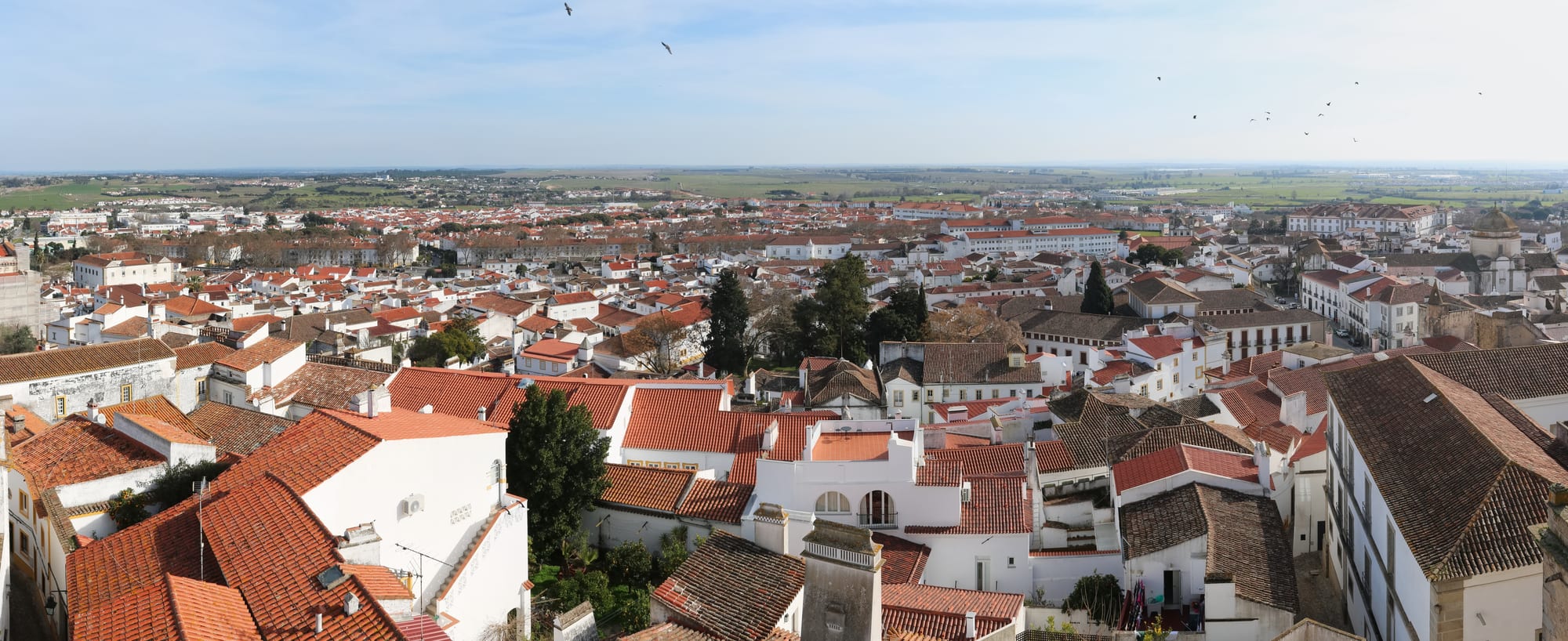
Whitewashed houses with orange tiled roofs filling the old town of Évora, with flat green plains on the horizon

Alentejo, Portugal

Évora

The old town of Évora seen from the roof of the cathedral, with the Alentejo plain beyond. (Ingo Mehling / Wikimedia Commons · CC BY-SA 4.0)

The historic capital of the Alentejo, on the plains of southern Portugal about 140 km from Lisbon. Roman Ebora, a Moorish farming town and then a frequent home of the medieval royal court, it keeps a walled centre of whitewashed lanes around a Roman temple and a Gothic cathedral, listed by UNESCO since 1986, and is a university town chosen as a European Capital of Culture for 2027.

Neighbourhoods

  • Praça do Giraldo and the lower old town
    • First-time visitors
    • Best for food
    • Shopping

    The main square, with its fountain of 1570 and the church of Santo Antão, is the city's social centre. Pedestrian Rua 5 de Outubro climbs from it towards the cathedral past small shops, and lanes of white houses lead off to the Church of St Francis and the Chapel of Bones.

    Open in Maps
  • The upper town around the cathedral
    • Historic district
    • Museums

    The highest part of the walled centre, where the Roman temple, the cathedral, the national museum, the Lóios church and the palace of the Dukes of Cadaval stand within a few steps of each other. It is the busiest part of town by day and quiet after dark.

    Open in Maps
  • The aqueduct quarter
    • Historic district
    • Quiet and residential

    Where the 16th-century Água de Prata aqueduct runs into the old town, houses, shops and cafés were built into its arches along Rua do Cano. It is a residential corner with fewer visitors.

    Open in Maps
  • Malagueira and the parishes outside the walls
    • Quiet and residential
    • Architecture

    Most of the city's people live outside the walls. Malagueira is known for Álvaro Siza Vieira's low white housing scheme, which won a Harvard urban design prize in 1988; most of the city's large shops and supermarkets are out here too.

    Open in Maps

Things to do

Famous landmarks

  • Roman Temple of Évoralandmark

    The city's best-known landmark, a 1st-century Corinthian temple probably dedicated to the cult of Augustus, often wrongly called the Temple of Diana; it survived because it was built into later structures.

    Open in Maps
  • Cathedral of Évoralandmark

    Built mainly between 1280 and 1340 on the highest point of the city, one of Portugal's major Gothic monuments, with apostle statues on its portal, Gothic cloisters whose upper storey looks over the surrounding landscape, and a Baroque main chapel.

    Open in Maps
  • Chapel of Boneslandmark

    A small chapel beside the entrance of the Church of St Francis whose walls are covered with human bones and skulls.

    Open in Maps
  • Church of St Francislandmark

    A Gothic church with Manueline touches, built between 1475 and the 1550s, with a wide single nave lined by twelve side chapels, classified as a National Monument in 1910.

    Open in Maps
  • Água de Prata Aqueductlandmark

    A 16th-century aqueduct built under João III that brought spring water about 9 km into the city; inside the walls, houses and shops fill its arches.

    Open in Maps
  • Palace of the Dukes of Cadaval and the Lóios Churchlandmark

    A 15th-century convent church lined with 18th-century azulejos, beside the palace of the Dukes of Cadaval and its pentagonal Tower of the Five Corners.

    Open in Maps
  • University of Évoralandmark

    Founded by Cardinal Henry in 1559 as a Jesuit college, closed in 1759 and reopened in 1973; its classrooms are decorated with azulejo tiles.

    Open in Maps

Museums

  • Frei Manuel do Cenáculo National Museummuseum

    The former Évora Museum, beside the cathedral, with more than 20,000 pieces from archaeology to painting and sculpture.

    Open in Maps

Walks and markets

  • Praça do Giraldoneighborhood

    The main square, the site of an annual fair since 1275 and of Inquisition autos-da-fé, with a fountain of 1570 and the church of Santo Antão at its northern end.

    Open in Maps
  • Municipal marketmarket

    The food market in the hall on Praça 1º de Maio, near the public garden, with fish, cheese, ham, bread and produce; an outdoor farmers' market sells fruit and vegetables in the square.

    Open in Maps

Short trips from the city

  • Almendres Cromlechlandmark

    A megalithic complex of standing stones west of the city, the largest group of structured menhirs in the Iberian Peninsula.

    Open in Maps
  • Great Dolmen of Zambujeirolandmark

    One of the biggest dolmens in Iberia, near Valverde, south-west of the city.

    Open in Maps
  • Arraiolosattraction

    A small town to the north known for its castle and for the embroidered wool rugs made there since at least the 16th century.

    Open in Maps
  • Estremozattraction

    A marble town to the north-east, whose castle King Dinis rebuilt as a royal palace.

    Open in Maps
  • Monsarazattraction

    A walled hill village above the Alqueva reservoir, reached by car in under an hour.

    Open in Maps

Eat and drink

Long-standing places and food districts in Évora. Hours, ratings and directions come from your maps app, always current.

Évora classics

  • Alentejo cooking in the old townneighborhood

    The tascas and restaurants inside the walls serve the regional repertoire: açorda, migas with pork, carne de porco à alentejana and convent desserts.

    Open in Maps

Food districts and markets

  • Municipal market, Praça 1º de Maiomarket

    The food market in the building in the middle of the square, with fish, meat, cheeses, hams, bread, fruit and flowers, and an outdoor farmers' market alongside.

    Open in Maps
  • Rua 5 de Outubroneighborhood

    The pedestrian street between Praça do Giraldo and the cathedral, with shops selling honey, olives, jams and cork goods.

    Open in Maps

Experience Évora

History

Évora's story goes back more than five thousand years, and the plain around it is scattered with dolmens and standing stones. The Celtici called the town Ebora, probably after the yew tree. The Romans took it in 57 BC, walled it and named it Liberalitas Julia; Pliny called it Ebora Cerealis for its wheat fields, and its 1st-century temple still stands at the top of the town. A bishop was here by the 4th century, and the Visigoths took the town in 584.

Arab forces captured it in 715, and as Yāburah it grew into a farming centre with a fortress and a mosque. In 1165 Gerald the Fearless took it in a surprise attack, and it passed to Afonso I the next year. In the later Middle Ages, and above all under the Avis kings, Évora was one of the most dynamic cities in Portugal: the court stayed here for long periods, royal weddings were held here, and humanists, sculptors and painters worked for the court. It became an archbishopric in 1540, Cardinal Henry founded the Jesuit university in 1559, and João III's aqueduct brought water to Praça do Giraldo.

Decline followed the expulsion of the Jesuits and the closure of the university in 1759. In 1808 French troops routed a Portuguese-Spanish force outside the city and sacked it, and in 1834 the surrender of King Miguel's army here ended the Liberal Wars. An earthquake damaged the city in 1909. The university reopened in 1973, UNESCO listed the historic centre in 1986, and Évora was chosen with Liepāja in Latvia as a European Capital of Culture for 2027.

Culture & Customs

Évora is called the museum-city: Roman, Romanesque, Gothic, Manueline, Renaissance and Baroque buildings stand within a single circuit of walls, in a labyrinth of squares and narrow white streets. Some of its monuments carry dark memories as well — thousands of Inquisition autos-da-fé were held in Praça do Giraldo — and the Chapel of Bones, with its walls of skulls, has become one of its best-known sights.

As the historic capital of the Alentejo, the city is a centre for the region's culture, including cante alentejano, the unaccompanied choral singing inscribed by UNESCO in 2014. The university gives the old town a student population, and the city's Capital of Culture year in 2027 has brought a programme of new cultural projects. The municipality sponsors festas populares for the saints' days, fairs and concerts, and the town holiday falls on 29 June.

Sport has a long local history. Lusitano Ginásio Clube, founded in 1911, played 14 straight seasons in Portugal's top football division in the 1950s and 1960s and won the Campeonato de Portugal in 2025. Like the rest of the Alentejo, Évora values an unhurried pace, a long lunch and an evening walk around the square.

Daily Life

About 53,600 people lived in the municipality at the 2021 census, about 40,500 of them in the city itself, the largest town in the Alentejo. Only a small share of them live inside the walls: most residents are in the parishes of Bacelo, Senhora da Saúde, Malagueira and Horta das Figueiras outside them, while the historic centre has about 4,000 buildings.

The economy rests on services: the University of Évora, the district hospital, regional offices of central government and tourism, which grew fast in the 2010s and brought many new hotels and bed-and-breakfasts. Aircraft-parts factories built by Embraer in 2015 were sold to Aernnova in 2022, and a 2006 University of Minho study ranked Évora first for competitiveness among Portugal's 18 district capitals.

Days follow the heat. Shops open in the morning, close for a long lunch and stay open into the early evening, and in summer people stay indoors through the hottest hours and come out after dark. Drought and desertification are long-term concerns on the plain around the city, and a new railway line east towards Elvas, mainly for freight, was being built in the 2020s.

Food

Évora eats the food of the Alentejo, built on bread, olive oil, pork and herbs. Açorda à alentejana is a bread soup of stale bread with garlic, coriander and poached eggs, a classic of the region; migas, made from stale bread, are served with pork; and carne de porco à alentejana combines marinated, fried pork with clams, potatoes and coriander, though whether the dish really comes from the Alentejo is disputed.

Desserts come from the convents. Sericaia, a soufflé-like pudding from Elvas, is often eaten with stewed plums; bolo podre, pão de rala and mel e noz are other traditional desserts of convent origin. The municipal market on Praça 1º de Maio sells cheeses, hams, bread and produce, with farmers selling outside in the square, and honey, olives and jams are the typical things to take home.

Wine is the drink. Alentejo wines are among the best-loved in Portugal, and Reguengos, Borba and Vidigueira are among the region's wine districts; a drink in the bar of one of the old convents now used as hotels is a way to see their public rooms.

Planning tools

Budget

Tourism in Évora grew fast in the 2010s. There are many bed-and-breakfasts and hotels both inside and outside the walls; the old-town rooms fill up in high season. Set lunches and market food keep daily costs down, while wine estates and upmarket hotels in converted convents push them up.

Daily Budget Midrange
USD 110–220 (old-town hotel, restaurant dinners, museum and monument tickets, a hire car for the megaliths)
Daily Budget Shoestring
USD 50–85 (guesthouse room, set lunches, market food, walking)

Eat the prato do dia at lunch, and book rooms early for spring and autumn weekends.

Best Time to Visit

Spring and autumn, when the plains are green or the harvest is in and days are warm rather than hot. July and August are very hot, with heatwaves, and the old town goes quiet in the early afternoon. Winter is mild by day, with frosty mornings and fewer visitors.

Suggested Number of Days

The walled centre is compact, so a first visit needs one or two days. Allow three or four with a car to take in the megalithic sites and the towns and villages around, and more for wine estates. Summer heat slows everything down.

First Visit
1–2 days
With Surroundings
3–4 days

Transportation

Inside the walls almost everything is reached on foot, and two small minibus routes run through the historic centre. Taxis wait at stands around the city. The megaliths and the villages around Évora need a car or an organised tour; the A6 motorway passes the city on its way from Lisbon to Spain.

Park outside the walls — the old town's lanes are narrow and often one-way.

Airport & Station Connections

Évora is about 140 km from Lisbon. Intercidades trains run from Lisbon to Évora station, and Rede Expressos coaches from Lisbon take about 1 hour 20 minutes to just over 2 hours to the bus terminal. The nearest major airports are Lisbon, Faro, Beja and Badajoz; the small municipal airfield has no airline service. Drivers come on the A6 motorway.

Walkability

The historic centre covers about one square kilometre and is easily walked, from Praça do Giraldo up to the cathedral in a few minutes. Lanes are cobbled and uneven, and there is little shade at midday in summer. The station and newer districts are a longer walk outside the walls.

Safety

Portugal is one of the safest countries in Europe, with low violent crime. Évora is a calm provincial city, and the main risk is the summer heat, which regularly brings heatwaves to the interior.

Carry water and stay out of the midday sun in July and August, and leave nothing visible in parked cars. Check current official travel advice before travelling.

Climate

A hot-summer Mediterranean climate, among the hottest in Portugal in summer. Summers are hot and dry, winters mild and moist; frosts are frequent but light and snow falls only about twice a decade. The record high is 45.4°C.

Summer
hot and dry — August averages about 24.5°C over day and night, with hot afternoons and frequent heatwaves
Winter
mild and damp — January averages about 9.3°C, with frequent light frosts

Local Customs

Évora keeps a provincial rhythm: shops usually close for a long lunch, roughly from one to three, and Praça do Giraldo is where people meet in the evening. Tipping is not generally expected; a euro or two after a full meal is appreciated. Churches remain places of worship — some small chapels open only for prayer.

Wear appropriate clothes and keep quiet in churches, including the Chapel of Bones, and check before photographing services.

Common Payment Methods

The currency is the euro. Cards and contactless payment are widely accepted, and Multibanco ATMs are easy to find in the centre; carry a little cash for small cafés, the market and rural stops.