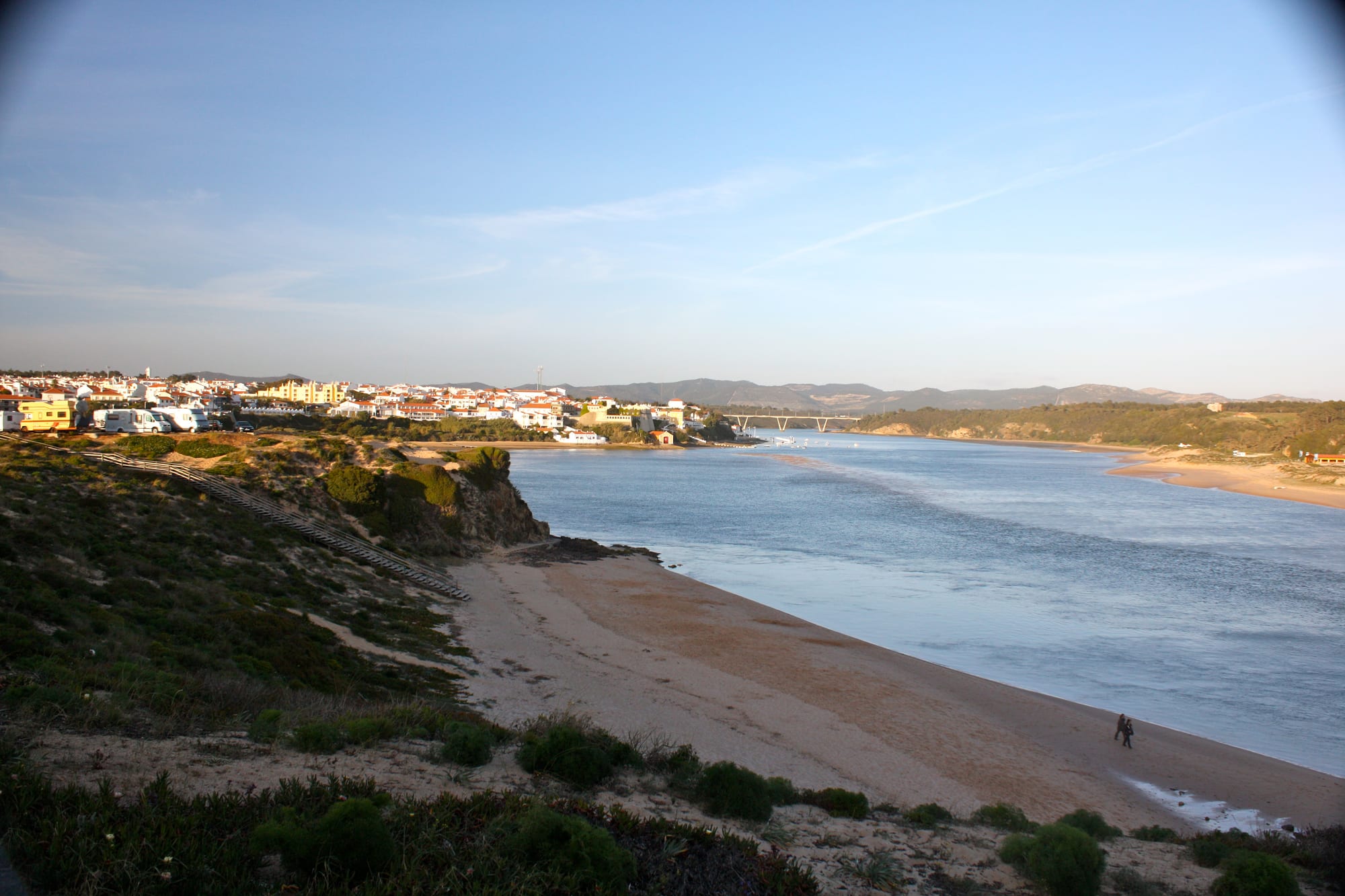
White houses of Vila Nova de Milfontes above the wide Mira estuary, with a sandy shore, a bridge upstream and hills beyond

Alentejo, Portugal

Vila Nova de Milfontes

Vila Nova de Milfontes and the Mira estuary in evening light, with the road bridge upstream. (Kyle Taylor from London, 84 Countries / Wikimedia Commons · CC BY 2.0)

A low white town on the north bank of the Mira where the river meets the Atlantic, about 115 km south of Lisbon on the Alentejo coast. Founded as a town in the 1480s and guarded by a fort built against pirates, it was a small fishing port until tourism arrived; it is now a base for the beaches and cliff paths of the Southwest Alentejo and Vicentine Coast Natural Park.

Neighbourhoods

  • The old town and the fort
    • First-time visitors
    • Historic district
    • Best for food

    The original core of low white houses on the north bank, around the parish church and the fort of São Clemente. Barbacã Square, with the aviators' monument, is beside the fort, and most restaurants and cafés are close by.

    Open in Maps
  • The riverside and Franquia beach
    • Beaches
    • Families

    The sandy shore along the estuary below the town, with Praia da Franquia, also called Praia do Rio, on calmer river water, and the small fishing harbour of Portinho do Canal.

    Open in Maps
  • The ocean beaches and the coast road
    • Beaches
    • Surfing
    • Walking

    Beyond the river mouth the town gives way to open Atlantic beaches such as Malhão, Furnas and Aivados, inside the natural park and popular with surfers.

    Open in Maps

Things to do

In the town

  • Fort São Clementelandmark

    The fort built between 1599 and 1602, under Philip II, after pirates destroyed the town in 1590, guarding the mouth of the Mira.

    Open in Maps
  • Monument to the Aviatorslandmark

    A monument in Barbacã Square beside the fort, recalling the pilots who set off from near Milfontes in 1924 on the first flight from Portugal to Macau.

    Open in Maps
  • Mira estuarypark

    The calm mouth of the 145 km Mira, a sheltered estuary with birds and marine life, used for swimming, boating and fishing.

    Open in Maps

Beaches

  • Praia da Franquiabeach

    The town beach, also called Praia do Rio, on the sheltered river shore.

    Open in Maps
  • Praia das Furnasbeach

    One of the beaches near the town that draws both holidaymakers and surfers.

    Open in Maps
  • Praia do Malhãobeach

    An Atlantic beach on the coast near the town, popular with surfers.

    Open in Maps

Walks and nature

  • Southwest Alentejo and Vicentine Coast Natural Parkpark

    The protected coast of cliffs, coves and dunes created in 1988, crossed by the Rota Vicentina trails, including the coastal Fishermen's Trail, which runs from São Torpes and Porto Covo to Lagos along this coast.

    Open in Maps

Short trips from the town

  • Porto Covoattraction

    A small coastal village to the north, on the route of the Fishermen's Trail.

    Open in Maps
  • Cabo Sardão Lighthouseviewpoint

    A lighthouse at the westernmost point of the Alentejo, beside a viewpoint popular with birdwatchers.

    Open in Maps
  • Zambujeira do Marattraction

    A coastal village to the south, set among cliffs and small sandy beaches, with the Festival Sudoeste held nearby each August.

    Open in Maps
  • Odemiraattraction

    The inland town upriver on the Mira, seat of the municipality to which Milfontes belongs.

    Open in Maps

Seasonal events

  • Festa de Nossa Senhora da Graça8 August

    The feast of the town's patron saint, whose high point is a procession on the river.

  • Tourism fairApril to May

    An annual fair with music and food stalls along the beachfront avenue.

  • Festival SudoesteAugust

    One of Portugal's largest music festivals, held since 1997 near Zambujeira do Mar, south of the town.

Eat and drink

Long-standing places and food districts in Vila Nova de Milfontes. Hours, ratings and directions come from your maps app, always current.

Milfontes classics

  • Restaurants in the old townneighborhood

    Restaurants and cafés around the church and the fort serve fish and seafood from the local boats alongside Alentejo dishes.

    Open in Maps

Food districts and markets

  • Vila Nova de Milfontes marketmarket

    The town's market, for local produce.

    Open in Maps
  • Portinho do Canalneighborhood

    The fishing harbour of the town, the largest in the municipality of Odemira.

    Open in Maps

Experience Vila Nova de Milfontes

History

The mouth of the Mira has been used as a harbour since ancient times. A Phoenician and Carthaginian necropolis has been found in the parish, and the sheltered estuary was valued as one of the best natural ports on the south-west coast. In the 13th century, after the Christian reconquest, the little fishing settlement was fortified, and Afonso III gave its lands to the Order of Santiago to bring settlers back.

King John II made Milfontes a town in the 1480s to protect its trade, separating it from Sines. Its first settlers included people sentenced for minor crimes, and fifty years later the parish still held little more than ten families. Pirates attacked it again and again: Manuel I renamed it Vila Nova de Mil Fontes in 1512 and ordered a new fort in 1552, but after the town was destroyed in 1590 the fort of São Clemente was built between 1599 and 1602, under Philip II.

In 1801 Milfontes was still a small fishing town of about 1,560 people. It lost its status as a municipal seat in 1836 and was joined to Odemira in 1855. On 7 April 1924 the aviators Sarmento de Beires and Brito Pais took off from a field near the town on the Lisbon–Macau Raid, the first flight from Portugal to Macau, remembered by a monument beside the fort. Today it is a tourist-oriented town whose population swells every summer.

Culture & Customs

Milfontes lives by the river and the sea. The patron saint, Nossa Senhora da Graça, is honoured every 8 August with a festival whose high point is a procession on the water, and an annual tourism fair between April and May brings music and food stalls to the beachfront avenue. The 1924 flight to Macau is a point of local pride, and the aviators' monument stands beside the fort in Barbacã Square.

The town sits inside the Southwest Alentejo and Vicentine Coast Natural Park, created in 1988 to protect one of the last stretches of wild European coast, and much of its outdoor culture follows from that: walking the Rota Vicentina trails, surfing the ocean beaches, fishing, diving and birdwatching. South along the coast, the Festival Sudoeste near Zambujeira do Mar has been one of Portugal's largest music festivals since 1997.

The municipality of Odemira, to which Milfontes belongs, is also home to a large immigrant community — more than a quarter of its population in 2021 — many of them working in the export-oriented farms of the area.

Daily Life

The parish had about 5,650 people at the 2021 census, but the town swells in summer and holiday seasons. Tourism, commerce and services are the main sources of income, alongside farming, livestock, fishing, construction and forestry; Portinho do Canal is the largest fishing harbour in the municipality, and there is an aquaculture centre nearby at Moinho da Asneira.

Life follows the seasons. From June to September the town fills with visitors, surfers and walkers, the beaches and restaurants are busy and evenings are spent by the river. Out of season it returns to a small, quiet community. The estuary shelters many birds and marine life, and wild boar and foxes live in the surrounding woods.

The surrounding municipality has grown on export agriculture, with large greenhouse operations, run by national and international companies, which has brought jobs and newcomers. Odemira, the municipal seat, lies upriver; the municipality, the largest in Portugal by area, had about 29,500 people in 2021.

Food

Milfontes eats from both the sea and the Alentejo. Fish and seafood come from the boats of Portinho do Canal and the river, and fill the menus of the town's restaurants. Fish soups belong to the Alentejo kitchen as well: sopa de cação, a dogfish soup with garlic, coriander and vinegar, served with bread, is a regional dish.

Inland Alentejo cooking is on most menus as well. Açorda alentejana is a bread soup of stale bread with garlic, coriander and poached eggs, and carne de porco à alentejana combines marinated, fried pork with clams, potatoes and coriander — a dish some trace to the meeting of the inland pork kitchen with the seafood of the coast. The town has its own market.

Wine from the Alentejo, whose wines are among the best-loved in Portugal, is the usual choice at table, and desserts follow the region's tradition of rich egg and sugar sweets from the convents.

Planning tools

Budget

Milfontes is cheaper than the Algarve for most of the year, but its population swells in summer and holiday seasons, and prices and demand for rooms rise sharply in August. Outside the peak, guesthouses and apartments are good value, and set lunches keep food costs down.

Daily Budget Midrange
USD 110–230 (guesthouse or apartment, seafood dinners, surf lessons or boat hire, a hire car)
Daily Budget Shoestring
USD 50–90 (guesthouse or campsite, set lunches, buses and walking)

Book well ahead for August, or come in June or September when the town is quieter and the trails less hot.

Best Time to Visit

June to September for the beaches; August is the peak, with the patron saint's festival and crowds. Spring and autumn are best for walking the Fishermen's Trail. The coast stays mild and breezy in summer and is quiet and often windy in winter.

Suggested Number of Days

Two or three days cover the town, the estuary and the nearby beaches. Allow four to six days for walking stretches of the coastal trail or exploring the coast to the north and south by car.

First Visit
2–3 days
With Surroundings
4–6 days

Transportation

The town is compact and walkable, and the river beaches are reached on foot. A car is the easiest way to reach the ocean beaches, the villages along the coast and the inland towns; buses are infrequent. The Rota Vicentina trails link the town with the coast on foot.

Coastal trail sections are long and exposed — carry water and plan where to finish before setting out.

Airport & Station Connections

Milfontes lies about 115 km south of Lisbon. Most visitors drive from Lisbon or the Algarve; intercity coaches serve the Odemira area.

Walkability

The old town and the riverside are small and easily walked, with gentle slopes down to the estuary. The ocean beaches lie further out along the coast, and the Fishermen's Trail is a sandy cliff path that is tiring underfoot.

Safety

Portugal is one of the safest countries in Europe, with low violent crime. In Milfontes the hazards are natural: the Atlantic is cold and rough, with strong currents, and cliff paths can be unstable.

Swim where lifeguards are on duty, respect the flags at the river mouth and ocean beaches, stay back from cliff edges, and leave nothing visible in parked cars. Check current official travel advice before travelling.

Climate

A mild Mediterranean climate with little seasonal change, kept cool in summer by upwelling ocean water. In nearby Sines temperatures stay mostly between 10 and 25°C through the year.

Summer
warm, sunny and breezy — in nearby Sines rarely much above 25°C
Winter
mild and wetter — in nearby Sines rarely much below 10°C

Local Customs

Milfontes is a resort town in summer and a quiet village the rest of the year. Tipping is not generally expected; a euro or two after a full meal is appreciated.

Wear appropriate clothes in churches, and ask before photographing fishermen at work.

Common Payment Methods

The currency is the euro. Cards are widely accepted in restaurants, shops and accommodation, and Multibanco ATMs are found in the town; carry some cash for small cafés and beach bars.