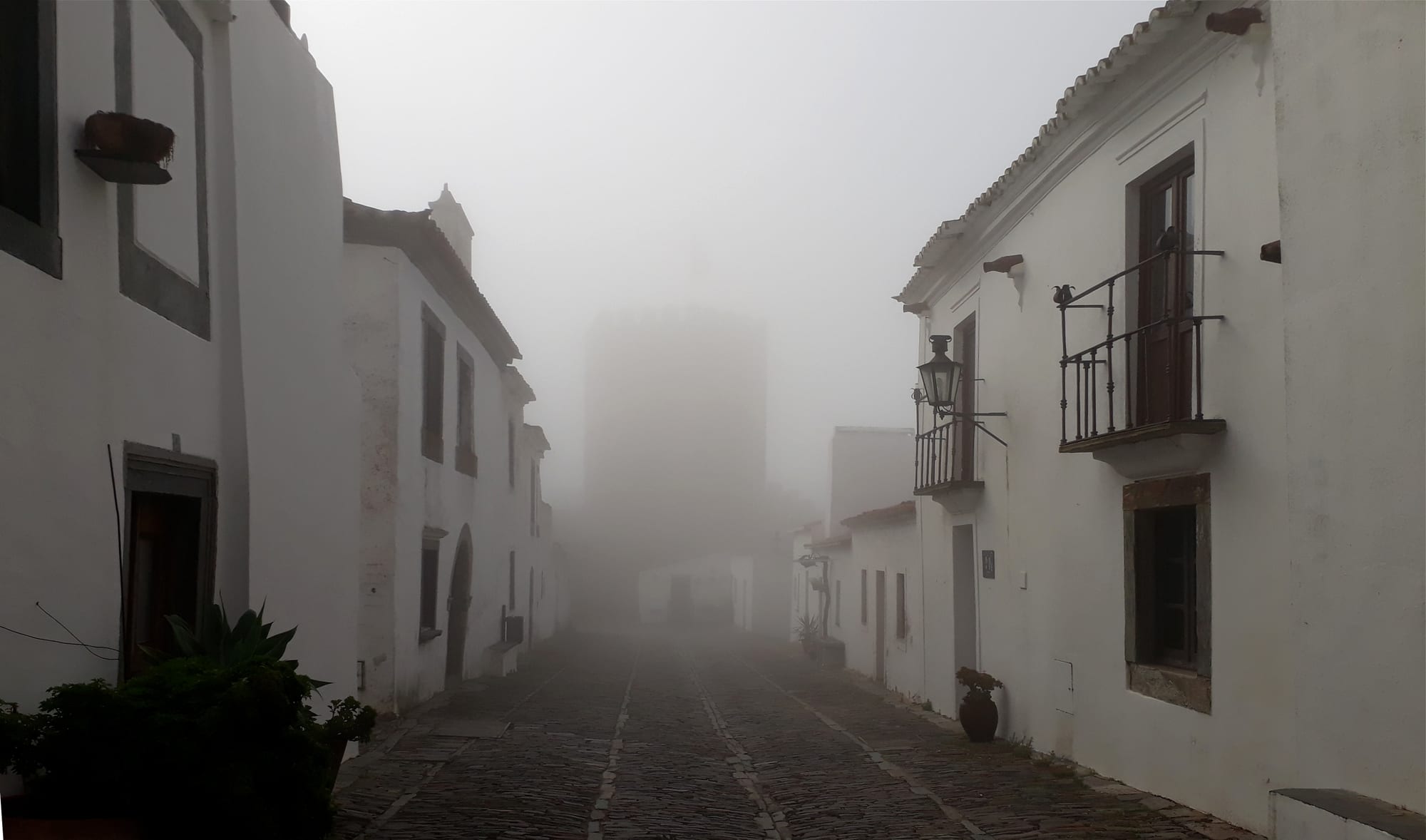
A cobbled street between whitewashed houses with iron balconies, leading towards a stone tower half hidden in fog

Alentejo, Portugal

Monsaraz

A street in Monsaraz on a foggy January day. (Alvesgaspar / Wikimedia Commons · CC BY-SA 4.0)

A tiny walled village on the highest hill above the Guadiana valley, near the Spanish border in the eastern Alentejo. Taken from the Moors for good in 1232 and held by the Templars and later the Braganzas as a border fortress, it lost its role as a municipal seat in the 19th century and now looks down on the Alqueva reservoir, with megaliths scattered across the slopes below.

Neighbourhoods

  • The walled village
    • First-time visitors
    • Historic district
    • Viewpoints

    The village inside the walls: a few cobbled streets of whitewashed houses, the parish church, the pillory and the old courthouse, ending at the castle on the edge of the hill. Day visitors fill it at midday; evenings are very quiet.

    Open in Maps
  • The slopes and hamlets below the hill
    • Quiet and residential
    • Megaliths
    • Countryside

    Below the walls lie small villages such as Telheiro and Outeiro, rural chapels, olive groves and vineyards, with standing stones and dolmens among the fields and the reservoir shore to the east.

    Open in Maps

Things to do

In the village

  • Monsaraz castle and wallslandmark

    The fortifications at the end of the village, a border fortress over the Guadiana given new defences after 1640, with views over the plain and the Alqueva reservoir.

    Open in Maps
  • Church of Santiago galleryattraction

    A former church inside the walls used for a permanent cycle of art exhibitions.

    Open in Maps

Megaliths below the hill

  • Menhir of Bulhoalandmark

    A granite standing stone near Monsaraz, thought to date from between 3500 and 2500 BC, long overlooked and identified in 1970.

    Open in Maps
  • Menhir of Outeirolandmark

    The Penedo Comprido, a granite monolith 5.6 metres high and the second largest in Portugal.

    Open in Maps
  • Antas do Olival da Pêgalandmark

    Two Neolithic dolmens, single-chamber megalithic tombs, near the village of Telheiro.

    Open in Maps
  • Xerez Cromlechlandmark

    A megalithic ring believed to date from the 5th or 4th millennium BC, moved from its original site because of the rising waters of the Alqueva.

    Open in Maps

Short trips from the village

  • Alqueva Damlandmark

    The dam on the Guadiana, completed in 2002, whose reservoir is the largest artificial lake in Western Europe, about 250 square kilometres when full.

    Open in Maps
  • Reguengos de Monsarazattraction

    The town about 15 km away that replaced Monsaraz as the municipal seat, known for its wines, Reguengos blankets and the pottery of nearby São Pedro do Corval.

    Open in Maps
  • Mourãoattraction

    The small town facing Monsaraz across the reservoir, part of the same 17th-century line of border defences.

    Open in Maps

Seasonal events

  • Monsaraz Museu AbertoJuly, every two years

    A biennial cultural event that turns the village into an open museum of exhibitions and performances.

Eat and drink

Long-standing places and food districts in Monsaraz. Hours, ratings and directions come from your maps app, always current.

Monsaraz classics

  • Village restaurants inside the wallsneighborhood

    A handful of restaurants and cafés in the old houses of the village, serving Alentejo cooking such as açorda, migas and pork.

    Open in Maps
  • Wine estates around Reguengosneighborhood

    Reguengos is a wine subregion of the Alentejo and a large wine producer, with estates on the plain below the village.

    Open in Maps

Experience Monsaraz

History

The hill of Monsaraz has been occupied since prehistory. Hundreds of megalithic monuments survive around it, and the hilltop itself was a fortified settlement before the Romans came. Romans, Visigoths, Arabs, Mozarabs and Jews all left their mark. Under Arab rule the place was called Saris or Sharish, after the gum rockrose that still grows in the dry slate soils of the hill — the origin of the name Monte Xaraz, and so Monsaraz.

Gerald the Fearless took the castle and town in 1167, but they were lost again after Afonso Henriques' defeat at Badajoz. In 1232 Sancho II retook them with the help of the Knights Templar, who garrisoned the border. Afonso III gave the town its first charter in 1276, and by then it was the head of a municipality with large privileges. After the crisis of 1383–1385 it passed into the estates of the House of Braganza, and King Manuel issued a new charter in 1512. When the plague emptied the area, the Duke of Braganza carried out small land reforms in 1527 to bring settlers back.

After the Restoration War of 1640 the castle was given a new bastion and became part of a chain of border defences with Elvas, Juromenha, Olivença and Mourão. The village's loyalty to the Miguelist side in the Liberal Wars, and the growth of Reguengos on the plain, cost it its status: the municipal seat moved to Reguengos in 1838, and definitively in 1851. In 2007 Monsaraz was a finalist in the Seven Wonders of Portugal.

Culture & Customs

Monsaraz is a village of whitewashed houses and slate streets inside medieval walls, and the old buildings tell its story: the parish church, the pillory, the old courthouse and town hall, a cistern and the castle. The former Church of Santiago holds a permanent cycle of art exhibitions, and every other year, usually in July, Monsaraz Museu Aberto turns the village into an open museum of cultural events.

The village has a place in Portuguese social science: in 1965–67 the anthropologist José Cutileiro studied it for his doctoral thesis, "A Portuguese Rural Society", under the pseudonym Vila Velha. Bullfighting has a strong following, and local people have sought the right to hold fights in which the bull is killed in the ring, as Barrancos has done legally since 2002.

The surrounding area is known for its crafts. The local economy once included terracotta earthenware and hammered copper, and nearby São Pedro do Corval is described as Portugal's first pottery centre; Reguengos is known for its woollen blankets. The Observatório do Lago Alqueva, an astronomical observatory, is listed among the area's attractions.

Daily Life

The parish of Monsaraz had about 660 people at the 2021 census, down from 782 in 2011, spread over some 88 square kilometres — fewer than eight people per square kilometre. Only a small part of them live inside the walls; the rest are in the hamlets on the slopes and the plain below.

Farming and livestock were the foundation of the local economy for centuries. Wine estates, olive groves and grazing still shape the land around the hill, and tourism, drawn by the village, the megaliths and the reservoir, has grown in the area in recent years. Since the Alqueva dam was completed in 2002 and its reservoir filled in 2010, the lake has spread across the valley below the village, changing the view and bringing new visitors.

Life in the village is slow, and the streets inside the walls are quiet once the day visitors have gone. The parish has been losing people, and residents depend on Reguengos de Monsaraz, about 15 km away, for most shops and services.

Food

Food in Monsaraz is the cooking of the Alentejo. Açorda, the bread soup made with stale bread, garlic, coriander and poached eggs, is a classic of the region; migas, made in the Alentejo from leftover bread with pork drippings and coriander; and pork is at the centre of many meals, including carne de porco à alentejana, pork marinated in white wine, paprika and garlic, fried and combined with clams and potatoes.

Wine is the local product. Reguengos is a wine subregion of the Alentejo, was the European City of Wine in 2015, and has vineyards on the plain around the village. The prized meat of the region is porco preto, the black Iberian pig raised on acorns in the oak woodland and prized for its ham, and the Alentejo's cheeses include the sheep's cheese of Évora, which has protected designation. Desserts follow the Alentejo's convent tradition of egg and sugar, such as sericaia, a soufflé-like pudding often served with plums.

Planning tools

Budget

Monsaraz has only a few guesthouses and restaurants inside the walls, so many visitors stay in rural guesthouses and wine estates around it or in Reguengos de Monsaraz. Costs are low by Portuguese standards, but the small number of rooms in the village fills quickly at weekends.

Daily Budget Midrange
USD 100–220 (village or rural guesthouse, restaurant dinners, a winery visit, a hire car)
Daily Budget Shoestring
USD 50–85 (guesthouse room, set lunches, picnic food)

Stay overnight to see the village after the day visitors leave, and keep a car for the megaliths and the reservoir.

Best Time to Visit

Spring and autumn give green or golden plains and comfortable days for walking out to the megaliths. Summer is very hot and dry on the open hillside, though the evenings are long and clear. Winter is quiet, with cool days and the occasional fog that wraps the hill.

Suggested Number of Days

The village itself can be seen in half a day or a day. Allow two or three days to add the standing stones, the reservoir and the wine country around Reguengos, or to use the village as a quiet base.

First Visit
1 day
With Surroundings
2–3 days

Transportation

The village itself is crossed on foot in a few minutes. A car is needed for almost everything beyond the village: the megaliths lie along small roads on the plain, and public transport in the area is very limited.

Drive out to the menhirs in the morning or late afternoon in summer, when the heat is lower.

Airport & Station Connections

Most visitors arrive by car. Évora is less than an hour away by road through Reguengos de Monsaraz, which lies about 15 km from the village. The nearest major airports, as for Évora, are Lisbon, Faro, Beja and Badajoz.

Walkability

The walled village is tiny and entirely walkable, but its streets are steep, uneven cobbles and slate. Walks down to the menhirs and hamlets on the slopes are possible on foot but long and exposed in the heat.

Safety

Portugal is one of the safest countries in Europe, with low violent crime. Monsaraz is a quiet village, and the hazards are natural: summer heat, sun on the exposed hillside and uneven stone streets and walls.

Wear good shoes on the cobbles, take care on the castle walls, and carry water in summer. Check current official travel advice before travelling.

Climate

A hot-summer Mediterranean climate typical of the interior Alentejo, with hot, dry summers and mild, damper winters. In nearby Évora the record high is 45.4°C and frosts are frequent in winter.

Summer
hot and dry — in nearby Évora August averages about 24.5°C over day and night, with hot afternoons
Winter
mild by day, with frosty mornings — in nearby Évora January averages about 9.3°C

Local Customs

Monsaraz is a living village with a small population, and many of its houses are homes. Tipping is not generally expected; a euro or two after a full meal is appreciated. Shops and restaurants keep the long Alentejo lunch.

Keep voices down in the evening, wear appropriate clothes in churches, and ask before photographing residents.

Common Payment Methods

The currency is the euro. Cards are accepted in most restaurants and guesthouses, but carry some cash for small cafés and craft shops; there are more ATMs in Reguengos de Monsaraz.